B2B vs B2C SaaS: 7 Key Differences, Metrics & Growth Strategies for 2026
Discover the 7 critical differences between B2B and B2C SaaS with 2026 benchmark data. Compare sales cycles, CAC, churn rates, LTV:CAC ratios, and learn which model fits your startup.
Here’s a number that should stop every SaaS founder in their tracks: B2B SaaS companies spend $2 to acquire $1 of new ARR, while B2C SaaS can acquire customers at a fraction of that cost—but lose them just as fast. The gap isn’t just about pricing. It’s about fundamentally different business models, sales cycles, and growth strategies.
I’ve spent years running paid acquisition for both B2B and B2C SaaS companies, and I’ll tell you this: most founders choose their market based on gut feeling, not data. They don’t realize that B2B and B2C SaaS operate like different sports with different rules, different scoreboards, and different winning strategies.
In this guide, I’ll break down the 7 key differences between B2B and B2C SaaS using 2026 benchmark data from 900+ companies. Whether you’re choosing your first market or reconsidering your current path, this data will help you make an informed decision.
What Is B2B SaaS?
B2B SaaS (Business-to-Business Software as a Service) refers to cloud-based software solutions sold to companies rather than individual consumers. Think Salesforce, Slack, HubSpot, or Notion’s enterprise tier. The buyer is an organization, and the decision typically involves multiple stakeholders.
The defining characteristic of B2B SaaS is that the product solves business problems—improving productivity, reducing costs, enabling collaboration, or driving revenue. The value proposition is measured in ROI, efficiency gains, and competitive advantage.
What Is B2C SaaS?
B2C SaaS (Business-to-Consumer Software as a Service) delivers cloud-based software directly to individual users. Examples include Duolingo, Calm, Headspace, or personal finance apps like YNAB. The buyer is a person using their own money for personal benefit.
B2C SaaS products solve personal problems—learning a language, managing mental health, organizing tasks, or editing photos. The value proposition is emotional and personal: self-improvement, entertainment, convenience, or creative expression.
Why the B2B vs B2C Distinction Matters
The B2B vs B2C choice shapes everything about your SaaS business: how you price, how you sell, how you retain customers, and how you scale. Get it wrong, and you’ll be fighting against the fundamental economics of your market.
According to 2026 data from SaaS Capital and OpenView Partners, B2B SaaS companies with $2M ARR need to grow 50%+ annually to be in the top quartile. B2C SaaS companies face different benchmarks—viral coefficient and payback period matter more than absolute growth rates.
7 Key Differences Between B2B and B2C SaaS
1. Average Contract Value (ACV) and Pricing
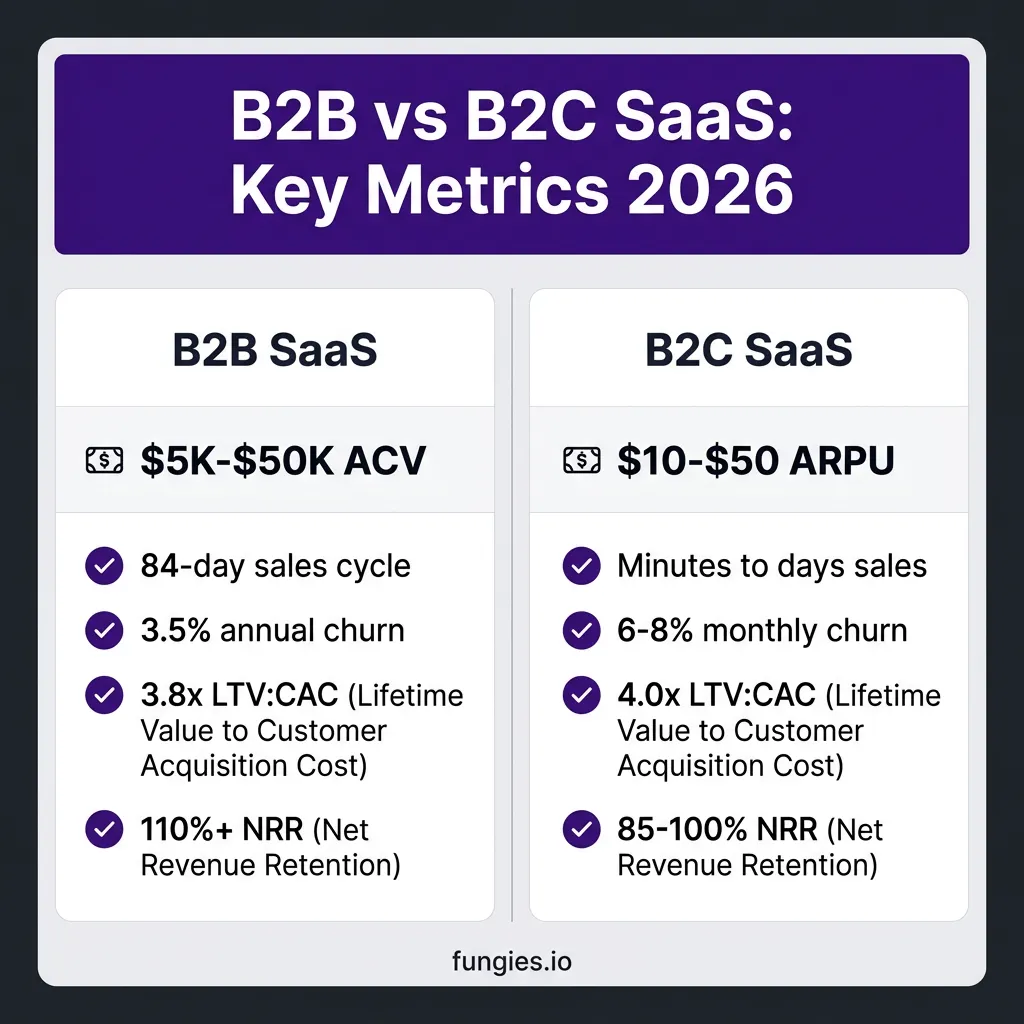
The most obvious difference is price. B2B SaaS commands significantly higher contract values:
| Metric | B2B SaaS | B2C SaaS |
|---|---|---|
| Average ACV | $5,000 – $50,000/year | $50 – $300/year |
| Monthly ARPU | $400 – $4,000+ | $10 – $50 |
| Typical Pricing Model | Per-seat, usage-based, or enterprise tiers | Freemium, flat subscription |
This 100x difference in ACV changes everything. A B2B SaaS company can be profitable with 100 customers. A B2C SaaS needs thousands—or tens of thousands—to reach the same revenue.
2. Sales Cycle Length
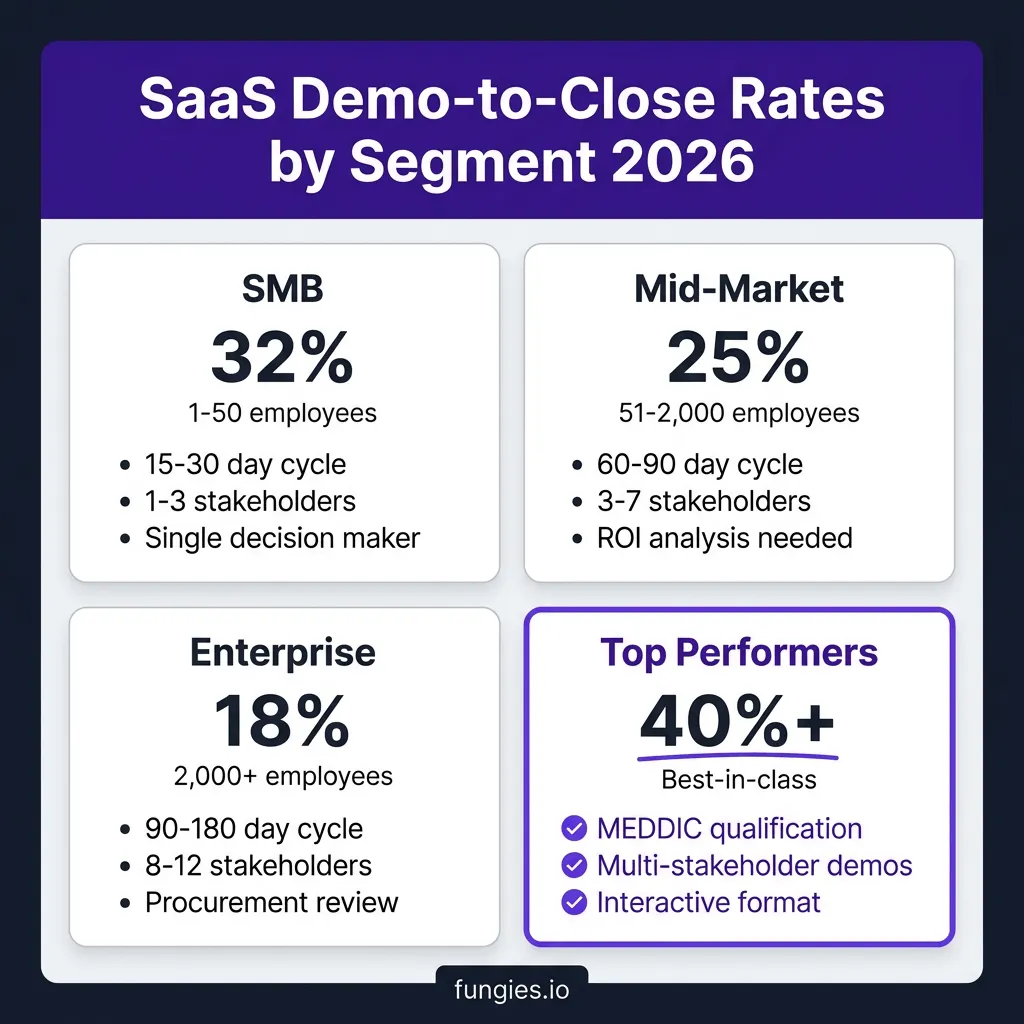
According to Optifai’s 2026 Pipeline Study of 939 B2B SaaS companies, sales cycles vary dramatically by deal size:
- SMB deals (<$15K ACV): 14-30 days
- Mid-market ($15K-$100K ACV): 30-90 days
- Enterprise (>$100K ACV): 90-180+ days
- Median B2B SaaS: 84 days
B2C SaaS? The sales cycle is measured in minutes or days. A user sees an ad, visits your landing page, and either converts immediately or bounces. There’s no procurement process, no security review, no budget committee.
Sales cycles have actually lengthened 22% since 2022, driven by larger buying committees (now averaging 6.8 stakeholders, up from 5.4) and increased security due diligence. This trend favors patient B2B founders—but it means you need more runway.
3. Customer Acquisition Cost (CAC)
The median CAC for B2B SaaS has hit $2.00 for every $1.00 of new ARR, according to 2026 benchmarks from BenchmarkIt. That’s right—you’re spending $2 to acquire $1 of annual revenue. This is why B2B SaaS companies need significant capital to scale.
B2C SaaS CAC varies wildly by channel, but it’s generally lower in absolute terms—$20-$100 per customer is typical. The challenge isn’t the absolute cost; it’s the LTV:CAC ratio given lower contract values.
Here’s the kicker: B2B SaaS CAC payback averages 8.6 months, while prosumer and SMB-focused tools reach faster 6.2-month payback periods. Longer sales cycles don’t always mean worse unit economics.
4. Churn and Retention
This is where B2B and B2C diverge most dramatically:
| Metric | B2B SaaS | B2C SaaS |
|---|---|---|
| Monthly Churn | 3-5% | 6-8% |
| Annual Churn | 3.5-4.9% | 30-50%+ |
| Net Revenue Retention | 110-130% | 85-100% |
According to Churnkey’s voluntary churn benchmarks, B2C companies lose 39% of their customers per year, while B2B companies lose 38%—but the pattern is completely different. B2B churn happens slowly: a committee loses its champion, a budget review cuts spending, an ROI case never gets built. B2C churn is faster and more emotional: the user loses interest, finds a cheaper alternative, or simply forgets about the subscription.
Net Revenue Retention (NRR) is the metric that separates good SaaS companies from great ones. Top-quartile B2B SaaS companies hit 115-125% NRR through expansion revenue. B2C SaaS rarely achieves NRR above 100% because consumers don’t expand their usage in the same way.
5. LTV:CAC Ratio
The gold standard LTV:CAC ratio is 3:1 for both B2B and B2C, but the path to getting there differs:
- B2B SaaS: Median 3.8x LTV:CAC, with growth-stage companies ($2M-$10M ARR) targeting 3-4:1
- B2C SaaS: 4.0x LTV:CAC is achievable due to faster payback periods, but requires high volume
Cybersecurity B2B firms often reach 4.2:1 LTV:CAC because of higher switching costs and longer retention. HR Tech companies typically see 3.5:1. For B2C, the key is achieving payback periods under 6 months—otherwise, you’re burning cash faster than you can raise it.
6. Go-to-Market Strategy
B2B SaaS relies on sales-led growth (SLG), product-led growth (PLG), or a hybrid approach. The median B2B SaaS company now spends $2 in Sales and Marketing to acquire $1 of new ARR—a structural failure of traditional siloed GTM models.
B2C SaaS is almost exclusively product-led. You can’t afford a sales team when your ACV is $100/year. Viral loops, content marketing, and paid social are the primary growth engines. The best B2C SaaS products have built-in sharing mechanics—think Calm’s meditation streaks or Duolingo’s leaderboards.
According to 2026 data, 92% of sales teams plan increased AI investment—but AI adoption is actually higher in B2C SaaS for marketing automation and personalization.
7. Customer Success Requirements
B2B SaaS requires dedicated customer success teams. With ACVs of $5K-$50K, you can afford—and need—CSMs to drive adoption, expansion, and renewals. The best B2B SaaS companies view customer success as a profit center, not a cost center.
B2C SaaS can’t support 1:1 customer success at scale. Instead, they rely on in-app guidance, help centers, community forums, and automated email sequences. The product itself must drive activation and retention.
How to Choose: B2B vs B2C SaaS
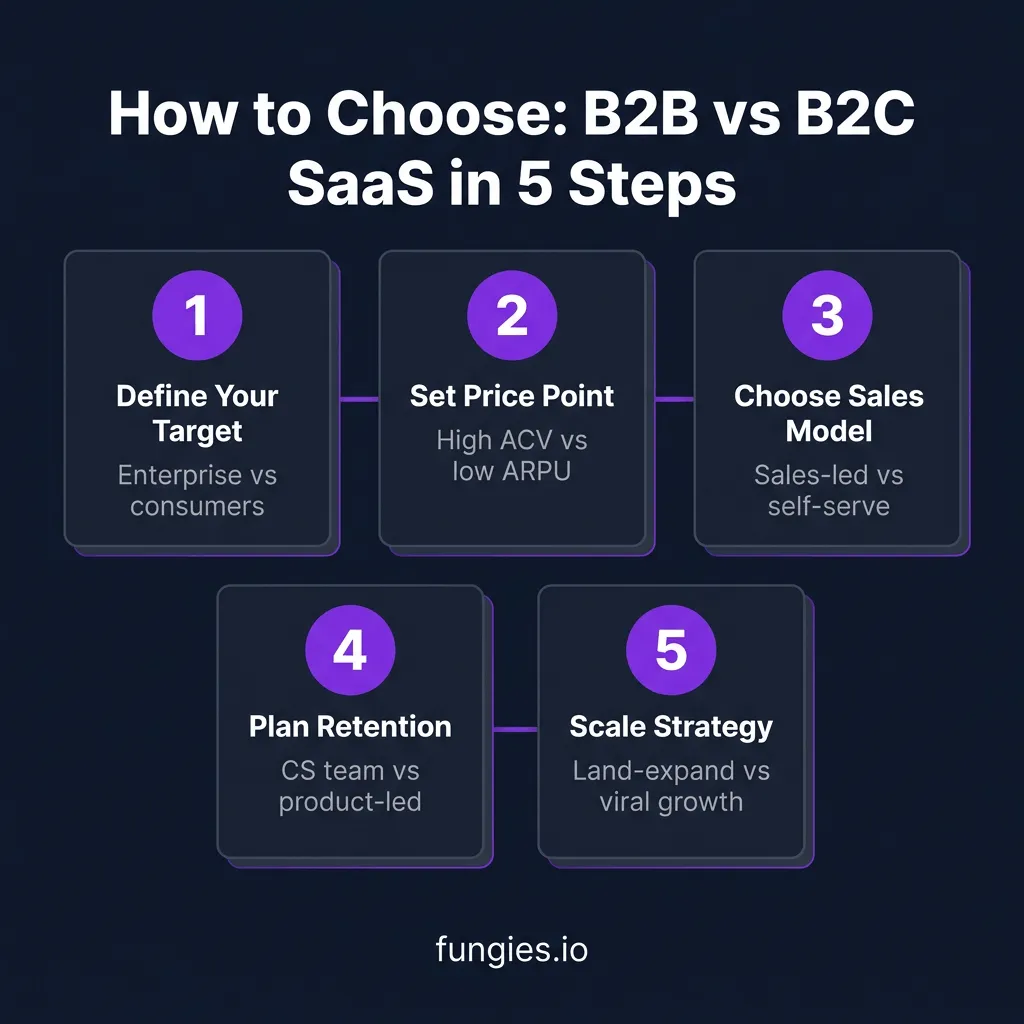
Choosing between B2B and B2C isn’t just about preference—it’s about matching your strengths to the market’s requirements. Here’s a framework:
Choose B2B SaaS If:
- You have industry expertise and existing relationships
- You can handle 3-6 month sales cycles
- You have access to capital for higher CAC
- Your product solves expensive business problems
- You enjoy consultative selling and relationship building
Choose B2C SaaS If:
- You understand consumer psychology and behavioral design
- You can build viral loops into your product
- You have marketing expertise in paid social or content
- Your product solves personal, emotional problems
- You can achieve sub-6-month CAC payback
Hybrid Models: The Best of Both Worlds?
Some of the most successful SaaS companies blur the B2B/B2C line. Notion started as B2C but now makes most revenue from enterprise. Slack’s freemium model captures individuals who then bring their teams. Canva serves both consumers and small businesses.
The “prosumer” segment—professional consumers who use personal tools for work—represents a growing middle ground. These users have B2C acquisition costs but B2B-like retention if they integrate the tool into their workflow.
However, serving both markets simultaneously is challenging. You need different marketing, different support, and often different product features. Most successful hybrid companies start with one focus and expand.
FAQ: B2B vs B2C SaaS
Can a SaaS company successfully serve both B2B and B2C?
Yes, but it’s challenging. Successful hybrid companies typically start with one market and expand. The key is having clear segmentation—different pricing pages, different onboarding flows, and different support channels. Don’t try to serve both with the same experience.
Which has better unit economics: B2B or B2C SaaS?
B2B SaaS generally has better unit economics due to higher ACV, lower churn, and expansion revenue. However, B2C SaaS can achieve faster payback periods and doesn’t require expensive sales teams. The “better” model depends on your specific product and market.
Is B2B or B2C SaaS easier to start?
B2C is easier to get initial users—you can launch on Product Hunt, run Facebook ads, or go viral on TikTok. But B2C is harder to monetize and retain. B2B is harder to get started (you need relationships and credibility) but easier to build a sustainable business once you have product-market fit.
What funding requirements differ between B2B and B2C?
B2B SaaS typically requires more upfront capital due to longer sales cycles and higher CAC. B2C SaaS can often start leaner but needs significant marketing spend to scale. B2B companies raise larger rounds; B2C companies often bootstrap longer.
How do retention strategies differ?
B2B retention relies on customer success teams, quarterly business reviews, and expansion revenue. B2C retention depends on product habit formation, push notifications, and content marketing. B2B churn is often detected early through usage tracking; B2C churn happens suddenly.
Conclusion: Pick Your Path Wisely
The B2B vs B2C choice isn’t about which is “better”—it’s about which aligns with your product, your team, and your market. B2B offers higher ACV, better retention, and more predictable revenue. B2C offers faster growth, viral potential, and simpler sales processes.
The data is clear: B2B SaaS companies with $2M ARR need 50%+ growth to be top quartile. B2C SaaS companies need viral coefficients above 0.2 and payback periods under 6 months. Both paths can lead to success, but they require different strategies, different metrics, and different mindsets.
Whichever path you choose, make sure your payment infrastructure can scale with you. Fungies.io handles global tax compliance, subscription billing, and 250+ payment methods—whether you’re selling $50 subscriptions to consumers or $50,000 enterprise contracts.
Sources
- Optifai Pipeline Study 2026 (N=939 B2B SaaS companies)
- SaaS Capital 2025 Benchmarking Report
- BenchmarkIt 2025 SaaS Performance Metrics
- Churnkey Voluntary Churn Benchmarks Report
- First Page Sage SaaS CAC Payback Benchmarks
- OpenView Partners 2025 SaaS Benchmarks
- Vena Solutions 2025 SaaS Churn Rate Report