10 Best Accounts Receivable Automation Software in 2026: Complete Comparison Guide
Discover the 10 best accounts receivable automation software in 2026. Compare HighRadius, Tesorio, Upflow, and more. See real DSO reduction data, pricing, and find the right AR automation platform for your business.
Here’s a sobering statistic: 87% of B2B payments arrive late, and the average company spends 15 hours per week just chasing overdue invoices. If your finance team is drowning in manual follow-ups, spreadsheet tracking, and payment reconciliation nightmares, you’re not alone.
I’ve spent years analyzing fintech solutions, and here’s what I’ve learned—accounts receivable automation software isn’t just a nice-to-have anymore. It’s the difference between a finance team that reacts to cash flow problems and one that prevents them entirely.
According to a 2025 Wakefield Research study, 99% of companies using AI-powered AR automation have reduced their Days Sales Outstanding (DSO). Some platforms deliver 30-50% faster collections and 40% cash flow improvements. The ROI isn’t theoretical—it’s measurable within the first quarter.
What Is Accounts Receivable Automation Software?
Accounts receivable automation software digitizes and automates the entire invoice-to-cash cycle. Instead of your team manually generating invoices, sending reminders, matching payments, and reconciling accounts, the software handles these workflows automatically.
Here’s what modern AR automation actually covers:
- Invoice delivery: Automatic generation and delivery via email, customer portals, or EDI
- Payment collection: Digital payment options with instant reconciliation
- Cash application: AI-powered matching of payments to invoices (90%+ accuracy)
- Collections management: Automated dunning sequences and follow-up scheduling
- Dispute resolution: Routing and tracking of billing disputes and deductions
- Reporting and forecasting: Real-time dashboards and cash flow predictions
The best platforms don’t just automate—they optimize. They use machine learning to predict which customers will pay late, prioritize collection efforts based on recovery probability, and recommend optimal payment terms for new customers.
Why AR Automation Matters More Than Ever in 2026
The business landscape has shifted dramatically. Remote work normalized digital processes. Economic uncertainty made cash flow visibility critical. And AI capabilities transformed what’s possible in financial automation.
Here’s the reality for companies still running manual AR processes:
- Revenue leakage: 2-5% of revenue is lost to billing errors and delays
- Time drain: 10-20 hours per week on invoice generation and follow-ups for every 100 customers
- Slow month-end close: Manual processes extend close from 1-3 days to 5-10 days
- Poor visibility: Cash flow forecasting becomes guesswork without real-time data
AR automation fixes these problems systematically. Companies using automated AR collect payments 15-30 days faster than those using manual workflows. That’s not a minor improvement—it’s transformational for working capital.
10 Best Accounts Receivable Automation Software in 2026
After evaluating dozens of platforms based on automation depth, integration quality, AI capabilities, and real customer outcomes, here are the top 10 AR automation solutions for 2026.
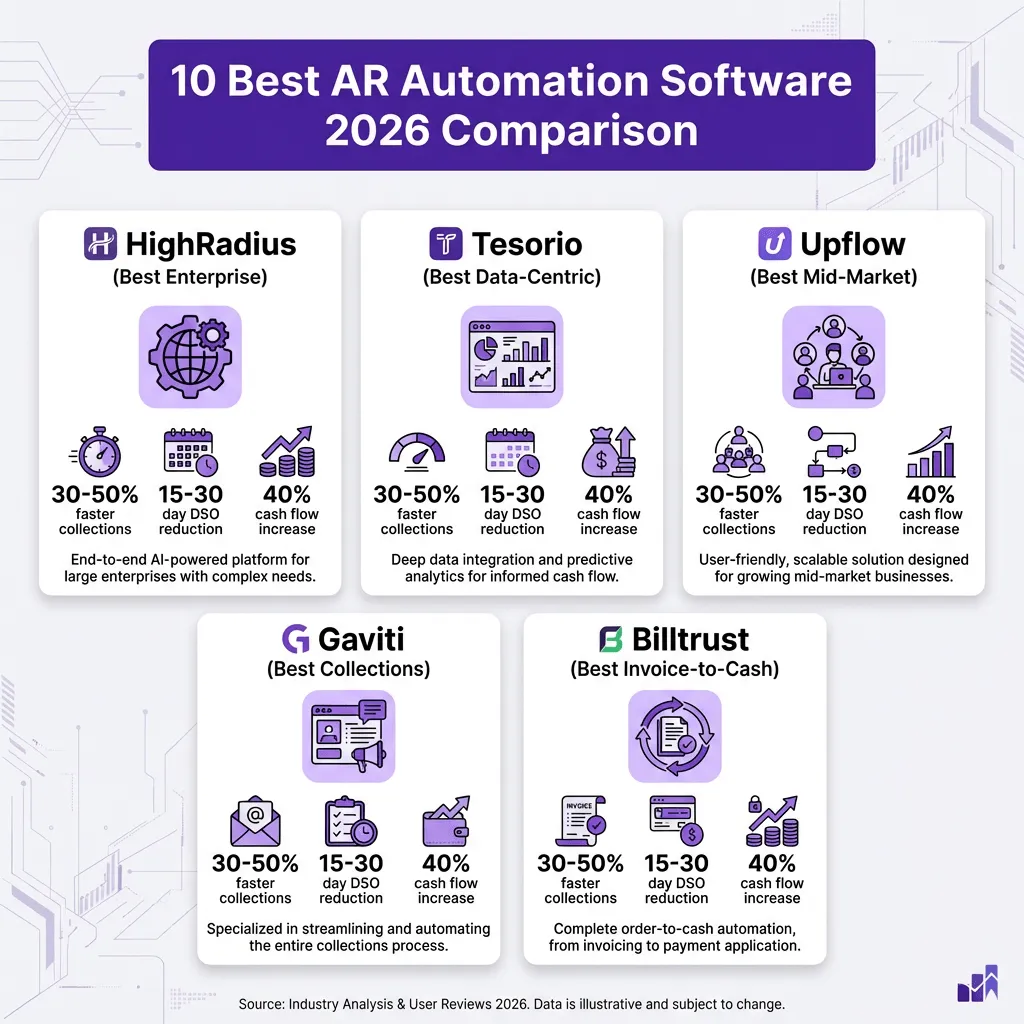
1. HighRadius — Best for Enterprise AR Automation
HighRadius dominates the enterprise AR automation space with a comprehensive suite covering credit management, collections, cash application, deductions, and e-invoicing. Their AI agents handle complex, high-volume environments that break other platforms.
Key Features:
- AI-powered cash application with 90%+ automation rates
- Integrated credit risk scoring and monitoring
- Automated dispute management and deduction resolution
- Real-time AR analytics and forecasting
- Native ERP integrations (SAP, Oracle, NetSuite, Microsoft Dynamics)
Pricing: Custom enterprise pricing based on invoice volume and modules required.
Best for: Large enterprises processing 10,000+ invoices monthly with complex, multi-entity operations.
2. Tesorio — Best Data-Centric AR Platform
Tesorio takes a fundamentally different approach. Instead of just automating tasks, they treat cash flow as a data integration challenge. Their platform aggregates payment data from spreadsheets, emails, and banking portals into a unified, real-time view.
Key Features:
- Transparent AI with explainable predictions
- Automated collections workflows with smart prioritization
- Cash flow forecasting based on operational reality
- Native integrations with major ERPs and CRMs
- Exception handling for complex enterprise scenarios
Pricing: $30,000-$150,000 annually for most organizations; enterprise deployments can exceed this range.
Best for: Mid-market to enterprise companies that prioritize data visibility and forecasting accuracy.
3. Upflow — Best for Mid-Market AR Teams
Upflow has earned a reputation as the strongest overall choice for mid-market AR automation. It strikes the right balance between automation and control, giving finance teams visibility without overwhelming complexity.
Key Features:
- Real-time cash flow insights and AR analytics
- Automated payment reminders with customizable sequences
- Self-service customer payment portal
- ERP and CRM integrations for context-rich workflows
- Workflow-driven outbound collections
Pricing: Tiered pricing based on invoice volume; typically starts around $500-1,000/month.
Best for: Growing SaaS and B2B companies with 500-5,000 invoices monthly seeking better AR visibility.
4. Gaviti — Best for Collections Workflows
Gaviti focuses specifically on optimizing collections workflows. Their rule-based automation standardizes follow-up processes while providing prioritization logic that helps teams focus on the highest-impact accounts.
Key Features:
- Standardized collections workflows and task scheduling
- Smart account prioritization based on risk and value
- Automated dunning sequences with customizable templates
- Aging reports and DSO tracking dashboards
- ERP integrations for invoice and customer data
Pricing: Custom pricing based on features and volume; mid-market focused.
Best for: Mid-market AR teams wanting structured collections processes without enterprise complexity.
5. Billtrust — Best Invoice-to-Cash Platform
Billtrust offers a unified AR automation platform covering invoicing, payments, cash application, and collections. Their strength lies in handling high invoice volumes with strong performance across the entire receivables lifecycle.
Key Features:
- Unified invoicing, payment, and collections automation
- AI-powered cash application with high match rates
- Customer payment portal with multiple payment options
- Strong invoicing and cash-application performance
- Broad ERP and payment system integrations
Pricing: Custom enterprise pricing based on volume and feature requirements.
Best for: Mid-sized to large enterprises seeking comprehensive invoice-to-cash automation.
6. Quadient AR (YayPay) — Best for Workflow Visibility
Quadient AR (formerly YayPay) provides solid mid-market AR automation with customizable workflows, a customer payment portal, and decent analytics. It’s particularly strong for teams wanting structured processes and clear visibility into collections activities.
Key Features:
- Customizable collections workflows
- Customer self-service payment portal
- Communications management and templates
- AR dashboards and aging reports
- ERP integration for data synchronization
Pricing: Mid-market pricing tier; custom quotes based on requirements.
Best for: Mid-market AR teams wanting structured workflows and visibility without enterprise complexity.
7. LedgerUp — Best for B2B SaaS with Complex Contracts
LedgerUp stands out for B2B SaaS companies dealing with negotiated contracts, usage-based pricing, and hybrid billing models. Their contract intelligence reads signed agreements directly and automates the entire contract-to-cash workflow.
Key Features:
- Contract intelligence that reads signed agreements
- AI-driven collections through Slack integration
- Native Stripe and Salesforce integration
- 90-95% automation for complex billing scenarios
- 15-30 day DSO reduction for customers
Pricing: $2,000-5,000/month; no revenue percentage fees.
Best for: B2B SaaS companies ($2M-100M ARR) with subscription-plus-usage billing and custom contract terms.
8. Versapay — Best Collaborative AR Platform
Versapay takes a unique approach by creating a collaborative portal where customers can view invoices, make payments, raise disputes, and communicate directly with your AR team. This reduces friction and accelerates resolution.
Key Features:
- Cloud-native AR platform with collaborative customer portal
- Integrated invoicing, payment processing, and cash application
- Dispute management and communication tools
- Real-time payment matching and reconciliation
- Strong enterprise collaboration features
Pricing: Enterprise pricing based on volume and feature set.
Best for: Enterprises wanting to reduce disputes through customer collaboration and self-service.
9. Esker — Best for Global, Complex AR Environments
Esker provides full invoice-to-cash automation with particular strength in global, multi-region deployments. Their platform handles complex tax requirements, multiple currencies, and high-volume operations across geographies.
Key Features:
- Full invoice-to-cash automation including dispute and remittance handling
- Global support with multi-currency and multi-language capabilities
- Strong ERP and banking integrations worldwide
- Credit checks and collections automation
- Audit-ready compliance features
Pricing: Custom enterprise pricing for global deployments.
Best for: Global enterprises with complex, high-volume AR operations across multiple regions.
10. Stuut — Best Autonomous AR Agent
Stuut represents the next evolution in AR automation—an autonomous AI agent that handles collections, cash application, payments, and deductions without human intervention. Instead of providing dashboards for humans to manage, Stuut executes workflows autonomously.
Key Features:
- Autonomous execution of collections and cash application
- AI analyzes payment amounts, customer history, and context for matching
- 40% cash flow increases and 37% DSO reduction reported
- Real-time ERP posting without manual intervention
- Handles exceptions through AI decisioning
Pricing: Custom pricing based on automation scope and volume.
Best for: Forward-thinking companies wanting fully autonomous AR execution rather than workflow tools.
AR Automation Software Comparison Table
| Platform | Best For | Key Strength | DSO Reduction | Pricing |
|---|---|---|---|---|
| HighRadius | Enterprise | Full AR suite with AI | 30-50% | Custom |
| Tesorio | Data-centric teams | Cash flow forecasting | 20-30% | $30K-150K/yr |
| Upflow | Mid-market | Balance & visibility | 20-30% | $500-1K/mo |
| Gaviti | Collections focus | Workflow automation | 15-25% | Custom |
| Billtrust | Invoice-to-cash | Unified platform | 25-35% | Custom |
| LedgerUp | B2B SaaS | Contract intelligence | 15-30 days | $2K-5K/mo |
| Versapay | Collaboration | Customer portal | 20-30% | Custom |
| Stuut | Autonomous AR | AI agent execution | 37% | Custom |
How to Choose the Right AR Automation Software
Selecting the right platform depends on your specific situation. Here’s my decision framework:
Consider Your Invoice Volume
Low volume (under 500/month): You might not need full AR automation yet. Focus on billing software with basic automation features.
Medium volume (500-5,000/month): Upflow, Gaviti, or Quadient AR offer the right balance of features and complexity.
High volume (5,000+/month): HighRadius, Tesorio, or Billtrust can handle the scale and complexity.
Evaluate Your ERP Integration Needs
Your AR software must integrate seamlessly with your existing ERP. Most platforms support major systems (NetSuite, SAP, Oracle, Microsoft Dynamics, QuickBooks, Xero), but verify native integration quality before committing.
Assess Automation Depth Requirements
Not all automation is equal. Some platforms automate reminders but require manual cash application. Others handle the entire invoice-to-cash cycle autonomously. Be clear about which workflows you want fully automated versus which need human oversight.
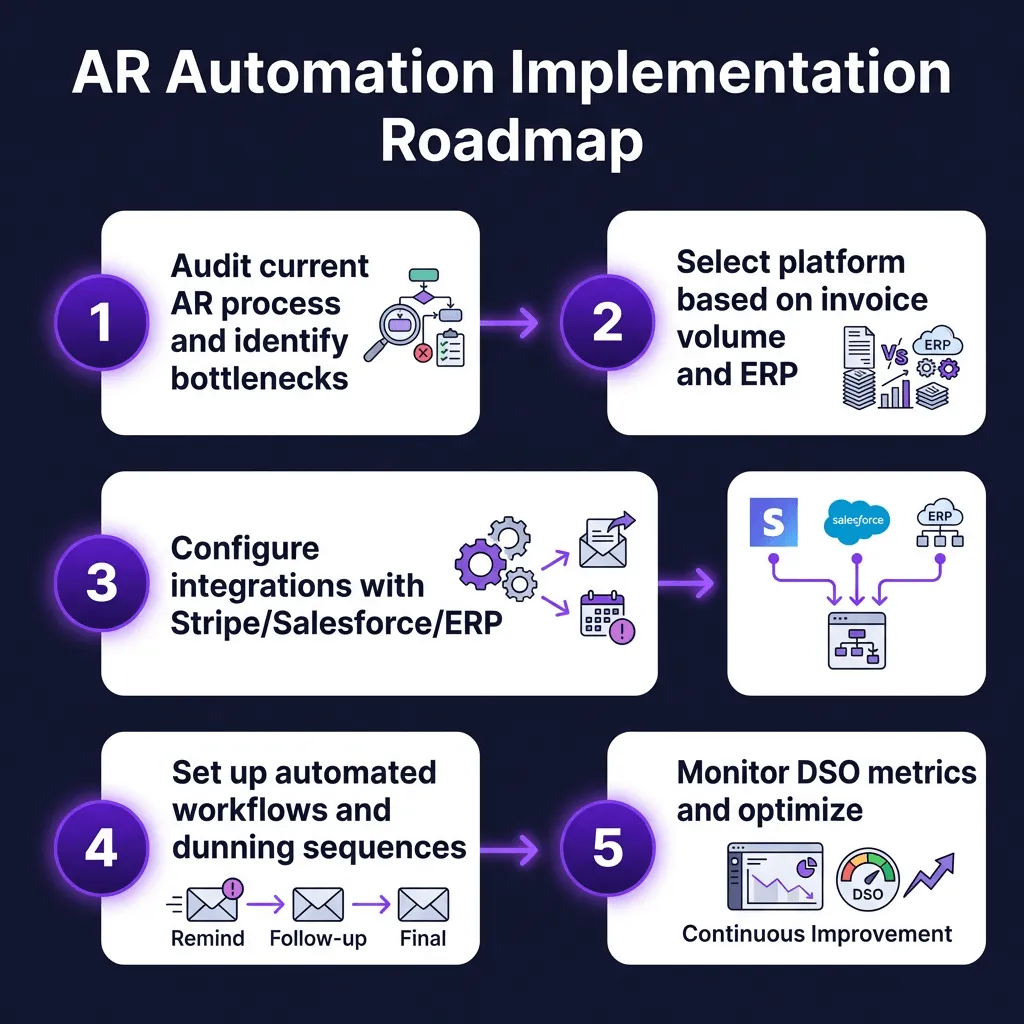
Implementation Best Practices
Getting the most from AR automation requires more than just software selection. Here’s how to ensure successful implementation:
1. Audit Your Current Process First
Before implementing any automation, document your current AR workflows. Identify bottlenecks, manual handoffs, and error-prone steps. This baseline helps you measure improvement and ensures you automate the right processes.
2. Clean Your Customer Data
AR automation is only as good as your data. Deduplicate customer records, verify contact information, and standardize payment terms before migration. Dirty data will undermine even the best automation.
3. Configure Dunning Sequences Strategically
Don’t just copy default reminder sequences. Customize timing, tone, and escalation based on customer segments. High-value customers might get personal calls after 15 days; smaller accounts might get automated notices at 7, 14, and 30 days.
4. Train Your Team on Exception Handling
Automation handles the routine; your team handles the exceptions. Make sure they understand how to intervene when the AI flags unusual situations, disputes, or complex payment scenarios.
5. Monitor and Optimize Continuously
AR automation isn’t “set it and forget it.” Review DSO trends, collection effectiveness, and cash application accuracy monthly. Adjust workflows based on what’s working and what isn’t.
Frequently Asked Questions
What’s the typical ROI for AR automation software?
Most companies see ROI within 3-6 months. Typical returns include 30-50% faster collections, 15-30 day DSO reduction, 2-5% revenue recovery from reduced leakage, and 10-20 hours weekly saved per 100 customers. The 2025 Wakefield Research study found 99% of AI AR users reduced DSO.
How long does implementation take?
Implementation timelines vary by complexity. Simple deployments with standard ERPs take 2-4 weeks. Complex enterprise implementations with custom integrations might take 2-3 months. Platforms like LedgerUp advertise 1-2 week implementations for B2B SaaS.
Can AR automation handle complex billing scenarios?
Modern platforms handle complex scenarios including usage-based billing, hybrid models, prepaid credits, and negotiated contracts. LedgerUp and HighRadius specifically target complex B2B billing. However, extremely custom scenarios might still require manual intervention.
Is AR automation secure?
Reputable AR automation platforms maintain SOC 2 Type II compliance, PCI DSS certification for payment processing, and bank-grade encryption. They typically offer role-based access controls and audit trails. Always verify security certifications during evaluation.
Do I need AR automation if I use Stripe or another payment processor?
Payment processors handle the transaction; AR automation handles everything around it—invoicing, collections, cash application, reconciliation, and reporting. Many AR platforms integrate with Stripe and other processors to provide end-to-end automation. They’re complementary, not competitive.
Conclusion: The Time for AR Automation Is Now
Manual accounts receivable processes are a competitive disadvantage in 2026. The data is clear—companies using AR automation collect faster, forecast better, and free their finance teams for strategic work rather than spreadsheet chasing.
The platforms I’ve covered represent the best options across different use cases, company sizes, and complexity levels. Whether you’re a growing SaaS company looking to automate collections or an enterprise seeking full invoice-to-cash transformation, there’s a solution that fits.
And if you’re building a SaaS business and need more than just AR automation—if you need a complete payment infrastructure that handles billing, tax compliance, and global payments—check out Fungies.io. We help SaaS companies accept payments globally without the engineering headache.
Sources
- Wakefield Research Study on AI in Accounts Receivable (October 2025) – Billtrust
- Best Accounts Receivable Software 2026 Guide – LedgerUp
- AR Automation Complete Guide – HighRadius
- Best AR Automation Software Comparison – Tesorio
- Top AR Automation Tools 2026 – LedgerUp Research
- Stuut AI AR Automation Report – Stuut
- 2026 State of Accounts Receivable Automation – Versapay