10 Best Merchant of Record Software for SaaS in 2026 (Compared)
Discover the 10 best merchant of record software for SaaS in 2026. Compare Paddle, Fungies, FastSpring, Cleverbridge & more. Find the right MoR provider with transparent pricing, global tax compliance, and features that match your business model.
Here’s a number that might surprise you: the global merchant of record software market is projected to hit $6.46 billion by 2025, growing at a CAGR of 14.71%. That’s not just steady growth—that’s explosive demand from SaaS founders who are tired of wrestling with tax compliance, VAT registrations, and chargeback disputes across dozens of countries.
If you’re selling software or digital products internationally, you’ve probably felt this pain. Setting up local entities. Registering for VAT in the EU. Figuring out sales tax in the US. Handling customer support for billing issues in languages you don’t speak. It’s a operational nightmare that has nothing to do with building great products.
That’s where merchant of record (MoR) providers come in. They become the legal seller of your product, handling payments, tax compliance, fraud protection, and regulatory requirements—so you can focus on what you actually do best.
What Is a Merchant of Record?
A merchant of record is the legal entity responsible for processing transactions on your behalf. When a customer buys your SaaS product, the MoR is technically the seller—not you. This means they handle:
- Payment processing and checkout
- Sales tax, VAT, and GST collection and remittance
- Fraud prevention and chargeback management
- Regulatory compliance (GDPR, PCI DSS, etc.)
- Customer support for billing issues
The trade-off? You pay a higher transaction fee than raw payment processing (like Stripe’s 2.9% + $0.30), but you eliminate the operational overhead of managing compliance yourself. For most SaaS companies selling globally, it’s a no-brainer.
How We Evaluated These Merchant of Record Providers
Honestly, most “best MoR” lists just regurgitate marketing copy. I looked at what actually matters when you’re running a SaaS business:
- Pricing transparency — Can you see rates without talking to sales?
- Integration quality — How’s the API, documentation, and SDK support?
- Tax coverage — Which countries and tax types are handled?
- B2B capabilities — Invoicing, quotes, and enterprise features
- Customer reviews — Real feedback from G2 and Trustpilot
The 10 Best Merchant of Record Software for SaaS in 2026
1. Paddle — Best for SMB B2C SaaS
Paddle has become the default choice for early-stage SaaS companies, and for good reason. They offer a complete all-in-one platform with fast setup, solid APIs, and genuine global tax handling.
Key Features:
- Subscription billing and management
- Global tax compliance (VAT, GST, sales tax)
- Checkout optimization and localization
- Revenue analytics and reporting
Pricing: 5% + $0.50 per transaction (pay-as-you-go)
Best for: Startups and SMB B2C SaaS teams that want an established provider with straightforward pricing.
G2 Rating: 4.6/5
2. Fungies — Best for SaaS & Digital Products
Full disclosure: I work with Fungies. But here’s why I’m including it—Fungies offers something genuinely different: a no-code checkout experience combined with full MoR coverage. You can literally set up a working checkout in under 10 minutes without writing a line of code.
Key Features:
- No-code checkout builder
- Full global tax compliance handled
- Subscription and one-time payment support
- Fraud protection and chargeback management
- Developer-friendly APIs when you need them
Pricing: 5% + $0.50 per transaction (no monthly fees)
Best for: SaaS founders and digital product creators who want speed-to-market without sacrificing compliance coverage.
G2 Rating: 4.8/5
3. FastSpring — Best for Digital Goods
FastSpring has been around since 2005, making them one of the veterans in digital commerce. They specialize in software and digital goods companies that need global reach without the enterprise complexity.
Key Features:
- Global checkout with 20+ payment methods
- Digital product delivery and license management
- Subscription and usage-based billing
- Multi-currency support
Pricing: Custom quote-based (no public pricing)
Best for: Software companies selling digital downloads, licenses, or subscriptions who prefer working with an established provider.
G2 Rating: 4.5/5
4. Cleverbridge — Best for Enterprise & B2B SaaS
Cleverbridge is built for complexity. If you’re running B2B SaaS with custom invoicing, quote workflows, and renewal management, they’re worth the premium. They’re not the cheapest, but they handle enterprise requirements that lighter platforms can’t touch.
Key Features:
- Global tax ownership and compliance
- B2B invoicing and quoting
- Subscription lifecycle management
- Professional services and dedicated support
- Renewal and NRR optimization tools
Pricing: Custom quote-based (enterprise pricing)
Best for: Mid-market and enterprise B2B SaaS with complex billing requirements and global customers.
G2 Rating: 4.3/5
5. Lemon Squeezy — Best for Creators & Indie Developers
Lemon Squeezy (acquired by Stripe in 2024) built its reputation on simplicity. Their storefront approach makes it dead-simple for creators and indie hackers to start selling digital products without any technical setup.
Key Features:
- Simple storefront setup
- Stripe-native workflows
- Tax handling included
- Fast time-to-market
Pricing: 5% + $0.50 per transaction
Best for: Creators, indie developers, and anyone who wants to start selling in minutes, not days.
G2 Rating: 4.5/5
6. PayPro Global — Best for Risk-Sensitive Products
PayPro Global specializes in supporting globally distributed SMBs, particularly in categories with elevated chargeback risk. If you’re in a “high-risk” category that other providers shy away from, they’re worth considering.
Key Features:
- Dispute management and chargeback protection
- Tax and compliance handling
- Cross-border payments
- 24/7 customer support
Pricing: Custom quote-based
Best for: Digital product sellers in risk-sensitive categories who need broad managed services.
G2 Rating: 4.9/5
7. 2Checkout (Verifone) — Best for Global SMB Expansion
2Checkout, now part of Verifone, offers a “set it and forget it” approach for SMBs looking to expand into new markets. They’ve got broad global coverage and automated compliance features.
Key Features:
- Payments, tax collection, and fraud management
- 45+ payment methods
- Multi-currency support
- Subscription billing
Pricing: Quote-based with multiple tiers
Best for: SMBs entering new international markets who want established global infrastructure.
G2 Rating: 3.9/5
8. Dodo Payments — Best for AI & SaaS Startups
Dodo Payments is a newer entrant positioning themselves as the MoR for modern SaaS and AI products. They emphasize transparent pricing and fast integration—things that matter when you’re trying to ship quickly.
Key Features:
- Transparent pricing (4% + $0.40 US, +1.5% international)
- Fast integration with good developer experience
- Global tax compliance
- AI and SaaS-focused feature set
Pricing: 4% + $0.40 per transaction (US), +1.5% for international
Best for: AI startups and SaaS teams that want modern tooling with transparent economics.
9. Xsolla — Best for Gaming & Virtual Goods
Xsolla is the specialist for gaming. If you’re building a game with in-app purchases, virtual currencies, or microtransactions, they’re purpose-built for your use case.
Key Features:
- In-game payments and virtual currencies
- Gaming monetization tools
- 700+ payment methods globally
- Player acquisition and analytics
Pricing: 5% flat transaction fee
Best for: Game developers and virtual goods sellers who need gaming-specific capabilities.
G2 Rating: 4.5/5
10. Digital River — Best for Large Enterprises
Digital River is the enterprise heavyweight. They’ve been handling global commerce for major brands for years. If you’re a large organization with complex global commerce needs and long procurement cycles, they’re a solid choice.
Key Features:
- Global commerce and payments
- Full tax and compliance management
- Fraud prevention and risk management
- Enterprise-grade infrastructure
Pricing: Enterprise quote-based
Best for: Large organizations with complex global commerce architecture and dedicated procurement teams.
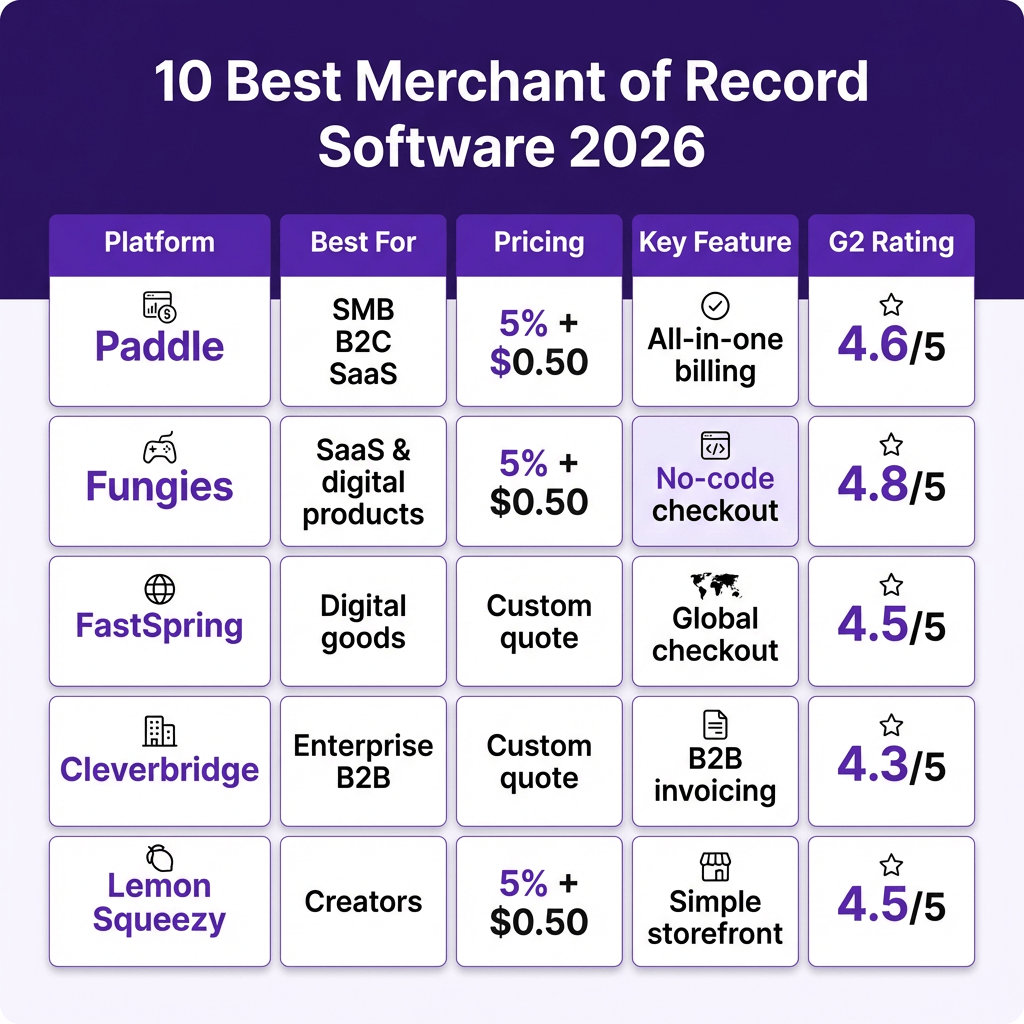
Merchant of Record Comparison Table
| Platform | Best For | Pricing | G2 Rating |
|---|---|---|---|
| Paddle | SMB B2C SaaS | 5% + $0.50 | 4.6/5 |
| Fungies | SaaS & Digital Products | 5% + $0.50 | 4.8/5 |
| FastSpring | Digital Goods | Custom | 4.5/5 |
| Cleverbridge | Enterprise B2B | Custom | 4.3/5 |
| Lemon Squeezy | Creators & Indie | 5% + $0.50 | 4.5/5 |
| PayPro Global | Risk-Sensitive | Custom | 4.9/5 |
| 2Checkout | Global SMBs | Quote-based | 3.9/5 |
| Dodo Payments | AI & SaaS | 4% + $0.40 | — |
| Xsolla | Gaming | 5% flat | 4.5/5 |
| Digital River | Enterprise | Custom | — |
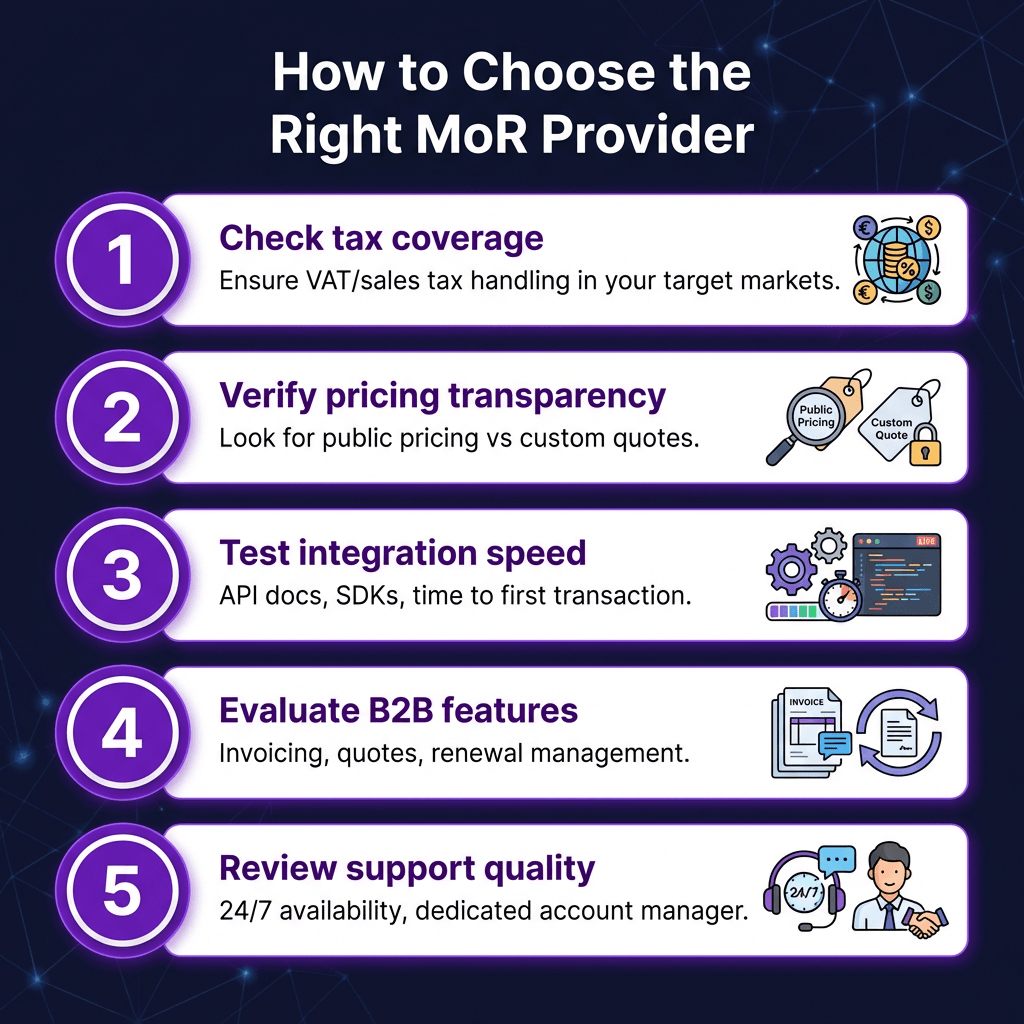
How to Choose the Right Merchant of Record Provider
Here’s the truth: there is no single “best” merchant of record. The right choice depends entirely on your business model, scale, and complexity. But I’ve seen too many founders make expensive mistakes by focusing on the wrong criteria.
Start with these questions:
- What’s your target market? B2C SaaS has different needs than B2B enterprise. Creators need simplicity; enterprises need customization.
- How complex are your billing needs? Simple subscriptions? Usage-based? Custom invoicing? Enterprise quotes?
- What’s your geographic footprint? EU VAT is table stakes. Do you need coverage in emerging markets?
- How much can you handle internally? Some teams want full service; others want APIs and autonomy.
In my experience, the biggest mistake is underestimating the operational work required to scale. Many providers handle the basics beautifully but fall apart when you hit edge cases. Plan for where you’re going, not just where you are today.
Common Pitfalls When Choosing an MoR
I’ve talked to dozens of SaaS founders about their MoR decisions. Here are the mistakes I see over and over:
- Choosing on price alone — The cheapest provider often becomes the most expensive when you factor in migration costs, support headaches, and missing features.
- Ignoring B2B requirements — If you plan to sell to enterprises, make sure your MoR handles invoicing, quotes, and procurement workflows from day one.
- Not testing support quality — When a chargeback hits or a tax question comes up, you need answers fast. Test their support before you commit.
- Overlooking data portability — MoR decisions are hard to unwind. Make sure you can export your data and migrate if needed.
FAQ: Merchant of Record Software
What’s the difference between a merchant of record and a payment processor?
A payment processor (like Stripe) handles the technical movement of money. A merchant of record becomes the legal seller, taking on liability for tax compliance, fraud, and regulatory requirements. You can think of an MoR as “payment processor plus compliance and liability coverage.”
Is a merchant of record more expensive than Stripe?
On a per-transaction basis, yes—MoR fees (typically 4-6%) are higher than raw Stripe processing (2.9% + $0.30). But when you factor in the cost of tax compliance tools, legal consultation, chargeback management, and operational overhead, many SaaS companies find the total cost is lower with an MoR.
Can I switch merchant of record providers later?
Yes, but it’s not trivial. You’ll need to migrate customer data, subscription billing, and tax records. The complexity depends on your billing architecture and contract terms. It’s worth planning for portability from day one.
Do I need an MoR if I’m only selling in one country?
Probably not. If you’re US-only and comfortable handling sales tax yourself, a simple payment processor might be sufficient. But the moment you start selling internationally—or want to eliminate compliance work—an MoR becomes valuable.
Which merchant of record is best for SaaS startups?
For most SaaS startups, I’d recommend looking at Paddle, Fungies, or Lemon Squeezy. They offer the best balance of transparent pricing, fast setup, and genuine MoR coverage. Choose based on whether you need no-code simplicity (Lemon Squeezy), all-in-one billing (Paddle), or speed-to-market with developer flexibility (Fungies).
Final Thoughts
The merchant of record market has matured significantly. You now have real options depending on your stage, model, and complexity. The key is being honest about what you need today—and what’s likely to change in the next 12-18 months.
Don’t overthink it. Pick a provider that fits your current needs, has a clear upgrade path, and lets you focus on building your product instead of wrestling with tax compliance.
Ready to simplify your global payments? Get started with Fungies and launch your checkout in minutes, not weeks.
Sources
- Dodo Payments — Best Merchant of Record Platforms 2026
- Cleverbridge — Top Merchant of Record Providers 2026
- QY Research — Global Merchant of Record Software Market Report
- Data Insights Market — Merchant of Record Software Market Dynamics
- G2 — Best Merchant of Record Software Reviews
- Reddit r/SaaS — Merchant of Record Recommendations