Best Payment Processor for Digital Products in 2026: Complete Comparison
Compare the best payment processors for digital products in 2026: Stripe, PayPal, Fungies, and Paddle. Find the right solution for your SaaS or digital business.
Choosing the right payment processor for digital products can make or break your online business. In 2026, with global e-commerce sales projected to exceed $7 trillion, the stakes have never been higher. Whether you’re selling software, online courses, ebooks, or digital art, your payment solution directly impacts conversion rates, customer trust, and your bottom line.
This guide compares the best payment processors for digital products in 2026, analyzing fees, features, tax compliance, and global reach. By the end, you’ll know exactly which solution fits your business model.
What Makes a Payment Processor Good for Digital Products?
Digital products have unique requirements compared to physical goods. Here’s what to look for:
- Instant delivery — Customers expect immediate access after purchase
- Global tax compliance — EU VAT, US sales tax, and other jurisdictions
- Subscription support — Recurring billing for SaaS and memberships
- Fraud protection — Digital goods are high-risk for chargebacks
- Multiple payment methods — Cards, PayPal, Apple Pay, local methods
- Low fees — Margins matter, especially for low-priced digital products
Top Payment Processors for Digital Products in 2026
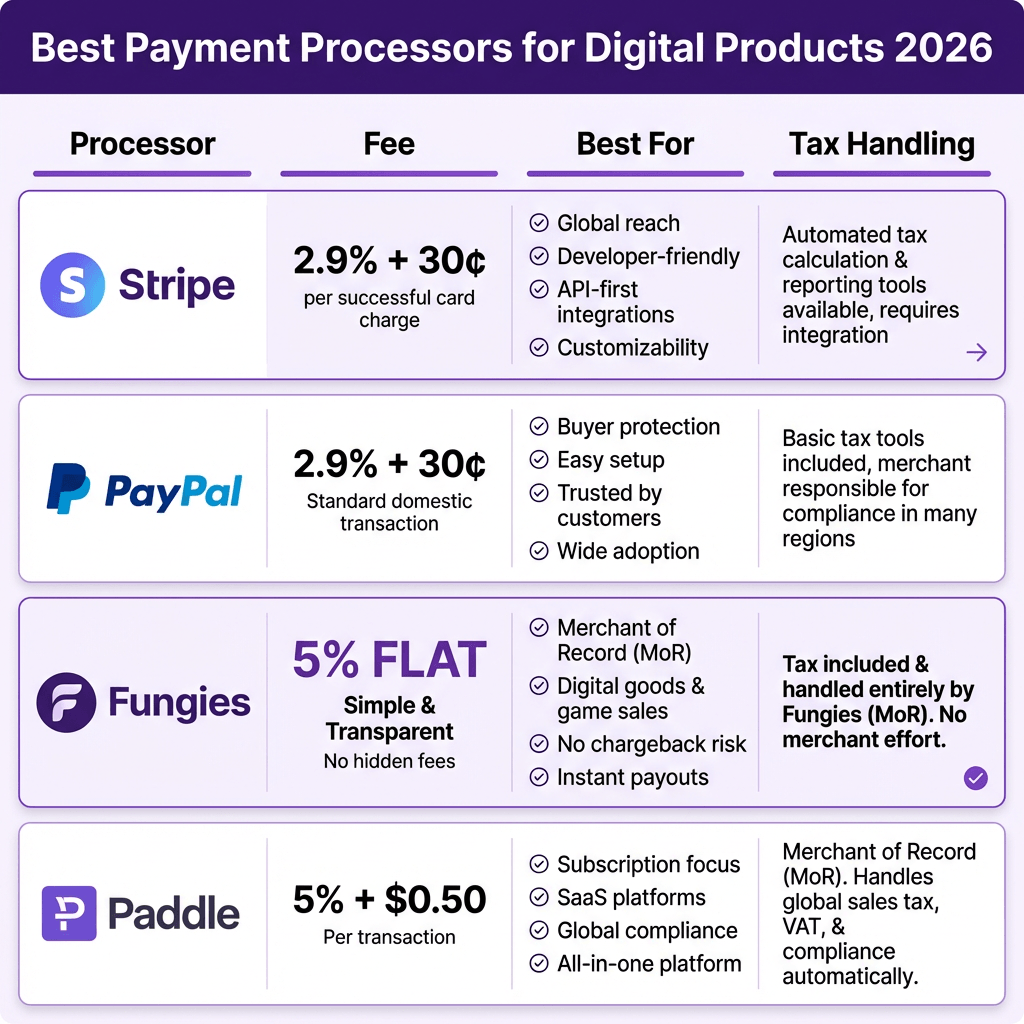
1. Stripe — Best for Developer-First Teams
Pricing: 2.9% + 30¢ per transaction
Stripe remains the gold standard for developers building custom checkout experiences. With robust APIs, extensive documentation, and a massive integration ecosystem, it’s the go-to choice for tech-savvy teams.
Pros:
- Developer-friendly with comprehensive APIs
- Supports 135+ currencies
- Advanced fraud detection (Radar)
- Subscription billing (Stripe Billing)
- Extensive third-party integrations
Cons:
- No built-in tax compliance — requires Stripe Tax ($0.50 per transaction) or third-party solutions
- You’re the merchant of record — responsible for chargebacks and compliance
- Steeper learning curve for non-technical users
Best for: SaaS companies with engineering resources who want maximum customization.
2. PayPal — Best for Trust and Recognition
Pricing: 2.9% + 30¢ per transaction
PayPal processes over $1 trillion annually and boasts 400+ million active accounts. For many customers, seeing the PayPal logo increases purchase confidence significantly.
Pros:
- Instant trust and brand recognition
- Buyer protection reduces customer hesitation
- One-click checkout for existing PayPal users
- Available in 200+ markets
- No monthly fees
Cons:
- Account holds and freezes are common complaints
- Limited customization options
- Customer service can be difficult to reach
- No built-in tax compliance
Best for: Sellers targeting consumers who prefer PayPal’s buyer protection.
3. Fungies — Best All-in-One for Indie Developers
Pricing: 5% flat fee (includes all payment processing and tax compliance)
Fungies is the newer entrant that’s quickly becoming the go-to choice for indie developers, bootstrapped SaaS founders, and small teams who want MoR protection without enterprise complexity. As a Merchant of Record, Fungies handles tax compliance, fraud, and chargebacks for you.
Pros:
- True Merchant of Record — Fungies is the seller of record, not you
- Automatic global tax compliance (EU VAT, US sales tax, GST)
- No monthly fees or setup costs
- 50+ payment methods including local options
- No-code checkout builder
- Built-in affiliate system
Cons:
- Higher per-transaction fee than raw Stripe (but includes tax compliance)
- Newer platform with smaller ecosystem than Stripe
Best for: Indie developers and small SaaS teams who want compliance handled without complexity.
4. Paddle — Best for B2B SaaS
Pricing: 5% + $0.50 per transaction
Paddle is one of the most established Merchant of Record platforms, popular among B2B SaaS companies. They handle tax compliance globally and offer strong subscription management tools.
Pros:
- Established MoR with global tax coverage
- Strong subscription management
- Developer-friendly APIs
- Good for B2B invoicing
Cons:
- More expensive than alternatives at lower volumes
- Complex pricing structure
- Can be overkill for simple digital products
Best for: B2B SaaS companies with complex billing needs.
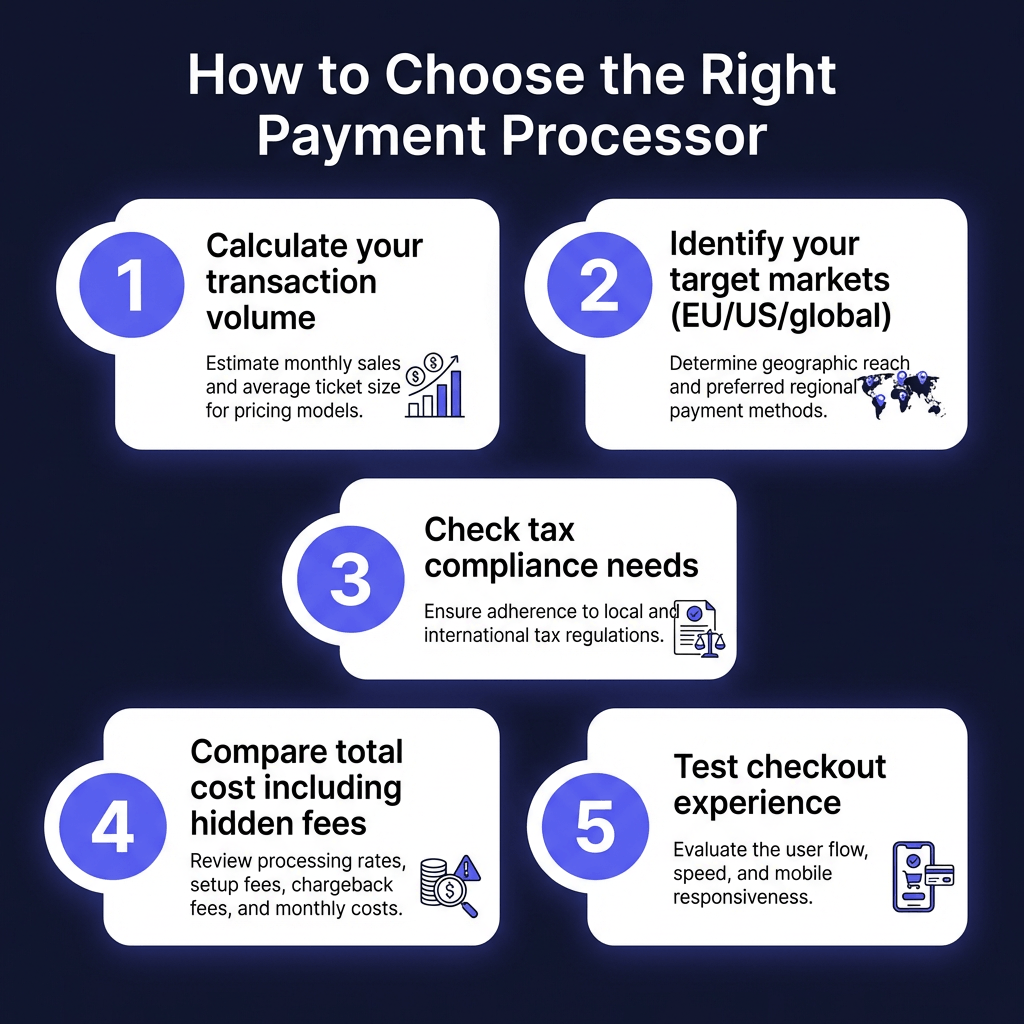
How to Choose the Right Payment Processor
Follow this decision framework to select the best option for your specific situation:
Step 1: Calculate Your Transaction Volume
At $10,000/month in sales, the difference between 2.9% + 30¢ and 5% flat is roughly $100/month. Factor in the cost of tax compliance tools (typically $50-200/month) when comparing.
Step 2: Identify Your Target Markets
Selling to EU customers? You’ll need VAT compliance. US customers? State sales tax. Global audience? You need a solution that handles it all automatically.
Step 3: Assess Your Technical Resources
Have developers on staff? Stripe offers maximum flexibility. Flying solo? A no-code solution like Fungies gets you selling faster.
Step 4: Consider Your Risk Tolerance
As a Merchant of Record, Fungies and Paddle handle chargebacks and fraud. With Stripe and PayPal, you’re personally liable.
FAQ: Payment Processors for Digital Products
What’s the cheapest payment processor for digital products?
Stripe and PayPal both charge 2.9% + 30¢, making them cheapest on raw fees. However, once you add tax compliance tools ($50-200/month), a 5% flat fee MoR like Fungies often works out cheaper for businesses under $50k/month.
Do I need a Merchant of Record for digital products?
If you sell to customers in the EU, UK, or US, you’re legally required to collect and remit consumption tax. An MoR handles this automatically. Without one, you’ll need to register for tax IDs in each jurisdiction and file returns manually.
Can I use multiple payment processors?
Yes, many businesses offer both Stripe/card payments and PayPal at checkout. However, managing tax compliance across multiple processors becomes complex quickly.
What’s better for subscriptions: Stripe or Paddle?
Both handle subscriptions well. Stripe Billing offers more customization but requires you to handle tax compliance. Paddle includes tax handling but has less flexibility in billing logic.
Final Verdict: Best Payment Processor by Use Case
| Use Case | Best Choice | Why |
|---|---|---|
| Developer-first SaaS | Stripe | Maximum flexibility and control |
| Indie developers & small teams | Fungies | All-in-one with no complexity |
| Consumer digital products | PayPal | Trust and buyer protection |
| B2B SaaS with complex billing | Paddle | Established MoR with B2B features |
Conclusion
The best payment processor for digital products in 2026 depends on your specific needs. Stripe leads for developers, PayPal for consumer trust, and Merchant of Record solutions like Fungies and Paddle for hands-off tax compliance.
For most indie developers and small SaaS companies, the simplicity of an all-in-one MoR solution outweighs the slightly higher transaction fees. You’ll save time, reduce risk, and avoid the headache of global tax compliance.
Ready to Simplify Your Payment Processing?
Join hundreds of SaaS and game developers using Fungies.io — automated tax compliance, 50+ payment methods, global Merchant of Record.
No credit card required