7 Best Platforms to Sell Your PC Game in 2025: Steam vs Epic vs Alternatives
40% of Steam games in 2025 haven’t recouped their $100 fee. Discover the 7 best platforms to sell your PC game — from Steam’s dominance to Epic’s 0% revenue share and itch.io’s indie paradise. Data-driven comparison with real 2025 statistics.
Here’s a brutal truth most gamedev Twitter won’t tell you: 40% of games released on Steam in 2025 haven’t even made back their $100 publishing fee. That’s over 5,000 titles that launched with big dreams and crashed into the harsh reality of discoverability hell.
But here’s the thing — Steam isn’t your only option. In fact, depending on your game’s genre, audience, and monetization strategy, another platform might make you significantly more money with way less competition.
What Is PC Game Distribution?
PC game distribution platforms are digital storefronts where developers sell their games directly to players. Think of them as the App Store or Google Play, but for desktop games. The big players — Steam, Epic Games Store, itch.io, and GOG — each offer different revenue splits, audience types, and discovery algorithms.
Unlike mobile, where you’re locked into Apple’s or Google’s ecosystem, PC gives you choices. Lots of them. And those choices matter more than ever in 2025.
Why Platform Choice Matters More Than Ever
The indie game gold rush peaked in 2024. This year? We’re seeing something different. Steam has already seen over 13,000 new releases in 2025 alone — on track to surpass last year’s 18,800 total. That’s roughly 50 new games every single day competing for attention.
The data from Gamalytic paints a sobering picture:
- Only 8% of 2025 releases have grossed over $100,000
- 40% haven’t recouped the $100 Steam Direct fee
- Average revenue per project is down compared to 2024
- Total revenue across all projects has decreased year-over-year
As Polish indie developer Artur Smiarowski noted: “We might have hit the peak of the golden indie rush last year.”
But this isn’t a doom-and-gloom piece. Smart developers are finding success by choosing the right platform for their specific game — not just defaulting to Steam because it’s the biggest.
The 7 Best Platforms to Sell Your PC Game in 2025
1. Steam — The Default (But Not Always the Best)
Steam dominates PC gaming with roughly 75% market share and 132 million monthly active users. If you want maximum reach, this is where you start. But that reach comes with serious caveats.
Key Features:
- Massive built-in audience of 132M+ monthly active users
- Robust discovery features (wishlists, tags, recommendations)
- Workshop support for mods
- Steam Deck compatibility
- Regional pricing tools
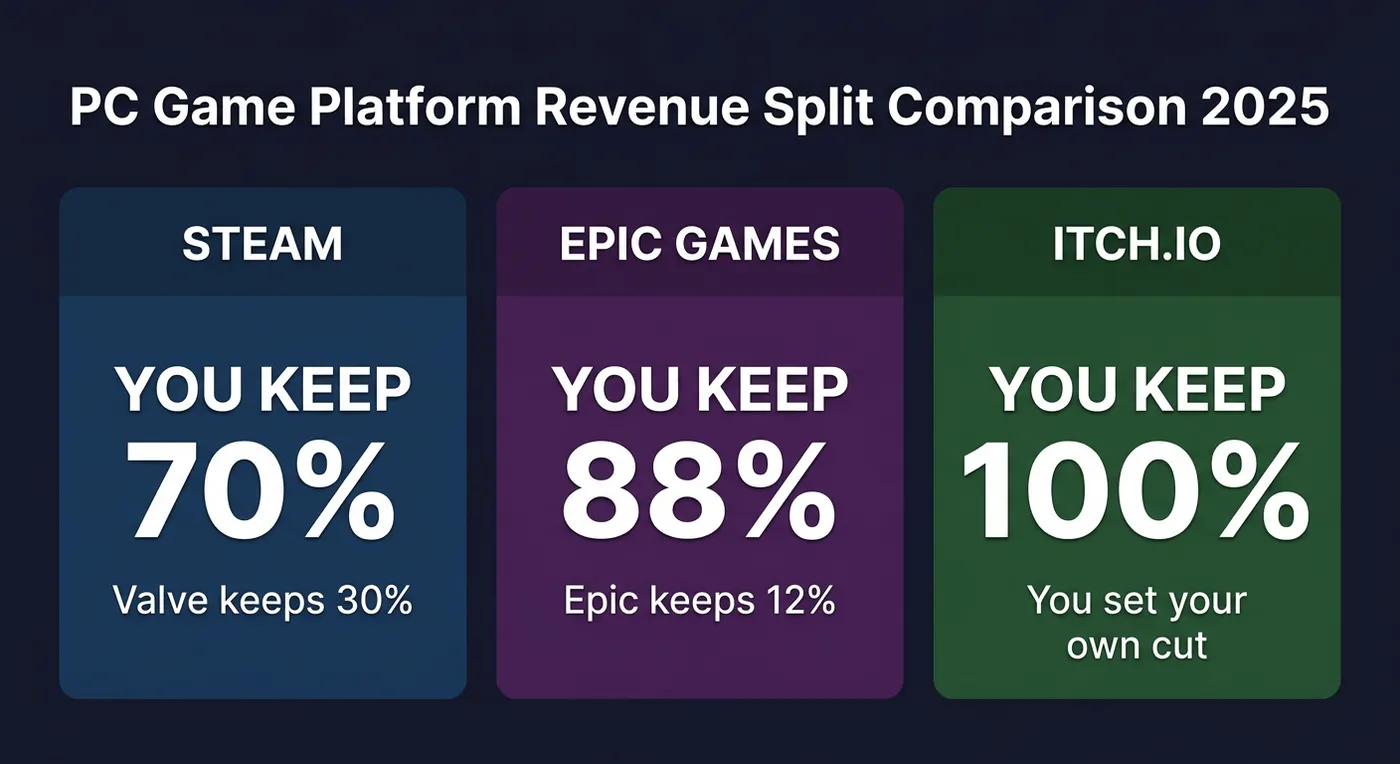
Revenue Share: 70/30 (70% to developer) on first $10M, then 75/25 up to $50M, then 80/20 beyond that.
Publishing Fee: $100 per game (refunded once you hit $1,000 in revenue).
Pricing: Free to publish (after the $100 fee). Steam takes their cut from sales.
Best for: Games with broad appeal, strong marketing budgets, or existing fanbases. If you can crack the algorithm, the rewards are massive. But honestly? Most indie devs underestimate how hard that crack is.
2. Epic Games Store — The Generous Underdog
Epic has been aggressively courting developers since 2018, and their 2025 revenue share update makes them even more attractive. With 295 million registered users and 67.2 million monthly active users, they’re a legitimate alternative — especially for newer indies.
Key Features:
- 0% revenue share on first $1M per product per year (started June 2025)
- 88/12 split after the first million (you keep 88%)
- Free games program drives massive user acquisition
- Less competition than Steam
- Direct developer relationships
Revenue Share: 100% on first $1M annually, then 88/12.
Publishing Fee: $100 per game (not refundable, unlike Steam).
Best for: Developers who want to maximize early revenue. That 0% fee on your first million is genuinely game-changing for small teams. If you’re launching your first title and need every dollar to fund the next one, Epic deserves serious consideration.
3. itch.io — The Indie Paradise
itch.io isn’t trying to be Steam. It’s something better for the right kind of developer: a community-first platform where weird, experimental, and niche games thrive. The “open revenue sharing” model is revolutionary — you choose what percentage (0-100%) goes to itch.io.
Key Features:
- Open revenue sharing — you decide the split (default is 10%)
- Zero upfront costs to publish
- Incredibly supportive indie community
- Game jam integration
- Pay-what-you-want pricing options
- Direct player relationships
Revenue Share: You choose (0-100%, default 10% to itch.io).
Publishing Fee: Free.
Best for: Experimental games, game jam projects, devlogs, and building a community before Steam. Many successful indies launch on itch.io first, build a following, then migrate to Steam with built-in wishlists. The community here actually cares about indie games — not just AAA releases.
4. GOG — The DRM-Free Purists
GOG (Good Old Games) has carved out a loyal niche among players who want to actually own their games — no DRM, no always-online requirements. Their audience skews older, more patient, and willing to pay for quality.
Key Features:
- 100% DRM-free games
- Loyal, engaged community
- Curated selection (harder to get approved)
- GOG Galaxy 2.0 universal launcher
- 30-day refund policy
Revenue Share: 70/30 standard.
Publishing Fee: Free, but curation is strict.
Best for: Games with retro aesthetics, RPGs, strategy titles, and narrative adventures. If your game would feel at home in a 2005 PC gaming magazine, GOG’s audience will probably love it. The curation means less competition but also less guaranteed placement.
5. Humble Bundle — The Charitable Choice
Humble Bundle built its reputation on pay-what-you-want bundles that support charity. For developers, getting featured in a bundle can drive massive exposure and sales — even at lower per-unit prices.
Key Features:
- Bundle exposure to millions of users
- Charity component resonates with players
- Humble Choice subscription model
- Revenue split with charity and platform
Revenue Share: Varies by bundle (typically split between dev, charity, and Humble).
Publishing Fee: Free.
Best for: Older games looking for a second wind, or new releases wanting massive exposure. Bundle sales can be brutal for revenue per unit, but the visibility often drives full-price sales elsewhere. Plus, Humble allocated $12.4 million to charity in 2024 — players feel good buying here.
6. Game Jolt — The Social Platform
Game Jolt positions itself as a social network for games. With built-in streaming, communities, and a younger demographic, it’s ideal for building hype before a wider release.
Key Features:
- Social features built-in (followers, feeds, comments)
- Integrated streaming and content creation tools
- Younger demographic (Gen Z heavy)
- Free hosting for devlogs and demos
Revenue Share: 70/30 standard.
Publishing Fee: Free.
Best for: Early community building, devlogs, and games targeting younger audiences. Think of it as a stepping stone — build your following here, then monetize on Steam or Epic.
7. Xbox (PC Game Pass) — The Subscription Wildcard
Microsoft’s PC Game Pass isn’t a traditional storefront — it’s a subscription service. But for the right developer, that upfront payment can fund your next project while exposing your game to millions.
Key Features:
- Upfront licensing payment (varies widely)
- Massive subscriber base (25M+ Game Pass members)
- Microsoft marketing support
- Play Anywhere (Xbox + PC)
Revenue Share: Licensing deal (not traditional revenue share).
Publishing Fee: N/A (requires approval).
Best for: Polished, complete games that can benefit from massive exposure. The upfront payment can be substantial — some indies report six-figure deals — but you sacrifice ongoing sales revenue. Great for funding your next project.
Platform Comparison: The Data You Need
| Platform | Revenue Split | Upfront Fee | Audience Size | Best For |
|---|---|---|---|---|
| Steam | 70/30 (scales up) | $100 (refundable) | 132M MAU | Broad appeal games |
| Epic Games Store | 100% then 88/12 | $100 | 67M MAU | Maximizing early revenue |
| itch.io | You choose (0-100%) | Free | Smaller but engaged | Niche/experimental |
| GOG | 70/30 | Free (curated) | Loyal niche | DRM-free fans |
| Humble Bundle | Bundle-dependent | Free | Bundle exposure | Visibility boost |
| Game Jolt | 70/30 | Free | Gen Z heavy | Community building |
| Xbox Game Pass | Licensing deal | N/A | 25M subscribers | Upfront funding |
The Reality Check: Steam’s Algorithm Isn’t Your Friend
Here’s what most “how to sell on Steam” guides won’t tell you: the algorithm doesn’t care about your game until players do. Steam’s discovery system rewards games that are already performing. It’s a classic rich-get-richer scenario.
Data from GameDiscoverCo shows that only 6% of games in the last 12 months hit 100,000 wishlists before launch. A massive 66% launched with fewer than 10,000 wishlists. And for games with over 25,000 wishlists, the median conversion rate is just 0.15x — meaning 25,000 wishlists translates to roughly 3,750 week-one sales.
The brutal truth? Steam’s algorithm responds to external demand. If you’re not driving traffic from Reddit, TikTok, YouTube, or Discord, Steam won’t magically surface your game to millions.
FAQ: Selling Your Game on PC
Do I need to publish on Steam?
No. While Steam has the largest audience, many successful indies have built sustainable businesses on Epic, itch.io, or multi-platform strategies. The “Steam or bust” mentality is outdated — and potentially harmful to your revenue.
Should I launch on multiple platforms at once?
Generally, yes — with one caveat. Some platforms (like Game Pass) require launch exclusivity windows. For standard storefronts, simultaneous launches let you capitalize on marketing momentum across all channels. Just be prepared to manage different communities and update pipelines.
What’s the minimum I need to publish?
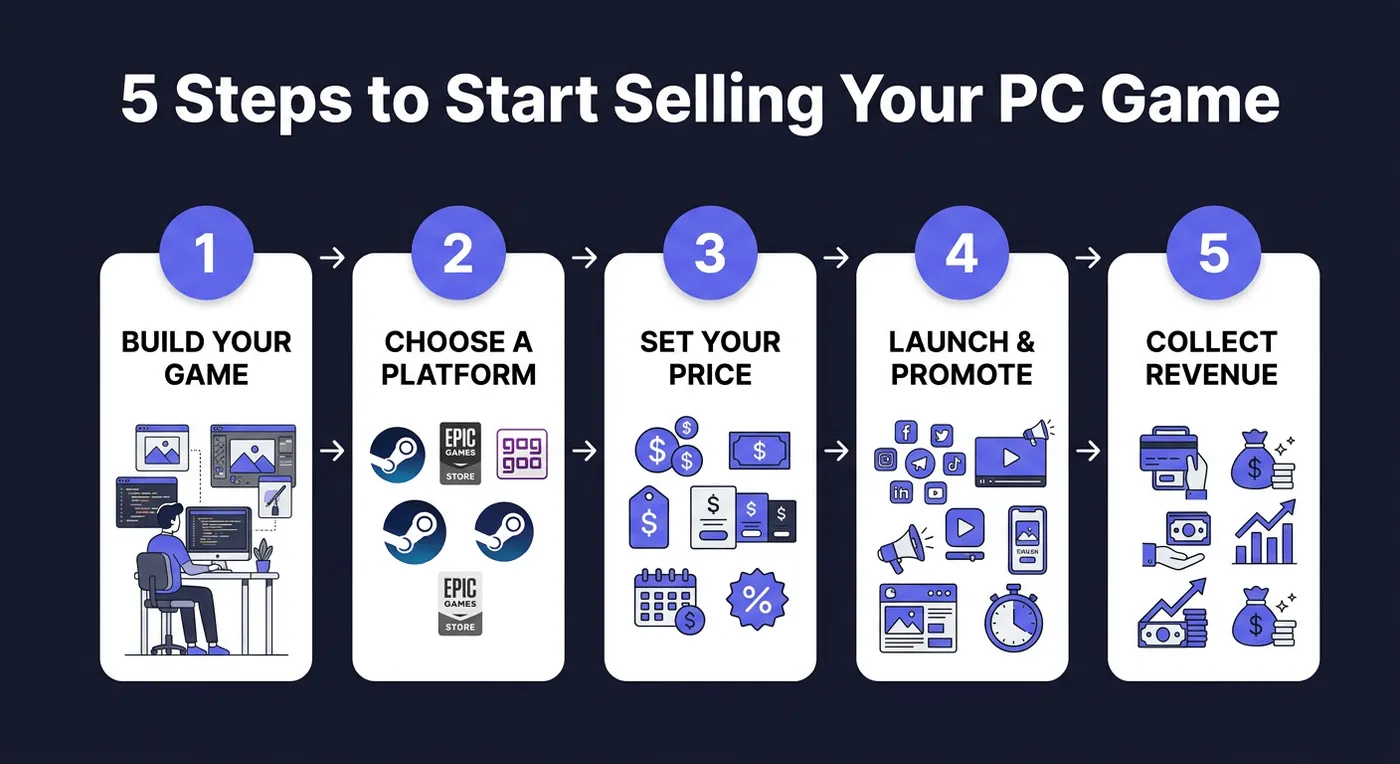
For Steam and Epic: $100, a working build, store page assets (trailer, screenshots, description), and tax documentation. For itch.io: literally just a game file and a description. GOG requires curation approval. Game Pass requires pitching to Microsoft’s ID@Xbox team.
How important are wishlists really?
Critical for Steam. Chris Zukowski’s research shows a direct correlation between pre-launch wishlists and week-one sales. But here’s the kicker — most of those wishlists need to come from external marketing, not Steam’s organic discovery. Start building your audience 6-12 months before launch.
Can I switch platforms later?
Absolutely. Many developers launch on itch.io for early feedback, then move to Steam for broader reach. Others start on Steam, then get picked up for Game Pass months later. Your platform strategy can evolve as your game grows.
Bottom Line: Choose Based on Your Game, Not Habit
Steam isn’t going anywhere. It’s still the 800-pound gorilla of PC gaming. But in 2025, defaulting to Steam without considering alternatives is leaving money on the table.
Epic’s 0% revenue share on your first million is a genuine opportunity. itch.io’s community-first approach can build the fanbase that makes your Steam launch successful. GOG’s DRM-free audience pays premium prices for quality. And Game Pass deals can fund your next project outright.
The developers winning in 2025 aren’t just making great games — they’re making smart platform choices. Don’t let platform inertia kill your game’s potential.
Ready to start selling? Create your Fungies merchant account and handle payments, taxes, and global compliance in minutes — no code required.
Sources
- WN Hub: 40% of Steam games 2025 didn’t recoup $100 fee
- PC Gamer: Steam 2025 release statistics
- Epic Games Store: Revenue share update 2025
- itch.io: Open revenue sharing announcement
- IconEra: Epic vs Steam market share 2025
- GameDiscoverCo: Steam wishlist conversion analysis
- How To Market A Game: Steam algorithm analysis
- Reddit r/gamedev: Steam wishlist importance 2025