7 Best SaaS GTM Strategies for 2026: Complete Guide to Go-to-Market Success
Discover the 7 best SaaS GTM strategies for 2026. From product-led growth to AI-powered acquisition, learn which go-to-market approach fits your SaaS with real data, benchmarks, and examples from Cursor, Figma, and Notion.
Here’s a number that should stop every SaaS founder in their tracks: 42% of SaaS startups fail because they build something nobody needs. Not because the code was buggy. Not because they ran out of money. But because they never figured out how to actually reach the people who should care.
That’s where your go-to-market (GTM) strategy comes in. In 2026, the difference between SaaS companies that scale and those that stall isn’t product quality — it’s GTM execution. The median SaaS company now spends $2.00 to acquire every dollar of new ARR. Top-quartile companies? They spend just $1.00.
In this guide, I’ll break down the 7 best SaaS GTM strategies that are actually working in 2026. These aren’t theoretical frameworks from business school. These are battle-tested approaches from companies like Cursor (fastest to $2B ARR), Figma, and Notion — plus the hard data on what makes each strategy work.
What Is a SaaS Go-to-Market Strategy?
A go-to-market strategy is your system for turning a product into revenue. It’s not just marketing — it’s the entire framework that connects your product’s value proposition with the right audience through the most effective channels.
Your GTM strategy answers five critical questions:
- Who is your ideal customer?
- Why should they buy from you?
- What will you charge them?
- How will they discover and evaluate your product?
- How will you measure success?
Here’s what most founders get wrong: they confuse GTM strategy with marketing strategy. Marketing is one channel within GTM. Your GTM encompasses pricing model, sales motion, product decisions, positioning, channel mix, and feedback loops — all working together.
Why Your GTM Strategy Matters More Than Ever in 2026
The SaaS landscape has fundamentally shifted. Customer acquisition costs have surged 222% over the past 8 years. The old playbook — buy ads, capture leads, nurture to sale — is breaking under the weight of privacy changes, ad fatigue, and buyer skepticism.
In 2026, 81% of B2B buyers make vendor decisions before engaging sales teams. They’re researching in private Slack communities, reading unfiltered Reddit threads, and comparing notes in Discord servers. The companies winning today aren’t interrupting buyers — they’re showing up where conversations are already happening.
Plus, AI has changed the game. AI-native SaaS companies achieve 3-5x faster customer acquisition than traditional SaaS. They’re using AI for personalization (boosting conversion rates by 202%), automated onboarding, and predictive lead scoring.
The 7 Best SaaS GTM Strategies for 2026
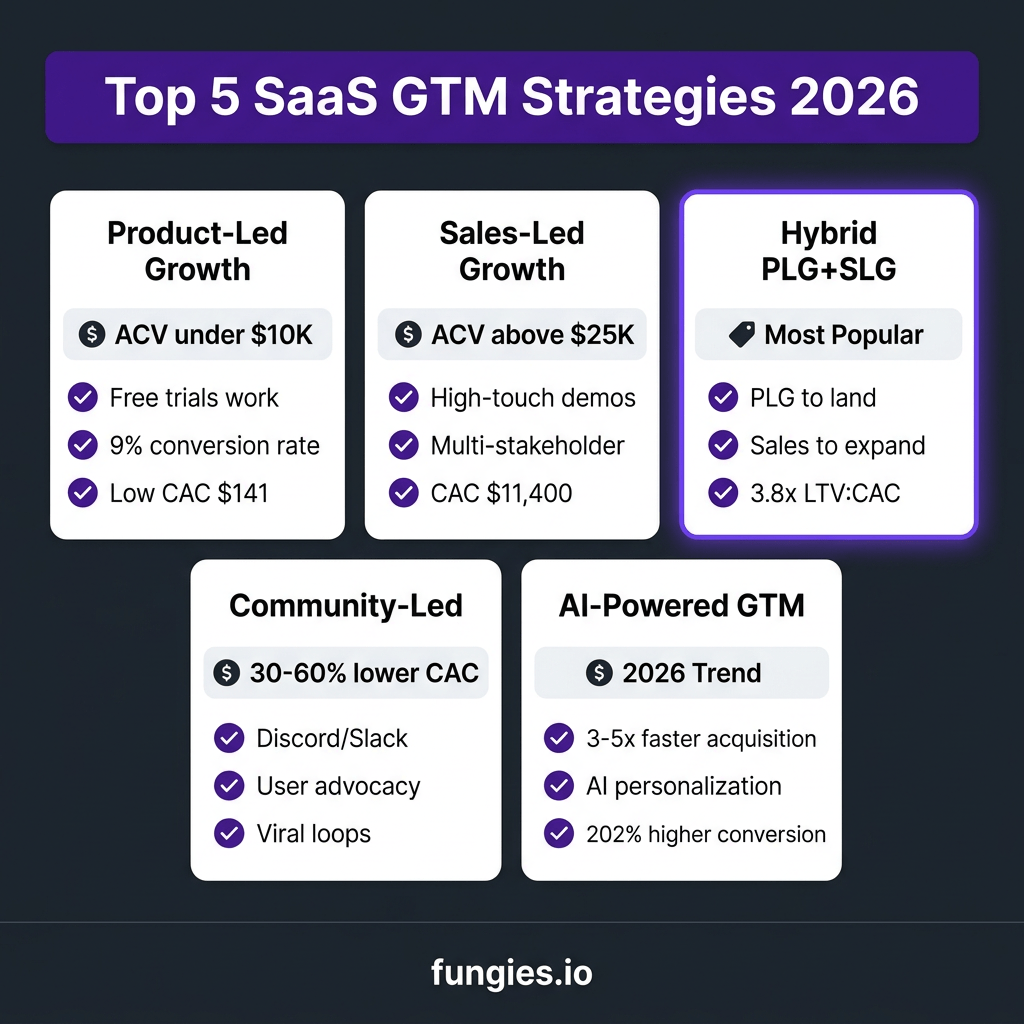
1. Product-Led Growth (PLG)
Product-led growth is a GTM motion where the product itself drives customer acquisition, conversion, and expansion. Users experience value directly through free trials or freemium tiers before ever talking to sales.
When it works: PLG excels when your product is simple enough for users to adopt without training, your average contract value (ACV) is under $10K, and individual users can experience value independently.
The numbers:
- Median free-to-paid conversion: 9%
- Freemium products convert visitors at 12% median
- Opt-out free trials (requiring credit card): 48.8% conversion
- PLG CAC averages just $141 compared to $205 for paid acquisition
Best for: Developer tools, productivity software, collaboration platforms, and any product where users can self-serve to value quickly.
Real example: Cursor, the AI code editor, crossed $500M ARR by mid-2025 and hit $2B ARR by February 2026 — becoming the fastest SaaS company to reach those milestones on a pure PLG motion.
2. Sales-Led Growth (SLG)
Sales-led growth relies on a dedicated sales team to guide prospects through demos, negotiations, and contract close. It’s the traditional approach that still dominates enterprise SaaS.
When it works: SLG is essential when your ACV exceeds $25K, buying committees involve multiple stakeholders, and the product requires implementation or customization.
The numbers:
- Median B2B SaaS CAC for sales-led: $11,400
- Enterprise deals often require 6-18 month sales cycles
- Target LTV:CAC ratio: 4:1 or higher for enterprise
Best for: Enterprise software, complex B2B solutions, regulated industries, and high-ACV products requiring security reviews and procurement processes.
Honest take: Sales-led growth is expensive and slow. But for the right product, it’s unavoidable. The key is making your sales process as efficient as possible with good qualification, standardized demos, and clear ROI calculators.
3. Hybrid PLG + Sales-Assisted
The hybrid model combines product-led acquisition with sales-assisted expansion. Users start through self-serve, and sales engages when product signals indicate expansion potential.
When it works: This is the dominant model for B2B SaaS in 2026. It works when you have a product users can try independently, but with expansion potential that benefits from human touch.
The numbers:
- Median B2B SaaS LTV:CAC ratio: 3.8x
- CAC payback period: 8.6 months median
- 48% of SaaS companies now use hybrid motions
Best for: Most B2B SaaS companies in the $10K-$50K ACV range. Think Figma, Notion, Slack — all started PLG, added sales later.
How to execute: Let users self-serve to value. Use product analytics to identify power users and expansion signals. Have sales engage with context — “I saw your team hit 100 projects, let’s talk about enterprise features.”
4. Community-Led Growth (CLG)
Community-led growth makes your users, customers, and advocates your primary growth engine. Instead of relying solely on paid ads or sales, you build an ecosystem where members drive acquisition, retention, and expansion.
When it works: CLG works when users are passionate about your product category, when templates/workflows can be shared, and when peer learning accelerates adoption.
The numbers:
- Community-led growth reduces CAC by 30-60%
- Cold outreach reply rates: below 6%
- Community-sourced deals close faster with higher win rates
Best for: Products with passionate user bases, template ecosystems (Notion, Figma), developer tools, and creator economy platforms.
Real examples: Figma built a community of 4+ million designers sharing templates and plugins. Notion’s user-created templates drive millions in organic acquisition. Both companies invested heavily in community before traditional marketing.
5. AI-Powered GTM
AI-powered GTM uses artificial intelligence across the entire customer journey — from personalized outreach to predictive churn prevention to automated onboarding.
When it works: AI GTM works when you have sufficient data to train models, when personalization at scale matters, and when you want to reduce manual work across marketing and sales.
The numbers:
- AI-native SaaS: 3-5x faster customer acquisition
- AI personalization boosts conversion rates by 202%
- AI-powered features command 28-42% price premiums
Best for: Data-rich companies, high-volume sales motions, and products where AI can deliver genuine user value (not just buzzword features).
Reality check: Most “AI-powered” GTM tools are just lead scoring with a rebrand. Real AI GTM requires investment in data infrastructure, model training, and continuous optimization. Don’t buy the hype — build the capability.
6. Partner-Led Growth
Partner-led growth leverages ecosystem partnerships, integrations, and co-marketing to extend reach without expanding headcount. It’s about finding where your customers already are and showing up there.
When it works: Partner-led works when your product integrates with platforms your customers already use, when complementary tools share your ICP, and when marketplace distribution is available.
The numbers:
- Partner-sourced deals often have 2x higher ACV
- Integration partnerships can drive 20-30% of new leads
- Co-marketing reduces CAC by sharing audience costs
Best for: Products with clear integration value, companies targeting established platforms (Salesforce, Shopify, HubSpot ecosystems), and businesses with limited marketing budgets.
7. Content-Led Growth
Content-led growth uses educational content as your primary acquisition channel. Instead of interrupting buyers with ads, you create the resources they’re already searching for.
When it works: Content-led works when buyers research extensively before purchasing, when SEO can capture high-intent traffic, and when you have expertise worth sharing.
The numbers:
- Content marketing drives 400% increase in lead generation
- SEO CAC averages $647 vs $802 for paid channels
- High-quality content generates leads as long as it ranks
Best for: Complex products requiring education, niche markets with underserved search demand, and companies willing to invest 6-12 months before seeing returns.
How to Choose the Right GTM Strategy for Your SaaS
Here’s my framework for choosing your GTM motion:
| Factor | Product-Led | Sales-Led | Hybrid |
|---|---|---|---|
| ACV | Under $10K | Above $25K | $10K-$50K |
| Product complexity | Simple, self-serve | Complex, needs implementation | Moderate complexity |
| Buying committee | Individual user | Multiple stakeholders | Team or department |
| Time to value | Minutes to hours | Weeks to months | Hours to days |
| Target CAC | Under $500 | $5K-$15K | $1K-$5K |
| Median LTV:CAC | 4.0x | 3.5x | 3.8x |
Most B2B SaaS companies in 2026 should start with a hybrid approach. Launch with PLG to validate product-market fit and generate initial revenue. Add sales-assisted motions as you identify expansion opportunities and move upmarket.
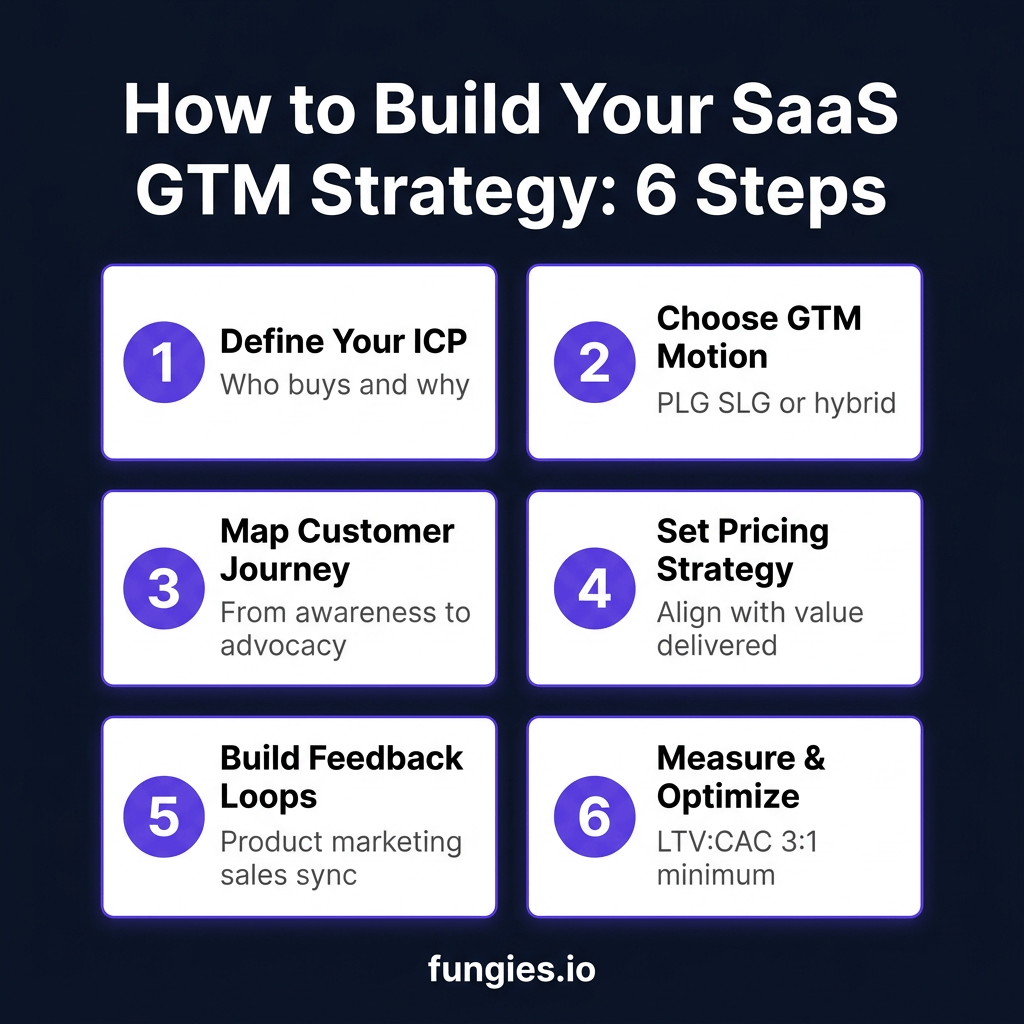
6 Steps to Build Your SaaS GTM Strategy
Once you’ve chosen your GTM motion, here’s how to execute:
Step 1: Define Your Ideal Customer Profile (ICP)
Your ICP isn’t “mid-market SaaS companies.” It’s specific: “Series A B2B SaaS companies with 20-100 employees, using Salesforce, struggling with billing complexity, and spending 15+ hours monthly on tax compliance.”
Interview 20-30 potential customers. Understand their pain points, current solutions, and buying process. Build tiered ICPs based on firmographic and behavioral data.
Step 2: Choose Your Primary GTM Motion
Based on your ACV, product complexity, and team capabilities, choose your dominant motion. Don’t try to do everything — pick one primary approach and layer in secondary motions as you scale.
Step 3: Map the Customer Journey
Document every touchpoint from awareness to advocacy. Where do prospects discover you? What content do they consume? What triggers the buying decision? Where do they get stuck?
Step 4: Align Pricing with Value
Your pricing should align with how customers derive value. Usage-based pricing works for infrastructure tools. Per-seat pricing works for collaboration software. Flat-rate pricing works for simple tools with clear ROI.
Step 5: Build Cross-Functional Feedback Loops
The best GTM teams treat it like a living system. Product, marketing, sales, and customer success should meet weekly to share insights. What features are prospects asking for? What objections come up in demos? What causes churn?
Step 6: Measure What Matters
Track these core metrics:
- LTV:CAC ratio: Target 3:1 minimum, 4:1+ for scale
- CAC Payback Period: Under 12 months for SMB, under 18 for mid-market
- Net Revenue Retention (NRR): Target 106%, best-in-class 120-130%
- Magic Number: Sales efficiency metric, target >1.0
- Free-to-paid conversion: Benchmark against 9% median
Common GTM Mistakes to Avoid
I’ve seen these mistakes kill promising SaaS companies:
- ICP not validated: Building for assumed needs rather than real pain. Fix: Interview customers before building.
- No feedback loop instrumentation: Can’t trace what drives revenue. Fix: Implement proper attribution from day one.
- Trying to serve everyone: “Our product works for any business” means it works for no one. Fix: Narrow your ICP.
- Ignoring CAC trends: Blended CAC looks fine while paid CAC explodes. Fix: Track channel-specific CAC separately.
- Sales and marketing misalignment: Marketing generates MQLs sales ignores. Fix: Define SQL criteria together.
Frequently Asked Questions
What’s the difference between GTM strategy and marketing strategy?
A GTM strategy is broader. It includes pricing, sales motion, product decisions, and channel mix. Marketing strategy is one component — focused on demand generation and brand building. Your GTM strategy defines how you’ll bring the product to market; marketing defines what you’ll say and where.
Can I combine multiple GTM strategies?
Yes — and most successful SaaS companies do. The hybrid model (PLG + sales-assisted) is now the dominant approach for B2B SaaS. Start with one primary motion, prove it works, then layer in complementary strategies.
How do I know if my GTM strategy is working?
Focus on unit economics. If your LTV:CAC ratio is above 3:1 and your payback period is under 12 months, your GTM is working. Don’t get distracted by vanity metrics like traffic or signups if they’re not converting to revenue.
When should I add sales to a PLG motion?
Add sales when you see expansion signals: power users hitting limits, teams growing within accounts, or enterprise features being requested. The best time is usually around $1-2M ARR when you have enough data to identify high-intent accounts.
What’s the biggest GTM trend in 2026?
AI-powered personalization at scale and community-led growth. Companies are using AI to deliver personalized experiences to thousands of prospects simultaneously, while building communities that reduce CAC by 30-60% compared to traditional channels.
Conclusion: Build Your GTM Engine
The SaaS companies winning in 2026 aren’t just building great products — they’re building great GTM engines. They’ve chosen a primary motion that fits their product and market. They’ve aligned their teams around clear metrics. And they’re continuously optimizing based on data, not gut feel.
Your GTM strategy isn’t a one-time decision. It’s a living system that evolves as your product matures, your market shifts, and your customers’ needs change. The framework in this article gives you a starting point. The execution is up to you.
Ready to streamline your SaaS billing and focus on growth? Get started with Fungies.io — the Merchant of Record platform that handles payments, tax compliance, and checkout so you can focus on building your GTM engine.
Sources
- GTM 80/20 – Customer Acquisition Cost Statistics 2026
- SaaS Hero – LTV:CAC Benchmarks 2026
- Digital Applied – CAC Benchmarks by Industry 2026
- SaaS Mag – PLG in 2026
- Salesmotion – PLG vs Sales-Led Strategy
- RevSure – Community-Led Growth Analysis
- GTM Quest – Strategy Playbooks 2026
- WitsCode – SaaS GTM Strategy Template