10 Best Sales Enablement Software in 2026: Complete Comparison with Real Pricing
Compare the top 10 sales enablement software platforms for 2026 with real pricing data. From Seismic and Highspot to Dock and SalesHood, find the right tool for your team’s size and budget. Includes implementation costs, feature comparisons, and ROI calculations.
Here’s a stat that should make every revenue leader pause: 75% of sales leaders logged into their enablement platform fewer than five times last quarter. That’s not a rep adoption problem — it’s a product-fit problem.
The sales enablement software market is booming — valued at $6.9 billion in 2026 and projected to hit $21.2 billion by 2033. But bigger isn’t always better. Most enablement tools don’t survive contact with how reps actually work. They’re either too complex, too expensive, or solve problems your team doesn’t actually have.
I’ve spent the last month digging into pricing data, implementation timelines, and real user reviews from G2, Vendr, and Reddit. The difference between the right platform and the wrong one? It can mean the difference between a 4-month implementation nightmare and being live in two weeks — or between a $350K three-year commitment and a $15K annual contract that actually gets used.
What Is Sales Enablement Software?
Sales enablement software is the integrated tech stack that equips revenue teams with the content, coaching, conversation intelligence, and engagement automation they need to close deals. Think of it as the central nervous system for your sales operation — connecting your CRM, content library, training programs, and buyer interactions into one coherent system.
In 2026, the category has evolved far beyond simple document storage. Modern platforms combine:
- Content management systems with AI-powered search and recommendations
- Learning management for onboarding and ongoing training
- Conversation intelligence that analyzes calls and provides coaching
- Digital sales rooms for buyer engagement
- Guided selling playbooks that surface the right content at the right time
The best platforms don’t just store assets — they actively guide reps through the sales process, automate repetitive tasks, and provide leadership with visibility into what’s actually working.
Why Sales Enablement Matters More Than Ever
The B2B buying journey has fundamentally changed. Buyers now complete about 70% of their journey before ever speaking to a rep, and 81% already have a preferred vendor by the time first contact happens. Your reps aren’t just competing against other vendors — they’re competing against the buyer’s own research.
Here’s what the data tells us about modern sales enablement:
- Companies with structured enablement programs see 15-20% higher win rates
- Effective onboarding reduces ramp time from 4 months to 3 months — accelerating revenue by $333K annually for a 50-rep team
- A 4-percentage-point improvement in win rate (from 20% to 24%) means 20% more deals closed
- The gap between top-performing and average sellers has widened significantly — making enablement a competitive necessity
But here’s the catch: you can’t just buy a platform and expect magic. The tool has to match your team’s workflow, your budget reality, and your growth stage. A Ferrari doesn’t help if you need a pickup truck.
10 Best Sales Enablement Software Platforms in 2026
I’ve evaluated these platforms based on real pricing data, implementation timelines, feature depth, and — most importantly — whether reps actually use them. The list covers everything from enterprise giants to lean startup-friendly options.
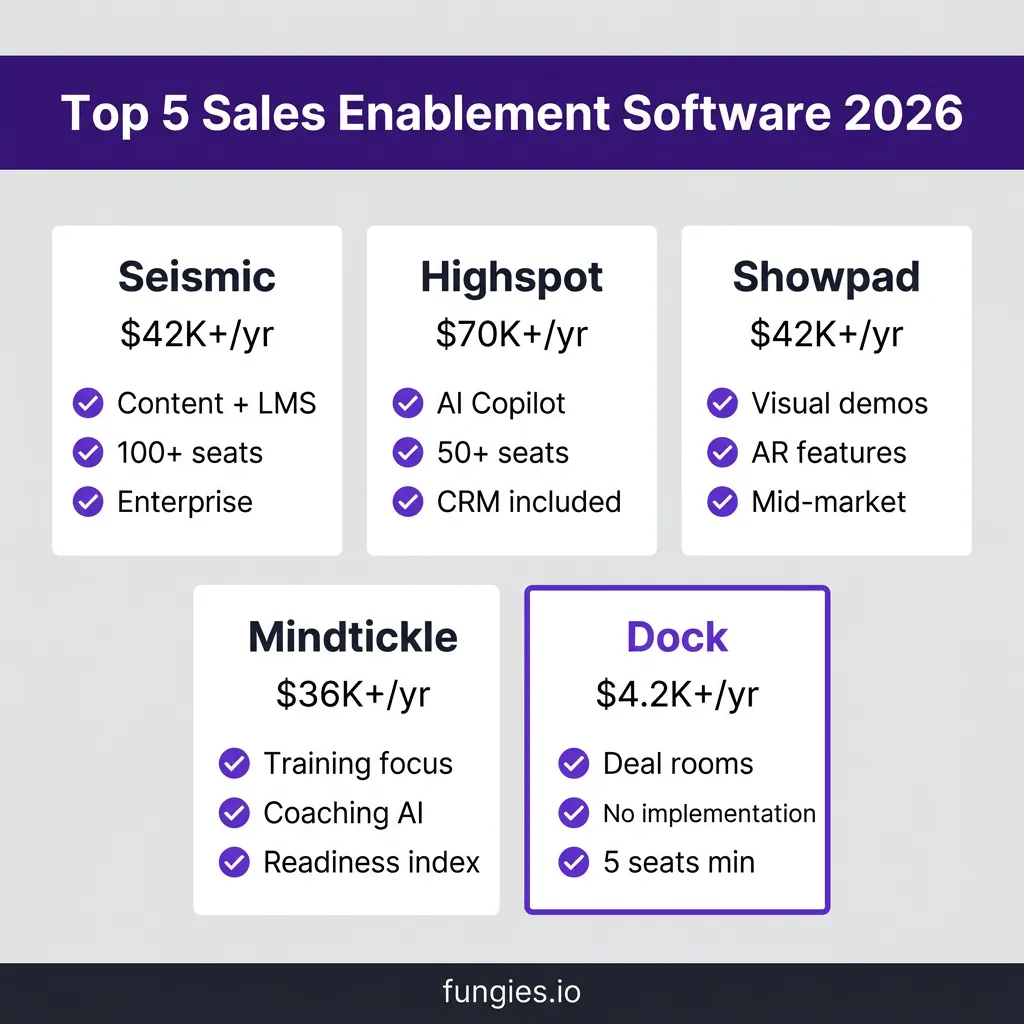
1. Seismic — Best for Large Enterprises
Seismic is the 800-pound gorilla of sales enablement. In February 2026, Seismic and Highspot announced a merger to create a combined entity valued at around $6 billion — the largest deal in the history of the category.
Key Features:
- Enterprise-grade content management with AI-powered search
- Dynamic content personalization (LiveDocs)
- Integrated learning management system
- Deep CRM integrations and engagement tracking
- Aura Copilot for AI-assisted selling
Pricing: ~$42,700/year for 100 seats (Professional tier). Enterprise deployments commonly exceed $150K–$250K annually. Implementation fees: $5K–$50K+ with 4-month average timelines.
Best for: Large enterprises (500+ employees) with dedicated enablement teams, complex content governance needs, and budgets to support 4+ month implementations. Seismic excels when you need robust content management and LMS capabilities — but only if you’ll use all those features.
2. Highspot — Best for AI-Powered Enablement
Highspot competes head-to-head with Seismic at the enterprise level, with a particular strength in AI capabilities and conversation intelligence. Their Copilot feature provides real-time guidance to reps during sales interactions.
Key Features:
- Highspot Copilot for generative AI and real-time guidance
- Role play and skill assessment tools
- Guided selling playbooks
- Meeting intelligence and conversation analytics
- CRM integrations included at no extra cost
Pricing: ~$70,000/year starting point for 50+ seats. Average contract size ~$91,460/year. Implementation: $15K–$45K plus $8K–$25K for content migration.
Best for: Mid-market to enterprise organizations (200+ employees) wanting strong AI capabilities and deep CRM integrations. Be prepared for the price tag and learning curve.
3. Showpad — Best for Visual Sales Demos
Showpad stands out for companies that prioritize design and buyer experience — especially in industries like medical devices where visual demos matter. The UI/UX is highly rated, and the platform excels at creating engaging buyer experiences.
Key Features:
- Content management with AI-powered recommendations
- Augmented reality for product demos
- Shared Spaces for buyer engagement
- Video recording tools
- Deep Salesforce integration
Pricing: ~$42,000/year for 100 users ($25–$45/user/month). Most organizations pay $50K–$100K annually. Implementation costs vary but typically add several thousand dollars.
Best for: Mid-market to enterprise organizations (200–1,000+ employees) that need content management, visual presentation tools, and training capabilities. Great for teams already using Salesforce.
4. Mindtickle — Best for Sales Readiness & Training
Mindtickle takes a training-first approach to enablement. It’s built for organizations with dedicated enablement teams running structured programs, with strong capabilities for correlating training activities directly to revenue outcomes.
Key Features:
- Comprehensive LMS with gamification
- AI-powered coaching (Mindtickle Copilot)
- Conversation intelligence for call analysis
- Digital sales rooms
- Readiness Index that correlates training to CRM outcomes
Pricing: ~$36,000–$60,000/year for 100 users. Average contract ~$92,000/year. Implementation: $3K–$25K with 6–8 week setup. Strongly prefers 36-month contracts.
Best for: Enterprise organizations (500–5,000+ employees) with large, distributed sales teams needing comprehensive training infrastructure. Excellent for onboarding at scale and ongoing skill development.
5. Dock — Best for Mid-Market Teams
Dock is the new entrant that’s disrupting the category. Built specifically for mid-market companies that need enterprise capabilities without enterprise complexity, Dock consolidates deal rooms, content management, mutual action plans, e-signatures, and LMS into one platform.
Key Features:
- Digital sales rooms with mutual action plans
- AI-powered content management with auto-tagging
- AI Documents that generate business cases from CRM data
- Learning management with playbooks and courses
- AI Enablement Agent for real-time rep guidance
- Native e-signatures and order forms
Pricing: Free plan available (10 workspaces). Standard: $350/month for 5 users ($4,200/year). Premium: $1,000/month for 10 users. Enterprise: Custom pricing. No implementation fees.
Best for: Mid-market companies (100–500 employees) that need real enablement infrastructure without a 4-month implementation or dedicated admin. Perfect for teams that want to consolidate 5-7 tools into one platform.
6. Allego — Best for Regulated Industries
Allego emphasizes video-based learning, mobile-first design, and conversation intelligence. It’s particularly strong in regulated industries like financial services, life sciences, and pharmaceuticals where compliance training is critical.
Key Features:
- Video coaching and role-play
- Conversation intelligence
- Content management and digital sales rooms
- Reinforcement training
- 120+ integrations
Pricing: ~$15–$30/user/month ($180–$360/user/year). Estimated $50K–$200K+ annually for mid-market to enterprise. Implementation: $5K–$50K+.
Best for: Mid-market to enterprise B2B companies (200–5,000+ employees) in regulated industries needing comprehensive training with video coaching and compliance features.
7. SalesHood — Best Value for Features
SalesHood offers a comprehensive feature set at a more accessible price point than the enterprise giants. It combines training, coaching, content, and digital sales rooms with transparent published pricing.
Key Features:
- AI Role Play and AI Pitch Practice
- AI Call Recaps and AI Content Writer
- Content management with searchable library
- Digital sales rooms with mutual action plans
- Pre-built sales methodology templates (MEDDICC, Sandler)
Pricing: Essential: ~$45/user/month. Pro: ~$75/user/month. Transform: Custom. For 50 users: $27K–$45K/year. For 100 users: $54K–$90K/year.
Best for: Mid-market to enterprise B2B companies (100–2,000+ employees) in high-growth SaaS and technology sectors that want unified platform capabilities without enterprise pricing.
8. Spekit — Best for Workflow Integration
Spekit delivers enablement directly in reps’ existing workflows rather than as a separate platform. It’s ideal for Salesforce-heavy organizations needing content, training, and coaching surfaced contextually in CRM, email, and other tools.
Key Features:
- AI Sidekick for contextual recommendations
- In-app guidance and knowledge access
- Digital sales rooms
- Learning modules
- Deep Salesforce integration
Pricing: Quote-only. Historical pricing was $10–$20/user/month, but current pricing for the full platform is likely significantly higher given feature expansion.
Best for: Mid-market to enterprise sales teams (100–1,000+ employees) that want enablement delivered in existing workflows rather than requiring reps to learn another platform.
9. Guru — Best for Knowledge Management
Guru is a cross-functional knowledge platform, not a purpose-built sales enablement tool. It focuses on AI chat, search, and automated knowledge management across the entire organization.
Key Features:
- AI-powered workplace search
- Automated knowledge management
- Enterprise AI Chat & Research
- 100+ integrations including Slack and Teams
- Permission-aware AI with verification workflows
Pricing: Standard: $25/seat/month ($300/seat/year). Enterprise: Custom pricing. For 50 users: $15K/year. For 100 users: $30K/year.
Best for: Mid-market to enterprise companies (50–1,000+ employees) across customer support, HR, IT, and operations that need AI-powered knowledge access at scale. Not ideal for sales-specific training or coaching needs.
10. Outreach — Best for Sales Engagement
While primarily known as a sales engagement platform, Outreach has expanded into enablement with conversation intelligence, coaching, and content management capabilities. It’s best for teams that want engagement and enablement in one platform.
Key Features:
- Sales engagement automation
- Conversation intelligence (Outreach Kaia)
- Deal health scoring
- Sales coaching and call analysis
- Revenue intelligence and forecasting
Pricing: Quote-only. Typically $100–$200/user/month for full platform. Implementation and professional services extra.
Best for: Enterprise sales teams that want to consolidate sales engagement and enablement into one platform. Best suited for organizations already using Outreach for engagement.
Sales Enablement Software Comparison Table
| Platform | Starting Price | Seat Minimum | Implementation | Best For |
|---|---|---|---|---|
| Seismic | $42,700/yr | 100+ | 4 months | Large enterprises |
| Highspot | $70,000/yr | 50+ | 6-8 weeks | AI-powered enablement |
| Showpad | $42,000/yr | 50+ | Varies | Visual demos |
| Mindtickle | $36,000/yr | 50+ | 6-8 weeks | Training & readiness |
| Dock | $4,200/yr | 5 | 2-4 weeks | Mid-market teams |
| Allego | ~$30,000/yr | Not disclosed | Varies | Regulated industries |
| SalesHood | $27,000/yr | Not disclosed | Not disclosed | Value & features |
| Spekit | Quote-only | Not disclosed | Not disclosed | Workflow integration |
| Guru | $15,000/yr | Not disclosed | Not disclosed | Knowledge management |
| Outreach | Quote-only | Not disclosed | Not disclosed | Engagement + enablement |
How to Choose the Right Sales Enablement Platform
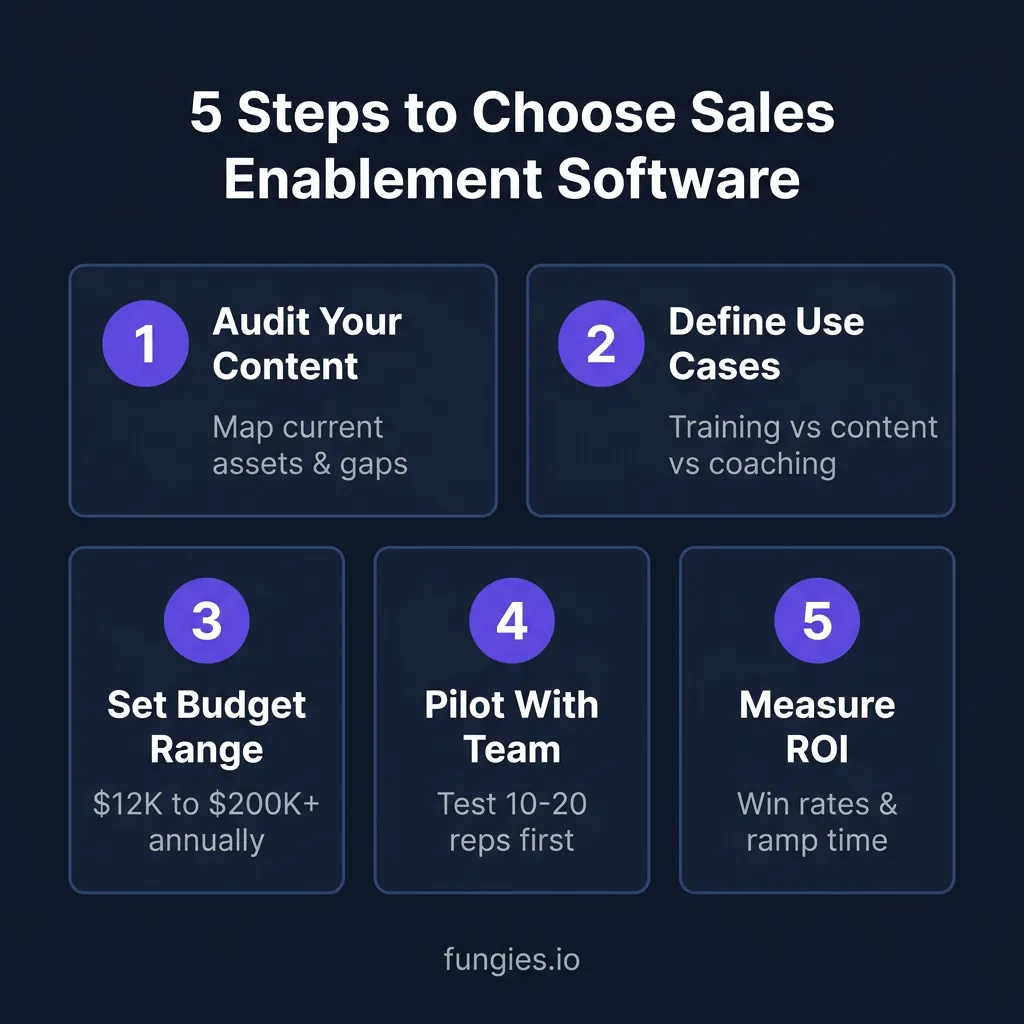
After reviewing dozens of platforms and talking to revenue leaders, here’s my framework for making the right choice:
1. Match Platform to Your Stage
Enterprise platforms like Seismic and Highspot are built for 5,000-person orgs. If you’re a 50-500 person company, you’re paying for features you’ll never use. Dock and SalesHood are built for mid-market reality.
2. Calculate Total Cost of Ownership
That $90K annual quote? It often climbs to $350K+ over three years when you factor in implementation ($15K–$50K), content migration ($8K–$25K), training, integrations ($5K–$15K each), and annual price escalations (8–12%).
Here’s a real example:
- Year 1: $90K licenses + $20K implementation + $15K migration + $10K training = $135K
- Year 2: $90K + 10% increase = $99K
- Year 3: $99K + 10% increase = $109K
- 3-year total: $343K (not the $270K you’d assume)
3. Prioritize Adoption Over Features
The best enablement platform isn’t the one with the most features — it’s the one your reps will actually open when they’re prepping for a call. Complexity kills adoption. If your platform requires days of training and dedicated admin staff, you’re paying for friction.
4. Demand Transparent Pricing
If a vendor won’t ballpark pricing after two calls, walk away. Custom quoting gives vendors pricing flexibility — they can charge more based on your company size, urgency, and how much you reveal during discovery.
5. Pilot Before Committing
Propose a phased rollout: Start with one sales team or region (10-20 reps) for 3 months. Measure ramp time, win rate, time-to-close, and content usage. If metrics improve, expand. If not, cancel before committing to a multi-year contract.
Building the Business Case for Sales Enablement
Your CFO thinks in terms of ROI. Here’s how to frame the investment:
Faster Ramp Time
If your current onboarding takes 4 months and enablement cuts it to 3 months, new reps contribute one month sooner. For a 50-rep team hiring 20 people annually at $200K quota each, that’s $333K in accelerated revenue.
Higher Win Rates
A 4-percentage-point improvement in win rate (from 20% to 24%) means 20% more deals closed. For a team working 250 opportunities annually at $50K average deal size, that’s 10 extra wins = $500K additional revenue.
Larger Deal Sizes
Better-trained reps upsell and cross-sell more effectively. A 5% increase in average deal size across 50 closed deals at $50K = $125K additional revenue.
Calculate Payback Period
Formula: Total Year 1 cost ÷ Monthly revenue impact = Months to payback
Example: $90K platform cost ÷ $50K monthly revenue impact = 1.8 months to payback. Even conservative estimates ($20K/month impact) break even in 4.5 months.
FAQ: Sales Enablement Software
What’s the difference between sales enablement and CRM?
Your CRM (Salesforce, HubSpot) tracks deals and customer data. Sales enablement provides the content, training, and guidance reps need to move those deals forward. They’re complementary — enablement platforms integrate deeply with CRMs but serve different purposes.
How long does implementation typically take?
Enterprise platforms (Seismic, Highspot): 4-6 months. Mid-market platforms (Dock, SalesHood): 2-4 weeks. The difference often comes down to complexity — enterprise tools require dedicated admin resources, content migration, and extensive training.
Can small teams use enterprise sales enablement platforms?
Technically yes, but practically no. Enterprise platforms typically require 50-100 seat minimums and significant implementation investment. A 10-person sales team would pay for 50+ seats they don’t need and wait 4 months to go live. Mid-market platforms like Dock (5-seat minimum) are built for smaller teams.
What’s the biggest mistake when buying sales enablement software?
Buying based on feature checklists rather than adoption potential. The most expensive mistake isn’t picking the wrong platform — it’s signing a three-year contract before understanding how the pricing actually works and whether your team will use it.
Should we build our own sales enablement solution?
Probably not. A basic enablement platform requires 12-18 months of engineering time (2-3 engineers) = $300K-$500K in development cost, plus ongoing maintenance. You’ll spend more building than buying, and you’ll be 18 months behind.
Final Thoughts: The Right Tool for the Job
Sales enablement software has moved from nice-to-have to strategic necessity. But the platform that works for a 5,000-person enterprise won’t work for a 50-person startup — and vice versa.
Honestly? Most teams overbuy. They get sold on enterprise features they’ll never use, sign multi-year contracts before piloting, and end up with shelfware that reps ignore. The 75% of sales leaders who barely log into their enablement platform? They’re victims of this mismatch.
My advice: Start with your actual use cases, not a feature checklist. Audit your content. Define your budget reality. Pilot with a small team. Measure what matters — ramp time, win rates, deal velocity. Then scale what works.
The best sales enablement platform isn’t the one with the most features or the biggest brand name. It’s the one your reps will actually use to close more deals.
Sources
- Cirrus Insight: Sales Enablement Statistics 2026
- Grand View Research: Sales Enablement Platform Market Size
- Dock: Sales Enablement Software Pricing Guide 2026
- Mordor Intelligence: Sales Enablement Platform Market Analysis
- Vendr: Seismic Pricing Data
- Vendr: Highspot Pricing Data
- G2: Sales Enablement Category Reviews