10 Best Usage-Based Billing Software for SaaS in 2026
Discover the 10 best usage-based billing software for SaaS in 2026. Compare Stripe, Chargebee, Paddle, Recurly, Zuora, and more. Find the right platform for your billing needs with real pricing and feature breakdowns.
Here’s a stat that caught me off guard: 78% of SaaS companies with usage-based pricing adopted it within the last five years. That’s not a gradual shift — it’s a tidal wave. If you’re still billing the same way you did in 2020, you’re probably leaving money on the table.
I’ve spent years optimizing billing flows for SaaS companies, and I can tell you this: the right usage-based billing software doesn’t just automate invoicing. It becomes a growth lever. When customers only pay for what they use, expansion revenue happens naturally. No sales calls required.
But here’s the problem. The market is flooded with options, and most “best of” lists are just affiliate marketing fluff. So I dug into the actual platforms, their real pricing, and what makes each one worth considering (or skipping).
What Is Usage-Based Billing Software?
Usage-based billing software (sometimes called metered billing or consumption billing) lets you charge customers based on their actual product usage rather than flat subscription fees. Think API calls, gigabytes stored, compute hours, or AI tokens consumed.
Unlike traditional subscription billing where everyone pays $49/month regardless of usage, usage-based billing aligns your revenue with customer value. Heavy users pay more. Light users pay less. It’s fair, and it removes friction from the buying decision.
Why Usage-Based Billing Matters in 2026
The data is pretty clear. According to Maxio’s 2025 Pricing Trends Report, companies using hybrid models (subscription + usage) report the highest median growth rate at 21%. That’s significantly higher than pure subscription or pure usage-based models.
Here’s what else the research shows:
- 59% of vendors expect usage-based models to grow
- 73% of SaaS companies with usage-based models actively forecast variable revenue
- 42% of buyers prefer usage-based pricing over fixed subscriptions
Honestly, if you’re not at least testing usage-based pricing in 2026, your competitors probably are. And they’re using it to steal your expansion revenue.
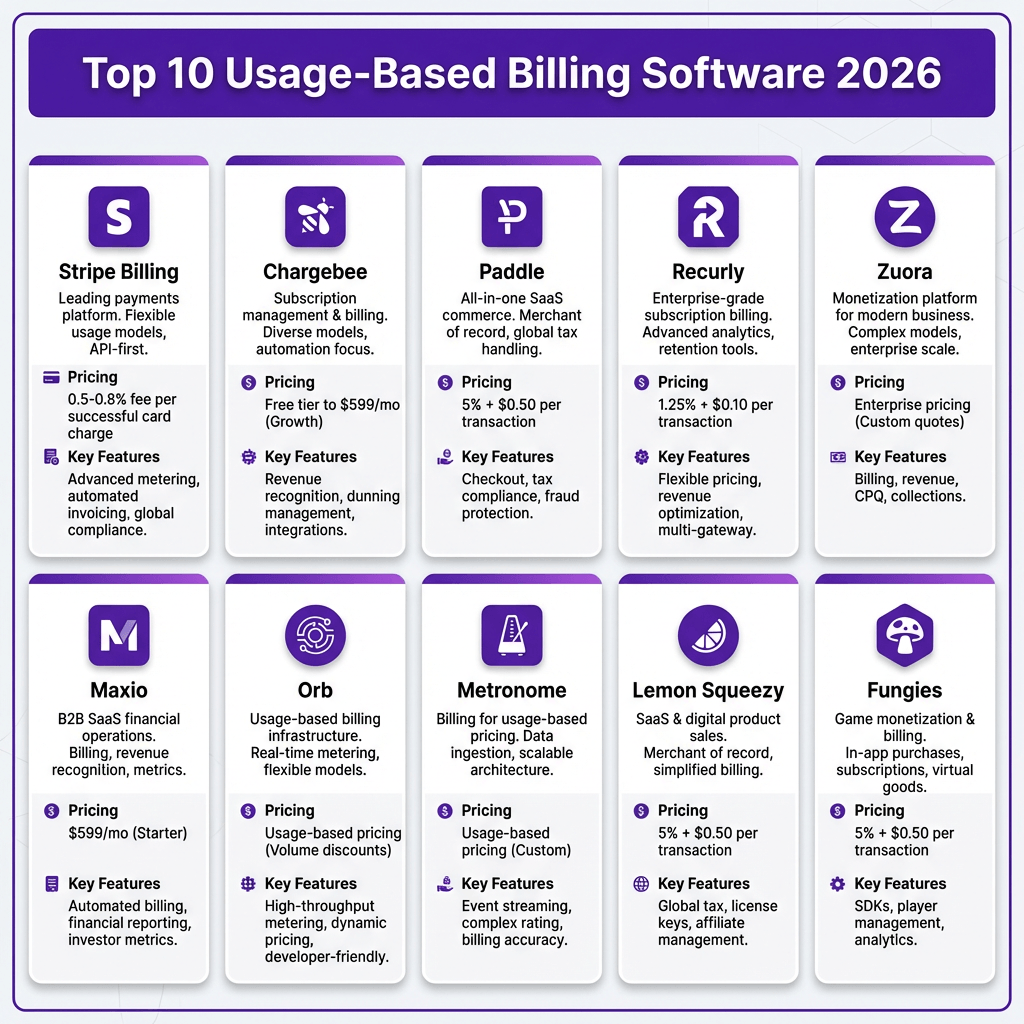
10 Best Usage-Based Billing Software for SaaS in 2026
I evaluated these platforms based on real-world factors: pricing transparency, usage metering capabilities, revenue recognition support, integration complexity, and how they handle the messy reality of hybrid billing models.
1. Stripe Billing — Best for Developer-Friendly Implementation
Stripe Billing is the default choice for many SaaS companies, and for good reason. If you’re already using Stripe for payments, adding billing is straightforward.
Key Features:
- Native support for usage-based, subscription, and hybrid pricing
- Robust API with excellent documentation
- Built-in invoicing and dunning management
- 140+ currency support
- Stripe Tax integration for global compliance
Pricing: 0.5% on recurring charges (Starter) or 0.8% (Scale). Payment processing is separate at 2.9% + $0.30.
Best for: Technical teams that want maximum flexibility and don’t mind managing tax compliance separately.
2. Chargebee — Best for Subscription-First with Usage Add-ons
Chargebee has been around since 2011 and handles the full subscription lifecycle well. Their usage billing is solid if you’re layering metered charges on top of subscription plans.
Key Features:
- Tiered, volume, and overage pricing models
- Automated revenue recognition
- Built-in dunning and churn reduction tools
- CPQ integration for complex B2B quotes
- Multi-entity support for global operations
Pricing: Free up to $250K in lifetime billing. Performance plan at $599/month for up to $100K MRR (0.75% overage). Enterprise is custom.
Best for: B2B SaaS companies with established subscription revenue adding usage-based components.
3. Paddle — Best All-in-One with Tax Compliance
Paddle acts as your Merchant of Record, which means they handle VAT, sales tax, GST, and regulatory compliance globally. That’s a massive time-saver if you sell internationally.
Key Features:
- Full Merchant of Record (tax compliance included)
- Subscription and usage-based billing
- Fraud protection and chargeback handling
- Checkout localization (25+ languages)
- Built-in analytics and retention tools
Pricing: 5% + $0.50 per transaction. No monthly fees.
Best for: Global SaaS companies that want to outsource tax compliance entirely.
4. Recurly — Best for Enterprise Retention
Recurly has processed over $100 billion in subscription revenue and specializes in reducing churn. Their machine learning models for payment recovery are genuinely impressive.
Key Features:
- AI-driven revenue optimization
- Advanced dunning management
- Subscription lifecycle automation
- Revenue recognition support
- Plan versioning and grandfathering
Pricing: 1.25% + $0.10 per transaction plus base subscription cost. Custom pricing for enterprise.
Best for: Companies where retention and failed payment recovery are top priorities.
5. Zuora — Best for Enterprise Complexity
Zuora powers billing for Zoom, DocuSign, Box, and other enterprise giants. If you need to handle multi-year contracts, complex ramp pricing, and global subsidiaries, Zuora delivers.
Key Features:
- Enterprise-grade subscription management
- Multi-attribute pricing models
- Revenue recognition automation
- Global tax and currency support
- Deep ERP integrations (NetSuite, SAP)
Pricing: Custom enterprise pricing. No public rates — expect significant implementation costs.
Best for: Large enterprises with complex billing requirements and dedicated finance teams.
6. Maxio (formerly SaaSOptics + Chargify) — Best for B2B SaaS Finance Teams
Maxio combines billing from Chargify with financial operations from SaaSOptics. The result is a platform built specifically for SaaS finance teams who need audit-ready reporting.
Key Features:
- GAAP-compliant revenue recognition
- SaaS metrics and analytics
- Subscription and usage billing
- ASC 606 compliance built-in
- Drillable financial reports
Pricing: Free tier available. Grow plan at $599/month for up to $100K monthly billings. Enterprise is custom.
Best for: B2B SaaS companies preparing for audits or IPO with strict compliance requirements.
7. Orb — Best for Pricing Agility
Orb is newer to the market but built specifically for teams that need to iterate on pricing quickly. Their “RevGraph” architecture decouples usage data from pricing logic.
Key Features:
- Raw event architecture for complex metering
- Plan versioning without code changes
- Multi-dimensional pricing (credits, thresholds, tiers)
- Revenue recognition support
- Native invoicing
Pricing: Usage-based pricing based on billable events. Contact for specific rates.
Best for: Fast-moving SaaS and AI companies that experiment with pricing frequently.
8. Metronome — Best for High-Volume Usage
Metronome processed 8x more revenue in 2024 than the previous year. They’re built from the ground up for pure usage-based pricing at scale.
Key Features:
- Real-time usage dashboards for customers
- Flexible pricing model configuration
- Credit and prepaid balance support
- Usage alerting and thresholds
- Enterprise-grade security
Pricing: Usage-based. Custom pricing based on volume.
Best for: Infrastructure, AI, and API companies with high event volumes.
9. Lemon Squeezy — Best for Digital Products
Lemon Squeezy started as a platform for digital creators but has expanded into SaaS billing. Like Paddle, they’re a Merchant of Record.
Key Features:
- Merchant of Record (tax compliance included)
- Digital product and SaaS billing
- Affiliate marketing built-in
- Email marketing integration
- Simple, clean checkout experience
Pricing: 5% + $0.50 per transaction. No monthly fees.
Best for: Indie hackers and digital product sellers wanting simplicity over advanced features.
10. Fungies — Best Value Merchant of Record
Full disclosure: I work with Fungies. But here’s why they made this list. Most Merchant of Record platforms charge 5% + $0.50. Fungies offers the same tax compliance and global coverage at 5% + $0.50 with a developer-friendly API and no-code checkout options.
Key Features:
- Merchant of Record (global tax compliance)
- Subscription and usage-based billing
- No-code checkout builder
- REST API and webhooks
- Digital product and SaaS support
Pricing: 5% + $0.50 per transaction. No monthly fees, no hidden charges.
Best for: SaaS and digital product companies wanting Merchant of Record protection with competitive fees.
Usage-Based Billing Software Comparison Table
| Platform | Best For | Pricing | Merchant of Record |
|---|---|---|---|
| Stripe Billing | Developer flexibility | 0.5-0.8% + 2.9% + $0.30 | No |
| Chargebee | Subscription + usage | Free-$599/mo + 0.75% | No |
| Paddle | Global tax compliance | 5% + $0.50 | Yes |
| Recurly | Retention & recovery | 1.25% + $0.10 + base | No |
| Zuora | Enterprise complexity | Custom | No |
| Maxio | Finance & compliance | $599/mo+ | No |
| Orb | Pricing agility | Usage-based | No |
| Metronome | High-volume usage | Usage-based | No |
| Lemon Squeezy | Digital products | 5% + $0.50 | Yes |
| Fungies | Value MoR | 5% + $0.50 | Yes |
How to Choose the Right Usage-Based Billing Software
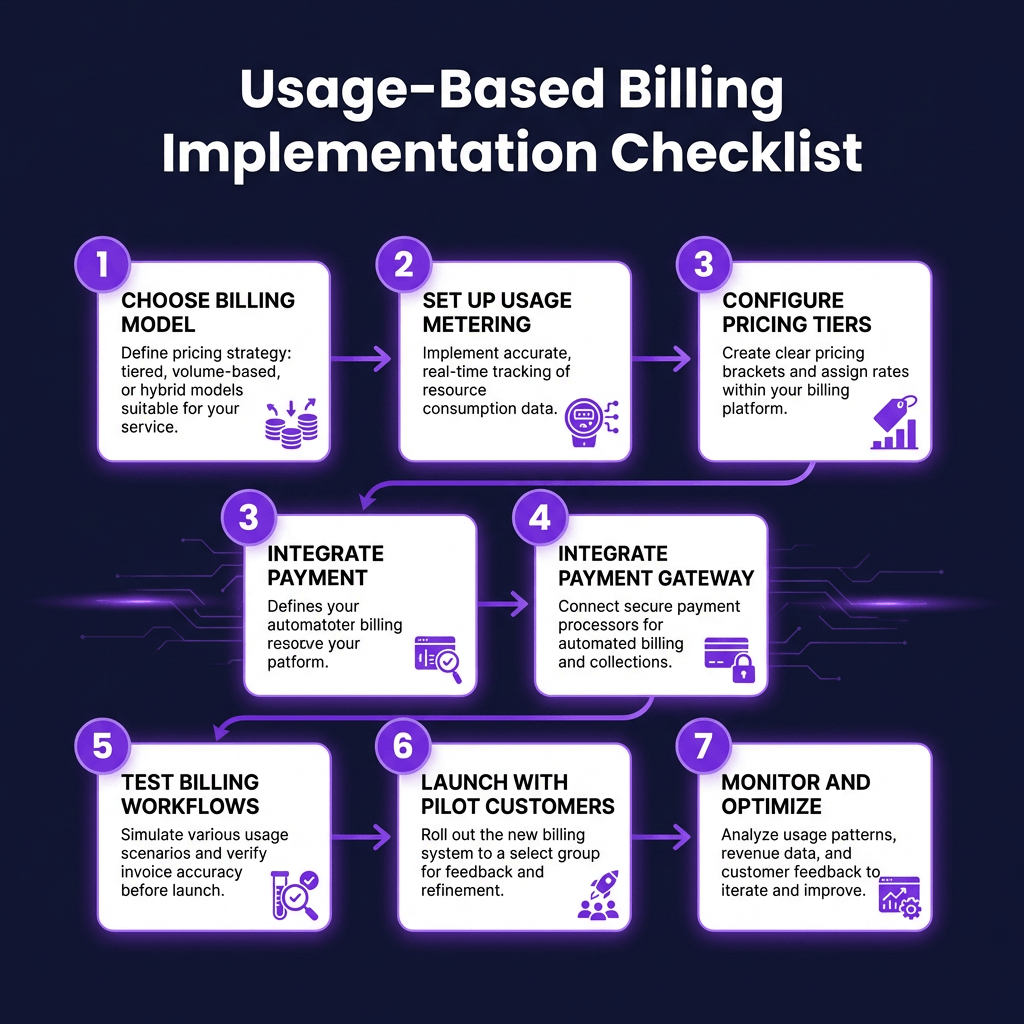
Picking a billing platform isn’t just about features. It’s about matching the tool to your business model, team capabilities, and growth stage. Here’s my decision framework:
If You Need Tax Compliance Handled
Go with Paddle, Lemon Squeezy, or Fungies. These Merchant of Record platforms handle VAT, sales tax, and GST automatically. The 5% fee is higher than Stripe’s base rate, but once you factor in tax software costs and accountant time, it’s often a wash.
If You’re Developer-Heavy
Stripe Billing or Orb. Both have excellent APIs and documentation. You’ll need to handle tax compliance separately (Stripe Tax or Avalara), but you get maximum flexibility.
If You’re Preparing for Audit or IPO
Maxio or Zuora. These platforms have built-in ASC 606 revenue recognition and audit-ready reporting. Finance teams love them. Engineers… tolerate them.
If You Change Pricing Frequently
Orb. Their plan versioning and pricing experimentation features are genuinely best-in-class. You can test new pricing on customer segments without engineering deploys.
Common Implementation Pitfalls
I’ve seen companies mess up usage-based billing implementations. Here are the mistakes to avoid:
1. Not Defining Usage Metrics Clearly
“API calls” sounds simple until you realize you need to distinguish between cached and uncached requests, or handle retries differently. Define your metering logic before you write any code.
2. Ignoring Revenue Recognition
Usage-based revenue is recognized as the service is delivered. This creates complexity for ASC 606 compliance. Make sure your platform can handle this or you’ll have accounting headaches.
3. Surprise Billing
Nothing kills customer trust like an unexpected $5,000 bill. Implement usage alerts, spending caps, and clear dashboards so customers can monitor their consumption.
4. Choosing Based on Current Volume
That free tier looks great now, but what happens when you hit $250K in billing? Migration is painful. Choose a platform that can scale with you for at least 2-3 years.
FAQ: Usage-Based Billing Software
What’s the difference between usage-based and metered billing?
They’re essentially the same thing. Usage-based billing, metered billing, and consumption billing all refer to charging customers based on actual product usage rather than flat fees. The terms are used interchangeably in the industry.
Can I combine usage-based and subscription billing?
Absolutely. This is called hybrid pricing, and it’s what most successful SaaS companies use. You charge a base subscription fee plus usage overages. Think AWS — you pay for reserved instances (subscription) plus data transfer (usage).
Do I need a Merchant of Record for usage-based billing?
Not technically, but it helps. A Merchant of Record handles tax compliance, fraud protection, and regulatory requirements. If you sell globally, the complexity of VAT and sales tax compliance often justifies the higher transaction fees.
How do I handle revenue recognition for usage-based billing?
Under ASC 606, usage-based revenue is recognized as the service is delivered. This differs from subscription revenue which is recognized ratably over the contract term. Platforms like Maxio, Zuora, and Chargebee have built-in revenue recognition for these scenarios.
Is usage-based billing better for reducing churn?
In my experience, yes. When customers pay based on value received, they’re less likely to cancel during low-usage periods. The flip side is revenue predictability becomes harder. You’ll need strong forecasting processes.
Final Thoughts
Usage-based billing isn’t a silver bullet, but it’s becoming table stakes for SaaS in 2026. The key is choosing software that matches your team’s capabilities and your customers’ expectations.
If you’re just getting started, I’d recommend testing the waters with a hybrid model. Keep your base subscription for predictability, add usage-based components for expansion revenue.
And if you want to explore Merchant of Record options without the complexity, check out Fungies. The no-code checkout builder gets you up and running fast, and the API gives you flexibility as you scale.
Sources
- Maxio 2025 SaaS Pricing Trends Report
- Metronome State of Usage-Based Pricing 2025
- Orb Usage Billing Software Comparison
- UniBee Usage-Based Billing Software Guide
- Stripe Billing Pricing
- Paddle Pricing
- Recurly Pricing
- Maxio Billing Features
\n