Community-Led Growth for SaaS: The Complete 2026 Guide to Building Your User Ecosystem
Community-led growth reduces CAC by 30-60% for SaaS companies. Learn the 5-step framework Figma, Notion, and HubSpot used to build thriving user communities that drive acquisition and retention.
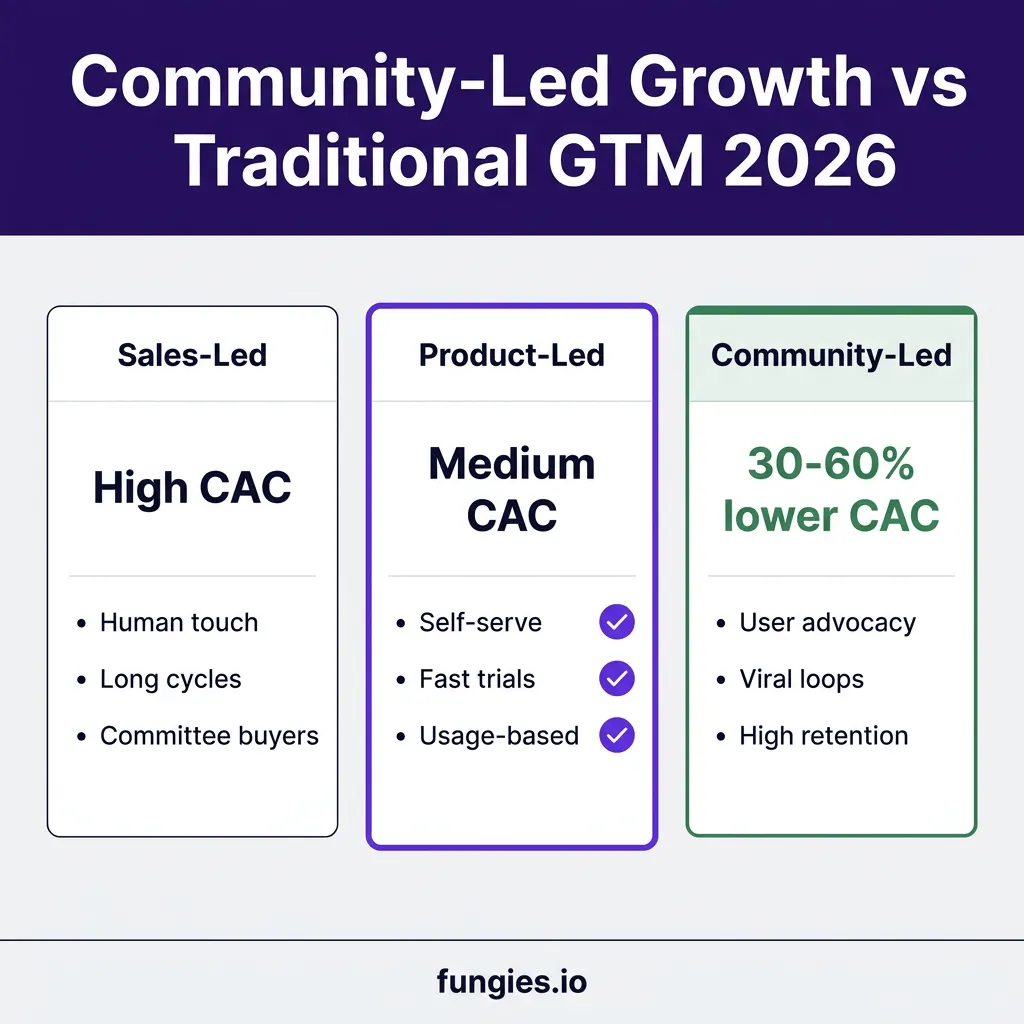
Here’s a stat that should make every SaaS founder pause: community-led growth reduces customer acquisition cost by 30-60% compared to traditional sales and paid marketing channels. Notion’s CRO Olivia Nottebohm calls it the “100-foot wave for SaaS entrepreneurs” — and she’s not exaggerating.
In 2026, the most successful SaaS companies aren’t just building products. They’re building movements. Figma didn’t just create a design tool — they built a community of 4+ million designers sharing templates and plugins. Notion didn’t just ship a note-taking app — they cultivated an ecosystem where users create templates that drive millions in organic acquisition.
What Is Community-Led Growth?
Community-led growth (CLG) is a go-to-market strategy where your users, customers, and advocates become your primary growth engine. Instead of relying solely on paid ads or sales teams, you build an ecosystem where members drive acquisition, retention, and expansion for you.
Honestly? Most SaaS companies get this wrong. They think adding a Discord server or a forum counts as “community.” It doesn’t. Real community-led growth means your community is woven into every stage of the customer journey — from first touch to advocacy.
Here’s what makes CLG different from other growth motions:
- Sales-led growth asks: “How many demos can we book this month?”
- Product-led growth asks: “How fast can users experience value?”
- Community-led growth asks: “How deeply can we connect users to each other and our mission?”
Why Community-Led Growth Matters More Than Ever
The SaaS landscape has shifted dramatically. CAC payback periods have stretched to 18 months on average. Buyers are increasingly skeptical of traditional marketing. And word-of-mouth has become the most trusted acquisition channel — with 92% of consumers trusting recommendations from people they know over any form of advertising.
In my experience running paid campaigns across multiple channels, I’ve watched CPCs climb while conversion rates stagnate. Meanwhile, companies with strong communities are seeing the opposite: lower acquisition costs, higher retention rates, and organic growth that compounds over time.
The data backs this up:
- Companies with engaged communities see 2-3x higher net revenue retention
- Community members have 40% lower churn than non-community users
- User-generated content from communities drives 400% more leads than traditional content marketing
- 58% of B2B SaaS companies now report having a product-led growth motion, with 91% planning to increase investment
The 3 Pillars of Community-Led Growth
Before diving into tactics, you need to understand the foundation. Community-led growth stands on three pillars:
1. Shared Purpose
Your community needs a reason to exist beyond your product. Notion’s community isn’t about note-taking — it’s about “building tools that make people more productive.” Figma’s community isn’t about design software — it’s about “making design accessible to everyone.”
This matters because purpose creates emotional investment. Users who feel part of a mission stick around longer and advocate harder.
2. Mutual Value Exchange
Healthy communities aren’t one-way streets. Members need to get value, not just give it. This could be:
- Access to exclusive content or features
- Networking with peers in their industry
- Recognition and status within the community
- Direct input on product roadmap
- Early access to beta features
3. Distributed Ownership
The best communities don’t feel company-owned. They feel member-owned. Figma’s community features 4+ million user-created resources. Notion’s template gallery has thousands of community submissions. When users create value for other users, the flywheel spins without your constant input.
Community-Led Growth in Action: 5 SaaS Companies Doing It Right
Theory is nice, but execution is everything. Let’s look at five SaaS companies that have mastered community-led growth:
1. Figma: The Template Economy
Figma’s community isn’t an afterthought — it’s core to their product. With over 4 million community files, templates, and plugins, Figma turned their users into content creators. When a designer publishes a template that gets 50,000 views, they’re not just using Figma — they’re marketing it.
The genius? Every template created is a new entry point into Figma. Someone searching for “iOS wireframe template” finds a Figma community file, creates an account to use it, and becomes a user.
2. Notion: The Template Revolution
Notion launched their template gallery in 2019, two years after launch. Today, it’s a massive growth engine. Users create templates for everything — from personal task management to company wikis to startup operating systems.
These templates spread organically. A founder shares their “Startup OS” template on Twitter. Their followers duplicate it. Some convert to paid plans. The creator gets recognition. Everyone wins.
3. Duolingo: Gamification Meets Community
Duolingo’s 34 million monthly active users aren’t just learning languages — they’re competing on leaderboards, joining clubs, and sharing streaks on social media. The community features create accountability loops that boost retention.
Their “Leagues” feature turns learning into a competition. Users don’t want to break their streak because they’ll lose status in their community. This drives daily active usage that pure utility never could.
4. HubSpot: Education as Community
HubSpot’s Academy has trained over 450,000 marketers. Their certification programs create a community of HubSpot-educated professionals who bring HubSpot methodology (and often HubSpot software) to every company they join.
This is long-term thinking. A marketer gets certified today, changes jobs three times over the next decade, and recommends HubSpot at every stop.
5. Discord: The Platform for Communities
Discord built the infrastructure that powers thousands of SaaS communities. Their own community — the Discord Developers server — has over 200,000 members. Bot developers build on Discord’s API, creating integrations that make Discord more valuable, which attracts more users, which attracts more developers.
It’s the ultimate platform play: the community creates the value that attracts more community.
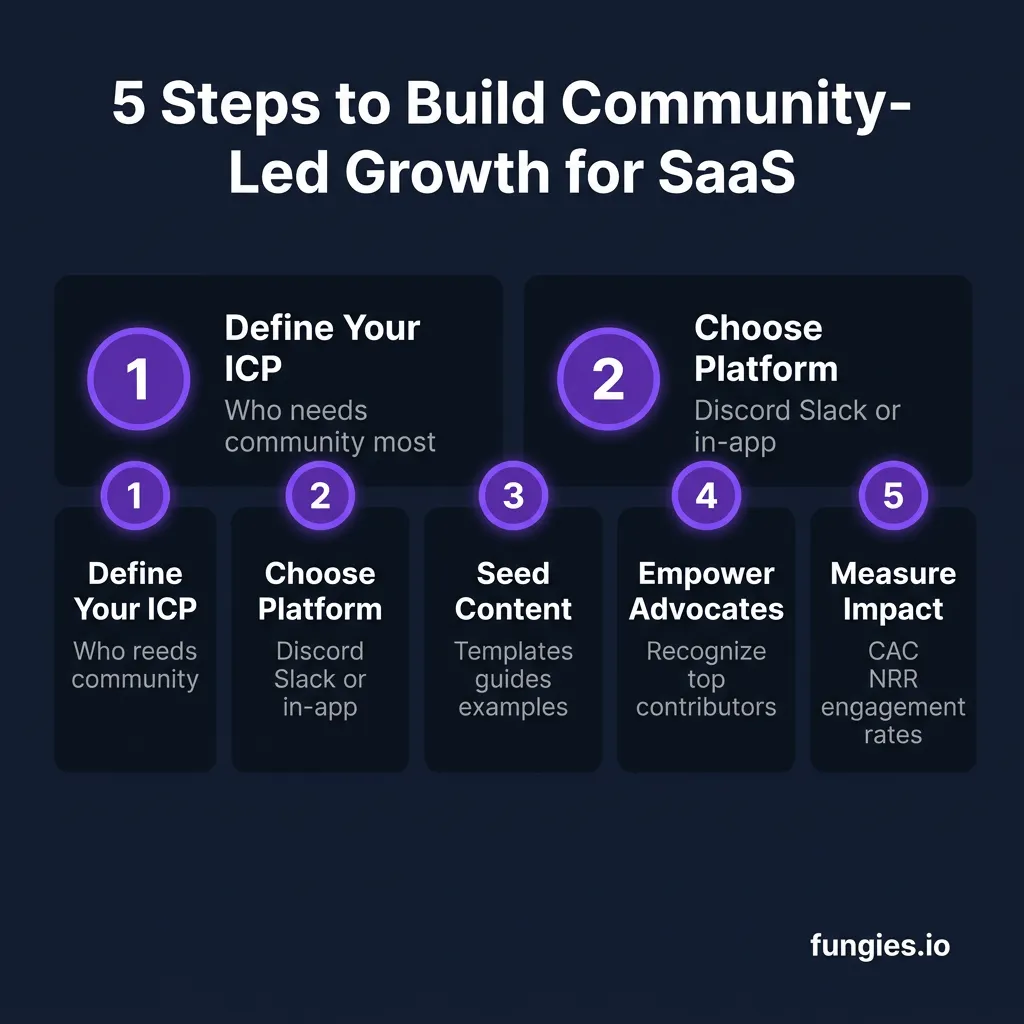
How to Build a Community-Led Growth Strategy: The 5-Step Framework
Ready to build your own community-led growth engine? Here’s the framework that works:
Step 1: Define Your Ideal Community Member
Before you choose a platform or create content, get crystal clear on who you’re building for. Your ideal community member (ICM) is more specific than your ICP. Ask:
- What problems are they trying to solve?
- What communities do they already participate in?
- What would make them actively contribute vs. just consume?
- What recognition or status matters to them?
Figma’s ICM is designers who want to share their work and learn from others. Notion’s ICM is productivity enthusiasts who love building systems. Get this wrong, and everything else fails.
Step 2: Choose Your Platform Strategy
Where you build matters. Here are the main options:
| Platform | Best For | Pros | Cons |
|---|---|---|---|
| Discord | Real-time chat, gaming, dev tools | Free, familiar to users, great for engagement | Can feel chaotic, hard to search |
| Slack | B2B SaaS, professional communities | Work-adjacent, good for async | Expensive at scale, 90-day history limit |
| Circle/Bevy | Courses, paid communities | purpose-built, great UX | Paid, smaller user base |
| In-App | Product-embedded communities | Contextual, drives activation | High engineering cost |
| Organic discovery, support | Massive reach, free | Less control, unpredictable |
Most successful SaaS companies use a hybrid approach. They might have a Discord for real-time chat, a Circle for deeper discussions, and in-app community features for product-specific interactions.
Step 3: Seed Content and Early Members
Empty communities die. Before you launch publicly, seed 50-100 pieces of content and recruit 20-30 founding members. These early members set the tone.
Look for:
- Power users who already love your product
- Industry influencers with engaged followings
- Your most vocal supporters on social media
- Team members who can be active daily
Give these founding members special status — “Founding Member” badges, early access to features, direct line to your team. Make them feel like insiders.
Step 4: Create Systems for User-Generated Content
This is where the magic happens. You need systems that make it easy for users to create value for other users:
- Templates: Let users share their setups (Notion, Figma)
- Plugins/Integrations: Enable developers to extend your product (Figma, Discord)
- Showcases: Feature the best work created with your tool (Webflow, Framer)
- Educational Content: Let experts teach others (HubSpot Academy)
The key is making creation feel rewarding. Figma features top community files on their homepage. Notion highlights template creators. Recognition drives contribution.
Step 5: Measure What Matters
Community metrics aren’t just about engagement. They’re about business impact. Track:
| Metric | What It Tells You | Benchmark |
|---|---|---|
| Community-influenced Revenue | % of revenue from community members | 20-40% |
| Net Revenue Retention (NRR) | Revenue growth from existing customers | >110% for community members |
| Time-to-Value | How fast users reach “aha” moment | 30% faster with community |
| User-Generated Content Volume | Templates, posts, contributions | Growing 10%+ monthly |
| Advocacy Rate | % of users who refer others | >15% |
Don’t get distracted by vanity metrics like “total members” or “messages sent.” A community of 1,000 engaged members drives more growth than 100,000 lurkers.
Common Community-Led Growth Mistakes to Avoid
I’ve seen plenty of SaaS companies attempt community-led growth and fail. Here are the most common pitfalls:
Mistake 1: Building Before You Have Product-Market Fit
Community amplifies what already works. If your product doesn’t solve a real problem, a community won’t save it. Focus on finding 100 customers who love your product before investing heavily in community.
Mistake 2: Treating Community as Support
Communities aren’t just places to answer “How do I…?” questions. If that’s all you’re doing, you’re leaving massive value on the table. Community should drive acquisition and expansion, not just reduce support tickets.
Mistake 3: Launching and Ghosting
Communities need consistent care, especially in the first 12 months. You can’t launch a Discord server and check in once a month. Active community management is a real job that requires dedicated resources.
Mistake 4: Making It All About You
The fastest way to kill a community is to make it a megaphone for your marketing. Members can smell promotional content from a mile away. Lead with value, not product pitches.
Integrating Community-Led Growth with Your Existing GTM Motion
Community-led growth doesn’t replace your existing GTM — it amplifies it. Here’s how to integrate CLG with other motions:
CLG + Product-Led Growth
Your community becomes part of the product experience. Users discover templates created by the community during onboarding. They see what others have built and get inspired. The community accelerates time-to-value.
CLG + Sales-Led Growth
Your sales team uses community success stories in their outreach. Prospects join the community before talking to sales, warming themselves up. Your community becomes a pipeline generation engine.
CLG + Content Marketing
User-generated content from your community becomes source material for your blog, social media, and email campaigns. Your community members become content creators and distribution partners.
FAQ: Community-Led Growth for SaaS
How long does it take to see results from community-led growth?
Community-led growth is a long game. Most SaaS companies see meaningful results after 12-18 months of consistent investment. The first 6 months are about building foundation and culture. Revenue impact typically shows up in months 9-18.
What’s the minimum viable community size?
Research suggests you need at least 1,000 engaged community members to see significant CAC reduction. But “engaged” is the key word — 1,000 active members beats 100,000 lurkers.
Should we build our own platform or use existing ones?
Start with existing platforms (Discord, Circle, Slack) to validate your community strategy. Only build custom community features after you’ve proven demand and understand what your members need. Figma and Notion built custom features only after years of learning.
How do we prevent our community from becoming toxic?
Set clear community guidelines from day one. Appoint moderators from your founding members. Be proactive about addressing conflicts. And most importantly, model the behavior you want to see — your team sets the tone.
Can B2B SaaS companies use community-led growth?
Absolutely. In fact, B2B SaaS often sees the highest returns from CLG because the buying cycles are longer and trust matters more. HubSpot, Salesforce, and Gainsight all have thriving communities that drive significant revenue.
Conclusion: Start Building Your Community Today
Community-led growth isn’t a nice-to-have anymore — it’s becoming table stakes for SaaS companies that want sustainable, efficient growth. The companies winning in 2026 aren’t just acquiring customers; they’re cultivating advocates who acquire customers for them.
The best time to start building your community was yesterday. The second-best time is today. Start small, stay consistent, and focus on genuine value. Your future self — and your CAC metrics — will thank you.
Ready to scale your SaaS with lower acquisition costs? Join Fungies and let us handle the tax complexity while you focus on building your community and growing your business.