Game Monetization Guide 2026: Proven Strategies to Maximize Revenue
Master game monetization in 2026 with proven strategies. Learn about premium, freemium, subscription models, and optimization tactics to maximize your game revenue.
Game monetization is the lifeblood of the gaming industry. Whether you are an indie developer launching your first title or a studio scaling to millions of players, choosing the right monetization strategy can make or break your success. In 2026, the global gaming market is projected to exceed $200 billion, with mobile gaming leading the charge at over $90 billion annually. Understanding how to effectively monetize your game is no longer optional—it is essential for sustainable growth.
The landscape of game monetization has evolved dramatically over the past decade. Gone are the days when a simple one-time purchase was the only option. Today’s successful games employ sophisticated hybrid models that combine multiple revenue streams to maximize player lifetime value while maintaining engagement. From battle passes and season passes to cosmetic microtransactions and subscription tiers, the options are vast—but so are the pitfalls.
Understanding Game Monetization Models in 2026
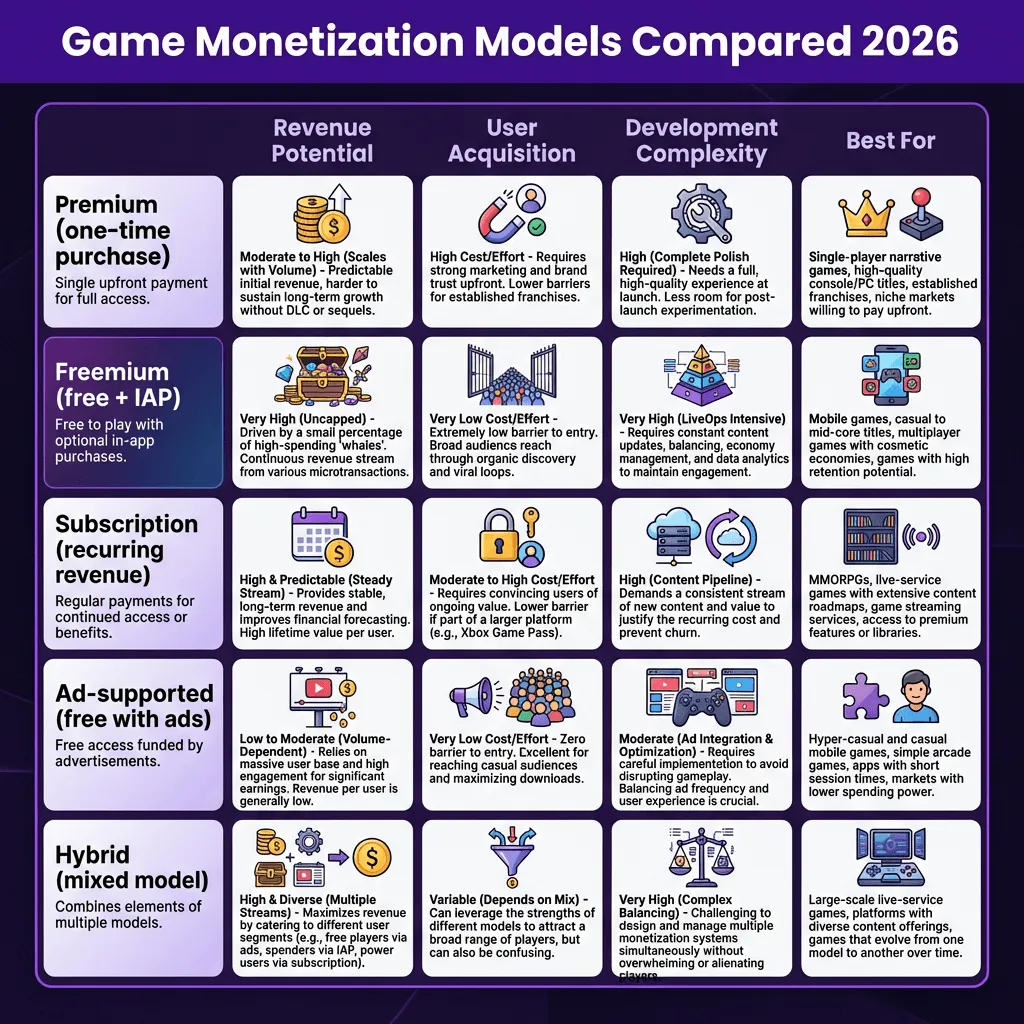
Before diving into specific strategies, it is crucial to understand the fundamental monetization models available to game developers. Each model has distinct advantages, challenges, and ideal use cases. The key is matching the right model to your game’s genre, target audience, and development resources.
Premium Model: The Traditional Approach
The premium model, also known as the pay-to-play model, requires players to purchase the game upfront before they can access any content. This traditional approach remains viable for certain genres, particularly single-player narrative experiences, AAA titles, and niche indie games with strong value propositions. Games like Elden Ring, Baldur’s Gate 3, and Hades have proven that players are willing to pay premium prices for high-quality experiences.
The advantages of the premium model are significant: predictable revenue, no need to design around monetization mechanics, and a focused development cycle. However, the barriers to entry are higher—players must be convinced to pay before experiencing the game, which requires substantial marketing investment and brand recognition. Additionally, premium games face intense competition from free-to-play alternatives that can capture player attention without upfront costs.
Freemium: The Gateway to Scale
Freemium games offer the core experience for free while charging for additional content, features, or conveniences. This model has become the dominant force in mobile gaming and is increasingly prevalent on PC and console platforms. The genius of freemium lies in its ability to remove barriers to entry—anyone can download and start playing immediately.
Successful freemium monetization relies on understanding player psychology and designing compelling value propositions. Cosmetic items, battle passes, convenience features, and progression boosters are common freemium offerings. The key is ensuring that paid content enhances rather than gates the core experience. Games like Fortnite, Genshin Impact, and League of Legends have mastered this balance, generating billions in revenue while maintaining positive player sentiment.
Subscription Model: Recurring Revenue
Subscription-based monetization provides players with ongoing access to content, features, or services for a recurring fee. This model has gained significant traction, with Xbox Game Pass, PlayStation Plus, and Apple Arcade demonstrating the power of subscription gaming. For developers, subscriptions offer predictable recurring revenue and stronger player retention compared to one-time purchases.
Implementing subscriptions within individual games typically involves offering premium tiers with exclusive benefits: ad-free experiences, bonus currency, exclusive cosmetics, early access to content, and special events. The challenge lies in continuously delivering value that justifies the ongoing cost. Successful subscription implementations require robust content pipelines and regular feature updates to maintain subscriber engagement.
Maximizing Revenue: Proven Strategies for 2026
Regardless of your chosen monetization model, certain strategies consistently drive revenue growth across the industry. These approaches are backed by data from thousands of successful games and represent best practices refined through years of A/B testing and market validation.
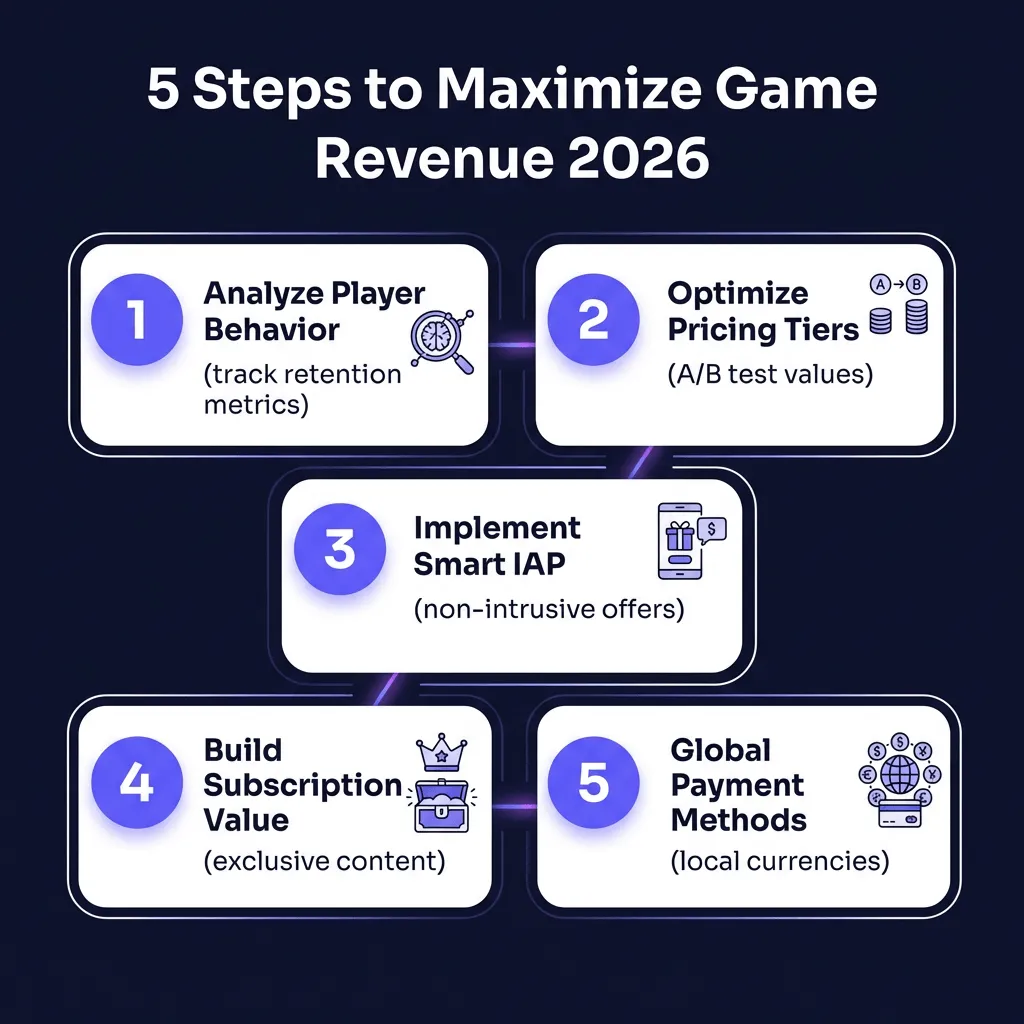
1. Analyze Player Behavior Deeply
Data is the foundation of effective monetization. Understanding when players are most engaged, what features they value, and where they encounter friction enables targeted optimization. Key metrics to track include daily active users (DAU), monthly active users (MAU), average revenue per user (ARPU), average revenue per paying user (ARPPU), conversion rate from free to paid, and player lifetime value (LTV).
Advanced analytics go beyond surface-level metrics. Cohort analysis reveals how different player segments behave over time. Funnel analysis identifies where players drop off in the purchase flow. A/B testing different price points, offer presentations, and timing can yield significant revenue improvements. The most successful developers treat monetization as a continuous optimization process rather than a set-and-forget system.
2. Optimize Pricing Tiers Strategically
Pricing psychology plays a crucial role in monetization success. The decoy effect, anchoring, and price bracketing are powerful tools when applied thoughtfully. Offering multiple price points—typically a low entry option, a mid-tier value option, and a premium option—caters to different willingness-to-pay levels while nudging players toward the middle tier.
Regional pricing is increasingly important as games reach global audiences. Purchasing power varies dramatically across markets, and localized pricing can significantly improve conversion rates in emerging markets. Dynamic pricing based on player behavior, purchase history, and engagement levels represents the cutting edge of monetization optimization, though it must be implemented carefully to avoid player backlash.
3. Implement Smart In-App Purchases
Not all in-app purchases are created equal. The most successful offerings tap into player motivations—status, progression, social connection, and self-expression—rather than simply gating content. Cosmetic items that allow players to express their identity consistently outperform pay-to-win mechanics in long-term revenue generation.
Battle passes have emerged as one of the most effective monetization mechanics of the decade. By offering a progression system with both free and premium rewards, battle passes create ongoing engagement while providing clear value. Limited-time offers, flash sales, and exclusive items leverage scarcity and FOMO (fear of missing out) to drive purchases. The key is balancing these mechanics with fair gameplay to maintain player trust.
4. Build Subscription Value Propositions
For games implementing subscriptions, the value proposition must be crystal clear and continuously reinforced. Successful subscription benefits include: removal of advertisements, daily login bonuses, exclusive cosmetic items, priority matchmaking, expanded storage or inventory, bonus experience or currency earnings, and access to subscriber-only events or content.
The subscription model works best when integrated into the core game loop rather than treated as an afterthought. Players should encounter subscription benefits naturally during gameplay, creating desire through demonstration rather than hard selling. Free trial periods, discounted first months, and loyalty rewards for long-term subscribers are proven tactics for improving subscription acquisition and retention.
5. Enable Global Payment Methods
Payment friction is a silent killer of monetization. Players who want to purchase but cannot complete transactions due to unsupported payment methods represent lost revenue. Supporting credit cards, PayPal, Apple Pay, Google Pay, and regional payment methods like iDEAL, Sofort, and Pix ensures maximum conversion across global markets.
Local currency display is equally important. Showing prices in the player’s native currency removes mental friction and builds trust. Tax compliance—handling VAT, sales tax, and other regional requirements—is a complex but essential component of global monetization. Solutions like Fungies.io handle this complexity automatically, allowing developers to focus on creating great games rather than navigating tax regulations.
Common Monetization Mistakes to Avoid
Even experienced developers fall into monetization traps that damage player relationships and long-term revenue. Understanding these pitfalls is as important as knowing best practices.
Pay-to-Win Mechanics
Selling gameplay advantages creates an uneven playing field that frustrates free players and devalues skill. While pay-to-win can generate short-term revenue, it typically leads to player exodus and negative reviews that harm long-term success. Competitive games especially suffer when monetization impacts gameplay balance.
Aggressive Monetization Timing
Asking for money before players have experienced the game’s value is a common mistake. The first purchase prompt should come after players have engaged meaningfully with the core experience and understand what they are paying for. Premature monetization attempts feel pushy and create negative first impressions.
Ignoring Player Feedback
Communities are vocal about monetization they perceive as unfair or exploitative. Dismissing these concerns damages brand reputation and player trust. Successful developers engage with community feedback, explain monetization decisions transparently, and adjust strategies based on player sentiment.
FAQ: Game Monetization Questions Answered
What is the most profitable game monetization model?
There is no universally “most profitable” model—it depends on your game genre, target audience, and development resources. Freemium with cosmetic microtransactions has proven most scalable for multiplayer games, while premium works well for narrative single-player experiences. Hybrid models combining multiple approaches often outperform single-model strategies.
How much should I charge for in-game items?
Pricing should reflect perceived value and target audience purchasing power. Cosmetic items typically range from $1-5 for small items to $20-50 for premium bundles. Battle passes usually cost $10-15 per season. Test different price points and analyze conversion rates to find the optimal balance for your specific audience.
When should I implement monetization in my game?
Monetization should be designed into your game from the beginning, not bolted on at the end. However, the first purchase prompt should appear only after players have experienced core gameplay and understand the value proposition—typically 15-30 minutes of engagement for mobile games, longer for PC/console experiences.
How do I handle taxes for global game sales?
Global tax compliance is complex, requiring registration, collection, and remittance of VAT, sales tax, and other regional taxes. Each jurisdiction has different thresholds, rates, and filing requirements. Using a Merchant of Record service like Fungies.io handles this complexity automatically, managing tax compliance across 190+ countries so you can focus on game development.
What percentage of players typically make purchases?
Conversion rates vary widely by genre and monetization model. Mobile freemium games typically see 1-5% of players making purchases, with top-performing games reaching 10% or higher. PC and console games with premium models see 100% conversion by definition. The key metric is not conversion rate alone but the combination of conversion rate and average revenue per paying user.
Conclusion: Building Sustainable Game Revenue
Game monetization in 2026 requires a sophisticated approach that balances revenue generation with player satisfaction. The most successful developers view monetization not as extracting maximum value from each player, but as creating sustainable ecosystems where players willingly invest in experiences they love.
Start by choosing a monetization model that fits your game’s design and audience. Implement analytics to understand player behavior deeply. Optimize pricing and offers based on data. Build subscription value that players genuinely want. And ensure global payment support with proper tax compliance to capture revenue from every market.
Remember: the best monetization is invisible to players. When done right, purchasing feels like a natural extension of enjoying the game rather than an interruption. Focus on creating value first, and revenue will follow.
Ready to Maximize Your Game Revenue?
Join hundreds of game developers using Fungies.io — automated global payments, tax compliance handled, and 50+ payment methods for your players.
No credit card required