Setting Up Global SaaS Billing with Tax Compliance: A Step-by-Step Guide
Here’s a fact most SaaS founders discover too late: the moment you accept your first payment from a customer in Germany, France, or Canada, you’re legally required to collect and remit VAT or GST — even if you’ve never heard of OSS registration. Get it wrong, and you’re looking at back taxes, interest, and penalties
Here’s a fact most SaaS founders discover too late: the moment you accept your first payment from a customer in Germany, France, or Canada, you’re legally required to collect and remit VAT or GST — even if you’ve never heard of OSS registration. Get it wrong, and you’re looking at back taxes, interest, and penalties that can wipe out months of revenue.
Setting up global SaaS billing with proper tax compliance isn’t optional. It’s the infrastructure decision that determines whether international expansion is smooth or painful. This guide walks you through exactly how to do it — the right way.
What Global SaaS Billing Compliance Actually Means
Global billing compliance for SaaS means your system correctly identifies, calculates, collects, and remits consumption taxes (VAT, GST, US sales tax) in every jurisdiction where your customers are located — not where your company is incorporated.
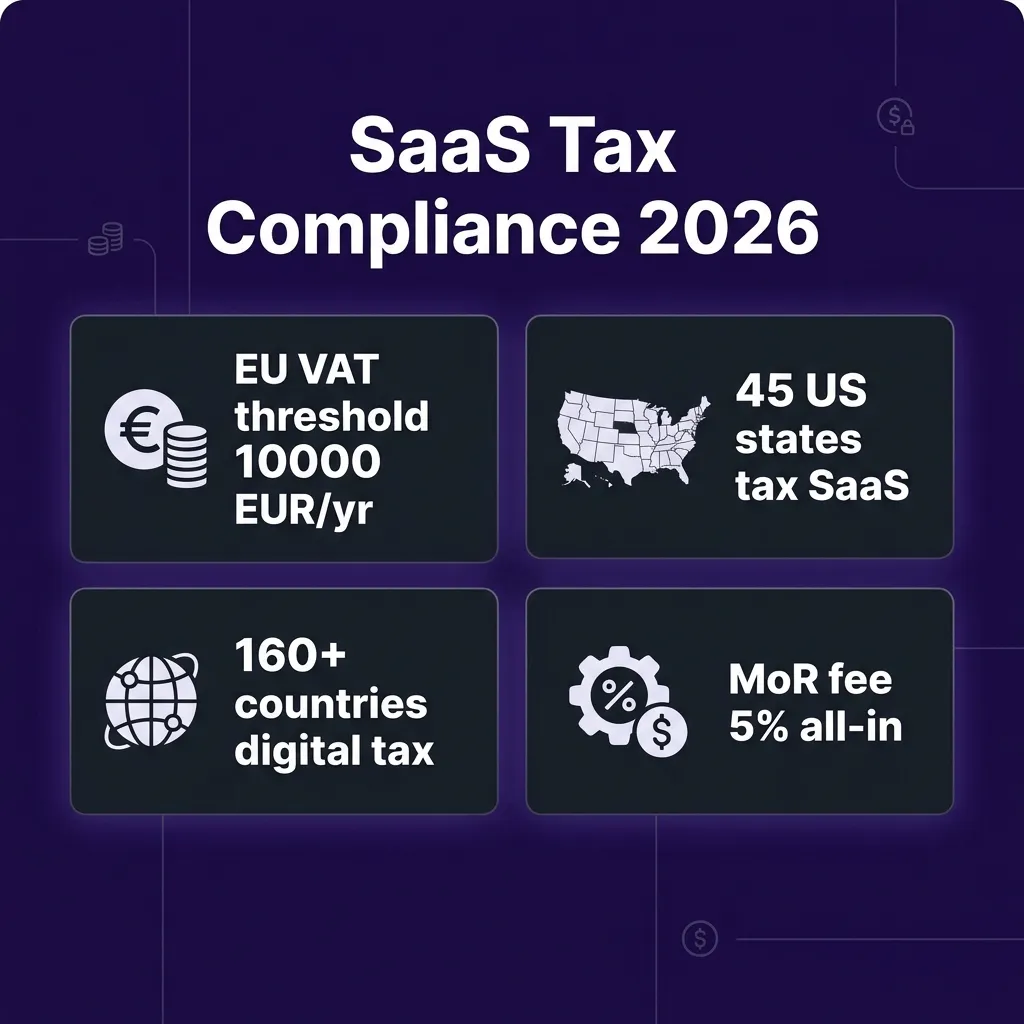
The rules changed dramatically over the last decade. Pre-2015, a US-based SaaS company could largely ignore EU VAT. Not anymore. Since the EU’s 2015 digital services VAT rules and the 2019 threshold update, you owe VAT in each EU customer’s country once your cross-border B2C sales exceed €10,000 per year. That’s one mid-sized customer in France and you’re already close.
In the US, it’s a different mess: 45 states tax SaaS (with varying definitions), and the 2018 South Dakota v. Wayfair Supreme Court ruling means economic nexus applies nationally — no physical presence required. Over 160 countries now have some form of digital services tax.
The math is brutal if you try to handle this yourself. A reasonable estimate for DIY compliance infrastructure runs $15,000–$40,000 per year in tax software, accountant fees, and engineering time. That’s before your first audit.
The Two Approaches: MoR vs. DIY Compliance Stack
When it comes to global SaaS billing, you have two realistic paths. Understanding the trade-offs upfront will save you a lot of backtracking.
Option A: Merchant of Record (MoR)
A Merchant of Record is the legal entity that appears on your customer’s credit card statement. When you use an MoR platform like Fungies, Paddle, or FastSpring, that platform becomes the seller of record — they collect payment, calculate and remit taxes, handle chargebacks, and take on the legal compliance liability.
For most indie SaaS founders and small teams, this is the correct default. One integration replaces an entire compliance department.
Option B: DIY Compliance Stack
The alternative is using a payment processor (Stripe, Braintree) and bolting on tax compliance software (Anrok, Avalara, TaxJar). This gives you more pricing control and slightly lower fees at high volume, but you own the compliance liability.
At scale (>$500K ARR) with a dedicated finance team, this can make sense. For everyone else, it’s usually overkill that creates operational drag.
| Approach | Who owns tax liability | Upfront complexity | Ongoing maintenance | Best for |
|---|---|---|---|---|
| Merchant of Record | MoR platform | Low (1-3 days to integrate) | Minimal | Startups, indie SaaS, teams <10 |
| DIY (Stripe + Anrok) | You | High (weeks to months) | Ongoing — law changes, new nexus | Enterprise, >$500K ARR with finance team |
| Hybrid (Stripe + MoR for intl) | Split | Medium | Medium | US-heavy SaaS expanding globally |
Step 1: Audit Your Current Tax Exposure
Before you choose a platform or write a line of integration code, you need to know where you’re already exposed. Run through this checklist:
Map your customer geography. Pull a report from Stripe (or wherever you process payments) broken down by customer country and US state. You want to see: Where are your paying customers? What’s your revenue concentration by jurisdiction?
Check EU VAT thresholds. If your cross-border B2C EU revenue is above €10,000 per year, you’re required to register for the EU’s One-Stop Shop (OSS) scheme and charge VAT at each customer’s local rate (Germany 19%, France 20%, Denmark 25%, etc.). Below €10,000, you can charge your home country’s rate.
Check US economic nexus. Most states use a $100,000/year or 200 transactions threshold. If you’ve crossed that in any state, you’re required to collect sales tax there. With SaaS specifically, check whether the state taxes “software as a service” — most do in 2026, but a handful still don’t.
Check UK post-Brexit rules. UK VAT is separate from the EU OSS system. If you have UK customers, you need to register separately for UK VAT once you exceed £85,000 in UK revenue.
This audit takes a few hours but it tells you exactly how complex your situation is — and which MoR platform’s geographic coverage matters most for you.
Step 2: Choose Your MoR Platform
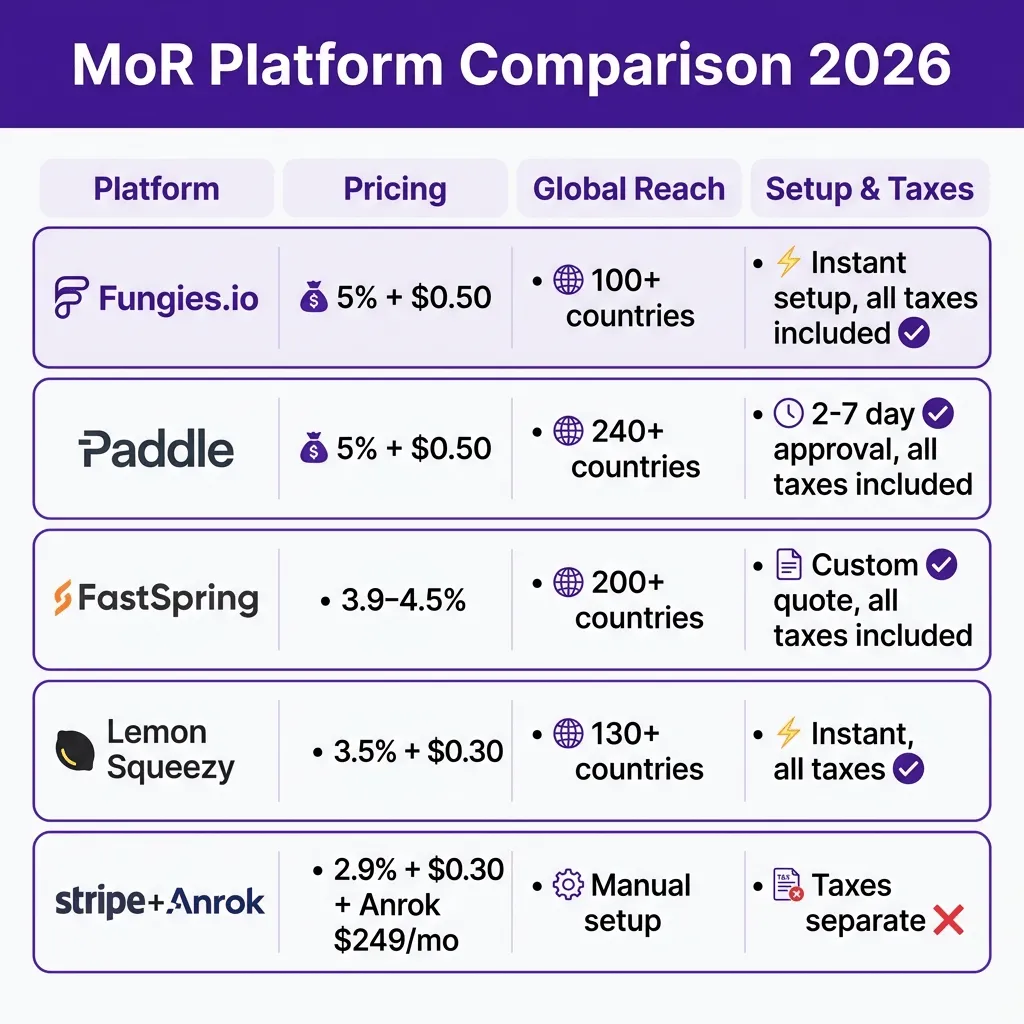
If you’ve decided to go the MoR route (smart choice for most teams), here’s how the main options stack up as of mid-2026:
| Platform | Fee | Countries | Approval time | Best for |
|---|---|---|---|---|
| Fungies.io | 5% + $0.50/transaction | 100+ | Same day | Indie SaaS, AI apps, digital products |
| Paddle | 5% + $0.50/transaction | 240+ | 2–7 days | Mid-market SaaS, subscription-heavy |
| FastSpring | 3.9–4.5% (custom) | 200+ | Custom quote | Enterprise software, high volume |
| Lemon Squeezy | 3.5% + $0.30/transaction | 130+ | Instant | Creators, digital downloads, plugins |
| Dodo Payments | Contact for pricing | 150+ | 1–3 days | Emerging market expansion |
A few notes on these options:
Fungies is the fastest to get running and has no monthly fees or minimums. If you’re building an AI app or digital product and want to be live in a day, it’s the fastest path. The 5% fee includes tax handling, fraud protection, and chargebacks — nothing extra.
Paddle has the deepest geographic coverage (240+ countries) and the most mature API. If global reach is your primary concern and you can handle a 2–7 day approval process, Paddle is solid.
FastSpring is geared toward larger software companies. Custom pricing means lower rates at volume, but their UX and onboarding are more enterprise-oriented. Not a fast start.
Note on Lemon Squeezy: After their Stripe acquisition, there’s ongoing uncertainty about platform direction. Many Lemon Squeezy users have migrated to Fungies or Paddle as a hedge against potential changes to the platform’s MoR status.
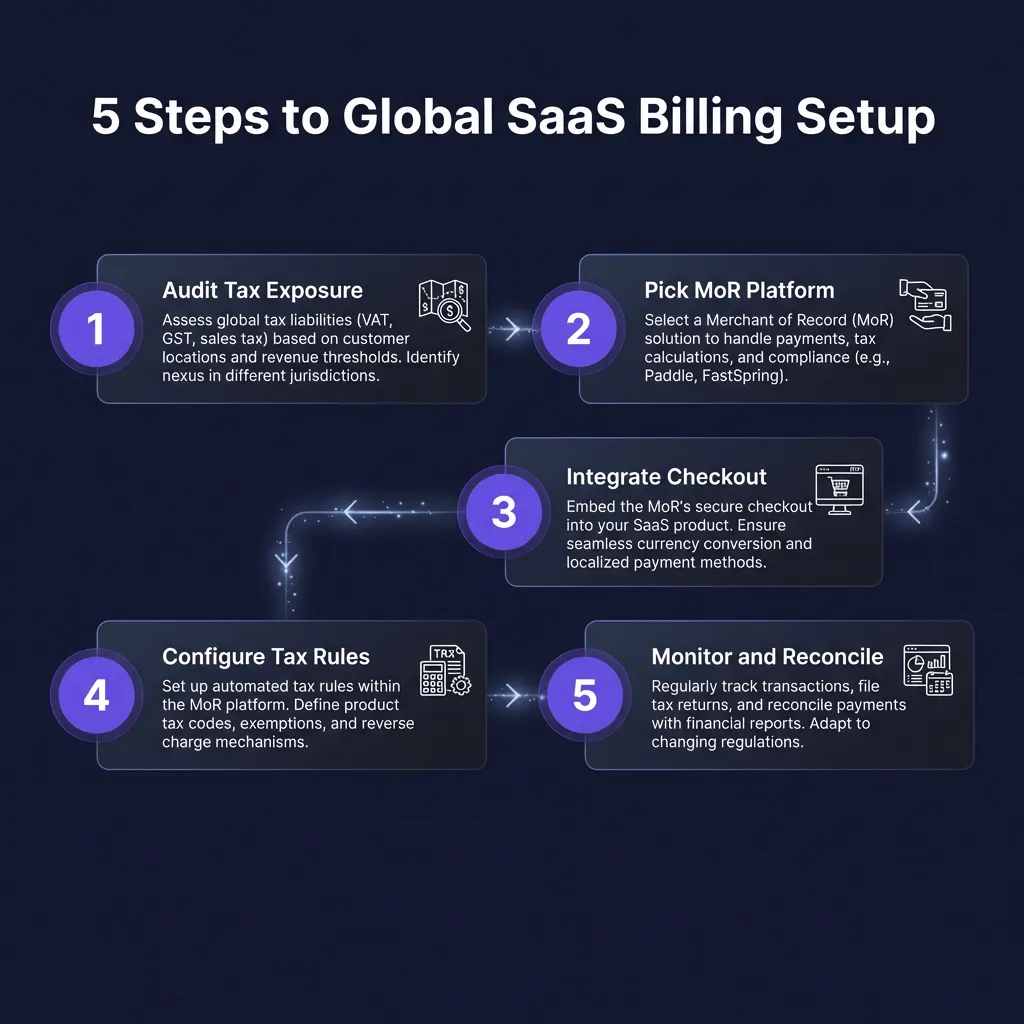
Step 3: Integrate Your Checkout
The integration approach depends on your product — but for most SaaS companies, you have three choices: hosted checkout, embedded checkout, or API-driven checkout.
Hosted Checkout (Easiest)
The MoR platform hosts the checkout page on their domain. You redirect customers there. Takes about an hour to set up. Works for MVPs and early-stage products. The downside: it’s a separate domain, which can create friction and slightly reduces conversion.
All the major MoR platforms support this out of the box.
Embedded Checkout (Best for Conversion)
You embed the checkout inside your app using JavaScript. The payment form appears within your UI — same domain, seamless experience. Fungies and Paddle both support this well. Integration typically takes 1–3 days.
For SaaS specifically, embedded checkout typically outperforms hosted checkout by 10–20% in conversion because customers never leave your product.
API-Driven Checkout
You build the UI yourself and call the MoR’s API to process payments. Maximum flexibility, but you’re responsible for PCI compliance on the form rendering. Typically only worth it for teams with dedicated engineering resources.
Sandbox Testing Checklist
Before you go live, run through these scenarios in the sandbox:
- Successful payment with a US card
- Successful payment with a European card (verify VAT is being collected)
- Failed payment / card decline
- B2B purchase with a valid EU VAT number (should be zero-rated)
- Refund flow
- Subscription renewal cycle
- Webhook delivery and idempotency (test duplicate events)
Step 4: Configure Tax Behavior for B2B vs. B2C
This is where most founders trip up. The tax rules are fundamentally different depending on whether you’re selling to businesses or consumers.
B2C (consumer) sales: You collect VAT at the customer’s local rate. No exceptions. A German consumer buying your app owes 19% German VAT. You collect it, the MoR remits it.
B2B (business) sales in the EU: If the purchasing business provides a valid EU VAT number, the sale is zero-rated under the reverse charge mechanism. The buyer accounts for VAT on their end. Your MoR should handle VAT number validation automatically — but you need to make sure you’re collecting VAT numbers at checkout.
US B2B sales: Not the same as EU. US businesses aren’t automatically exempt from sales tax. Some states have exemption certificates; most don’t. Your MoR should manage this, but check what exemption certificate flows they support if you’re selling to US enterprises.
In your MoR platform settings, configure:
- Enable B2B checkout flow (shows VAT number field)
- Set product tax category correctly (SaaS/software is often a different category than digital downloads or e-books)
- Configure reduced/zero rates where applicable (e.g., educational software often has different treatment)
Step 5: Set Up Monitoring and Reconciliation
The worst way to discover a compliance problem is during an audit. Build a minimal monitoring practice from day one.
Monthly reconciliation: Run a tax summary report from your MoR platform each month. Cross-reference total revenue by country with what was collected and remitted. Most platforms have this as a built-in report. Takes 15 minutes. Do it.
Track new nexus creation: If your US revenue in a new state crosses the threshold mid-year, you need to know. Set up a quarterly review of your US sales by state. Fungies and Paddle include jurisdiction-level breakdowns in their dashboards.
Invoice compliance: For B2B EU customers, invoices must include specific fields: your company name and address, customer’s company name and VAT number, your VAT number (or the MoR’s), the VAT amount, and the reverse charge notice. Again, the MoR handles this automatically — but verify the invoice format meets EU requirements before you send your first B2B invoice to an EU customer.
Webhook reliability: Tax remittance depends on accurate transaction records. Make sure your webhook handler processes events idempotently and logs failures. A missed payment webhook can cascade into underreported revenue.
| Monitoring task | Frequency | Time required | Who does it with MoR |
|---|---|---|---|
| Tax collection summary | Monthly | 15 min | Platform handles remittance; you review report |
| US nexus check | Quarterly | 30 min | Platform collects; you verify thresholds |
| EU VAT filing | Quarterly | 0 min | MoR files automatically |
| Invoice format audit | Semi-annual | 1 hour | You verify B2B invoices meet local rules |
| Webhook error review | Weekly | 10 min | Engineering monitors your handler |
Common Mistakes That Get SaaS Founders in Trouble
After speaking with dozens of founders who’ve gone through tax audits or compliance scrambles, these patterns come up repeatedly:
Assuming “I’m too small to matter.” EU VAT enforcement has intensified since 2021. The €10,000 threshold is low. A SaaS with 200 European customers easily crosses it in year one. The liability accrues from day one of non-compliance, not from when you get caught.
Not collecting VAT numbers at B2B checkout. If you’re targeting European companies, you need to collect VAT numbers at checkout. If you didn’t, and a B2B customer paid VAT they shouldn’t have, they’ll want a corrected invoice — and you’ll have an accounting mess to unwind.
Treating Lemon Squeezy’s acquisition as “someone else’s problem.” When your MoR changes ownership or strategy, their tax compliance infrastructure can drift. Keep an eye on announcements from your platform and have an emergency migration plan ready.
Setting up monthly billing without testing proration and upgrade scenarios. Subscription billing edge cases (mid-period upgrades, downgrades, pause/resume) can create incorrect tax charges. Test every billing scenario in sandbox before going live.
Ignoring the UK separately. Post-Brexit, UK VAT is a separate system from EU VAT. Some founders register for EU OSS and assume they’re covered for UK customers. They’re not. UK registration threshold is £85,000, but you need UK VAT-compliant invoices from the first UK transaction. Your MoR should handle this — verify it explicitly.
Fungies vs. Paddle vs. FastSpring: Which MoR for Global SaaS Billing?
There’s no universal right answer, but here’s the honest take:
Choose Fungies if you’re an indie SaaS founder or small team that needs to be live fast, wants no monthly fees, and your revenue is under $500K ARR. The 5% all-in fee is transparent, the integration is fast, and you’re live the same day you sign up. Particularly well-suited for AI apps and digital products.
Choose Paddle if you need coverage in 240+ countries, have more complex subscription scenarios (trials, pause/resume, seat-based billing), and can tolerate a slightly slower onboarding process. Paddle’s API is one of the most developer-friendly in the category.
Choose FastSpring if you’re enterprise SaaS, doing $1M+ ARR, and need dedicated account management plus volume pricing. The onboarding is heavier, but the per-transaction rate is lower at scale.
For most teams reading this — early-stage to Series A — Fungies or Paddle is the right answer. Both handle the full compliance stack. The main differentiators are speed of onboarding and geographic coverage priorities.
Key Takeaways
- Tax liability starts at transaction 1. EU VAT applies from day one for non-EU sellers; the €10,000 threshold only determines which rate mechanism you use.
- An MoR eliminates 90% of your compliance workload. For most teams, the 5% fee is cheaper than the engineering, accounting, and tax software required to DIY it.
- Collect VAT numbers at B2B checkout. Zero-rating EU B2B sales correctly requires validated VAT numbers — make sure your checkout collects them.
- Test all billing edge cases in sandbox before launch. Mid-period upgrades, failed payments, and refunds all have tax implications.
- Build a monthly reconciliation habit. 15 minutes per month reviewing your tax summary report prevents audit surprises.
FAQ
Do I need to set up global SaaS billing compliance before I have international customers?
Practically speaking, you should have the infrastructure ready before you actively market internationally. The moment you accept a payment from an EU customer, VAT obligations begin. The easiest approach is to use a Merchant of Record from day one so you never have a compliance gap.
Is a Merchant of Record the same as a payment gateway?
No. A payment gateway (like Stripe) processes the transaction and transfers the money to you — you’re the merchant of record. An MoR platform like Fungies or Paddle steps in as the legal seller, taking on tax compliance, chargebacks, and fraud liability. The distinction matters significantly for tax purposes.
What’s the penalty for not collecting VAT in the EU?
Penalties vary by country, but they’re significant. EU member states can assess back taxes plus interest (typically 2–10% per year) plus penalties of up to 100% of the underpaid tax in serious cases. Some countries also have criminal liability for intentional evasion. The practical risk for most SaaS companies is back taxes plus interest — not criminal charges — but it still adds up fast.
Can I switch MoR platforms later if my needs change?
Yes, but it takes planning. You’ll need to migrate active subscriptions, update payment methods with customers, and ensure there’s no lapse in tax compliance during the transition. Most MoR platforms have migration guides. Give yourself 4–6 weeks for a clean migration. The main risk is subscription churn during the migration window if the payment update flow isn’t smooth.
Ready to Set Up Compliant Global Billing?
If you’re building SaaS and plan to sell internationally — which means basically everywhere — the fastest path to global billing compliance is a Merchant of Record that handles tax from day one. No engineering sprint, no tax software subscriptions, no accountant consultations every time a new state updates its nexus rules.
Fungies is built specifically for SaaS founders and digital product creators who want to be live fast. 5% all-in, no monthly fees, same-day setup.
Start selling globally on Fungies — no credit card required →
References
- Paddle — 2026 SaaS Sales Tax Guide
- Nexway — 2026 EU VAT rules compliance guide
- 1stopVAT — VAT Compliance for SaaS in the EU
- Dodo Payments — EU Digital Services Tax guide
- Kintsugi — Cross-border VAT compliance software comparison
- VATupdate — 2026 Sales Tax Changes for SaaS
- Outseta — Best SaaS Billing Platforms 2026