Global Tax Compliance for SaaS: The Complete 2026 Guide
Navigate global tax compliance for SaaS with our complete guide. Learn VAT, GST, and sales tax requirements across 100+ countries and discover automated compliance solutions.
Selling SaaS globally sounds simple until you realize every country wants a piece of your revenue through taxes. Global tax compliance for SaaS has become one of the biggest operational challenges for software companies expanding internationally. With over 100 countries now requiring foreign digital service providers to collect and remit consumption taxes, the complexity has reached a breaking point for many startups.
The stakes are high: non-compliance can result in penalties of 10-50% of unpaid taxes, plus interest and potential restrictions on doing business in those markets. In 2025 alone, tax authorities worldwide collected over $12 billion in back taxes and penalties from non-compliant digital service providers. This guide breaks down everything SaaS founders need to know about global tax compliance — from understanding your obligations to implementing automated solutions.
What Is Global Tax Compliance for SaaS?
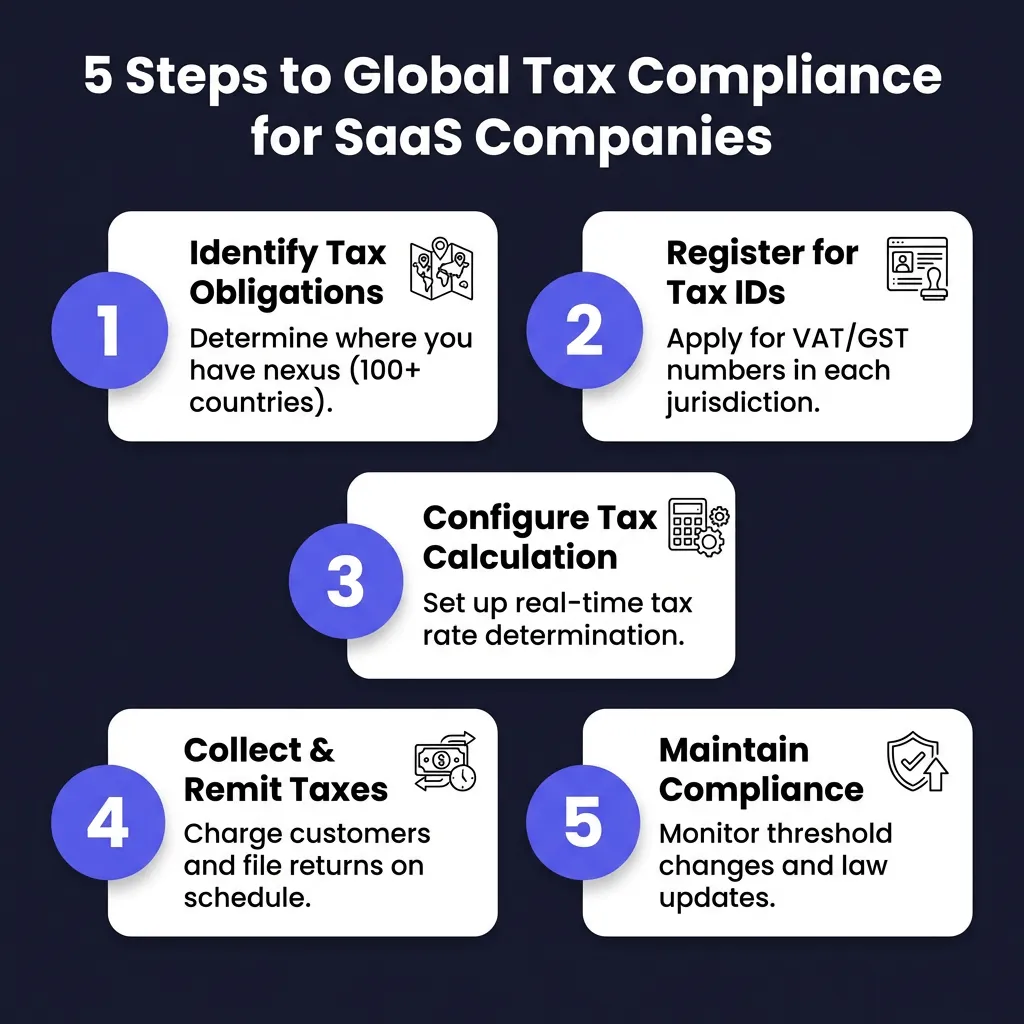
Global tax compliance for SaaS refers to the process of identifying, calculating, collecting, and remitting consumption taxes (VAT, GST, sales tax) across all jurisdictions where your software-as-a-service company has customers. Unlike physical goods, digital services are taxed based on the customer’s location, not the seller’s — creating a complex web of obligations.
Key components include:
- Tax registration: Obtaining tax IDs in every country where you exceed revenue thresholds
- Real-time calculation: Determining the correct tax rate based on customer location and product type
- Tax collection: Charging customers the appropriate amount at checkout
- Record keeping: Maintaining detailed transaction records for audit purposes
- Tax filing: Submitting returns and remitting collected taxes on schedule
- Compliance monitoring: Tracking threshold changes and new tax laws
Major Tax Jurisdictions Every SaaS Must Understand
European Union and United Kingdom
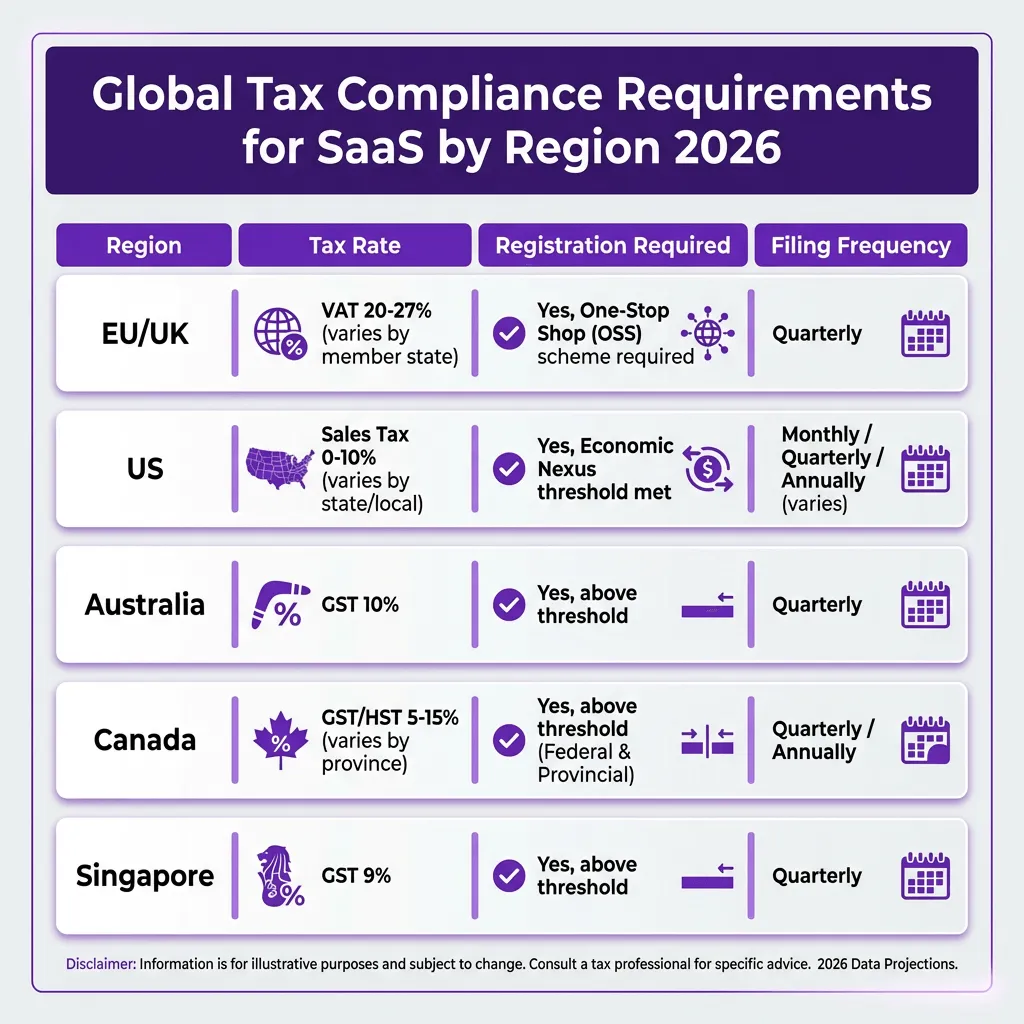
The EU’s VAT rules for digital services are among the most complex globally. Since 2015, the place of supply for B2C digital services is where the customer is located, not where the business is established. VAT rates range from 17% in Luxembourg to 27% in Hungary, with most countries charging 20-25%.
The One-Stop Shop (OSS) scheme simplifies compliance by allowing businesses to file a single quarterly return for all EU sales instead of registering in each member state. However, you must still track sales by country and charge the correct local rate. The UK’s post-Brexit VAT system mirrors EU rules but requires separate registration and filing.
United States
US sales tax for SaaS is a patchwork of 45+ state regimes with varying rules. Following the 2018 South Dakota v. Wayfair Supreme Court decision, states can require out-of-state sellers to collect sales tax based on economic nexus — typically $100,000 in annual sales or 200 transactions.
Complicating matters further, some states tax SaaS as a service, others as software, and some exempt it entirely. Texas taxes SaaS at 80% of the sale price, while California generally exempts it. This creates a compliance nightmare requiring state-by-state analysis.
Asia-Pacific Region
Australia requires GST registration once you exceed AUD $75,000 in annual turnover. Singapore’s GST rate increased to 9% in 2024 and will reach 10% by 2026. Japan’s consumption tax applies to B2C digital services with a 10% rate. India has one of the most complex systems with different GST rates (5%, 12%, 18%, 28%) depending on software classification.
China’s VAT on digital services is particularly challenging — foreign providers must register through a local agent or establish a Chinese entity. The standard rate is 6%, but compliance requires working with a local fiscal representative.
The True Cost of Manual Tax Compliance
Many SaaS founders underestimate the true cost of handling tax compliance internally. Beyond the obvious filing fees and software costs, consider these hidden expenses:
- Personnel costs: A dedicated tax specialist costs $80,000-150,000 annually, plus ongoing training as laws change
- Registration fees: $500-5,000 per jurisdiction depending on complexity and whether you use local agents
- Accounting integration: Connecting tax engines to billing systems requires engineering time (2-4 weeks typically)
- Audit defense: Responding to tax authority inquiries costs $5,000-50,000 per audit
- Opportunity cost: Time spent on tax compliance is time not spent on product and growth
- Penalty risk: Late filings and errors trigger penalties averaging 15-25% of tax due
For a SaaS company selling in 20+ countries, total first-year compliance costs often exceed $200,000 when fully loaded. This is why growing SaaS companies increasingly turn to Merchant of Record solutions that bundle tax compliance into a single transaction fee.
Automated Solutions: Build vs Buy
When it comes to global tax compliance, SaaS companies face a fundamental choice: build internal capabilities or outsource to specialized providers.
Building internally requires integrating tax calculation APIs (like TaxJar or Avalara), setting up registration and filing workflows, and maintaining a compliance calendar. This approach offers maximum control but demands significant ongoing investment in monitoring law changes across dozens of jurisdictions.
Merchant of Record (MoR) solutions like Fungies handle the entire compliance stack — registration, calculation, collection, filing, and remittance — as part of their service. You integrate once and gain instant compliance in 100+ countries. The trade-off is higher per-transaction fees (typically 5-10% vs 2.9% + $0.30 for pure payment processing), but this includes all compliance costs.
For most SaaS companies under $10M ARR, the MoR model makes economic sense. The break-even point typically occurs around $20-50M ARR, at which point building internal capabilities may become cost-effective.
Simplify Global Tax Compliance with Fungies
Stop wrestling with VAT, GST, and sales tax in 100+ countries. Fungies acts as your Merchant of Record — we handle tax registration, collection, and filing so you can focus on growing your SaaS.
No credit card required • Instant setup
FAQ: Global Tax Compliance for SaaS
When do I need to register for VAT/GST in a country?
Registration requirements vary by country. In the EU, you must register for OSS once you exceed €10,000 in annual B2C sales across all member states. Other countries have thresholds ranging from $0 (immediate registration required) to $100,000+ in local currency. Some countries, like Switzerland and Norway, have no threshold — you must register before making your first B2C sale.
What’s the difference between B2B and B2C tax treatment?
For B2B sales, the reverse charge mechanism often applies — your business customer is responsible for accounting for VAT/GST. You typically need to validate their tax ID and include it on invoices. B2C sales always require you to charge and remit tax directly. This distinction is crucial because it affects your registration obligations and checkout flow.
How do tax authorities know if I’m non-compliant?
Tax authorities use multiple methods to identify non-compliant foreign sellers: payment processor data sharing, cross-referencing with customs and immigration records, monitoring app stores and marketplaces, and analyzing public fundraising announcements. The OECD’s Common Reporting Standard facilitates information sharing between countries. In 2024, automated data matching identified over $3 billion in unreported digital service revenue.
Can I just block sales to high-compliance countries?
Technically yes, but this significantly limits your addressable market. The EU alone represents 25% of global SaaS spending. Blocking these markets creates a competitive disadvantage and may signal to investors that your business isn’t ready for international scale. Most successful SaaS companies view global tax compliance as a cost of doing business in the digital economy.
Conclusion: Making Global Tax Compliance Work for Your SaaS
Global tax compliance for SaaS isn’t getting simpler — new countries introduce digital service taxes every year, and existing regimes become more sophisticated in enforcement. The companies that thrive internationally are those that treat compliance as a strategic infrastructure decision, not an afterthought.
Whether you choose to build internal capabilities or partner with a Merchant of Record, the key is making an intentional decision before compliance issues create business risk. Start by auditing your current sales by country, understanding your existing obligations, and projecting the cost of compliance at your current growth rate.
For most SaaS companies, the math favors outsourcing to a specialized provider that can amortize compliance costs across thousands of merchants. The time and risk savings typically outweigh the higher transaction fees, especially during the critical growth phase from $1M to $50M ARR.