How to Choose a Merchant of Record Platform in 2026: Complete Evaluation Framework
Here’s a number that’ll change how you evaluate payment infrastructure: at $50K MRR, a 1% difference in platform fees equals $6,000 per year. At $500K MRR, that’s $60,000. Most SaaS founders treat choosing a Merchant of Record (MoR) like picking a developer tool. Then, 18 months later, they’re managing a tax audit in Germany, absorbing
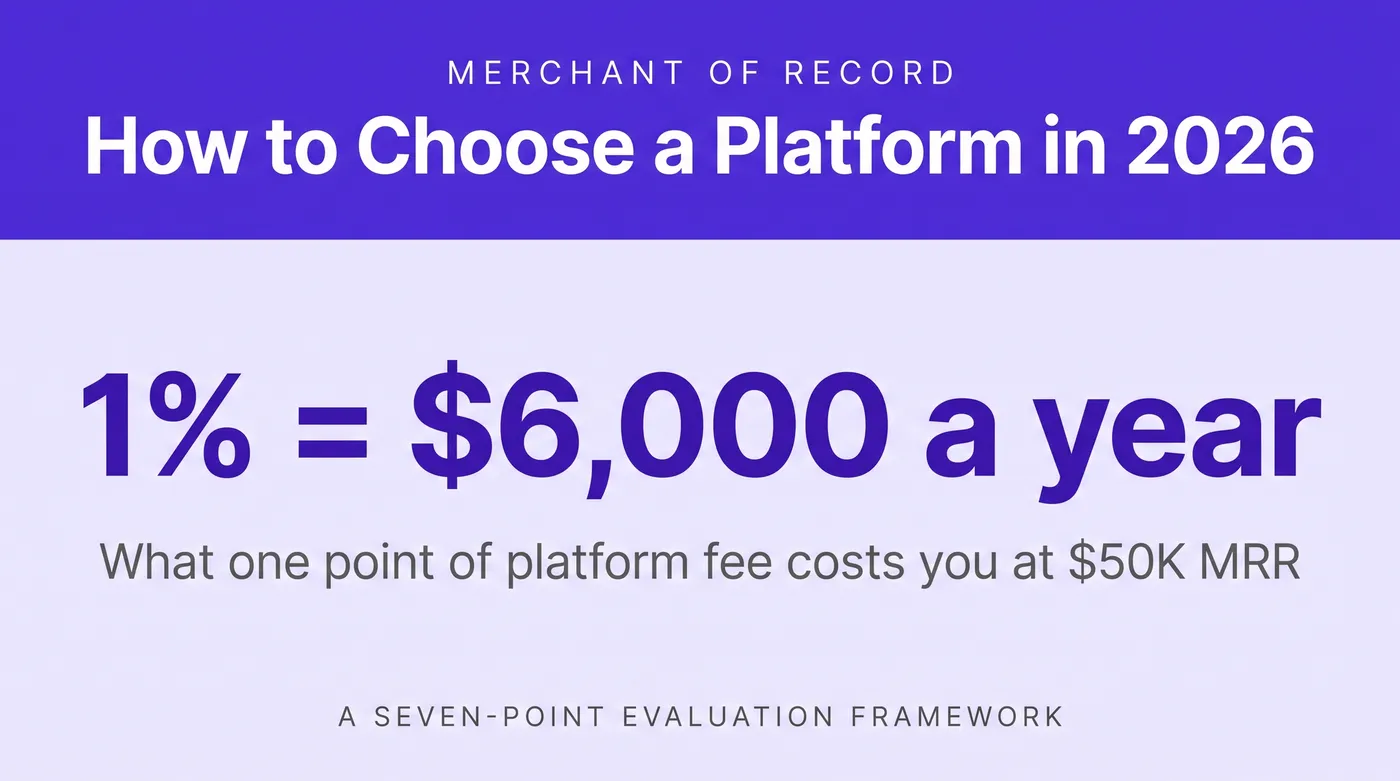
Here’s a number that’ll change how you evaluate payment infrastructure: at $50K MRR, a 1% difference in platform fees equals $6,000 per year. At $500K MRR, that’s $60,000.
Most SaaS founders treat choosing a Merchant of Record (MoR) like picking a developer tool. Then, 18 months later, they’re managing a tax audit in Germany, absorbing involuntary churn they didn’t know was recoverable, or re-platforming a billing stack they’ve already built their pricing model on top of.
The MoR decision is a financial infrastructure decision—closer in consequence to choosing a banking relationship than it is to choosing a SaaS tool.
In this guide, I’ll walk you through a practical framework for evaluating Merchant of Record platforms in 2026. No fluff, no generic advice. Just the criteria that actually matter when you’re comparing Paddle, FastSpring, Creem, Dodo Payments, and newer options like Fungies.
What Is a Merchant of Record (And Why the Choice Matters)
A Merchant of Record is a legal entity that takes on the operational and regulatory responsibility of payments on behalf of your business. When a customer buys your SaaS product, the MoR becomes the seller of record—handling payment processing, tax collection and remittance, fraud prevention, chargebacks, and compliance in every jurisdiction where you sell.
Here’s what changes when you use an MoR:
- You don’t register for VAT/GST in 100+ countries—the MoR does
- You don’t file quarterly tax returns in the EU, US states, or Australia—the MoR handles it
- You don’t manage chargeback disputes or fraud liability—the MoR absorbs it
- You don’t build billing infrastructure—subscriptions, invoicing, and dunning are included
The trade-off? You pay a percentage of every transaction, typically 4-6% plus a fixed fee. For many SaaS businesses, this is worth it. For others, it’s not.
The 7 Criteria That Actually Matter When Evaluating an MoR
After analyzing the major platforms and talking to founders who’ve switched between them, here are the seven criteria that determine whether an MoR will help or hurt your business:
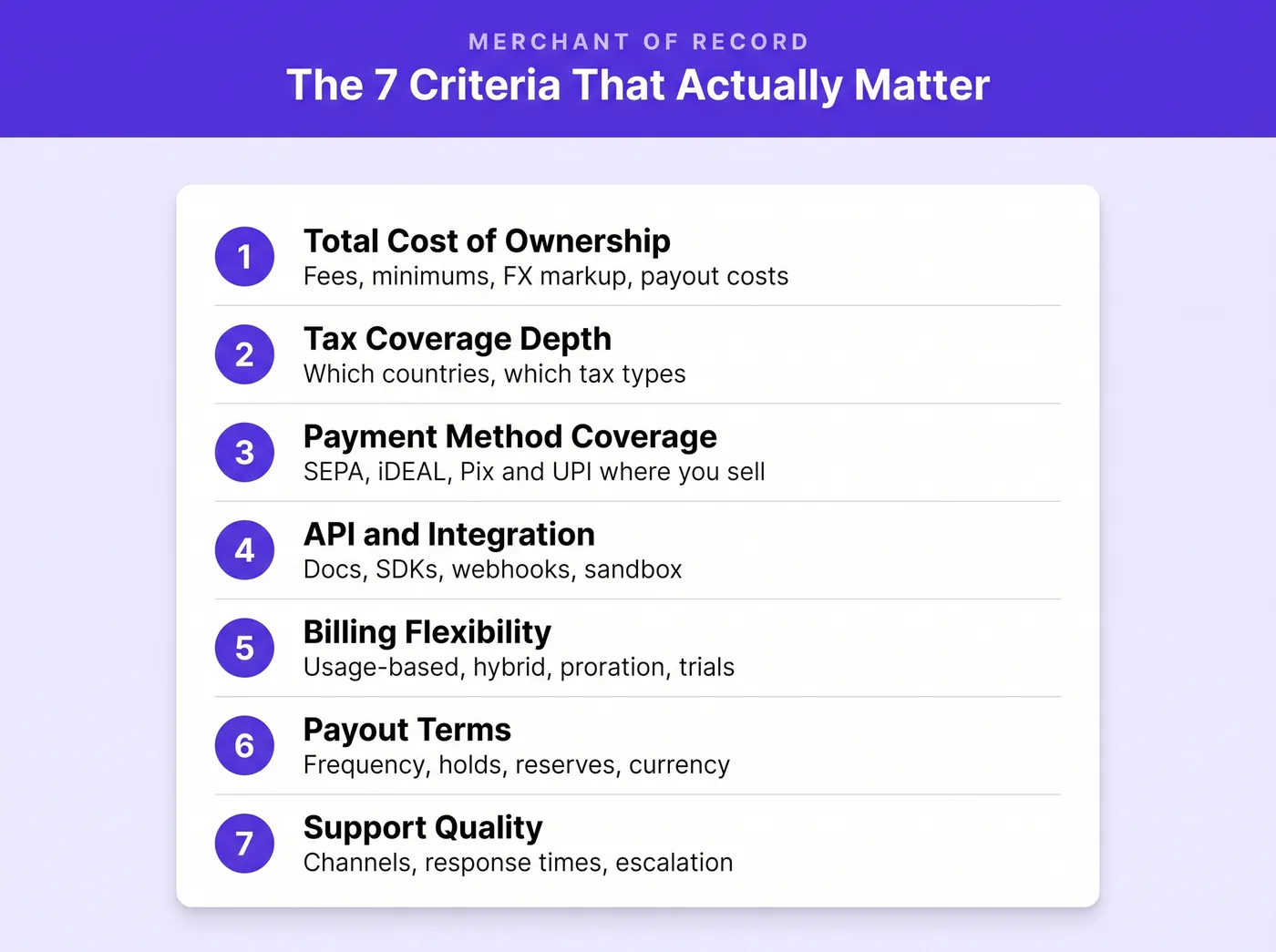
1. Total Cost of Ownership (Not Just the Headline Fee)
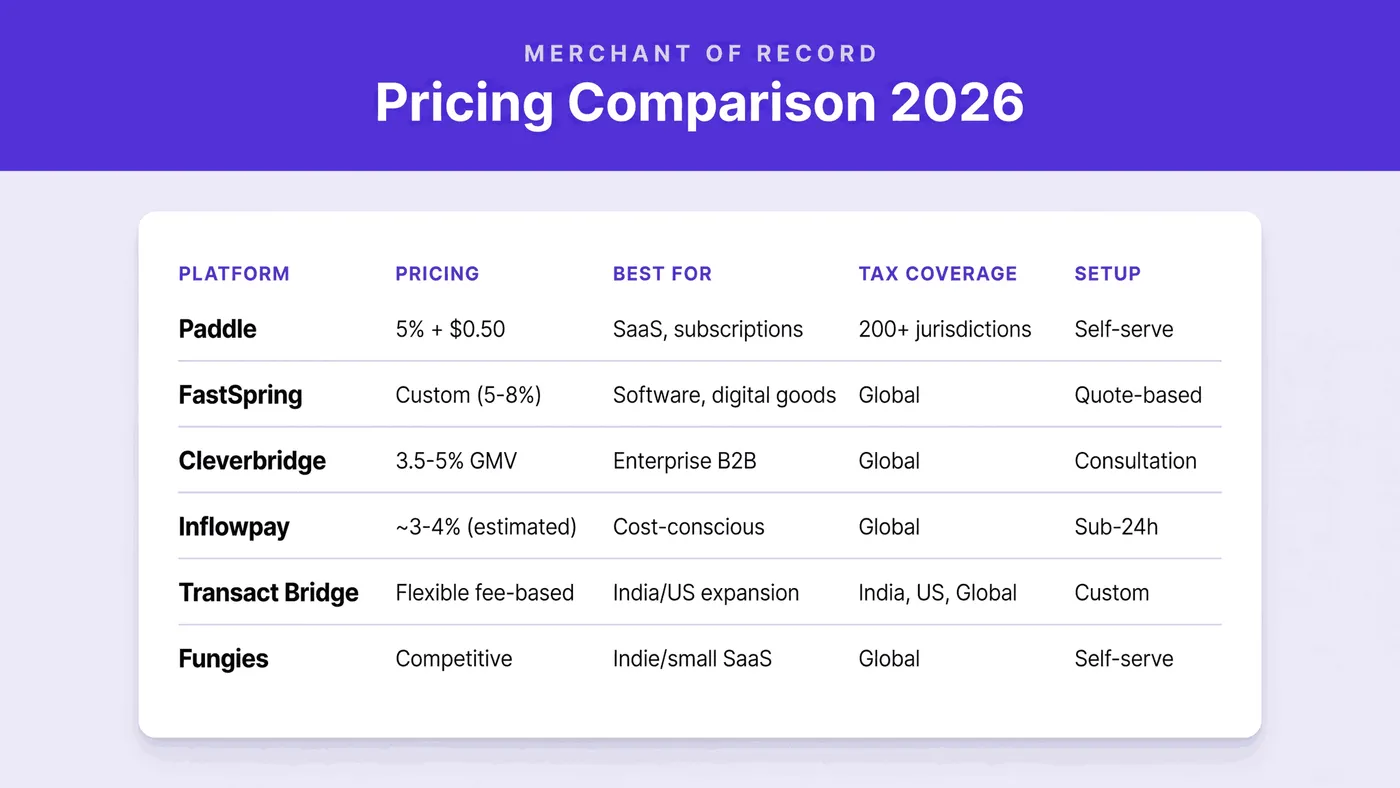
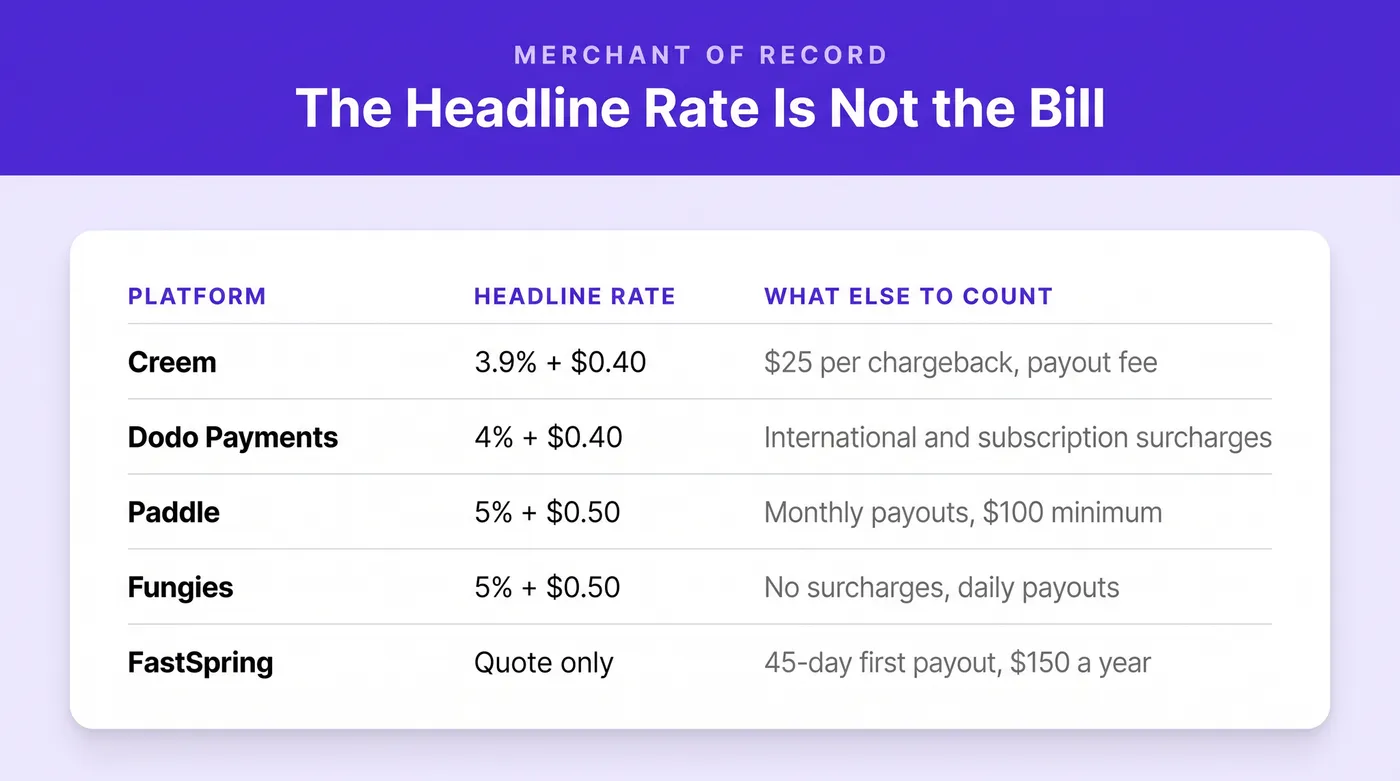
Every MoR publishes a transaction fee, or almost every one. Creem charges 3.9% + $0.40. Dodo Payments charges 4% + $0.40. Paddle and Fungies both charge 5% + $0.50. FastSpring publishes no rate at all — theirs comes from a sales call, and third-party analyses put it somewhere around 5.9% for smaller volumes.
But the headline fee isn’t the total cost. Here’s what to calculate:
- Transaction fees: The percentage + fixed fee per transaction
- Monthly minimums: Some platforms charge if you don’t hit volume thresholds
- Payout fees: Wire transfers, currency conversion, and withdrawal costs
- FX markup: Hidden in the exchange rate when converting customer currencies
- Feature tiers: Advanced features like usage-based billing or affiliate management may cost extra
Real example: At $20K MRR with average transaction size of $50, here’s the annual platform cost difference:
- Creem (3.9% + $0.40): ~$11,280/year
- Dodo (4% + $0.40): ~$11,520/year
- Paddle (5% + $0.50): ~$14,400/year
- Fungies (5% + $0.50): ~$14,400/year
- FastSpring (~5.9%): ~$16,560+/year
That’s a $5,280+ annual difference between the cheapest and most expensive options—money that could go toward hiring, marketing, or product development.
But that table is the mistake this section is warning about. It prices one transaction shape—a domestic card, paid once—and almost nobody sells only that. Run the same $30 international subscription renewal through each platform’s published surcharges and the order changes:
- Creem: $1.57 on the transaction, but their docs add $25 per chargeback, $7 or 1% per payout against a $50 minimum balance, and 5% of anything abandoned-cart recovery brings back.
- Dodo Payments: 4% + $0.40 becomes $2.20—7.3%—once the 1.5% international-card surcharge and the 0.5% subscription surcharge land. PayPal and BNPL add 3%, a dispute costs $30, a refund costs $1.
- Paddle: $2.00, then payouts monthly against a $100 floor. Anything priced under $10 is excluded from the standard rate and routed to their sales team.
- Fungies: $2.00, and that is the whole bill—no international surcharge, no subscription surcharge, no per-dispute or per-refund fee, no payout fee.
- FastSpring: unknowable until you take the call. What is published is a 45-day hold before your first payout is scheduled, a 14-day settlement delay after that, a $100 payout minimum, a 2.5% conversion fee when your store and payout currencies differ, and a $150 annual fee for vendors under $5,000 of yearly volume.
So the cheapest headline is Creem’s and we would rather say so plainly than pretend otherwise. Whether it is the cheapest bill depends entirely on who your customers are, how often they pay, and how much of your revenue arrives from abroad.
2. Tax Coverage Depth (Not Just “We Handle Taxes”)
Every MoR claims to handle global tax compliance. But “global” means different things to different platforms.
Here’s what to verify:
- Countries covered: Do they remit VAT in all 27 EU countries, or just the major ones? Do they handle GST in Australia, New Zealand, and Singapore? What about emerging markets like India, Brazil, and Nigeria?
- Tax types: Do they handle sales tax (US), VAT (EU/UK), GST (APAC), and consumption tax (other regions)?
- Registration: Are they registered as the merchant in each jurisdiction, or do they use a third-party aggregator?
- Invoice compliance: Do they generate locally-compliant invoices with the required fields for each country?
Red flag: Some platforms claim “global tax coverage” but only handle major markets. If you sell to customers in Portugal, Hungary, or Croatia, you might still be on the hook for compliance.
3. Payment Method Coverage (Especially in Your Target Markets)
Credit cards work everywhere—until they don’t. In Germany, many B2B customers prefer SEPA direct debit. In the Netherlands, iDEAL dominates. In Brazil, Pix is essential. In India, UPI has overtaken cards for digital payments.
When evaluating an MoR, check:
- Local payment methods: Do they support the dominant payment methods in your target countries?
- Buy-now-pay-later: Options like Klarna, Affirm, or local equivalents can increase conversion 15-30% in some markets
- Alternative methods: PayPal, Apple Pay, Google Pay, and cryptocurrency (if relevant to your audience)
Key insight: Paddle and FastSpring have the broadest payment method coverage, having been in the market longest. Newer platforms like Creem and Dodo are catching up but may lack coverage in smaller markets.
4. API and Integration Experience
If you’re a developer-led team, API quality matters. A lot.
Here’s what to evaluate:
- Documentation quality: Is it clear, complete, and up-to-date? Are there code examples in your language?
- SDK availability: Do they offer native SDKs for your stack (React, Vue, Node, Python, etc.)?
- Webhook reliability: Do webhooks deliver consistently? Is there retry logic? Can you debug failed deliveries?
- Sandbox environment: Can you test the full payment flow without real transactions?
- Integration time: How long does it actually take to go live? (Paddle and FastSpring: weeks. Creem and Dodo: days.)
Founder feedback: Teams switching from Paddle to Creem or Dodo consistently cite faster integration times and cleaner APIs as major factors. Teams switching the other direction often mention Paddle’s more mature feature set.
5. Subscription and Billing Flexibility
Not all SaaS billing is simple monthly subscriptions. You might need:
- Usage-based pricing: Charging by API calls, seats, storage, or other metrics
- Hybrid models: Base subscription + usage overages
- Multi-currency: Charging customers in their local currency while receiving payouts in yours
- Proration: Handling mid-cycle upgrades and downgrades correctly
- Trials and freemium: Supporting trial-to-paid conversion flows
Platform comparison:
- Paddle: Strongest subscription management, recently added usage-based billing
- FastSpring: Good for traditional subscriptions, limited usage-based options
- Creem: Clean API for subscriptions, usage-based billing available
- Dodo: Focused on SaaS and AI products, good usage-based support
6. Payout Terms and Fund Access
This is where platforms differ significantly—and where hidden costs emerge.
Questions to ask:
- Payout frequency: Daily, weekly, or monthly? Can you choose?
- Payout methods: Wire transfer, ACH, PayPal, cryptocurrency?
- Minimum payout: Is there a minimum threshold before you receive funds?
- Reserve/hold: Does the platform hold a percentage of funds as a risk reserve?
- Currency: Can you receive payouts in USD, EUR, GBP, or your local currency?
Important: Some platforms hold funds for 7-14 days before payout. If you’re running lean, this cash flow delay matters.
7. Support Quality and Response Times
When your checkout breaks or a customer disputes a $5,000 charge, you need help fast.
Evaluate:
- Support channels: Email, chat, phone, or community?
- Response times: What’s the SLA for critical issues?
- Account management: Do you get a dedicated rep, or are you in a queue?
- Technical support: Can you talk to engineers for integration issues?
- Time zones: Is support available in your business hours?
Founder reports: Paddle and FastSpring offer dedicated account managers at higher tiers. Creem and Dodo are more self-serve but have responsive chat support. FastSpring’s support gets mixed reviews—great for some, slow for others.
Platform-Specific Recommendations by Use Case
Here’s my honest take on which platform fits which situation:
Choose Creem If:
- You want the lowest fees (3.9% + $0.40)
- You’re a developer who values clean APIs
- You want fast onboarding (minutes, not weeks)
- You’re selling software or digital products globally
- You don’t need complex enterprise features
Choose Dodo Payments If:
- You’re an Indian founder selling globally
- You want strong India/US payment coverage
- You’re building AI or SaaS products
- You want competitive fees (4% + $0.40)
- You need UPI, Pix, and other local payment methods
Choose Paddle If:
- You want the most established platform
- You need advanced subscription management
- You want usage-based billing capabilities
- You’re okay paying more (5% + $0.50) for maturity
- You need enterprise-grade features and support
Choose FastSpring If:
- You’re selling high-ticket software or enterprise products
- You need professional services and implementation help
- You want a full-service approach with account management
- You have complex B2B invoicing needs
- You are comfortable agreeing a rate on a call rather than reading one, and the service level justifies it
Choose Fungies If:
- You want one rate that does not move (5% + $0.50, the same on an international subscription renewal as on a domestic one-off)
- You want to be paid daily, into your own account, with no minimum balance and no payout fee
- You sell anything under $10, or anything that lives inside a game—both are on the standard rate here and excluded or prohibited elsewhere
- You want the storefront included rather than assumed, so there is no hosting bill alongside the commission
- You’d rather not be charged per dispute or per refund
- You want to embed checkout without redirects
Don’t choose Fungies if the lowest flat percentage is what decides it. At 5% + $0.50 we are level with Paddle and above Creem and Dodo on the headline, and if your customers are domestic and buy once, that gap is real.
Red Flags: When to Walk Away from an MoR
Here are warning signs that a platform might cause problems:
- Vague tax coverage: If they can’t list the specific countries where they’re registered, be skeptical
- No sandbox environment: You should be able to test everything before going live
- Long-term contracts: Avoid platforms that lock you in for 12+ months without an escape clause
- Hidden fees: If pricing isn’t transparent on their website, expect surprises
- Poor API documentation: This usually indicates a platform that prioritizes sales over developer experience
- Slow support responses: Test this before committing—send a question and see how long they take
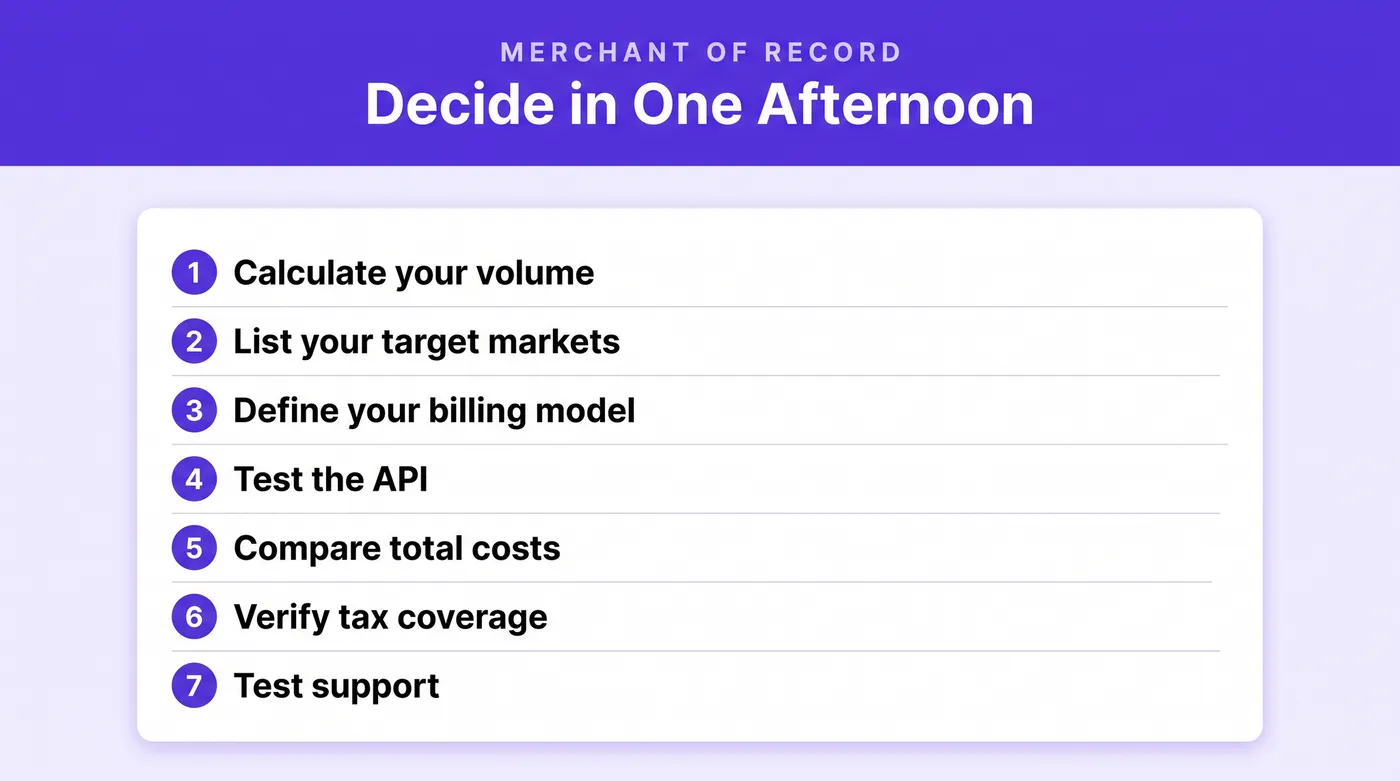
The Evaluation Checklist: Make Your Decision in One Afternoon
Here’s a practical framework for evaluating any MoR:
Step 1: Calculate your volume
What’s your current MRR? What’s your average transaction size? What’s your projected growth over 12 months?
Step 2: List your target markets
Which countries do you sell to (or plan to)? What payment methods matter there?
Step 3: Define your billing model
Simple subscriptions, usage-based, or hybrid? Do you need trials, proration, or complex invoicing?
Step 4: Test the API
Sign up for a sandbox account. Try implementing a basic checkout. How long did it take? Did anything confuse you?
Step 5: Compare total costs
Calculate annual costs including transaction fees, payout fees, and any monthly charges. Use your projected volume, not current volume.
Step 6: Verify tax coverage
Ask specifically about the countries where you have customers. Get it in writing.
Step 7: Test support
Send a technical question. How long until you get a helpful response?
Key Takeaways
- The cheapest MoR isn’t always the best. Consider total cost of ownership, not just transaction fees.
- Tax coverage varies significantly. Verify specific countries, not just “global coverage” claims.
- API quality matters for developer-led teams. Test the integration experience before committing.
- Payout terms affect cash flow. Understand when you’ll actually receive your money.
- The MoR market is evolving fast. Newer platforms like Creem and Dodo offer compelling alternatives to established players.
Frequently Asked Questions
What’s the difference between a Merchant of Record and a payment processor?
A payment processor (like Stripe) handles the technical movement of money but you remain the legal seller responsible for tax compliance. An MoR becomes the legal seller, absorbing tax and compliance liability.
Can I switch MoR platforms later?
Yes, but it’s painful. You’ll need to migrate customer payment methods (if the platform allows exports), update your checkout, and potentially re-collect tax registrations. Choose carefully upfront.
Do I still need an accountant if I use an MoR?
Yes, but for different reasons. The MoR handles sales tax/VAT compliance, but you still need accounting for income tax, financial reporting, and business planning.
What happens if my MoR gets acquired?
This happened with Lemon Squeezy (acquired by Stripe in 2024). Have a backup plan and own your customer data. Consider newer platforms that are less likely acquisition targets.
Which merchant of record is cheapest?
On the headline rate, Creem, at 3.9% + $0.40. On the actual bill it depends on your mix: platforms with a low headline tend to charge separately for international cards, subscriptions, disputes, refunds, payouts and recovered revenue, and those line items are where a 4% platform becomes a 7% one. Price the transaction you actually sell—your typical amount, your customer’s country, one-off or recurring—rather than the rate on the pricing page.
Is an MoR worth it for a brand-new SaaS?
If you’re pre-revenue or under $1K MRR, the fees might not justify the convenience. Consider starting with Stripe and switching to an MoR once you have international customers or hit $5K+ MRR.
Conclusion
Choosing a Merchant of Record is one of the most consequential infrastructure decisions you’ll make as a SaaS founder. The right choice saves you thousands in compliance costs, reduces operational overhead, and lets you focus on building product. The wrong choice locks you into high fees, limited flexibility, and potential tax headaches.
Use the framework in this guide to evaluate your options systematically. Calculate real costs, test the APIs, verify tax coverage, and don’t be swayed by marketing claims. Your future self—and your bank account—will thank you.
Ready to get started with a modern, developer-friendly Merchant of Record? Create your free Fungies account and start accepting global payments at 5% + 50¢ per sale—no monthly fee, no setup cost, and negotiable once you are selling at volume.