How to Handle VAT for SaaS: The Complete 2026 Guide
Learn how to handle VAT for your SaaS business with our complete 2026 guide. Covers EU OSS registration, compliance steps, common mistakes, and automation strategies.
Selling SaaS products to customers across Europe? You’re likely facing one of the most complex tax challenges in the digital economy: EU VAT compliance. With over 160 countries implementing VAT and the EU’s strict OSS (One Stop Shop) requirements, getting it wrong can result in penalties, back taxes, and damaged customer relationships.
This guide walks you through exactly how to handle VAT for your SaaS business — from understanding when you need to register to automating compliance as you scale.
Understanding EU VAT for SaaS: The Basics
Value Added Tax (VAT) applies to most digital services sold to EU consumers, including SaaS subscriptions, software licenses, and cloud services. The key challenge? Each EU member state sets its own VAT rate, ranging from 17% in Luxembourg to 27% in Hungary.
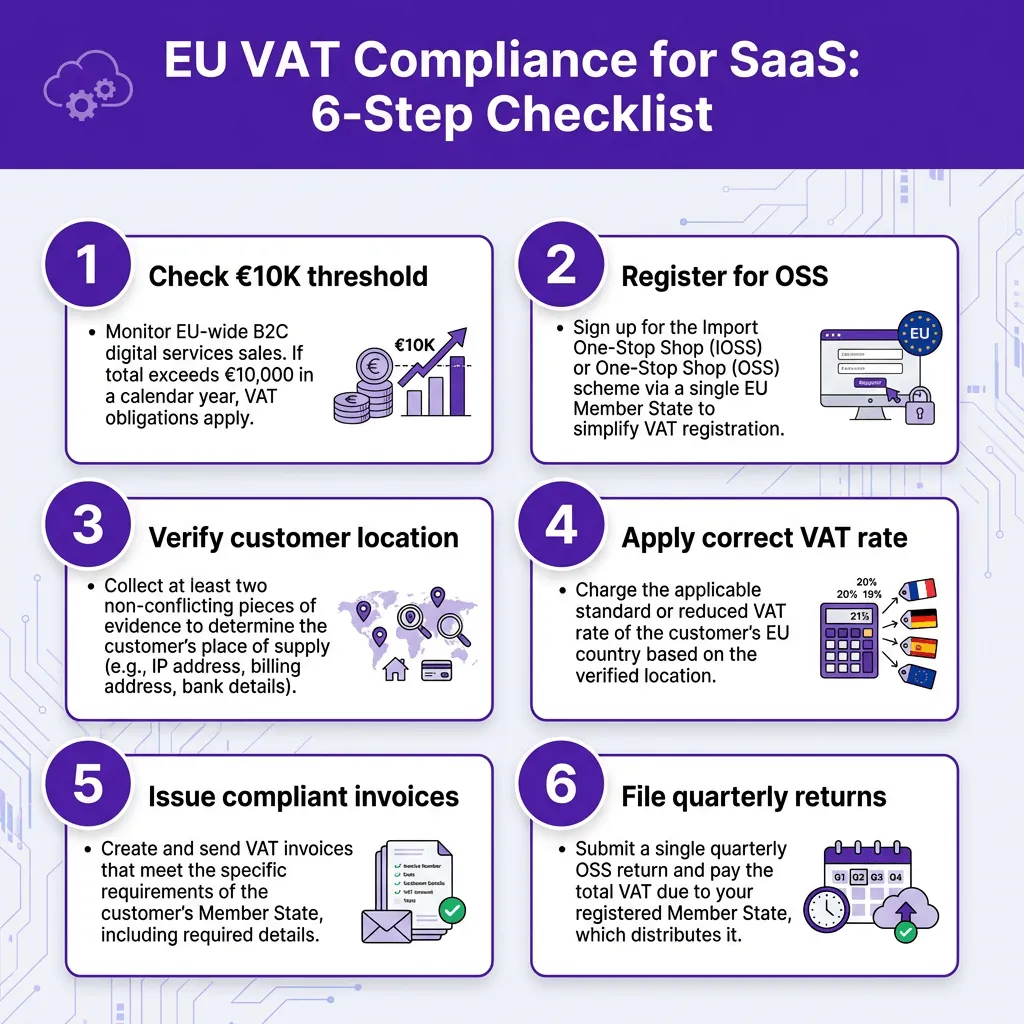
For SaaS businesses, the critical threshold is €10,000 in annual cross-border B2C sales within the EU. Below this amount, you can charge your home country’s VAT rate on all EU sales. Exceed it, and you must charge each customer their local VAT rate — potentially requiring registration in 27 different countries.
This is where the One Stop Shop (OSS) system becomes essential. Introduced in July 2021, OSS allows you to register in one EU country and file a single quarterly return covering all EU sales. Your home tax authority then distributes the VAT revenue to other member states automatically.
Step-by-Step: How to Handle VAT for Your SaaS
Step 1: Determine Your VAT Obligations
First, identify whether your SaaS is taxable in your target markets. Most EU countries tax SaaS as a digital service, but some have specific exemptions for B2B transactions under the reverse charge mechanism. If all your EU customers are VAT-registered businesses, they handle VAT themselves — you don’t need to register for OSS.
For non-EU businesses selling to EU consumers, the rules are stricter. You’re technically required to register for VAT from your very first B2C sale — there’s no €10,000 threshold. This surprises many US and UK SaaS founders expanding into Europe.
Step 2: Register for OSS (One Stop Shop)
If you exceed the €10,000 threshold (or you’re a non-EU business), register for OSS in your home country (or choose an EU member state if you’re outside the EU). The registration process typically requires:
- Business registration documents
- Proof of identity for company directors
- Bank account details for VAT payments
- Estimated annual turnover in the EU
Processing times vary by country but expect 2-4 weeks for approval. Once registered, you’ll receive an OSS identification number to include on invoices.
Step 3: Verify Customer Location
EU VAT rules require two pieces of non-contradictory evidence to determine your customer’s location. Acceptable evidence includes:
- Billing address
- IP address geolocation
- Bank location (from payment details)
- Country code of SIM card (for mobile)
Your checkout system must collect and store this evidence for at least 10 years. Many SaaS businesses use automated tax software to handle this verification in real-time.
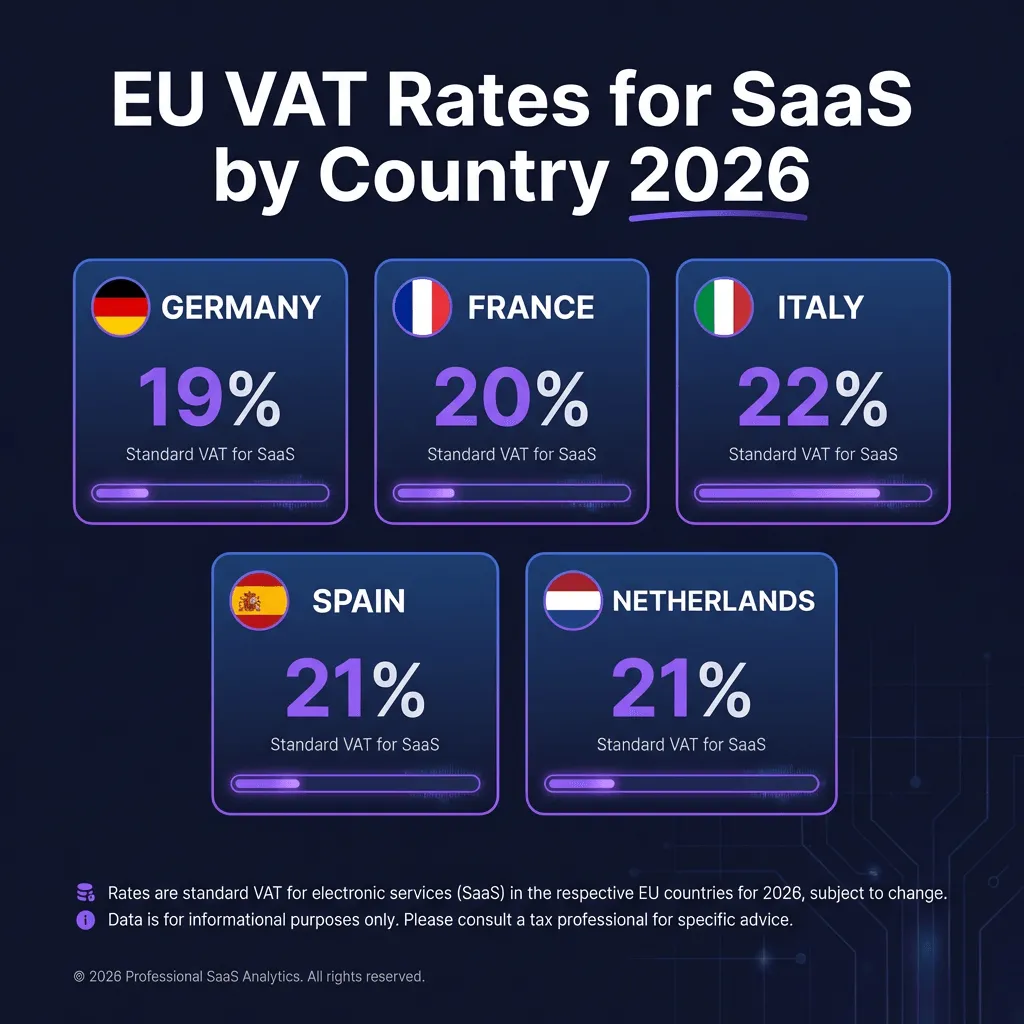
Step 4: Apply the Correct VAT Rate
Once you’ve verified the customer’s location, apply their local VAT rate. Standard rates range from 17% to 27%, but some countries offer reduced rates for certain digital services. Your invoicing system must dynamically calculate and display the correct VAT amount at checkout.
Common mistake: Applying your home country’s VAT rate to all EU sales. This violates EU rules and can trigger audits and penalties. Always use the customer’s local rate once you’re registered for OSS.
Step 5: Issue Compliant Invoices
EU VAT invoices must include specific information:
- Your business name, address, and VAT/OSS number
- Customer’s name and address
- Invoice date and unique invoice number
- Description of the SaaS service
- VAT rate applied and VAT amount
- Total amount payable
For B2B sales to VAT-registered businesses, include a reference to the reverse charge mechanism: “VAT exempt – reverse charge applies.”
Step 6: File Quarterly OSS Returns
OSS returns are due quarterly, with deadlines at the end of the month following each quarter (April 30, July 31, October 31, and January 31). Your return must detail:
- Sales value by EU member state
- VAT amount collected by country
- Total VAT payable
Payment is due at the same time as the return. Late filing or payment can result in penalties ranging from €50 to thousands of euros depending on the country and delay duration.
Stop Wrestling with VAT Compliance
Fungies.io handles EU VAT, US sales tax, and global compliance automatically. Focus on building your SaaS, not filing tax returns.
No credit card required • Automated tax compliance included
Common VAT Mistakes SaaS Companies Make
Even experienced SaaS founders stumble over VAT compliance. Here are the most common pitfalls:
- Missing the €10,000 threshold: Many businesses don’t realize they’ve crossed it until they’re already non-compliant. Monitor your cross-border sales monthly.
- Confusing OSS and IOSS: OSS handles intra-EU sales. IOSS (Import One Stop Shop) is for goods imported from outside the EU under €150. They serve different purposes.
- Insufficient location evidence: Collecting only a billing address isn’t enough. You need two non-contradictory pieces of evidence.
- Not registering despite exceeding thresholds: Tax authorities share data. If you’re selling to EU customers without proper VAT registration, they likely already know.
- Applying wrong VAT rates: Using your home country’s rate for all EU sales is a common error that triggers audits.
When to Automate VAT Compliance
Manual VAT management becomes unsustainable quickly. Consider automation when:
- You’re registered in 5+ states or countries
- You’re spending 8+ hours monthly on tax tasks
- You have more than 100 transactions per month
- You’re expanding into new markets
Automated solutions handle real-time tax calculation, invoice generation, evidence collection, and return filing. For SaaS businesses, a Merchant of Record (MoR) like Fungies.io goes further — taking full legal responsibility for tax compliance, chargebacks, and regulatory changes.
FAQ: Handling VAT for SaaS
Do I need to register for VAT if I only sell B2B?
If all your EU customers are VAT-registered businesses, the reverse charge mechanism applies. You don’t need OSS registration — just validate their VAT numbers and include reverse charge wording on invoices.
What’s the difference between OSS and registering in each country?
OSS lets you file one return covering all EU sales. Without it, you’d need to register, file returns, and make payments separately in each country where you have customers — a significant administrative burden.
How do I handle VAT for UK customers post-Brexit?
UK customers are outside the EU VAT system. UK VAT rules apply separately, with a £85,000 registration threshold. You’ll need to register for UK VAT separately if you exceed this threshold.
Can I use a Merchant of Record to avoid VAT registration?
Yes. A Merchant of Record like Fungies.io becomes the legal seller of record, handling all VAT registration, collection, and remittance on your behalf. This eliminates your direct VAT obligations entirely.
Conclusion
Handling VAT for your SaaS doesn’t have to be overwhelming. By understanding the €10,000 threshold, registering for OSS when required, and maintaining proper evidence of customer location, you can stay compliant while focusing on growing your business.
For SaaS companies scaling internationally, automation is essential. Whether through dedicated tax software or a comprehensive Merchant of Record solution, investing in proper VAT handling early prevents costly headaches as you grow.
The alternative? Let Fungies.io handle it all — from EU VAT to US sales tax to global compliance — so you can focus on what you do best: building great software.