How to Launch a Digital Product in 2026: The Complete Pre-Launch Checklist
42% of startups fail because there’s no market need. Most of them didn’t find out until after launch. The other common failure mode? Building a great product, setting up zero distribution, and wondering why nobody showed up on day one. This checklist is for indie developers, SaaS founders, and creators who want to launch a
42% of startups fail because there’s no market need. Most of them didn’t find out until after launch. The other common failure mode? Building a great product, setting up zero distribution, and wondering why nobody showed up on day one.
This checklist is for indie developers, SaaS founders, and creators who want to launch a digital product in 2026 — and actually get sales. Not just “go live.” We’ll cover validation, payment setup, pre-launch marketing, and the exact steps that separate products that convert from ones that disappear.
Let’s get into it.
The State of Digital Product Launches in 2026
The market for digital products has exploded. Creators are pulling in $1K to $750K from single launches. The difference isn’t talent — it’s preparation. Here’s what the data shows:
- Products with a pre-launch waitlist of 500+ convert at 3x the rate of cold launches
- A developer who spent 54 days building their product and zero days marketing it got their first sale in week 8 — after fixing that mistake
- Product Hunt’s top-of-day winners typically spend 6 weeks on pre-launch prep
- Sellers using a Merchant of Record spend 80% less time on tax compliance vs those on raw Stripe
The playbook has changed. Launching in 2026 means treating distribution as seriously as the product itself.
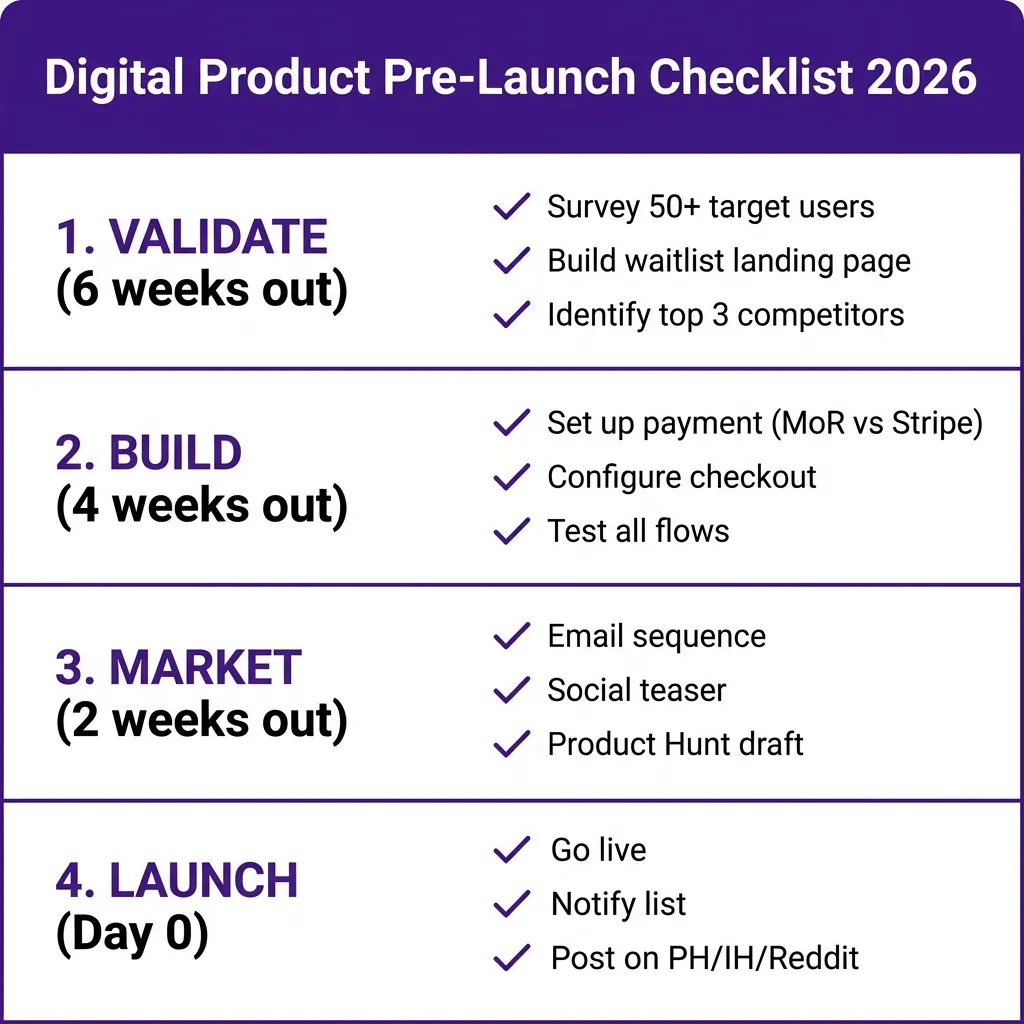
Phase 1: Validation (6 Weeks Before Launch)
Don’t build first and validate after. That’s how you end up with a finished product and no buyers.
Validate the Idea
Talk to real people before writing a single line of code or creating your first page. Here’s the minimum viable validation:
- Survey 50+ people in your target audience — not your friends, actual potential buyers. Use Twitter/X, Reddit, Discord, or cold outreach.
- Find the exact pain point. “I want to learn design” isn’t a pain. “I lost 3 clients last month because my proposals looked amateurish” is a pain. Build for pains, not interests.
- Check what’s already selling. Gumroad’s bestsellers list, Product Hunt’s top products, AppSumo deals — what’s getting bought in your category?
- Validate willingness to pay. Ask: “Would you pay $X for something that solves Y?” If you get “maybe” or “it depends,” keep digging.
Research Your Competitors
Identify 3–5 direct competitors. For each one, document:
- Price point and pricing model (one-time, subscription, tiered)
- Their top complaints from reviews (G2, Trustpilot, Reddit, Product Hunt comments)
- What keywords they rank for (SEMrush or even just Google autosuggest)
Your positioning should address their #1 complaint. That’s your wedge.
Build a Waitlist Landing Page
You don’t need a finished product to start building an audience. A single landing page with:
- A clear headline (outcome + target persona)
- 3–5 bullet points on what they’ll get
- Email capture with an incentive (early access, 20% discount, bonus content)
Use ConvertKit, Beehiiv, or even a Notion page with a Tally form. The goal is 200–500 emails before launch. Even 100 engaged people is enough to get momentum on day one.
Phase 2: Build and Payment Setup (4 Weeks Before Launch)
While you’re building (or finishing) the product, your payment and delivery infrastructure needs to be in place well before launch day. Nothing kills launch momentum like a checkout that breaks under load.
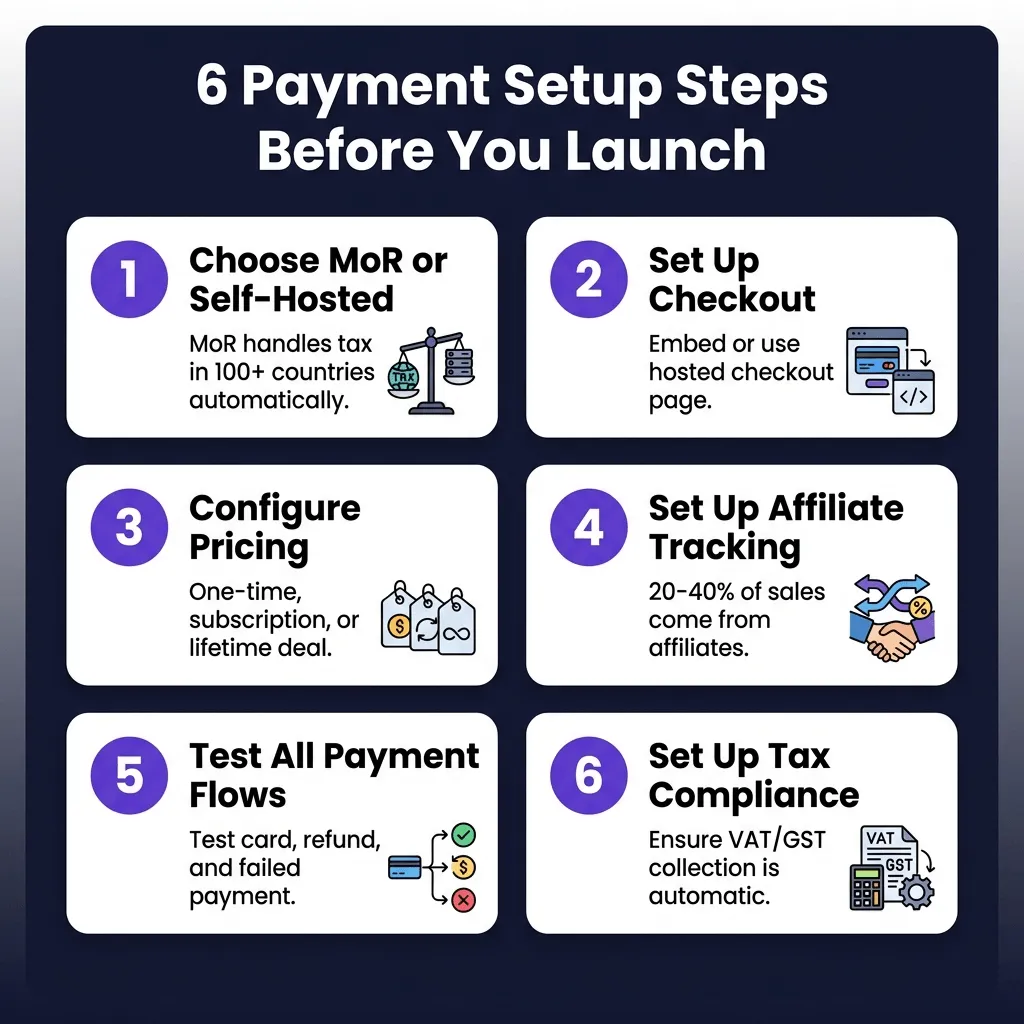
Choose Your Payment Stack
This is the most consequential tech decision you’ll make pre-launch. Your options:
| Approach | Best For | Tax Handling | Fees | Setup Time |
|---|---|---|---|---|
| Merchant of Record (MoR) | Global sales, any product type | Automatic in 100+ countries | 0% platform + 2.9%+$0.30 | 1–2 days |
| Gumroad | Creators, simple digital files | Partial (limited countries) | 10% flat | Hours |
| Payhip | Beginners, low volume | EU VAT only | 5% (free plan) | Hours |
| Raw Stripe | Developers who want control | None (you handle it) | 2.9%+$0.30 | Days to weeks |
| ThriveCart | Courses, coaching, upsells | None | $495 one-time | 1–2 days |
If you’re selling globally (and you will be — digital products don’t respect borders), a Merchant of Record is the cleanest setup. You sell, they handle VAT in the EU, GST in Australia, sales tax in the US, and every other jurisdiction that wants a piece. Fungies.io charges 0% platform fees — you pay only standard payment processing (2.9% + $0.30), and you get automatic tax compliance in 100+ countries included.
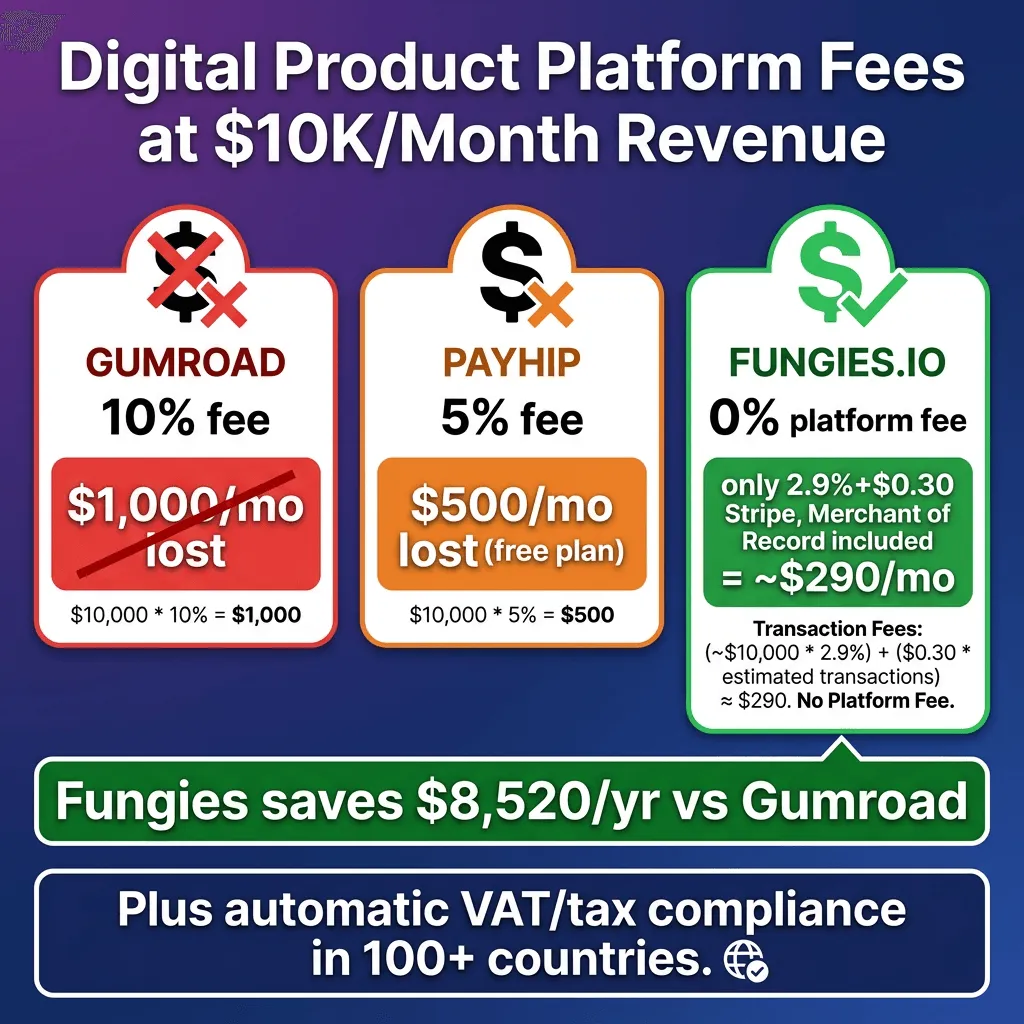
At $10K/month revenue, the difference is stark: Gumroad costs you $1,000/month. Fungies costs $290. That’s $8,520/year you keep.
Configure Your Checkout
Your checkout is the last mile. Don’t skimp on it. Before launch, make sure you’ve tested:
- Successful payment flow — use a real test card, go through the entire purchase
- Failed payment handling — what does the buyer see? Is it clear what to do?
- Refund flow — can you issue a refund in under 2 minutes? Buyers will test this.
- Product delivery — does the download/access link work immediately after purchase?
- Mobile checkout — at least 60% of traffic will be mobile in 2026
Embed the checkout on your sales page if your platform supports it. Redirecting to a third-party page costs you 15–30% of conversions from friction alone.
Set Up Affiliate Tracking
This one catches people off guard: 20–40% of revenue for digital products often comes from affiliates. Set this up before launch so you can recruit affiliates during your pre-launch window.
Most MoR platforms (including Fungies.io) include built-in affiliate management. If you’re on raw Stripe, tools like Rewardful, FirstPromoter, or Refgrow connect directly. Pick your commission rate (20–30% is standard for digital products) and have your affiliate link ready before launch day.
Configure Email Delivery
Set up your transactional email immediately:
- Purchase confirmation with product access link
- Welcome onboarding sequence (3–5 emails over 7 days)
- Renewal reminders (if subscription)
- Refund confirmation
Use ConvertKit, Beehiiv, or Mailchimp for marketing. Use your payment platform’s built-in emails for transactional. Don’t mix the two — it’s harder to debug when something breaks.
Phase 3: Pre-Launch Marketing (2 Weeks Before Launch)
Warm Up Your Waitlist
Start sending emails to your waitlist 2 weeks out. A simple sequence:
- Week -2: “We’re launching soon — here’s what you’ll get.” Share 1 valuable piece of preview content.
- Week -1: “Launch is in 7 days — here’s behind-the-scenes content.” Build anticipation.
- Day -3: “Last chance for early access pricing.” Create urgency.
- Day -1: “We go live tomorrow.” Final reminder.
Prepare Your Distribution Channels
Where will you announce on launch day? Have accounts ready and posts drafted for:
- Product Hunt — submit your product the night before (midnight PST is optimal). Draft your tagline, description, and 3 screenshots in advance. Reach out to 20–30 people who’ve asked to support you. PH is still worth it in 2026 for initial traction, even if it’s less powerful than 2020.
- Indie Hackers — post in the product launches thread. The IH community is small but high-quality buyers.
- Reddit — identify 2–3 subreddits where your buyers hang out. Don’t spam. Contribute first, then share.
- Twitter/X — build in public leading up to launch. Share metrics, milestones, and genuine behind-the-scenes content. Not hype — real stuff.
- Niche communities — Slack groups, Discord servers, Facebook groups in your niche. These often outperform the big platforms.
Set Up Analytics
You need to know what’s working. Install before launch:
- Google Analytics 4 or Plausible (privacy-friendly)
- Conversion tracking for your checkout
- UTM parameters on all your launch links (so you know which channel drove sales)
| Channel | Typical Launch Day Conversion | Best For |
|---|---|---|
| Email list (warmed) | 5–15% | Existing audience |
| Product Hunt | 0.5–2% | New discovery |
| Indie Hackers | 2–5% | SaaS / dev tools |
| Reddit (relevant sub) | 1–3% | Niche products |
| Affiliates | Varies (pays over time) | Reach at scale |
| Twitter/X build-in-public | 1–4% | Audience with trust |
Launch Day Execution
Launch day isn’t a passive event. Treat it like a shift.
Morning (6am–9am):
- Submit to Product Hunt (midnight PST the night before — it goes live in the morning)
- Send launch email to full waitlist
- Post on all social channels simultaneously
- Text your closest supporters directly to ask for upvotes/shares
Midday:
- Post in niche communities (Indie Hackers, Reddit, Discord/Slack groups)
- Respond to every comment, question, and review — be present
- Share a “we just launched” post with early results
Evening:
- Send a “last hours of launch pricing” email if you’re running a time-limited offer
- Post a final update on social
- Screenshot your dashboard — document everything for post-launch content
The #1 mistake on launch day is going quiet. You’re not done when you hit publish. You’re just starting.
Post-Launch: What Actually Drives Sustainable Revenue
A launch is a spike, not a business. What keeps sales coming after the initial burst:
- SEO content — articles targeting your exact buyer keywords. This takes 3–6 months to kick in but becomes your best channel long-term.
- Affiliate program — once live, keep recruiting affiliates. Share conversion data and creatives with them.
- Review collection — email buyers 7 days after purchase asking for feedback. Turn positive feedback into testimonials. Turn negative feedback into product improvements.
- List building — your email list is your most valuable asset. Keep growing it with lead magnets, free tools, and content upgrades.
The Payment Decision That Compounds Over Time
Here’s something most launch guides skip: your payment platform decision compounds. Platform fees that seem small per transaction add up to thousands per year — and that’s money you could reinvest into ads, affiliate commissions, or hiring.
At $10K/month:
- Gumroad (10%): $1,000/month = $12,000/year in fees
- Payhip (5%): $500/month = $6,000/year in fees
- Fungies.io (0% platform): ~$290/month = ~$3,480/year — and you get a full Merchant of Record handling global tax compliance
The $8,520/year you save vs Gumroad is a part-time content writer. A solid paid ads budget. Or 12 months of affiliate payouts to grow your reach.
Choose your payment stack like it matters. Because it does.
Key Takeaways
- Validate before you build — talk to 50+ real potential buyers, confirm willingness to pay, and identify the specific pain point
- Build your waitlist early — 200–500 emails before launch is a realistic and impactful target; even 100 engaged subscribers can generate launch momentum
- Set up payments before you’re ready to launch — test every flow (purchase, refund, failed payment, delivery) a week before go-live
- A Merchant of Record saves you from global tax complexity — VAT, GST, and US sales tax become someone else’s problem; $0 platform fee options like Fungies.io make this a no-brainer
- Launch is active, not passive — be online, respond to everyone, and post updates throughout launch day across every channel you’ve prepared
FAQ
How long before launch should I start building my email list?
Ideally 6–8 weeks before launch. You want at least 200 subscribers who’ve explicitly said they’re interested in your product. A waitlist page with a landing page and email capture form is the minimum. Even a simple Notion page with a Tally form works. The goal isn’t perfection — it’s getting real people on record before you launch.
Do I need a Merchant of Record or can I just use Stripe?
Raw Stripe works for simple US-only sales with low volume. But if you’re selling globally, you’re legally required to collect VAT in the EU, GST in Australia, and sales tax in an increasing number of US states. Miss these and you’re accumulating tax liability with every sale. A Merchant of Record like Fungies.io handles all of this automatically — and at 0% platform fee, it’s often cheaper than Gumroad or Payhip after accounting for their percentage cuts.
Is Product Hunt still worth launching on in 2026?
Yes, but with adjusted expectations. Getting #1 of the Day still drives meaningful traffic — typically 2K–10K+ visitors in 24 hours. The community is more saturated than it was in 2020, but a well-prepared launch (Hunter relationships, community participation, quality screenshots and copy) still delivers real results. Don’t build your entire launch strategy around PH, but it’s a solid channel in a diversified plan.
What’s a realistic revenue target for a first digital product launch?
Highly variable by product type, audience size, and price point. With a 500-person waitlist, a $97 product, and a 5% conversion rate on launch day, you’re looking at ~$2,400 on day one. That’s a reasonable expectation. Some products do $10K+ on launch; most do less. The real metric to watch is week-over-week revenue post-launch, not just the spike. A product doing $500/month consistently is more valuable than a $5K launch that goes quiet.
Conclusion
Launching a digital product in 2026 isn’t hard. It’s just sequential. Validate, build, market, launch — in that order. Skip the validation, and you might ship something nobody needs. Skip the marketing setup, and you might ship something great that nobody finds.
The payment infrastructure question is simpler than people make it: use a Merchant of Record that handles global taxes automatically, charges minimal fees, and gets out of your way. Then focus your energy on distribution and building something people actually want.
Ready to set up a professional payment system for your digital product launch? Get started with Fungies.io free — no platform fees, full Merchant of Record coverage, and a checkout you can embed anywhere.
References
- Dev.to — From Zero to First Digital Product Sale: A Developer’s Journey (2026): https://dev.to/__be2942592/from-zero-to-first-digital-product-sale-a-developers-journey-3122
- LaunchTry — Pre-Launch Marketing Strategies That Work in 2026: https://launchtry.com/blog/pre-launch-marketing-strategies-2026
- Waitlister — Product Launch Strategy: The Complete Pre-Launch to Launch Day Playbook: https://waitlister.me/growth-hub/guides/product-launch-strategy
- LaunchList — How to Launch on Product Hunt 2026: https://getlaunchlist.com/blog/how-to-launch-on-product-hunt-2026
- ThriveCart — How to Sell Digital Products in 2026: https://thrivecart.com/blog/how-to-sell-digital-products
- Fungies.io — Best Platforms to Sell Digital Products in 2026: https://fungies.io/best-platforms-sell-digital-products-2026