How to Market an Indie Game: Complete 2026 Guide for Developers
Learn how to market your indie game effectively in 2026. This complete guide covers pre-production marketing, Steam wishlist campaigns, influencer outreach, and launch strategies.
Here’s a sobering statistic: the average indie game on Steam earns just $15,000 lifetime. Not per month — total. Yet some indie developers pull in millions. The difference? Marketing. In 2026, making a great game isn’t enough. You need a marketing strategy that cuts through the noise of 12,000+ games released on Steam annually. This guide gives you a proven framework to market your indie game without a publisher or massive budget.
Why Most Indie Games Fail at Marketing
Before diving into tactics, understand why marketing fails for most indie developers:
- Starting too late: 67% of indie developers begin marketing within 3 months of launch
- Wrong channels: Chasing viral TikTok moments instead of building sustainable discovery
- No differentiation: Failing to answer “why this game, why now”
- Budget misallocation: Spending on ads before validating the game resonates
The developers who succeed treat marketing as a parallel track to development, not an afterthought.
Phase 1: Pre-Production Marketing (6+ Months Before Launch)
Marketing starts before you write your first line of code. This phase builds the foundation everything else rests on.
Define Your Unique Position
Answer these three questions in one sentence each:
- What is it? Genre + core mechanic (e.g., “roguelike deckbuilder with time manipulation”)
- Who’s it for? Specific audience segment (e.g., “fans of Slay the Spire who want more narrative”)
- Why should they care? Unique hook (e.g., “every decision permanently alters the game world”)
This positioning becomes your north star for all marketing copy, trailer scripts, and pitch emails.
Build Your Presence Early
Start building audience while you build the game:
- Twitter/X: Share development progress, behind-the-scenes content, technical challenges
- Discord: Create a server for playtesters and early fans — this becomes your launch army
- Reddit: Participate in r/gamedev, r/indiegaming, genre-specific subreddits authentically
- YouTube/TikTok: Devlogs perform exceptionally well; show, don’t just tell
Aim for 1,000 true fans before launch. These early supporters drive wishlists, reviews, and word-of-mouth.
Phase 2: The Wishlist Campaign (3-6 Months Out)
Steam wishlists are the single best predictor of launch success. Here’s how to maximize them:
Optimize Your Steam Page
Your Steam page is your storefront. Get these elements right:
- Capsule image: Readable at thumbnail size, conveys genre instantly
- Trailer: Hook in first 5 seconds, gameplay in first 15, total under 90 seconds
- Screenshots: Show variety — combat, exploration, UI, emotional moments
- Description: Lead with hook, use bullet points, include social proof
- Tags: Research competitors, use all 20 slots strategically
Test your page with fresh eyes. If someone can’t understand your game in 10 seconds, rework it.
Drive Traffic to Steam
Steam’s algorithm rewards external traffic. Drive visitors from:
- Social media: Regular wishlist pushes with clear CTAs
- Demo releases: Free demos on Itch.io with Steam page links
- Newsletter: Capture emails early, announce major milestones
- Events: Steam Next Fest, genre-specific festivals, game awards
Target: 5,000-10,000 wishlists minimum for a viable launch. Top indies hit 50,000+.
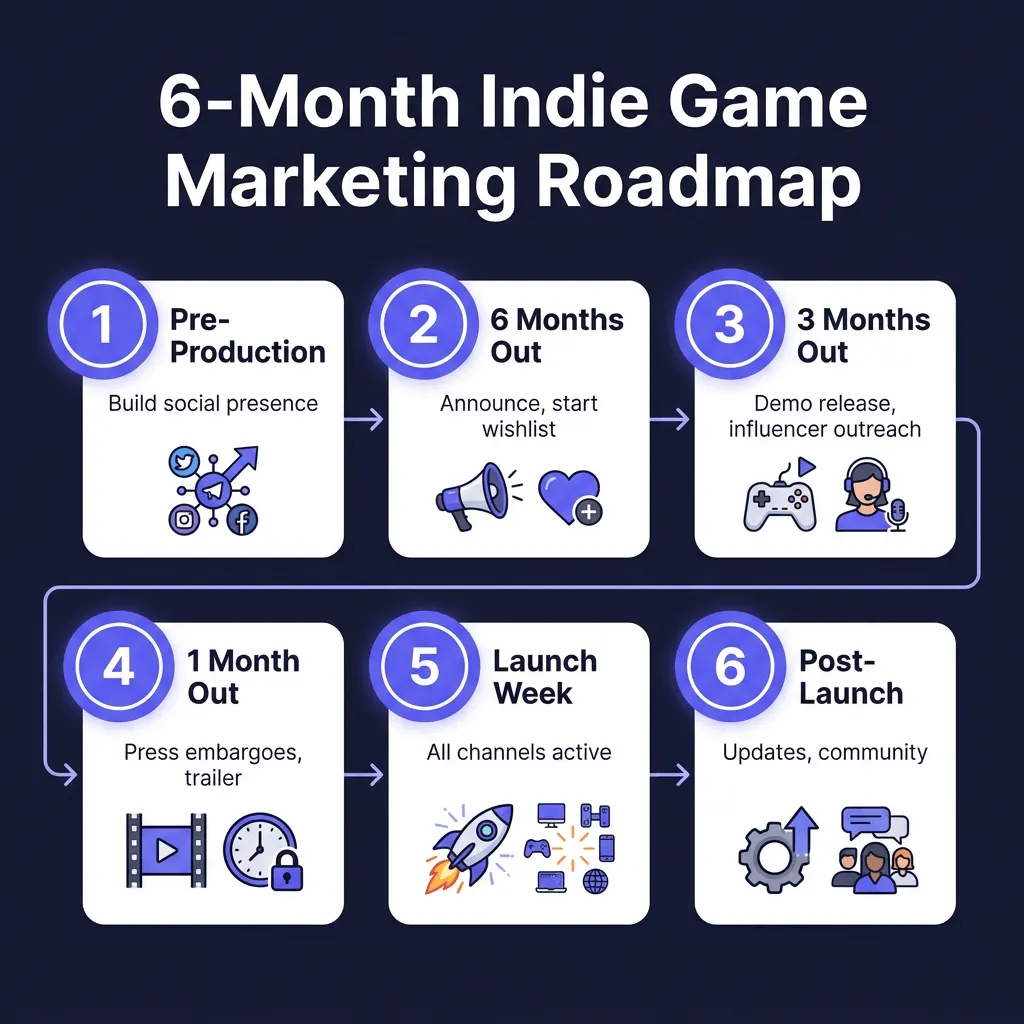
Phase 3: Influencer & Press Outreach (1-3 Months Out)
Third-party validation accelerates discovery exponentially. Here’s how to get coverage:
Influencer Strategy
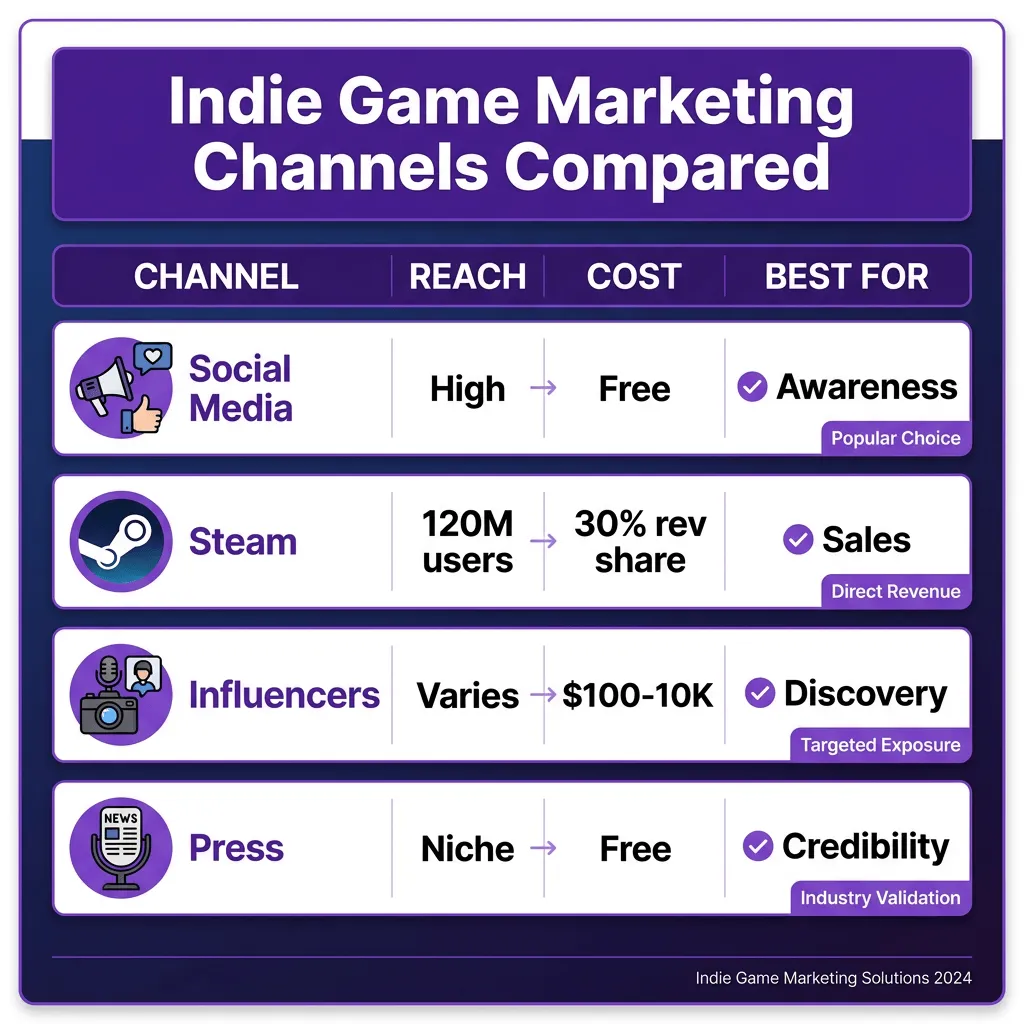
Don’t just target the biggest streamers. Micro-influencers (10K-100K followers) often deliver better ROI:
- Research: Find creators who’ve covered similar games in your genre
- Personalize: Reference specific videos, explain why your game fits their audience
- Provide value: Offer exclusive access, early builds, or co-created content
- Make it easy: Include Steam keys, press kit, one-page game summary
Budget $500-5,000 for sponsored content depending on creator size. Negotiate performance-based deals when possible.
Press Outreach
Gaming press is competitive. Stand out with:
- Newsworthy angles: Unique mechanics, compelling dev story, genre innovation
- Professional press kit: High-res assets, fact sheet, developer bio
- Embargo strategy: Coordinate coverage for maximum launch impact
- Targeted pitches: Research journalists who cover your genre specifically
Use tools like Press Kitty or DIY with a spreadsheet. Start outreach 6-8 weeks before launch.
Phase 4: Launch Week Execution
Launch week determines your game’s trajectory. Execute this checklist:
- Day -7: Send press builds, confirm influencer coverage schedule
- Day -3: Final trailer release, social countdown begins
- Day -1: Discord announcement, email blast to wishlisters
- Launch Day: All-hands on social, respond to every comment and review
- Day +1-7: Monitor metrics, fix critical bugs, engage community constantly
Steam’s algorithm heavily weights launch week performance. High conversion rate and positive reviews in the first 48 hours dramatically improve visibility.
Phase 5: Post-Launch Sustainability
Launch is just the beginning. Sustainable indie games follow this pattern:
- Content updates: Major updates every 2-3 months drive re-engagement
- Discount strategy: Participate in Steam sales strategically, avoid constant discounting
- Community building: Discord events, developer streams, user-generated content
- Platform expansion: Console ports, mobile adaptations, regional pricing optimization
The most successful indie games are live services, not fire-and-forget releases.
Ready to Monetize Your Game Globally?
Join hundreds of indie developers using Fungies.io — automated global tax compliance, 50+ payment methods, and seamless checkout for your game.
No credit card required
Frequently Asked Questions
How much should I budget for indie game marketing?
Budget 20-30% of your total development budget for marketing. Minimum viable marketing spend is $2,000-5,000 for a professional launch. Successful indies often spend $10,000-50,000 on marketing over the game’s lifecycle.
When should I start marketing my indie game?
Start building your audience at least 6 months before launch, ideally 12 months. The earlier you start, the more wishlists you’ll accumulate and the stronger your launch will be.
Do I need a publisher to market my indie game?
No, but publishers help. Self-publishing is viable if you dedicate time to marketing or hire marketing help. Publishers provide expertise, funding, and existing relationships with press and influencers in exchange for revenue share.
What’s the most effective marketing channel for indie games?
Steam itself is the most important channel — optimize your page, drive wishlists, and convert browsers to buyers. Outside Steam, influencer coverage on YouTube and Twitch consistently drives the highest-quality traffic.
How many wishlists do I need for a successful launch?
Aim for 5,000-10,000 wishlists minimum. The conversion rate from wishlist to purchase is typically 10-15% at launch. Top-performing indies launch with 50,000+ wishlists.
Conclusion
Marketing your indie game isn’t about viral tricks or massive ad spends. It’s about consistent execution: building an audience early, optimizing your Steam presence, securing third-party validation, and executing a coordinated launch. The developers who treat marketing as seriously as development are the ones whose games find their audience — and generate sustainable revenue.
Start today. Even if your game is months from release, begin building that audience. The wishlists you collect now become the sales you make at launch.