How to Reduce SaaS Customer Acquisition Cost: The Complete 2026 Guide
Customer acquisition costs have surged 222% in 8 years. Learn 7 proven strategies to reduce your SaaS CAC, optimize your LTV:CAC ratio, and build sustainable growth. Includes 2025 industry benchmarks and channel comparison data.
Here’s a sobering statistic: customer acquisition costs have surged 222% over the past 8 years, with a 60% jump in just the last 5 years alone. If you’re running a SaaS business in 2025, you’re probably feeling this pinch. The median SaaS company now spends $2.00 to acquire every single dollar of new ARR. That’s not sustainable.
But here’s the thing — not every company is struggling equally. Top-quartile SaaS businesses spend approximately $1.00 to acquire $1 of ARR, while fourth-quartile companies burn through $2.82. The difference isn’t luck. It’s strategy.
In this guide, I’ll walk you through exactly how to reduce your SaaS customer acquisition cost without sacrificing growth. These aren’t theoretical ideas — they’re proven tactics I’ve seen work across dozens of SaaS companies.
What Is Customer Acquisition Cost (CAC) in SaaS?
Customer Acquisition Cost (CAC) is the total amount you spend to acquire one new paying customer. Simple enough, right? But most founders miscalculate it.
The proper formula is: Total Sales & Marketing Expenses ÷ Number of New Customers Acquired. This includes salaries, ad spend, software costs, agency fees, content production, event sponsorships — everything. If you spent $50,000 on sales and marketing in Q2 and brought in 250 new customers, your CAC is $200.
Here’s where it gets interesting. There’s “blended CAC” (all customers, including organic) and “paid CAC” (only customers from paid channels). Your blended CAC might look healthy at $200 while your paid CAC through Google Ads is bleeding at $600. You need both numbers to make intelligent decisions.
There’s also “fully loaded CAC” versus “variable CAC.” Fully loaded includes your entire sales and marketing team’s salaries. Variable CAC only includes direct program costs like ad spend. For early-stage companies, focus on fully loaded — it reflects reality. For scaling companies analyzing channel efficiency, variable CAC helps you understand marginal economics.
Why CAC Matters More Than Ever in 2025
Three forces are driving CAC through the roof right now:
- Privacy changes — iOS 14.5 and the ongoing cookie deprecation have destroyed attribution accuracy. You’re flying partially blind, which means wasted spend on channels you can’t properly track.
- Platform saturation — Everyone’s on Google Ads and LinkedIn. Auction prices keep climbing as more SaaS companies compete for the same keywords and audiences.
- Economic headwinds — Buyers take longer to decide. Budget approvals require more stakeholders. Sales cycles stretch from weeks to months. Your CAC payback period extends whether you like it or not.
The average B2B SaaS customer acquisition cost now sits at $702. For enterprise-focused products, that number can easily hit $10,000+. If your LTV:CAC ratio is below 3:1, you’re in trouble. Below 2:1, you’re burning cash with every new customer.
Customer acquisition costs have also risen 14% year-over-year specifically for new customer acquisition, according to Benchmarkit’s 2025 data. Meanwhile, expansion ARR now represents 40% of total new ARR for the average SaaS company — up 5% from the previous year. This shift toward expansion is partly defensive: it’s cheaper to grow existing customers than acquire new ones.
SaaS CAC Benchmarks by Industry (2025 Data)
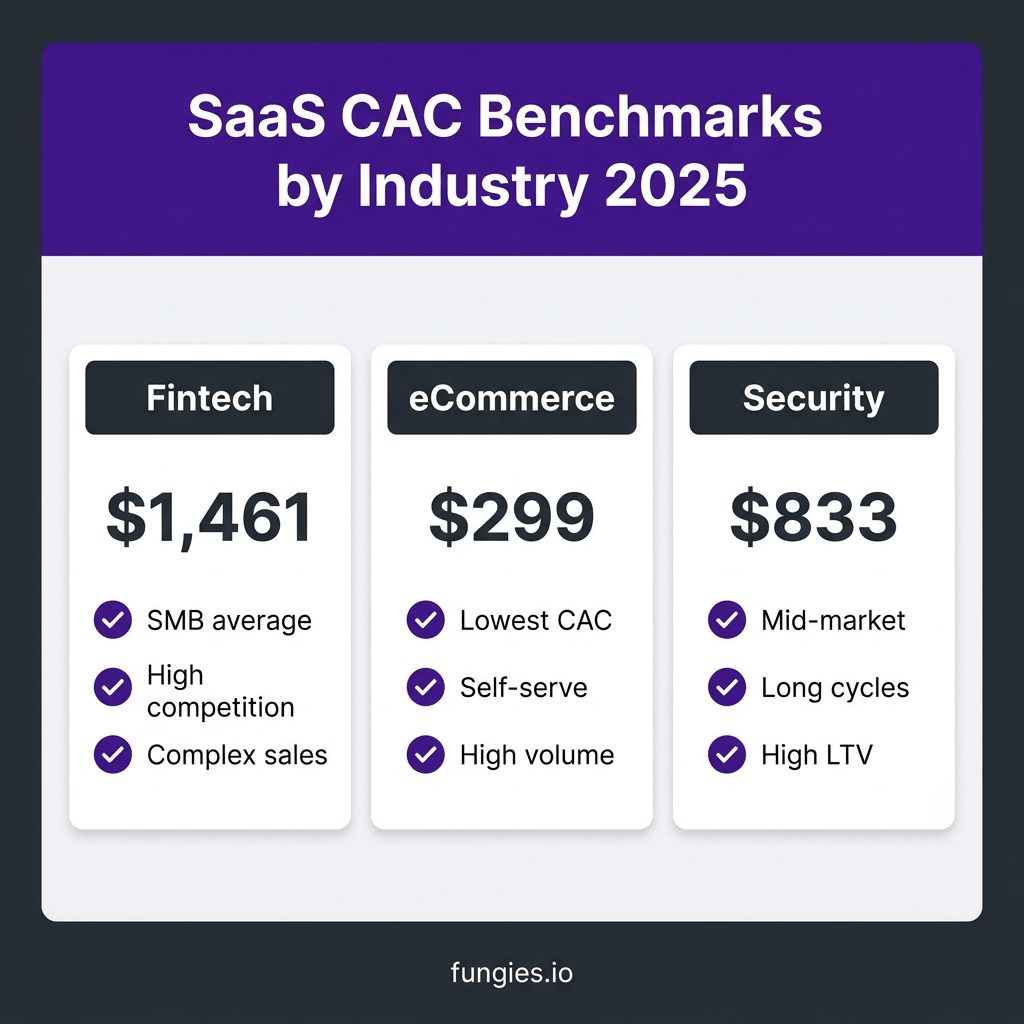
Before you panic about your CAC, understand your industry’s baseline. Here’s what First Page Sage found analyzing over a decade of SaaS data across 583 companies:
| Industry | Small Business | Middle Market | Enterprise |
|---|---|---|---|
| Fintech | $1,461 | $4,923 | $14,774 |
| eCommerce SaaS | $299 | $1,407 | $2,206 |
| Cybersecurity | $833 | $5,330 | $10,226 |
| Project Management | $933 | $2,958 | $7,444 |
| HR Tech | $440 | $1,912 | $6,793 |
| Legaltech | $321 | $2,652 | $6,477 |
| EdTech | $849 | $2,846 | $6,682 |
| Insurance Tech | $1,310 | $4,477 | $11,251 |
| Medtech | $948 | $4,357 | $11,044 |
| Construction Tech | $638 | $4,420 | $7,962 |
Notice the pattern? Fintech pays the highest CAC because the lifetime value justifies it — fintech customers stick around longer and generate more revenue. eCommerce SaaS enjoys lower CAC due to self-serve models and higher velocity. Your target CAC depends entirely on your ACV and retention rates.
Here’s another way to look at it: SMB-focused SaaS typically sees CAC between $200–$400. Mid-market ranges from $1,000–$5,000. Enterprise SaaS can see $5,000–$15,000+. The key question isn’t whether your CAC is high or low — it’s whether your unit economics work.
How to Reduce SaaS CAC: 7 Proven Strategies
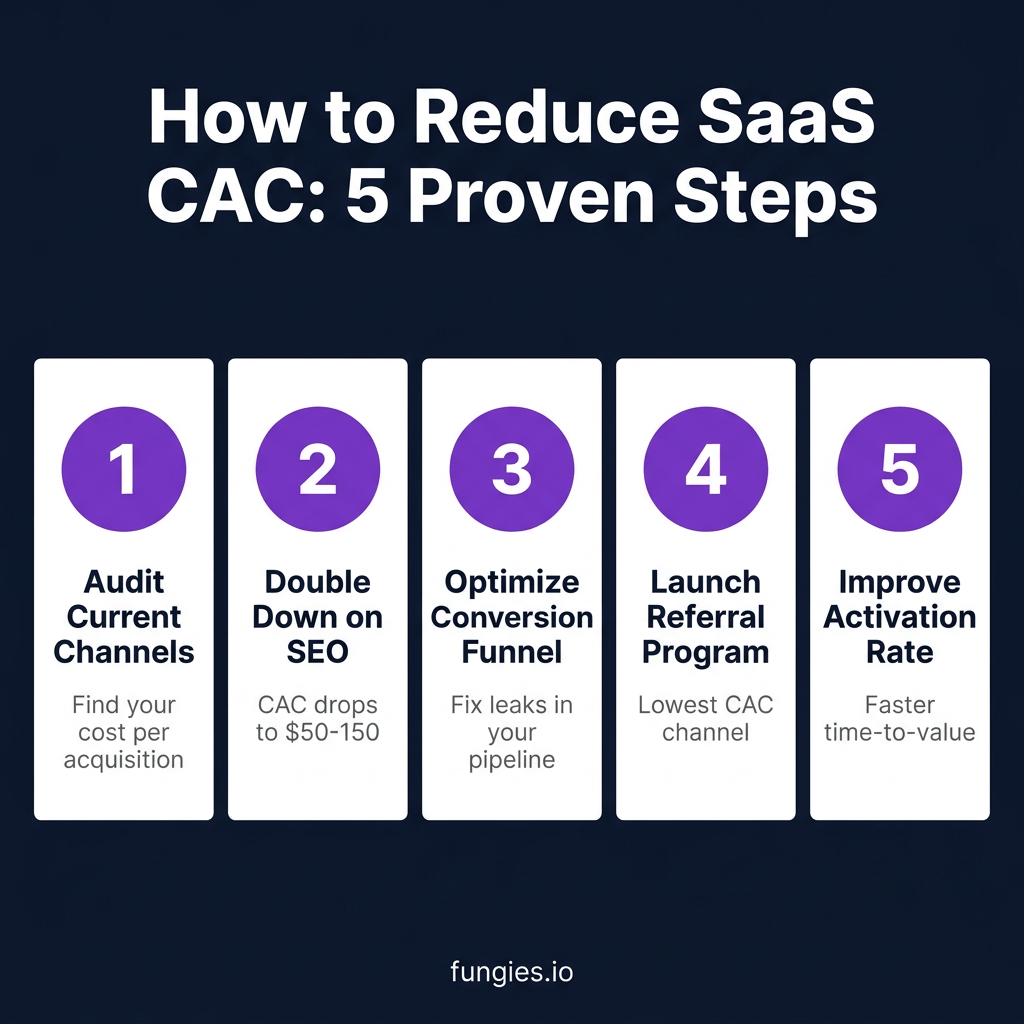
1. Shift Budget to Organic Channels
Here’s a comparison that should wake you up: SEO-driven content marketing typically delivers CAC of $50–$150. Paid search? $200–$500. Event marketing? $400–$800.
The math is brutal. If you’re spending $10K/month on Google Ads with a $300 CAC, that same budget invested in SEO could theoretically acquire 2-6x more customers over time. The catch? SEO takes 6-12 months to mature. But once it does, it compounds.
Honestly, most SaaS companies underinvest in organic. They want immediate results. But immediate results come at a premium price. The companies winning in 2025 started building their content engines two years ago.
Start with bottom-of-funnel content — comparison pages, alternatives posts, use-case guides. These convert faster than top-of-funnel educational content. Target keywords with commercial intent like “best [category] software” or “[competitor] alternative.”
2. Fix Your Conversion Funnel Leaks
You don’t have a traffic problem. You have a conversion problem. I’ve seen SaaS companies double their customer count without spending an extra dollar — just by fixing their onboarding flow.
Start here:
- Audit your trial-to-paid conversion rate. Industry average is 15-25%. If you’re below 15%, fix this first.
- Reduce time-to-value. The faster users experience their “aha moment,” the more likely they convert. Aim for users to see value within the first session.
- Simplify your signup flow. Every extra field drops conversion by 10-15%. Do you really need their phone number upfront?
- Add in-app guidance. Don’t make users figure it out alone. Tooltips, checklists, and progress bars work.
- Send behavioral emails. Trigger messages based on what users do (or don’t do) in your product.
A 20% improvement in trial conversion effectively reduces your CAC by 20%. No ad spend required. Just better product experience.
3. Implement a Referral Program
Referred customers have the lowest CAC of any channel. Period. Dropbox famously grew to 4 million users through referrals. Tesla built a trillion-dollar company with minimal advertising thanks to word-of-mouth.
Your existing customers already know other people like them. They run in the same circles, attend the same events, face the same problems. A warm introduction beats a cold ad every time.
Offer meaningful incentives — account credits work better than cash for SaaS. Make sharing frictionless with one-click invites. Track everything so you know which customers are your best advocates. Double down on them.
Even a modest referral program can reduce blended CAC by 15-30%. The best programs I’ve seen drive 20-40% of new customers organically.
4. Narrow Your ICP and Messaging
Most SaaS companies cast too wide a net. They fear missing potential customers, so they target everyone. The result? Wasted ad spend on poor-fit prospects who churn quickly.
Get specific. Really specific. “B2B SaaS companies” isn’t an ICP. “Series A fintech startups with 10-50 employees using Stripe” is. The tighter your targeting, the higher your conversion rates and the lower your CAC.
Review your highest-LTV customers. What do they have in common? Industry? Company size? Tech stack? Use case? Double down on acquiring more of them specifically. Ignore everyone else — at least for now.
This applies to messaging too. Generic value props don’t convert. Specific ones do. “Save time” is weak. “Reduce churn by 23% in 90 days” is strong. Speak directly to your ICP’s exact pain points.
5. Leverage Product-Led Growth (PLG)
Product-led growth companies typically achieve 2-3x lower CAC than sales-led competitors. Why? Because the product sells itself through free trials, freemium tiers, and viral features.
Calendly didn’t need a massive sales team. Neither did Slack or Notion. Their products created natural distribution mechanisms. Users invited teammates. Teammates became advocates. Growth compounded.
Ask yourself: Can users experience value before paying? Can they invite teammates? Does usage naturally spread within organizations? If not, you’re paying for distribution that could be organic.
PLG isn’t just for consumer products. B2B SaaS companies like Figma, Notion, and Loom have proven it works at scale. The key is removing friction from the first experience.
6. Improve Your CAC Payback Period
It’s not just about lowering CAC. It’s about recovering it faster. The CAC payback period tells you how many months it takes to earn back your acquisition cost.
Here’s the formula: CAC ÷ (Monthly Revenue per Customer × Gross Margin)
If your CAC is $1,000, MRR per customer is $150, and gross margin is 70%, your payback period is 9.5 months. That’s acceptable for enterprise SaaS. For SMB-focused products, you want under 6 months.
Ways to shorten payback period:
- Move customers to annual billing (upfront cash). Offer a discount for annual — even 10-15% off is worth it for the cash flow.
- Implement expansion revenue (upsells, cross-sells). Usage-based pricing naturally creates expansion.
- Reduce churn through better onboarding. Customers who activate in week 1 stay longer.
- Increase pricing for new customers. Most SaaS companies underprice by 20-30%.
The median CAC payback period for SaaS companies is 8.6 months. Top-quartile companies achieve payback in under 6 months. If you’re over 12 months, you’re tying up too much capital in acquisition.
7. Use AI and Automation
AI is reshaping customer acquisition. Companies using AI for targeting and personalization are seeing 30-50% reductions in CAC. Here’s how to leverage it:
- Predictive lead scoring — Focus sales efforts on prospects most likely to convert. Don’t waste time on tire-kickers.
- Dynamic ad creative — AI-generated variations that match user intent. Test hundreds of headlines automatically.
- Chatbots for qualification — Handle initial conversations without human cost. Route only qualified leads to sales.
- Automated email sequences — Nurture leads at scale with personalized messaging based on behavior.
- Content generation — AI-assisted content creation lets you produce more SEO content faster.
The tools are accessible now. You don’t need a data science team. Platforms like Mutiny, Clearbit, and even native ad platform AI can drive significant efficiency gains. Start small, measure results, then scale what works.
CAC by Acquisition Channel: Where to Invest
Not all channels are created equal. Here’s what the data shows for B2B SaaS in 2025:
| Channel | Typical CAC Range | Payback Period | Best For |
|---|---|---|---|
| SEO/Content Marketing | $50–$150 | 6-12 months | Long-term, sustainable growth |
| Referral Programs | $30–$100 | 3-6 months | Lowest CAC, highest LTV customers |
| Google Ads (Search) | $200–$500 | 6-12 months | High-intent, immediate demand |
| LinkedIn Ads | $300–$800 | 9-18 months | B2B targeting, enterprise leads |
| Event Marketing | $400–$800 | 12-24 months | Relationship building, enterprise |
| Cold Email/Outbound | $150–$400 | 6-12 months | Targeted account-based sales |
| Partnerships/Integrations | $100–$300 | 6-9 months | Access to existing user bases |
The smart play? Build your organic engine while using paid channels strategically for immediate wins. Don’t become dependent on platforms you don’t control. Google can change its algorithm. LinkedIn can raise its prices. Your owned channels — email list, content, community — are your insurance policy.
The LTV:CAC Ratio: Your North Star Metric
CAC in isolation is meaningless. You need context. That’s where the LTV:CAC ratio comes in.
3:1 — Minimum threshold for sustainable growth. You’re viable but not thriving. Focus on improving this before scaling aggressively.
4:1 to 5:1 — Ideal zone. Healthy unit economics with room to scale. This is where you want to be.
6:1+ — Very profitable, but possibly underinvesting in growth. You could spend more to grow faster. Don’t leave growth on the table.
Below 3:1? Fix this before scaling. You’re burning cash faster than you’re creating value. Either reduce CAC or increase LTV — or both.
Here’s a framework: If your LTV:CAC is below 3:1, focus on efficiency. If it’s above 5:1, focus on growth. Between 3:1 and 5:1, balance both.
FAQ: Reducing SaaS Customer Acquisition Cost
What is a good CAC for SaaS?
It depends on your ACV and industry. For SMB-focused SaaS, $200–$400 is typical. For mid-market, expect $1,000–$3,000. Enterprise SaaS often sees $5,000–$15,000+. The key is your LTV:CAC ratio — aim for at least 3:1.
How can I lower CAC without reducing marketing spend?
Shift budget from high-CAC channels (paid ads, events) to lower-CAC channels (SEO, referrals). Improve your conversion funnel. Narrow your targeting to higher-intent prospects. Optimize your landing pages. Better efficiency beats bigger budgets.
Why is my CAC increasing?
Common culprits: increased competition in your ad auctions, poor audience targeting, longer sales cycles, economic headwinds reducing buyer urgency, or platform privacy changes hurting attribution. Audit each channel individually to identify the leak.
How long should my CAC payback period be?
For SMB SaaS, aim for under 6 months. Mid-market can stretch to 9-12 months. Enterprise SaaS sometimes sees 12-18 months. Beyond 18 months, you’re tying up too much cash in acquisition.
Is it better to focus on reducing CAC or increasing LTV?
Both matter, but increasing LTV often has higher leverage. A 20% increase in LTV improves your ratio more than a 20% decrease in CAC. Plus, existing customers are easier to expand than new ones are to acquire. Don’t neglect retention and expansion.
How do I calculate CAC for a specific channel?
Channel-specific CAC = (Channel Spend + Allocated Team Costs) ÷ Customers Acquired from Channel. Use multi-touch attribution if possible — most customers interact with multiple channels before converting. First-touch gives credit to awareness channels. Last-touch favors conversion channels. Linear attribution spreads credit evenly.
Conclusion: Sustainable Growth Requires CAC Discipline
Rising customer acquisition costs aren’t going away. Platform competition, privacy changes, and economic uncertainty will keep pressure on CAC for the foreseeable future.
But here’s the opportunity: companies that master efficient acquisition will outcompete those that don’t. While your competitors burn cash on inefficient channels, you’ll be building organic engines, optimizing conversion funnels, and acquiring customers profitably.
Start with an honest audit of your current CAC by channel. Kill what’s not working. Double down on what is. Fix your conversion leaks. Build referral loops. And remember — the goal isn’t the lowest possible CAC. It’s the most sustainable growth engine.
The companies winning in 2026 are making these changes now. Don’t wait for your burn rate to force your hand.
Ready to optimize your SaaS growth? Get started with Fungies.io and focus your resources on what matters — building a product customers love.
Sources
- First Page Sage — B2B SaaS Customer Acquisition Cost: 2025 Report
- Benchmarkit — 2025 SaaS Performance Metrics Benchmarks
- ScaleXP — 2025 SaaS Benchmarks: CAC Payback
- Optifai — B2B SaaS LTV Benchmarks Study (N=939)
- Baremetrics — 10 Ways To Lower Customer Acquisition Costs
- Userflow — 10 Best SaaS Customer Acquisition Strategies for 2025
- Phoenix Strategy Group — CAC Benchmarks by Channel for 2025
- GTM 80/20 — Customer Acquisition Cost Statistics for B2B SaaS