How to Sell Ebooks Online: The Complete 2026 Guide for Authors
Learn how to sell ebooks online in 2026 with this complete guide. Covers best platforms, pricing strategies, tax compliance, and the 5-step process to publish and sell your first ebook.
The ebook market is exploding. In 2026, digital book sales are projected to hit $17.2 billion globally, with self-published authors capturing an ever-larger slice of that pie. Whether you’re a fiction writer, business consultant, or niche expert, selling ebooks online has never been more accessible — or more profitable.
But here’s the reality: most authors struggle not with writing, but with the business side. Where do you sell? How do you price? What about taxes, delivery, and marketing? This guide cuts through the noise and gives you a proven framework to sell ebooks online in 2026.
Why Sell Ebooks Online in 2026?
Before diving into tactics, let’s talk about why ebooks remain one of the best digital products to sell:
- Zero inventory costs: Create once, sell infinitely. No printing, no shipping, no storage.
- High profit margins: Keep 70-95% of each sale depending on your platform.
- Instant delivery: Customers get their book immediately — no waiting, no fulfillment headaches.
- Global reach: Sell to readers in 190+ countries without leaving your desk.
- Passive income potential: A well-written ebook can generate revenue for years with minimal maintenance.
The barriers to entry have never been lower. But that also means competition is fierce. To win, you need a strategy — not just a Word document and a prayer.
The Best Platforms to Sell Ebooks Online
Choosing where to sell is your first major decision. Each platform has trade-offs between reach, control, and fees. Here’s the breakdown:
Amazon Kindle Direct Publishing (KDP)
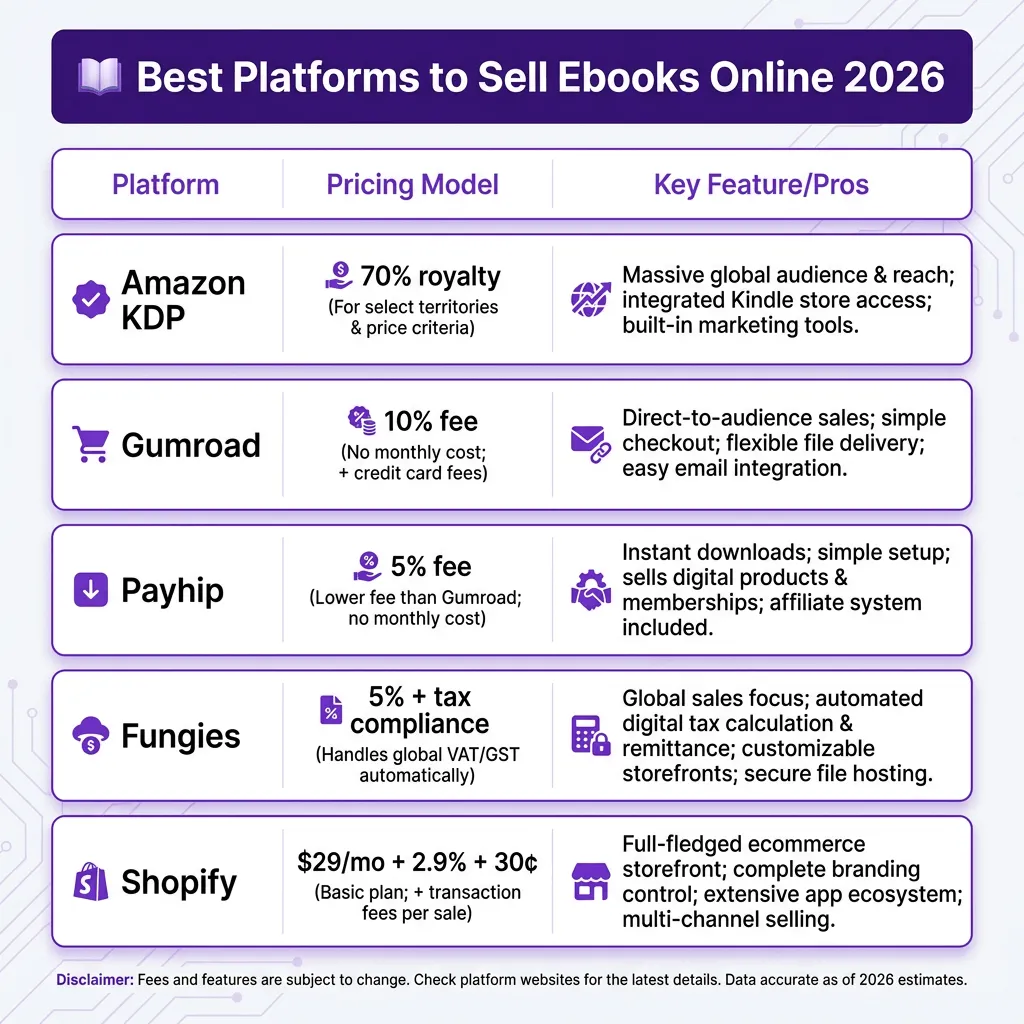
Amazon is the 800-pound gorilla. With 70% royalty rates on books priced $2.99-$9.99 and access to millions of Kindle readers, it’s the default choice for many authors. The downside? You’re competing in a crowded marketplace, and Amazon controls your pricing, reviews, and visibility.
Best for: Fiction authors, genre writers, and anyone prioritizing reach over margins.
Gumroad
Gumroad built its reputation serving creators. It’s dead-simple to use, handles payments globally, and recently lowered fees to 10% + processing. The catch? You’re responsible for your own tax compliance — and trust me, VAT and sales tax get complicated fast when selling internationally.
Best for: Indie creators, designers, and developers who want simplicity and don’t mind handling taxes themselves.
Payhip
Payhip offers a compelling 5% fee structure with no monthly costs. It supports ebooks, courses, and memberships. The platform handles basic EU VAT, but you’ll still need to manage other jurisdictions yourself.
Best for: Budget-conscious authors who want low fees and basic EU tax handling.
Fungies
Full disclosure — I work with Fungies. But here’s why it matters for ebook sellers: Fungies acts as your Merchant of Record. That means they handle all tax compliance — VAT, sales tax, GST — automatically. You get a 5% fee that includes global tax handling, fraud protection, and instant delivery. For authors selling internationally (which you should be), this is a game-changer.
Best for: Authors who want global reach without the tax headaches, and those prioritizing compliance and peace of mind.
Shopify
Shopify gives you maximum control — your own store, your own branding, your own customer data. But that control comes at a cost: $29/month plus 2.9% + 30¢ per transaction, plus you’re on the hook for all tax compliance. For most ebook authors, this is overkill unless you’re building a full author brand with multiple products.
Best for: Established authors with multiple books and products, or those building a full brand ecosystem.
The 5-Step Process to Sell Your First Ebook
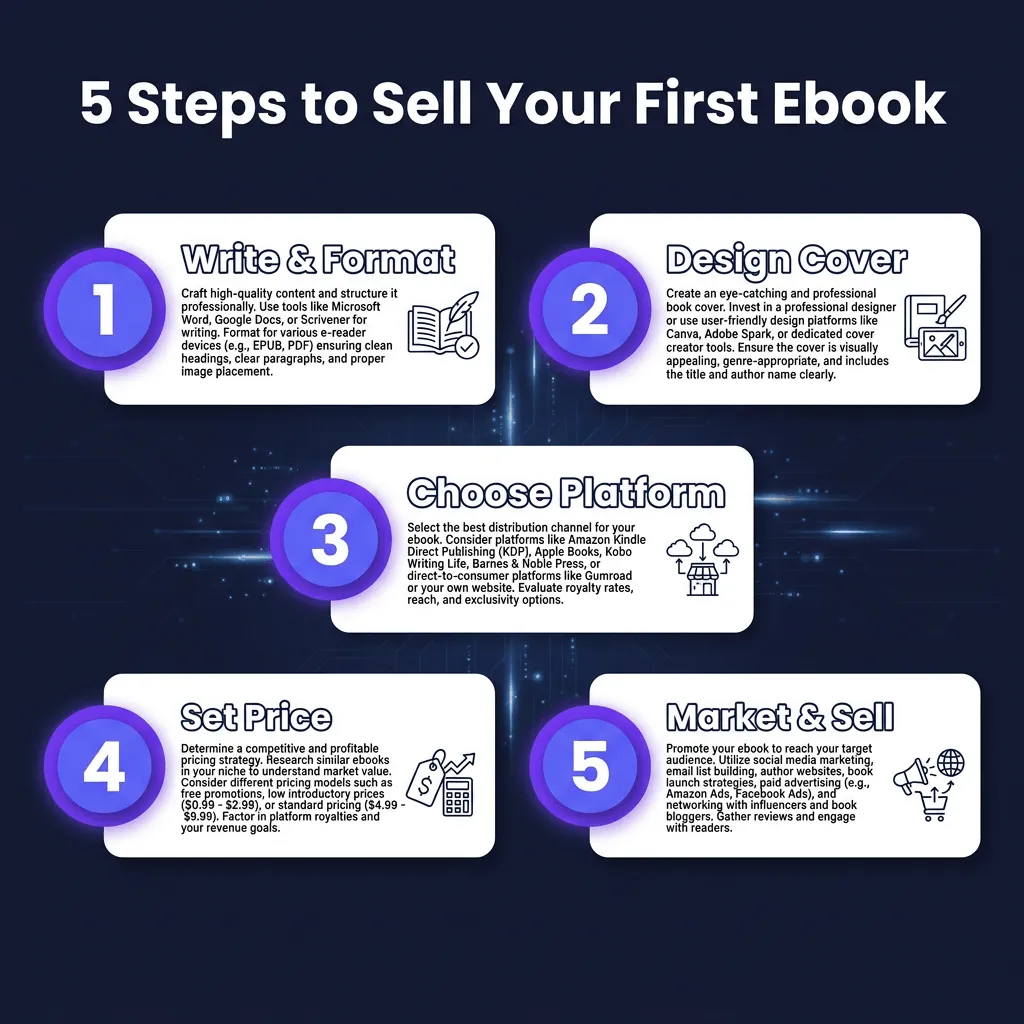
Step 1: Write and Format Your Ebook
Quality matters. In a sea of mediocre content, a well-researched, well-edited book stands out. Aim for at least 10,000 words for non-fiction (enough to deliver real value) or 50,000+ for fiction.
For formatting, use tools like Vellum (Mac), Atticus, or Scrivener. Export to both PDF (for direct sales) and EPUB/MOBI (for Kindle). Test your files on multiple devices before publishing — formatting errors kill credibility.
Step 2: Design a Professional Cover
People absolutely judge books by their covers. A professional cover can mean the difference between a sale and a scroll-past. Budget $100-300 for a designer on 99designs, Reedsy, or Fiverr. Or use Canva Pro if you’re design-savvy.
Your cover needs to:
- Look professional at thumbnail size (most readers will see it small first)
- Match genre expectations (romance covers look different from business covers)
- Include readable title text
- Use high-contrast colors that pop
Step 3: Choose Your Platform and Upload
Based on your goals (reach vs. margins vs. control), pick your primary platform. Don’t try to be everywhere on day one — master one channel first. Upload your files, write a compelling description, set your price, and hit publish.
Pro tip: Write your book description like sales copy. Lead with the transformation or outcome readers will get. Use bullet points for scannability. Include social proof if you have it.
Step 4: Price Strategically
Pricing psychology is real. Here are the norms in 2026:
- Fiction: $2.99-$4.99 for new authors, $4.99-$9.99 for established
- Non-fiction: $9.99-$19.99 depending on depth and niche
- Specialized/technical: $29-$99+ if you’re solving expensive problems
Don’t race to the bottom. A $2.99 book signals low value. Test higher prices — you might be surprised what readers will pay for quality.
Step 5: Market and Sell
“Build it and they will come” is a lie. You need a marketing plan:
- Email list: Start building before you launch. Offer a free chapter or related resource.
- Social media: Share valuable content related to your book’s topic. Don’t just spam links.
- Content marketing: Write blog posts, make videos, or start a podcast around your niche.
- Amazon ads: If on KDP, AMS ads can drive visibility.
- Cross-promotion: Partner with other authors in your niche for newsletter swaps.
The authors who win treat their book like a business, not a hobby.
Ready to Sell Your Ebooks Without the Tax Headaches?
Join hundreds of creators using Fungies.io — automated tax compliance, instant ebook delivery, and global payments handled for you.
No credit card required • 5% fee includes everything
Tax Compliance: The Hidden Landmine
Here’s something most guides won’t tell you: selling ebooks internationally creates tax obligations. When you sell to customers in the EU, you owe VAT. Many US states require sales tax collection. Australia has GST. Canada has GST/HST.
Each jurisdiction has different thresholds, rates, and filing requirements. Get it wrong, and you face penalties. Get it right manually, and you’ll spend hours on paperwork instead of writing.
This is why platforms that handle tax compliance as a Merchant of Record exist. They collect, remit, and file taxes on your behalf. You get a clean 1099 or equivalent at year-end. For serious ebook sellers, this isn’t optional — it’s essential.
FAQ
Do I need an ISBN to sell ebooks?
No. ISBNs are required for print books in most countries, but ebooks don’t need them on most platforms. Amazon assigns its own ASIN, and direct sales platforms don’t require ISBNs.
Can I sell the same ebook on multiple platforms?
Yes, with caveats. If enrolled in KDP Select (Amazon’s exclusivity program), you can’t sell elsewhere for 90 days. Outside of Select, you’re free to sell on multiple platforms. Many successful authors use Amazon for reach and direct sales (via Gumroad, Fungies, etc.) for higher margins.
How do I protect my ebook from piracy?
Short answer: you can’t completely. DRM (digital rights management) exists but annoys legitimate customers and doesn’t stop determined pirates. Focus on making purchasing easier than pirating, and use watermarked PDFs for direct sales.
What’s the best ebook format?
For direct sales: PDF (universal compatibility) + EPUB (for e-readers). For Amazon: MOBI (though KDP now accepts EPUB and converts automatically).
How long should my ebook be?
Long enough to deliver on your promise. Non-fiction: 10,000-30,000 words for most topics. Fiction: 50,000+ for novels, 20,000-30,000 for novellas. Quality beats quantity — a tight 15,000-word book beats a padded 50,000-word book.
Conclusion
Selling ebooks online in 2026 is straightforward but not easy. The tools exist. The market exists. The opportunity exists. What separates successful authors from struggling ones is execution — writing quality content, choosing the right platform, pricing strategically, and marketing consistently.
Don’t let tax complexity or technical hurdles stop you. Platforms like Fungies exist specifically to handle the messy parts — compliance, payments, delivery — so you can focus on what you do best: writing.
Your first ebook won’t be perfect. Your first launch won’t be massive. But start anyway. The authors winning in 2026 are the ones who started in 2025.
Ready to sell? Create your free Fungies account and publish your first ebook today.