How to Set Up an Affiliate Program for Your Digital Product or SaaS (2026 Guide)
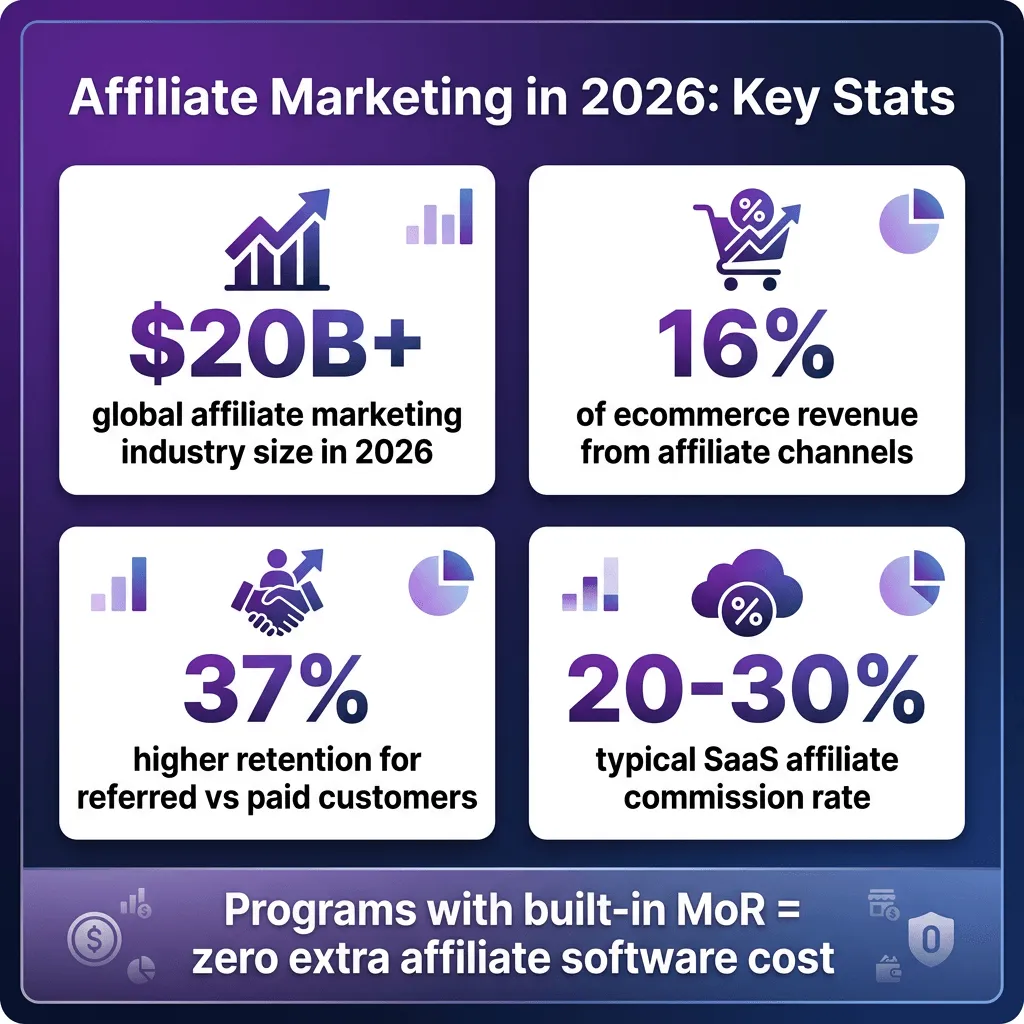
Here’s a stat most founders ignore until it’s too late: affiliate marketing now drives 16% of all ecommerce revenue globally, and the overall industry is projected to surpass $20 billion in 2026. If you’re selling a digital product or SaaS and you don’t have an affiliate program, you’re leaving a measurable chunk of revenue on
Here’s a stat most founders ignore until it’s too late: affiliate marketing now drives 16% of all ecommerce revenue globally, and the overall industry is projected to surpass $20 billion in 2026. If you’re selling a digital product or SaaS and you don’t have an affiliate program, you’re leaving a measurable chunk of revenue on the table every single month.
The good news? Setting up an affiliate program for your digital product or SaaS is far simpler than it used to be — especially if you’re already using a Merchant of Record that has affiliate management baked in. This guide walks you through every step: commission structure, tracking software, recruiting affiliates, and what to avoid.
Why Affiliate Programs Work for Digital Products and SaaS
Affiliate marketing is performance-based, which means you only pay when a sale happens. For SaaS founders, that’s an unusually clean unit economics story: you set the commission, you own the product, and your affiliates drive targeted traffic that you’d otherwise pay for through ads.
Three reasons digital products and SaaS are particularly well-suited to affiliate programs:
- Zero marginal cost: Selling one more license or download costs you almost nothing, so you can afford generous commissions and still come out ahead.
- Recurring revenue creates recurring commissions: A 20–30% recurring commission on a $49/month subscription plan compounds quickly — affiliates are motivated to send quality traffic, not just one-time clicks.
- Referred customers retain better: Research consistently shows referred customers have a 37% higher retention rate than those acquired through paid channels. Your LTV math improves, not just your CAC.
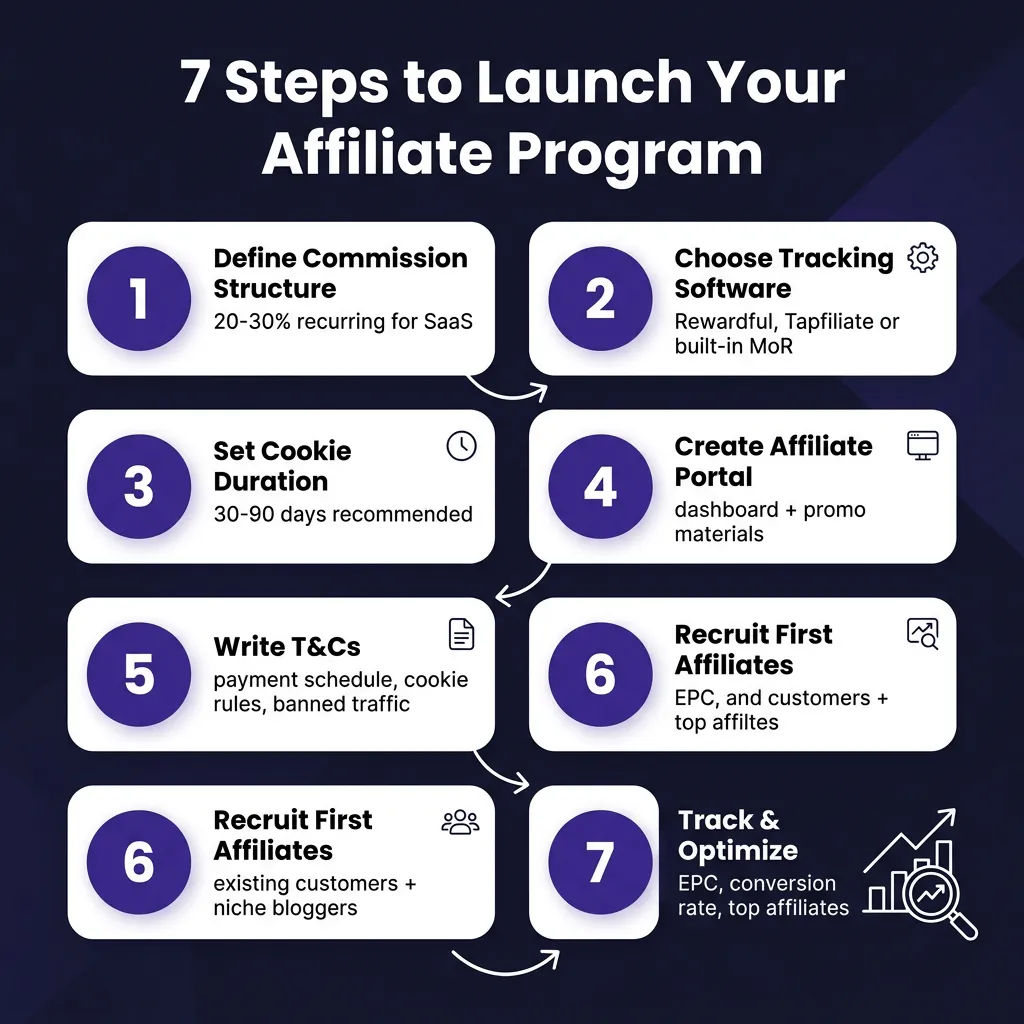
Step 1: Define Your Commission Structure Before You Build Anything
Commission structure is the most important decision you’ll make. Get it wrong and you’ll either bleed margin or fail to attract any decent affiliates at all.
Here’s what the data says about SaaS affiliate commissions in 2026:
| Commission Type | Typical Rate | Best For | Payout Example |
|---|---|---|---|
| Recurring % | 20–30% monthly | Subscription SaaS | $10/mo on a $49/mo plan |
| One-time CPA | 100–200% of first month | High-ticket SaaS or courses | $50–100 flat per sale |
| Tiered recurring | 20% → 30% → 40% | High-volume affiliate incentives | Escalates with referral count |
| Revenue share (lifetime) | 15–25% lifetime | Premium/exclusive affiliates | Pays as long as customer stays |
For most indie SaaS founders, a 20–30% recurring commission is the sweet spot. It’s competitive enough to attract bloggers and newsletter operators, and it’s sustainable at a $49–$99/month price point. If you’re selling a digital product (course, template, tool), a flat CPA of $20–$50 works well and is simpler to track.
One thing people miss: set a minimum payout threshold ($50–$100) and a clear payment schedule (monthly, net 30) up front. Ambiguity here kills trust with affiliates fast.
Step 2: Choose Your Affiliate Tracking Software (Or Use a Built-In MoR)
This is where most founders overthink it. You have two options:
Option A: Dedicated Affiliate Software
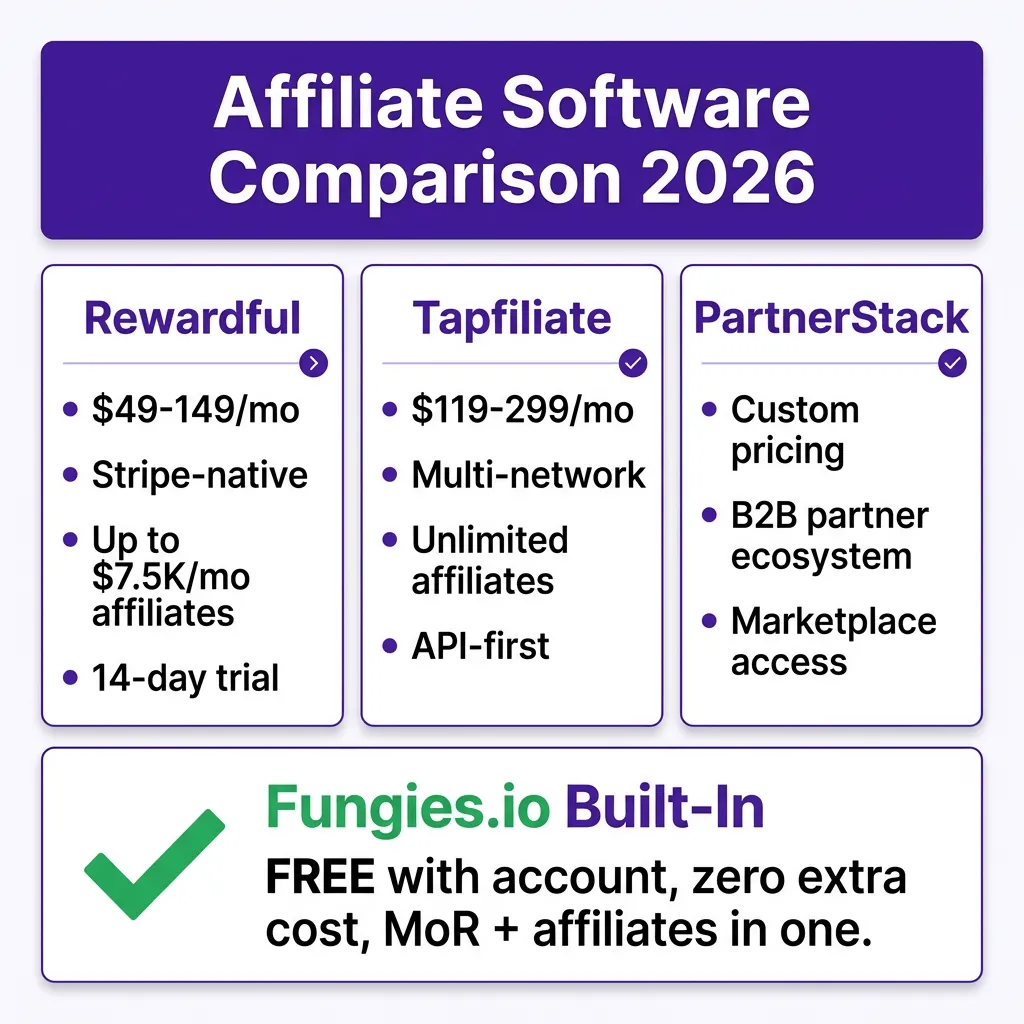
If you’re already on Stripe and want a standalone solution, here’s the honest comparison:
| Tool | Price | Best For | Key Limitation |
|---|---|---|---|
| Rewardful | $49–$149/mo | Stripe-native SaaS | Capped affiliate revenue on lower plans ($7.5K/mo on Starter) |
| Tapfiliate | $119–$299/mo | Multi-channel, API-heavy setups | More complex, higher floor cost |
| PartnerStack | Custom pricing | B2B SaaS partner ecosystems | Expensive, overkill for <$1M ARR |
| Refgrow / Affonso | $19–$49/mo | Bootstrapped founders | Fewer integrations |
Rewardful is the most popular choice for early-stage SaaS — clean Stripe integration, reasonable pricing, gets you live in under an hour. Tapfiliate is better if you have multiple products or want webhook-level control. PartnerStack makes sense when you’re managing 100+ active affiliates and running a proper partner program, not just tracking links.
Option B: Use a Merchant of Record with Built-In Affiliate Management
Here’s something most “how to set up affiliate programs” articles won’t tell you: if you’re using a Merchant of Record like Fungies.io to handle global tax compliance and payments, you may already have affiliate tracking built in at no extra cost.
This matters more than it sounds. When your payment processor is also your affiliate platform:
- Attribution is exact — no cookie mismatch between your affiliate tool and payment processor
- Payouts are handled directly from the same system that processes revenue
- You don’t pay $50–$150/month for a separate SaaS just to track links
- Global tax handling (VAT, GST, US sales tax) is still covered — affiliates don’t complicate your compliance
For most indie SaaS founders and digital product creators who are already thinking about global compliance, an MoR with built-in affiliate tools is the cleanest architecture. One platform, one dashboard, zero extra subscription fees.
Step 3: Set Your Cookie Duration and Attribution Rules
Cookie duration determines how long after a click an affiliate gets credit for a conversion. Industry standard has shifted in 2026:
- 30 days: Minimum acceptable. Most products with free trials need at least this long for the user to convert.
- 60–90 days: The sweet spot for SaaS with longer evaluation cycles (annual billing, team decisions).
- Lifetime cookies: Used by premium programs (e.g., ConvertKit, Notion). Creates very loyal affiliates but is harder to audit for fraud.
A few attribution rules you need to decide up front:
- Last-click vs first-click: Most platforms default to last-click. Some affiliates will argue for first-click if they’re early in the funnel. Pick one and put it in your T&Cs.
- Self-referrals: Explicitly ban affiliates from using their own link to buy, or automate detection. It’s the #1 abuse vector.
- Coupon stacking: Decide whether affiliate links stack with discount codes. Usually better to separate them.
Step 4: Build Your Affiliate Portal and Promo Materials
Affiliates are lazy. That’s not an insult — it’s just reality. The programs that perform best make it insultingly easy to start promoting. Here’s your bare-minimum launch kit:
| Asset | Format | Notes |
|---|---|---|
| Affiliate dashboard | Web portal | Show clicks, conversions, earnings, payout history in real time |
| Pre-written email swipe | 3–5 email templates | Newsletter operators will use these verbatim — make them good |
| Banner ads | PNG/SVG, 3–4 sizes | 728×90, 300×250, 160×600 are most commonly used |
| Product screenshots | PNG, 1280px wide | Real UI screenshots, not stock photos |
| 30-second pitch | Plain text | What you do, who it’s for, the main benefit in 2–3 sentences |
| Unique affiliate link | Tracking URL | Each affiliate gets their own — ideally with custom slug option |
Don’t overthink the portal design. Affiliates care about two things: can I see my earnings in real time? and do I get paid on time? Answer both clearly and you’re ahead of 80% of programs out there.
Step 5: Write Your Affiliate Terms and Conditions
This is not optional. Without clear T&Cs, you have no recourse when an affiliate starts spamming your brand name in Google Ads or buying fake traffic.
Your affiliate T&Cs should cover at minimum:
- Eligible traffic sources (organic, content, email — not PPC on your brand name)
- Self-referral prohibition (affiliate cannot use their own link)
- Cookie rules (last-click, 60-day, no stacking without permission)
- Payment terms (monthly, net 30, minimum $50 payout, PayPal/wire/Stripe)
- FTC disclosure requirement (affiliates must disclose paid relationships)
- Termination clause (you can remove affiliates for fraud or T&C violations)
- Chargeback policy (commissions reversed on chargebacks or refunds within 30 days)
Keep it readable. A 15-page legal document will scare off legit affiliates. A 1–2 page plain-English T&C doc with the above points is enough for 95% of use cases.
Step 6: Recruit Your First 10–20 Affiliates
Cold outreach to random bloggers is a grind with poor ROI. The best early affiliates are almost always people already connected to your product:
- Your existing customers. Email your happiest customers first. They already get the product, they already talk about it in Slack groups and on Twitter. Converting them into paid affiliates takes one email.
- Newsletter operators in your niche. Find newsletters covering “indie hackers,” “digital products,” “SaaS tools,” or whatever fits your product. A $50 CPA or 25% recurring commission is genuinely interesting to a newsletter with 5,000 engaged subscribers.
- Bloggers ranking for your keywords. If someone wrote “Best tools for selling digital products in 2026,” they’re already speaking to your exact audience. Reach out with a custom pitch and your affiliate deck.
- YouTubers and creators in your space. Software review channels are primed for affiliate deals — they already create “best of” content and their audiences trust their recommendations.
For outreach, keep it short: who you are, what the product does, commission terms, link to sign up. Three sentences, not three paragraphs.
Step 7: Track, Optimize, and Scale
Once you’re live, the metrics that actually matter:
| Metric | What It Tells You | Benchmark (SaaS) |
|---|---|---|
| EPC (Earnings Per Click) | Quality of affiliate traffic | $0.50–$2.00 is healthy for SaaS |
| Conversion rate (click → trial) | How well your landing page converts affiliate traffic | 2–5% is typical |
| Trial-to-paid conversion | Overall product quality signal | 15–30% for self-serve SaaS |
| Active affiliate rate | % of affiliates who sent ≥1 conversion last 90 days | 20–30% is normal (most are passive) |
| Affiliate-driven % of MRR | Channel impact on overall revenue | Target 10–20% within 12 months |
Most programs have a Pareto distribution: 20% of affiliates drive 80% of revenue. Identify that top 20% early and invest in them — exclusive bonuses, early access to new features, higher commission tiers. The long tail of passive affiliates isn’t worth much optimization energy.
Common Mistakes That Kill Affiliate Programs
- Setting commissions too low. A 5% one-time commission won’t attract anyone with an audience worth having. Be generous upfront — you can always tighten it later for new signups.
- Slow or unreliable payouts. Nothing kills an affiliate relationship faster than a late payment or unexplained reversal. Pay on time, every time, with a clear breakdown.
- No affiliate communication. Send a monthly email to your affiliates: what’s new, any promo assets, tips on what’s converting. Programs that go dark lose active affiliates to competitors.
- Ignoring fraud signals. A sudden spike in clicks from a single affiliate with zero conversions is usually a bot or click farm. Most tracking software has fraud detection — use it.
Key Takeaways
- Start with a 20–30% recurring commission for SaaS and a flat $20–$50 CPA for digital products — these are the sweet spots that attract real affiliates
- Rewardful ($49/mo) is the fastest path to launch if you’re on Stripe; if you use a Merchant of Record like Fungies, you may already have affiliate tools built in at zero extra cost
- Cookie duration of 60–90 days is the right default for SaaS with free trial funnels
- Your first 10 affiliates should be existing customers — reach out personally, not through a mass email blast
- Track EPC and active affiliate rate monthly; the top 20% of affiliates drive most revenue — double down on them
FAQ: Setting Up an Affiliate Program for SaaS and Digital Products
How much does it cost to set up an affiliate program for my SaaS?
Dedicated tools like Rewardful start at $49/month. Tapfiliate runs $119–$299/month. If you’re using a Merchant of Record that includes affiliate management (like Fungies.io), the affiliate tracking is included in your existing payment processing setup, so the marginal cost is zero. Total program cost depends on commissions paid, which is variable and only triggered by actual sales.
What’s a good affiliate commission rate for digital products in 2026?
For subscription SaaS: 20–30% recurring is the market standard. For one-time digital products (courses, templates, tools): 30–50% one-time CPA or 100–200% of the first month’s value. Higher commissions attract more affiliates; the ceiling is your margin. At a typical SaaS gross margin of 70–80%, even a 30% recurring commission leaves you strongly profitable.
Do I need a Merchant of Record to run an affiliate program?
No — you can run affiliate tracking on top of Stripe or any payment processor. But if you’re selling globally, a Merchant of Record handles VAT, GST, and US sales tax compliance, which is a separate and significant compliance problem. Using an MoR that also handles affiliate tracking just means one less SaaS subscription and one less point of potential attribution mismatch between your payment data and affiliate dashboard.
How do I find affiliates for a brand new SaaS product?
Start with your existing users — email your happiest customers directly. Then look for newsletter operators, bloggers, and YouTubers who already cover your niche. Search for “[your category] alternatives 2026” or “[competitor name] vs” articles — those authors are perfect affiliate targets. Cold outreach with a short, specific pitch and clear commission terms is all you need. Most programs that fail do so because they don’t actively recruit; the affiliates don’t come to you.
Conclusion
An affiliate program is one of the highest-ROI marketing investments a digital product or SaaS business can make in 2026. You define the economics, you only pay on results, and the affiliates you recruit do the hard work of content creation and audience building for you.
Start simple: pick a commission structure, get tracking live (Rewardful for Stripe users, or your MoR’s built-in tools), write a 1-page T&C, and email five of your happiest customers this week. You’ll have your first affiliate-driven sale within 30 days.
If you’re looking for a payment platform that handles global tax compliance and affiliate management without juggling two separate tools, try Fungies.io free — get your first affiliate program live today.
References
- Tapfiliate: How to Calculate SaaS Affiliate Commissions (2026)
- Rewardful: How to Create an Affiliate Program for SaaS (2026)
- Reditus: How to Set Up an Affiliate Program (SaaS Edition)
- Digital Applied: Affiliate Marketing Statistics 2026 (130+ data points)
- FindAffiliates: Tapfiliate vs Rewardful vs PartnerStack (2026)