Merchant of Record for SaaS: The Complete 2026 Guide
A complete guide to Merchant of Record (MoR) for SaaS companies. Learn what an MoR is, how it differs from payment processors, real pricing comparisons for 2026, and when you actually need one. Includes pros, cons, and platform recommendations.
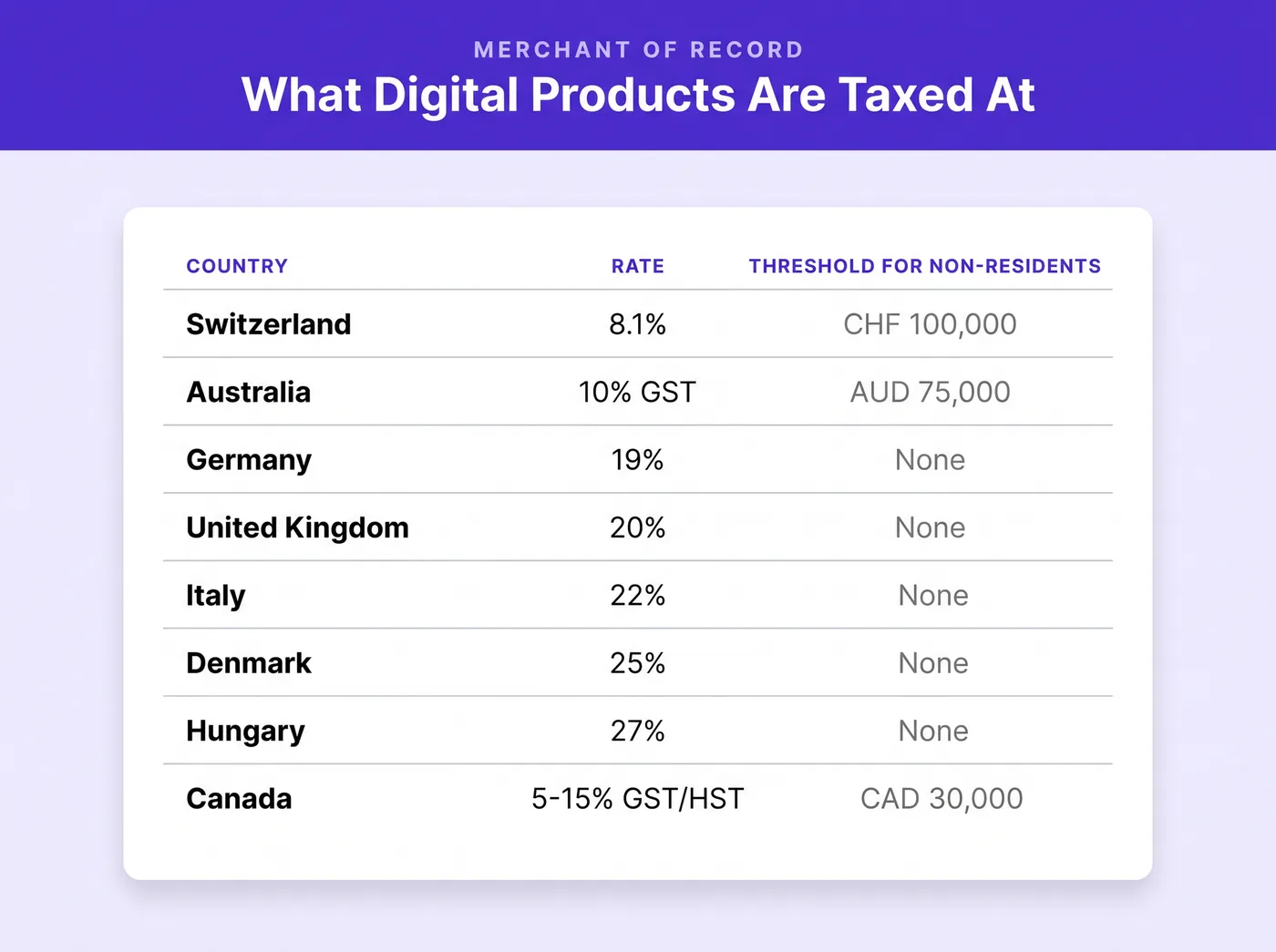
Here’s a hard truth: most SaaS founders underestimate how much time they’ll lose dealing with payments, taxes, and compliance. You’re building a product, not a tax department. Yet somehow, you end up researching VAT rates for 30+ countries and filing sales tax returns in states you’ve never visited.
That’s where a Merchant of Record (MoR) comes in. It’s not just a payment processor — it’s a complete compliance and payments partner that legally sells on your behalf, handles all the tax complexity, and lets you focus on what actually matters: growing your SaaS.
In this guide, I’ll break down exactly what a Merchant of Record is, when you actually need one (vs just a payment processor), the real costs involved, and how to choose the right MoR for your SaaS in 2026. I’ve included real pricing data, comparison tables, and the lessons I’ve learned from working with multiple MoR platforms.
What Is a Merchant of Record?
A Merchant of Record (MoR) is a third-party entity that legally acts as the seller of your products or services. When a customer buys from your SaaS, they’re technically buying from the MoR — not from you directly. The MoR then handles everything: payment processing, tax calculation and collection, tax filing, fraud prevention, chargebacks, and compliance with local regulations.
Think of it this way: with a traditional payment processor like Stripe, you are the merchant. You’re responsible for calculating the right VAT rate for a customer in Germany, filing quarterly sales tax returns in Texas, and dealing with chargeback disputes. With an MoR, they become the merchant. You hand off all that operational and legal complexity.
Here’s what an MoR actually does for your SaaS:
- Payment processing: Accepts credit cards, PayPal, Apple Pay, and local payment methods globally
- Tax compliance: Calculates, collects, and remits VAT, GST, and sales tax in every jurisdiction
- Legal liability: Assumes responsibility for payment compliance, fraud, and chargebacks
- Global expansion: Enables instant international sales without setting up local entities
- Subscription management: Handles recurring billing, upgrades, downgrades, and cancellations
- Customer support: Often provides billing and payment support to your end customers
The key difference? Liability. An MoR takes on legal and financial responsibility for the transaction. A payment processor just moves money.
Merchant of Record vs Payment Processor: What’s the Actual Difference?
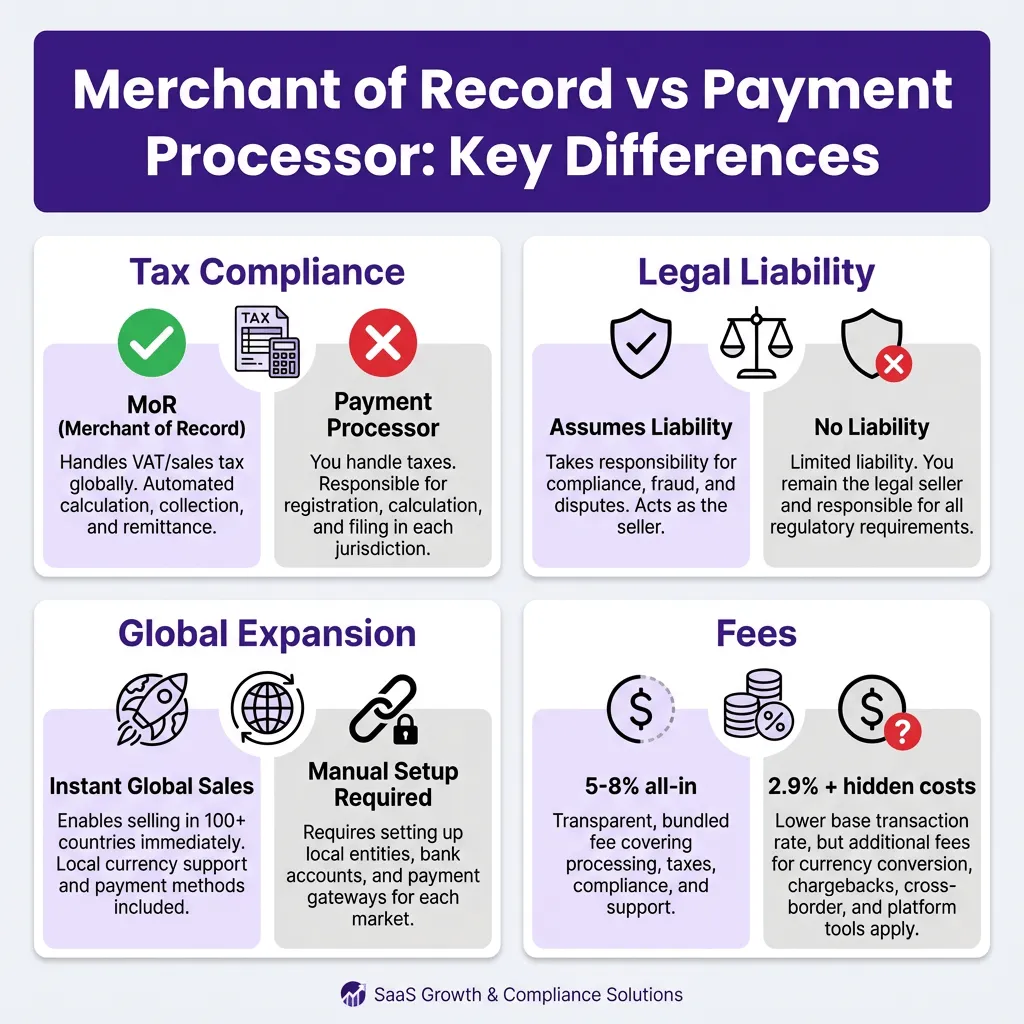
This is where most SaaS founders get confused. Stripe, PayPal, and Braintree are payment processors. Paddle, Fungies, and Lemon Squeezy are Merchants of Record. They look similar on the surface — you integrate an API, customers can pay — but the underlying model is completely different.
| Feature | Merchant of Record (MoR) | Payment Processor (Stripe, PayPal) |
|---|---|---|
| Tax Compliance | ✅ Handles VAT, GST, sales tax calculation, collection, and filing | ❌ You handle everything (or pay for TaxJar/Avalara) |
| Legal Liability | ✅ MoR assumes liability for transactions | ❌ You retain full liability |
| Global Expansion | ✅ Instant global sales, no local entities needed | ⚠️ You must handle international compliance yourself |
| Fraud & Chargebacks | ✅ MoR manages fraud prevention and disputes | ⚠️ You handle disputes, MoR may offer tools |
| Pricing Model | 5-8% all-in (includes tax compliance) | 2.9% + $0.30 + tax compliance tools extra |
| Payment Methods | ✅ Local methods included (iDEAL, SEPA, etc.) | ⚠️ May require additional integrations |
| Customer Billing Support | ✅ Often included | ❌ You handle all support |
| 1099-K / Tax Forms | ✅ MoR handles reporting | ❌ You handle all tax reporting |
Here’s the real question: is the higher fee worth it?
For most early-stage SaaS companies selling globally, yes. Here’s why:
With Stripe alone: You pay 2.9% + $0.30 per transaction. But then you need TaxJar ($19-99/month) for sales tax automation, a VAT compliance service for Europe (£50-200/month), fraud prevention tools ($50-200/month), and potentially a virtual merchant account for international payments. Once you add it all up and factor in the 10-20 hours/month you’ll spend managing this, the MoR’s 5-8% fee starts looking reasonable.
With an MoR: You pay 5-8% all-in. No monthly fees. No surprise costs. No late-night panic about whether you charged the right VAT rate for a customer in Poland.
How Merchant of Record Works: The 5-Step Process
Let me walk you through exactly what happens when a customer buys your SaaS through an MoR:
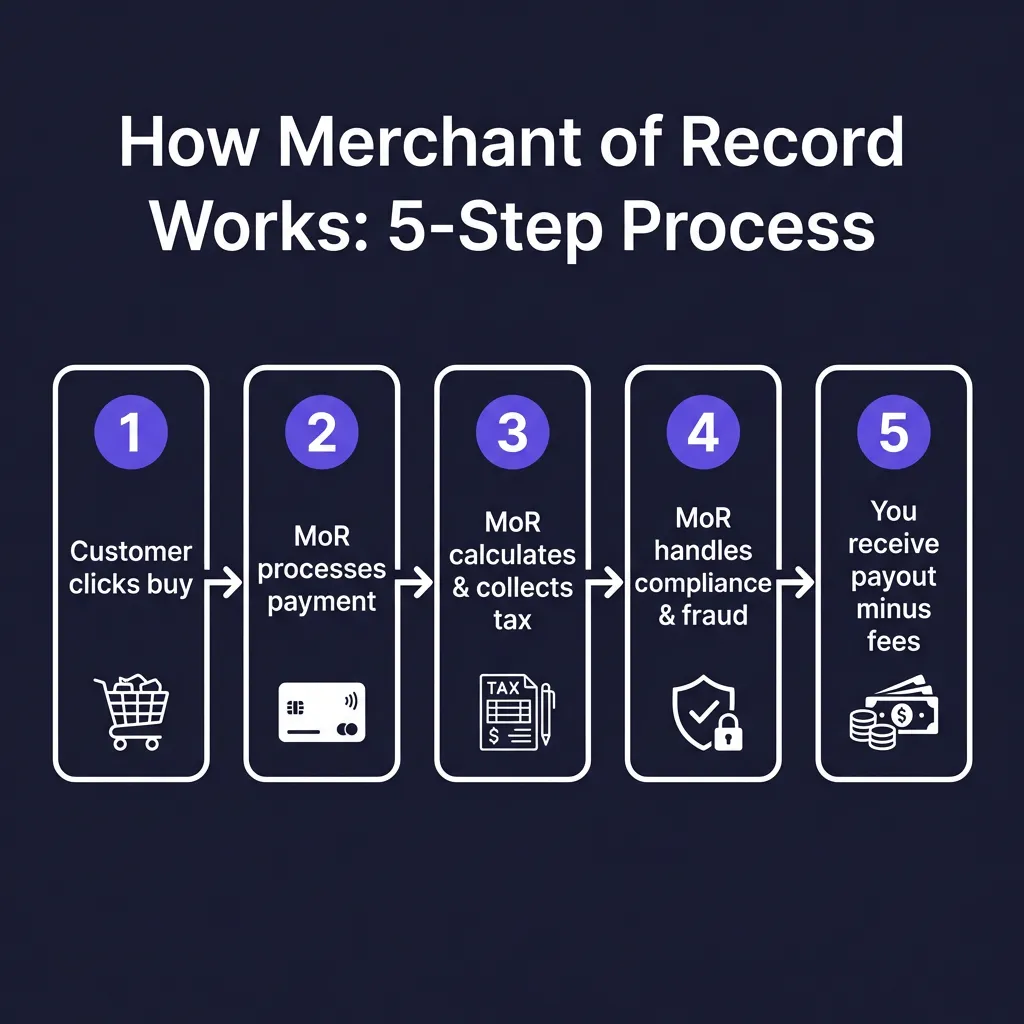
Step 1: Customer Clicks Buy
Your customer visits your pricing page and clicks “Subscribe.” They enter their email and payment details into a checkout form (hosted by the MoR or embedded in your site via API).
Step 2: MoR Processes Payment
The MoR’s system processes the payment using their payment infrastructure. They handle PCI compliance, tokenization, and secure storage of payment data — not you.
Step 3: MoR Calculates & Collects Tax
Based on the customer’s location, the MoR automatically calculates the correct VAT, GST, or sales tax rate. They add it to the transaction and collect it from the customer. You don’t need to maintain a database of tax rates or worry about nexus thresholds.
Step 4: MoR Handles Compliance & Fraud
The MoR runs fraud checks, manages 3D Secure authentication where required, and assumes liability for the transaction. If there’s a chargeback, they handle the dispute process.
Step 5: You Receive Payout Minus Fees
After the transaction settles (typically on a weekly or monthly schedule), the MoR sends you a payout minus their fees. They provide a detailed report showing transactions, fees, taxes collected, and net revenue.
When Do You Actually Need a Merchant of Record?
Not every SaaS needs an MoR. Here’s when it makes sense — and when you can stick with a basic payment processor:
✅ You SHOULD use an MoR if:
- You sell globally: Even 10-20% of revenue from outside your home country means tax complexity
- You’re early-stage (under $50k MRR): You can’t afford a dedicated finance person to handle compliance
- You sell digital products or SaaS: Digital goods have complex VAT rules (reverse charge, MOSS, etc.)
- You want predictable pricing: All-in fees beat surprise tax compliance costs
- You’re selling in the EU or UK: VAT compliance alone is worth the MoR fee
- You want to focus on product, not payments: Your time is better spent building features
❌ You might NOT need an MoR if:
- You only sell domestically: No international tax complexity
- You’re B2B enterprise only: Your customers handle their own reverse-charge VAT
- You need full control over checkout UX: MoRs have less customization than self-hosted Stripe
- You have a dedicated finance team: You can handle compliance in-house
- You’re processing $500k+ monthly: At this scale, negotiating custom Stripe pricing + hiring a tax specialist might be cheaper
Honestly, most SaaS founders I talk to should be using an MoR until they hit at least $50k-100k MRR. The time savings alone are worth it.
Merchant of Record Pricing: Real 2026 Comparison
Let’s talk numbers. Here’s what the major MoR platforms charge in 2026:
| Platform | Standard Pricing | Subscription Pricing | International Cards | Monthly Fee | Payout Schedule |
|---|---|---|---|---|---|
| Fungies | 5% + $0.50 | 5% + $0.50 | Included | $0 | Weekly |
| Paddle | 5% + $0.50 | 5% + $0.50 | +1% fee | $0 | Monthly |
| Lemon Squeezy | 5% + $0.50 | 5% + $0.50 | Included | $0 | Monthly |
| FastSpring | 5.9% + $0.95 | Custom | Included | $0 | Monthly |
| Dodo Payments | 4% + $0.40 | 4.5% + $0.40 | +1.5% | $0 | Weekly |
| Creem | 3.9% + $0.40 | 3.9% + $0.40 | Included | $0 | Monthly |
A few things to note:
- Fungies offers competitive 5% + $0.50 pricing with weekly payouts (faster than most competitors)
- Paddle charges an extra 1% for international cards — this adds up fast if you have global customers
- Creem has the lowest headline rate but narrower global coverage
- Dodo looks cheap at 4%, but the +1.5% international fee makes it expensive for global SaaS
The biggest pricing mistake SaaS founders make? Comparing headline rates without factoring in hidden costs. That 3.9% MoR might charge extra for subscriptions, international cards, currency conversion, or chargebacks. Always calculate your effective rate based on your actual customer mix.
Pros and Cons of Using a Merchant of Record
Let me be honest — MoRs aren’t perfect. Here’s what you gain and what you give up:
✅ Pros
- Zero tax compliance burden: No VAT returns, no sales tax filings, no nexus tracking
- Instant global expansion: Sell to 150+ countries from day one
- Reduced legal risk: MoR assumes liability for payment compliance
- Faster setup: Get started in hours, not weeks
- Predictable pricing: All-in fees, no surprise costs
- Local payment methods: iDEAL, SEPA, Bancontact, etc. included
- Built-in subscription management: Handle upgrades, downgrades, and cancellations
❌ Cons
- Higher fees: 5-8% vs 2.9% for basic processors
- Less control: You’re not the merchant of record, so you have less control over the checkout experience
- Limited customization: Checkout flows are more standardized
- Customer data access: Some MoRs limit access to full customer payment data
- Harder to switch: Migrating away from an MoR is more complex than switching processors
- Payout delays: Most MoRs pay weekly or monthly, not daily
In my experience, the pros heavily outweigh the cons for most SaaS companies under $100k MRR. Once you’re scaling past that, you can reassess whether bringing payments in-house makes sense.
Common Merchant of Record Mistakes to Avoid
I’ve seen SaaS founders make the same mistakes over and over. Here’s what to watch out for:
1. Choosing Based on Price Alone
The cheapest MoR isn’t always the best. If you have 40% of customers in Europe, that “low” 3.9% rate with +1.5% international fees becomes 5.4% — more expensive than Fungies’ flat 5% + $0.50.
2. Not Understanding Payout Schedules
Some MoRs pay monthly. If you’re bootstrapped and need cash flow, weekly payouts (like Fungies) matter. Don’t find out after signing up that you’re waiting 30 days for your first payout.
3. Ignoring Integration Complexity
Some MoRs have great APIs and documentation. Others… not so much. If you’re a solo founder, you want something that integrates in a few hours, not a few weeks.
4. Forgetting About Migration
What happens when you outgrow your MoR? Make sure you can export customer data, payment methods, and subscription info. Switching costs are real.
5. Not Testing Checkout Flow
Before you go live, test the entire checkout flow on mobile, desktop, and with different payment methods. A clunky checkout kills conversions.
Frequently Asked Questions About Merchant of Record for SaaS
What’s the difference between Merchant of Record and payment processor?
A payment processor (like Stripe) just handles the transaction — moving money from customer to you. A Merchant of Record legally sells on your behalf, handling payment processing PLUS tax compliance, fraud prevention, chargebacks, and legal liability. The MoR model is more comprehensive but costs more (5-8% vs 2.9%).
Is a Merchant of Record worth it for small SaaS companies?
Yes, absolutely. If you’re selling globally (even 10-20% international revenue), the tax compliance alone justifies the MoR fee. Most early-stage SaaS companies under $50k MRR should use an MoR to avoid spending 10-20 hours/month on payment operations.
What are the best Merchant of Record platforms for SaaS in 2026?
Top options include Fungies (5% + $0.50, weekly payouts), Paddle (5% + $0.50, established player), Lemon Squeezy (5% + $0.50, creator-focused), FastSpring (5.9% + $0.95, enterprise-ready), and Dodo Payments (4% + $0.40, budget option). The best choice depends on your customer geography and payout needs.
Does an MoR handle VAT for EU customers?
Yes. This is one of the biggest benefits. The MoR calculates the correct VAT rate based on customer location, collects it, files VAT returns, and remits payment to tax authorities. You don’t need to register for VAT in the EU or use the MOSS system.
Can I switch from Stripe to a Merchant of Record later?
Yes, and it’s common. Many SaaS companies start with Stripe, then switch to an MoR once they realize how much time they’re spending on tax compliance. The migration involves updating your checkout integration and communicating the change to customers (billing will show the MoR name instead of yours).
Final Verdict: Should You Use a Merchant of Record?
Here’s my take after working with multiple MoR platforms:
Use a Merchant of Record if: you’re a SaaS company selling globally, you value your time over saving 2-3% on fees, you don’t want to deal with tax compliance, or you’re under $100k MRR and can’t afford a dedicated finance person.
Stick with a payment processor if: you only sell domestically, you’re B2B enterprise with reverse-charge VAT, you need maximum checkout customization, or you’re processing $500k+ monthly and can negotiate custom pricing.
For most SaaS founders reading this, an MoR is the right choice. The time you save on compliance, the reduced legal risk, and the ability to sell globally from day one are worth the higher fees.
Ready to get started? Sign up for Fungies and launch your SaaS payments in hours, not weeks. You get 5% + $0.50 pricing, weekly payouts, and all the tax compliance handled — so you can focus on building your product.
Sources
- Paddle. “What is a merchant of record (MoR) + why use one?” paddle.com/blog/what-is-merchant-of-record
- Numeral. “Should SaaS Businesses Use a Merchant of Record?” numeral.com/blog/merchant-of-record-saas
- Fastspring. “What Is a Merchant of Record? (And Why Should You Care?)” fastspring.com/blog/what-is-a-merchant-of-record
- PayPro Global. “Merchant of Record vs Payment Gateway: Comparison (2025)” payproglobal.com/comparisons
- Dodo Payments. “Cheapest Merchant of Record for SaaS in 2026” dodopayments.com/blogs/cheapest-merchant-of-record
- Inovio Pay. “The Hidden Downsides of Merchant of Record Models for SaaS Businesses” inoviopay.com/blog