Merchant of Record vs Payment Processor: What’s the Difference in 2026?
Choosing between a Merchant of Record and Payment Processor? This guide breaks down the key differences in liability, tax compliance, pricing, and when to choose each for your SaaS business.
Choosing the right payment infrastructure can make or break your SaaS business. When you’re ready to accept payments, you’ll face a critical decision: should you use a Merchant of Record (MoR) or a Payment Processor? While both handle transactions, they differ dramatically in liability, compliance, and operational overhead. This guide breaks down everything you need to know to make the right choice for your business in 2026.
What Is a Payment Processor?
A payment processor is a service that facilitates transactions between your customers and your business. Think Stripe, PayPal, or Square. They handle the technical side of moving money from your customer’s bank account to yours.
Here’s what a payment processor does:
- Transaction processing: Authorizes and captures credit card payments
- Payment gateway: Provides the checkout interface for customers
- Fund transfers: Moves money to your bank account (typically 2-7 days)
- Basic fraud detection: Flags suspicious transactions
However, with a payment processor, you remain the legal merchant. This means you’re responsible for everything else: tax compliance, chargebacks, refunds, and regulatory requirements.
What Is a Merchant of Record?
A Merchant of Record is a comprehensive payment solution that acts as the legal seller of your products. Companies like Fungies, Paddle, and FastSpring operate as MoRs. When a customer buys from you, they’re technically buying from the MoR, which then resells to you.
An MoR handles everything a payment processor does, plus:
- Tax compliance: Calculates, collects, and remits VAT, GST, and sales tax globally
- Legal liability: Assumes responsibility for transactions, chargebacks, and disputes
- Global compliance: Ensures adherence to regional regulations (GDPR, PCI DSS, etc.)
- Localized checkout: Displays prices in local currency with regional payment methods
- Subscription management: Handles recurring billing, dunning, and cancellations
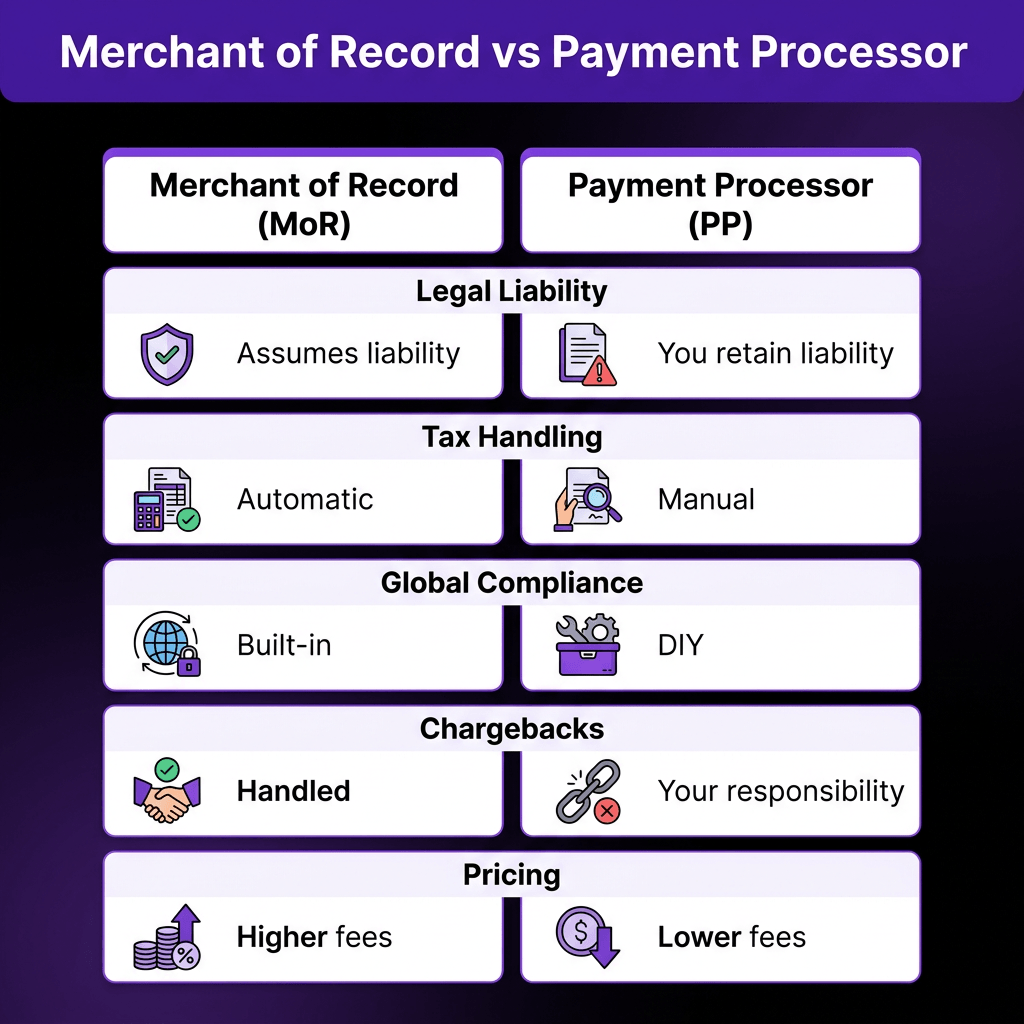
Key Differences: MoR vs Payment Processor
1. Legal Liability
With a payment processor, you are the merchant of record. This means you assume all legal liability for transactions. If a customer disputes a charge, you’re responsible for fighting the chargeback. If tax authorities come knocking, you’re on the hook.
With an MoR, the provider assumes legal liability. They handle chargebacks, tax audits, and compliance violations. This shield is invaluable for small teams without dedicated legal and finance departments.
2. Tax Compliance
Tax compliance is where MoRs truly shine. When you sell globally using a payment processor, you’re responsible for:
- Registering for VAT/GST in every jurisdiction where you have customers
- Calculating the correct tax rate for each transaction (rates vary by country, state, and even city)
- Collecting and remitting taxes on the correct schedule
- Filing regular tax returns in multiple jurisdictions
This complexity explodes quickly. Selling to customers in the EU, US, UK, Australia, and Canada means navigating five different tax regimes with unique rules, thresholds, and filing requirements.
An MoR handles all of this automatically. They register for taxes, calculate rates at checkout, collect the correct amount, remit to authorities, and file returns. You receive a simple payout with taxes already deducted.
3. Pricing Structure
Payment processors typically charge 2.9% + $0.30 per transaction. This seems attractive until you factor in the hidden costs:
- Tax registration and filing services ($200-500/month per jurisdiction)
- Chargeback fees ($15-25 per dispute)
- Compliance consulting
- Additional tools for subscription management, dunning, and tax calculation
MoRs typically charge 5-10% per transaction, but this includes everything: processing, tax compliance, fraud protection, and subscription management. For many businesses, the all-inclusive pricing is actually cheaper when you factor in the operational savings.
4. Time to Market
Setting up a payment processor takes hours. Setting up global tax compliance takes months. You’ll need to:
- Research tax obligations in each target market
- Register for tax IDs (can take 4-8 weeks per jurisdiction)
- Integrate tax calculation APIs
- Set up tax filing workflows
- Build compliance monitoring
With an MoR, you can sell globally from day one. The compliance infrastructure is already built—you just integrate the checkout and start accepting payments.
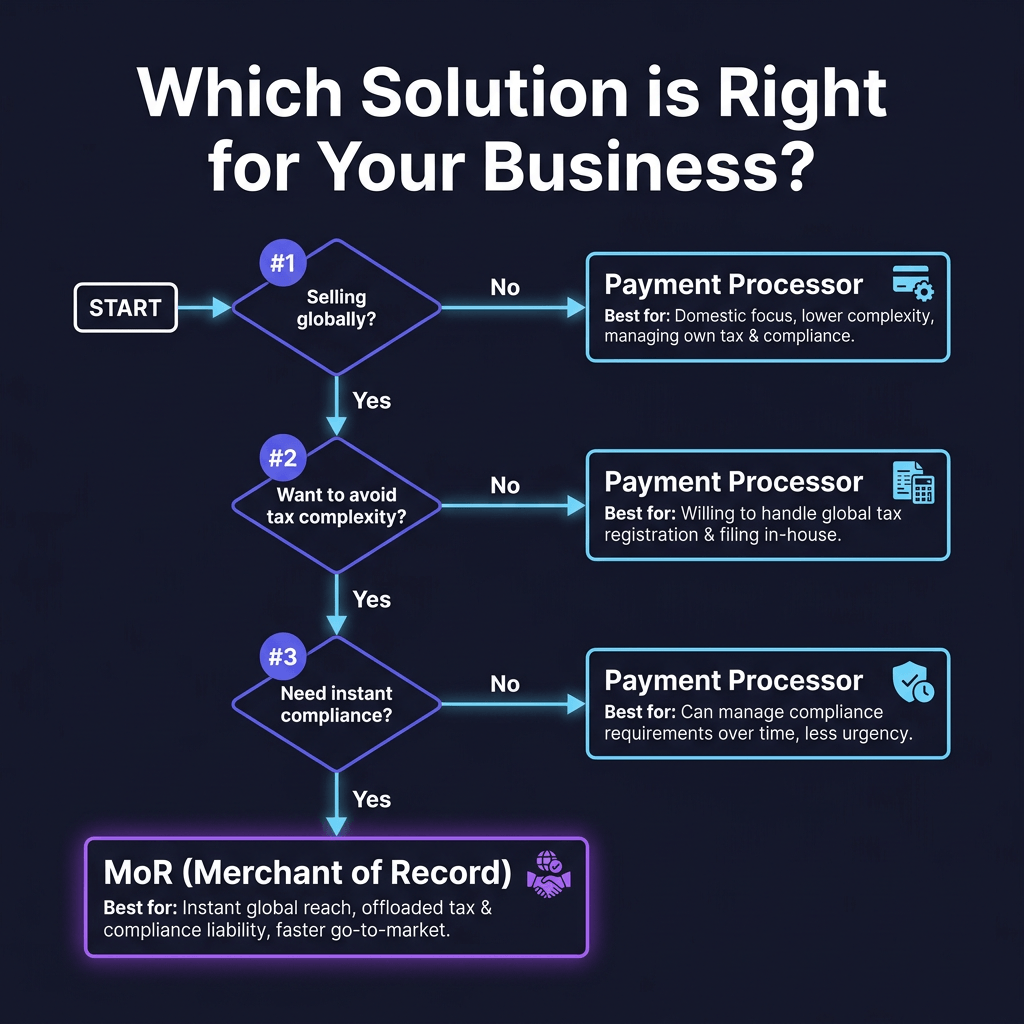
When to Choose a Payment Processor
A payment processor makes sense if:
- You only sell domestically: If your customers are all in one tax jurisdiction, compliance is manageable
- You have a finance team: Large companies with dedicated tax and legal staff can handle compliance in-house
- You want maximum control: Payment processors offer more flexibility in checkout customization and fund timing
- You have simple products: One-time purchases are easier to manage than complex subscriptions
- You’re price-sensitive: The lower transaction fees matter if you have thin margins
When to Choose a Merchant of Record
An MoR is the better choice if:
- You sell globally: The more countries you sell to, the more valuable MoR tax compliance becomes
- You’re a small team: Without dedicated finance and legal staff, MoR liability protection is essential
- You sell subscriptions: MoRs handle recurring billing, dunning, and cancellation compliance
- You want to move fast: Launch globally without waiting months for tax registrations
- You value simplicity: One integration, one payout, one relationship to manage
Popular Options in 2026
Payment Processors
- Stripe: The developer favorite. Best-in-class API, extensive customization, but you’re on your own for compliance.
- PayPal: Trusted by consumers, easy setup, but higher fees and limited subscription features.
- Square: Great for omnichannel businesses, strong in-person and online integration.
Merchants of Record
- Fungies: Built for SaaS and digital products. Competitive fees, instant global compliance, developer-friendly APIs.
- Paddle: Focused on software companies. Strong subscription features and pricing optimization tools.
- FastSpring: Long-established player with broad digital product support and extensive global coverage.
Making Your Decision
The choice between a payment processor and Merchant of Record ultimately comes down to your business model, team size, and growth ambitions.
If you’re a solo founder selling a simple product to domestic customers, a payment processor like Stripe is probably sufficient. The lower fees and greater control outweigh the compliance burden.
But if you’re building a global SaaS business, the calculus changes. The cost of tax compliance, legal liability, and operational complexity quickly exceeds the transaction fee difference. An MoR lets you focus on building your product instead of navigating international tax law.
Consider starting with the question: Where will my customers be in 12 months? If the answer includes multiple countries, an MoR is likely the smarter long-term choice.
Ready to Simplify Your Global Payments?
Join hundreds of SaaS companies using Fungies.io — automated tax compliance, 50+ payment methods, global Merchant of Record.
No credit card required
Frequently Asked Questions
Can I switch from a payment processor to an MoR later?
Yes, but it requires migrating your existing customers and subscriptions. Most MoRs provide migration tools and support to make the transition smooth. The earlier you switch, the easier it is.
Do MoRs work with existing payment methods?
MoRs typically support all major credit cards, PayPal, and local payment methods. They often offer broader global coverage than individual payment processors because they aggregate volume across all their merchants.
Is an MoR worth it for a small business?
If you’re selling internationally or plan to, absolutely. The time and cost savings on tax compliance alone often justify the higher transaction fees. For domestic-only businesses, the value depends on your transaction volume and margin.
What’s the difference between an MoR and a marketplace?
A marketplace (like Amazon or Etsy) hosts your products and handles discovery, while an MoR powers payments for your own website. With an MoR, you own the customer relationship and brand experience.
Can I use both a payment processor and an MoR?
Generally no—you choose one primary payment infrastructure. However, some businesses use an MoR for international sales and a payment processor for domestic transactions, though this adds complexity.
Conclusion
The Merchant of Record vs Payment Processor decision isn’t about finding the “best” option—it’s about finding the right fit for your specific situation. Payment processors offer lower fees and more control but require you to handle compliance yourself. Merchants of Record provide a complete compliance and payments solution at a higher transaction cost.
For global SaaS businesses and digital product sellers, the operational simplicity and liability protection of an MoR typically outweigh the fee difference. You didn’t start your business to become an expert in international tax law—an MoR lets you focus on what you do best.