Merchant of Record vs Stripe: The Complete 2026 Comparison
Is Stripe a Merchant of Record? No. Learn the key differences between Merchant of Record vs Stripe, when to choose each, and which is right for your SaaS business in 2026.
Short answer: Stripe is NOT a Merchant of Record. When you use Stripe, you remain legally responsible for tax compliance, chargebacks, and regulatory requirements in every country where you sell. A Merchant of Record (MoR) like Fungies takes on that liability for you.
If you’re building a SaaS business and deciding between Stripe and a Merchant of Record, this decision affects your tax obligations, legal exposure, and operational complexity. Choose wrong, and you could face unexpected tax bills, compliance headaches, or blocked expansion into key markets. In 2026, with tax authorities tightening enforcement globally, understanding this distinction isn’t optional—it’s essential for sustainable growth.
What Is a Merchant of Record?
A Merchant of Record is the legal entity responsible for processing payments, collecting sales tax and VAT, handling chargebacks, and maintaining compliance with local regulations. When you use an MoR, they become the seller of record in the eyes of tax authorities, payment networks, and customers.
This means the MoR handles the entire transaction lifecycle:
- Tax registration: The MoR registers for VAT/GST in 100+ countries so you don’t have to
- Tax calculation: Real-time tax rates applied based on customer location
- Tax collection: VAT, sales tax, and GST collected at point of sale
- Tax remittance: Taxes filed and paid to authorities on your behalf
- Chargeback management: Disputes handled by the MoR’s expert team
- Fraud prevention: Built-in fraud detection and prevention tools
- PCI compliance: Payment security maintained by the platform
- Payouts: You receive funds net of fees, with taxes already handled
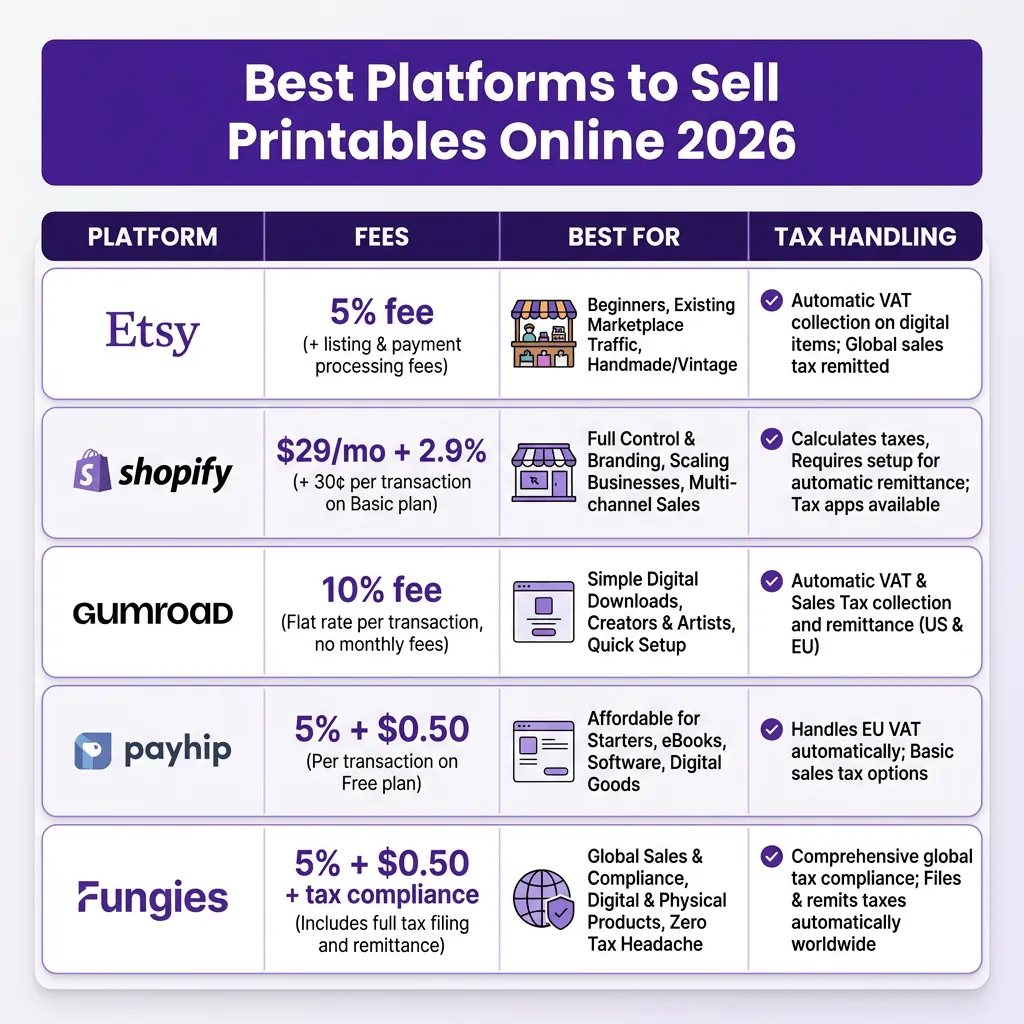
Popular Merchant of Record platforms include Fungies, Paddle, FastSpring, and Lemon Squeezy. Each offers varying features, pricing, and target markets, but all share the core MoR model of taking legal responsibility for transactions.
What Is Stripe?
Stripe is a payment service provider (PSP) and payment infrastructure platform. It provides the technical tools to accept payments, manage subscriptions, and handle payouts—but you remain the merchant of record. This critical distinction means you retain full legal and financial responsibility for compliance.
With Stripe, your responsibilities include:
- Tax registration: You must register for sales tax/VAT in every jurisdiction where you have customers
- Tax calculation: Stripe Tax (separate add-on) calculates taxes, but doesn’t handle compliance
- Tax filing: You must file returns and remit payments to each tax authority
- Chargeback management: You handle disputes directly with card networks
- PCI compliance: You’re responsible for maintaining PCI DSS compliance
- Legal liability: Your business name appears on customer statements and receipts
Stripe excels at payment infrastructure, developer experience, and customization. It’s the industry standard for payment processing, with robust APIs, extensive documentation, and reliable uptime. However, it’s not a compliance solution.
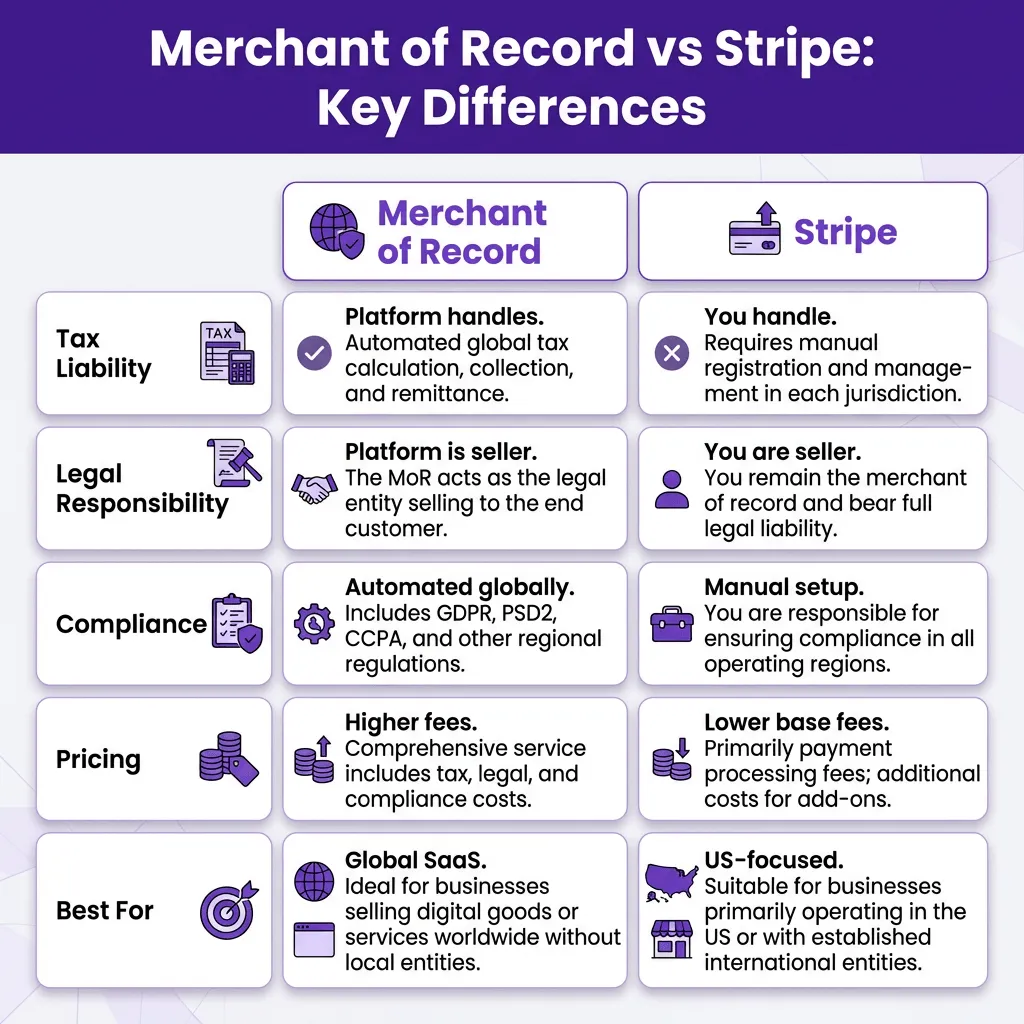
Key Differences: Merchant of Record vs Stripe
1. Tax Liability and Compliance
Merchant of Record: The platform assumes full tax liability. They register for VAT in the EU, sales tax in US states, GST in Australia, and similar taxes worldwide. You sell globally from day one without setting up a single tax registration. The MoR calculates, collects, and remits all taxes, filing returns with authorities on your behalf.
Stripe: You bear all tax liability. While Stripe Tax (starting at $0.50 per transaction) can calculate tax rates, you must still register in each jurisdiction, understand local tax laws, file periodic returns, and remit payments. For a global SaaS business, this means managing 50+ tax registrations and filing hundreds of returns annually.
2. Legal Responsibility and Liability
Merchant of Record: The MoR’s business name appears on customer credit card statements and receipts. They are the legal seller of your product. If a customer disputes a charge, the MoR handles the chargeback process. If tax authorities audit transactions, the MoR responds. Your legal exposure is minimal.
Stripe: Your business name appears on all customer-facing materials. You are the legal seller. You handle chargebacks directly, build evidence, and communicate with banks. If tax authorities question transactions, you must respond. You carry the full legal and financial risk of non-compliance.
3. Global Expansion Capabilities
Merchant of Record: Instant global reach. The MoR already holds tax registrations in 100+ countries. You can accept payments from customers worldwide immediately, without legal setup in each market. This is crucial for SaaS businesses where customers can come from anywhere.
Stripe: Expansion limited by your tax footprint. To sell compliantly in the EU, you need VAT registrations (which can take 2-3 months per country). For US sales tax, you need to monitor nexus thresholds in 45+ states and register where required. This creates friction that slows international growth.
4. Pricing and Total Cost of Ownership
Merchant of Record: Typically 5% + $0.50 per transaction. This includes payment processing, tax compliance, fraud protection, and global coverage. The pricing is all-inclusive and predictable. For a $100 sale, you pay $5.50 in fees and receive $94.50.
Stripe: 2.9% + $0.30 for card payments. Lower base cost, but excludes tax compliance. You’ll pay extra for Stripe Tax ($0.50/transaction), potentially subscribe to tax software like Avalara or TaxJar ($200-500/month), hire accountants for filing ($150-300/hour), and manage registrations yourself. The true cost often exceeds MoR pricing for global businesses.
5. Setup Time and Complexity
Merchant of Record: Fast setup. Connect your product, set pricing, and start selling globally within hours. No tax registrations needed. No compliance research required. The MoR handles everything behind the scenes.
Stripe: Technical integration requires developer time. Then you must research tax obligations, register in relevant jurisdictions, set up tax calculation tools, and build internal processes for compliance. For global selling, this can take months before you’re ready to accept international payments.
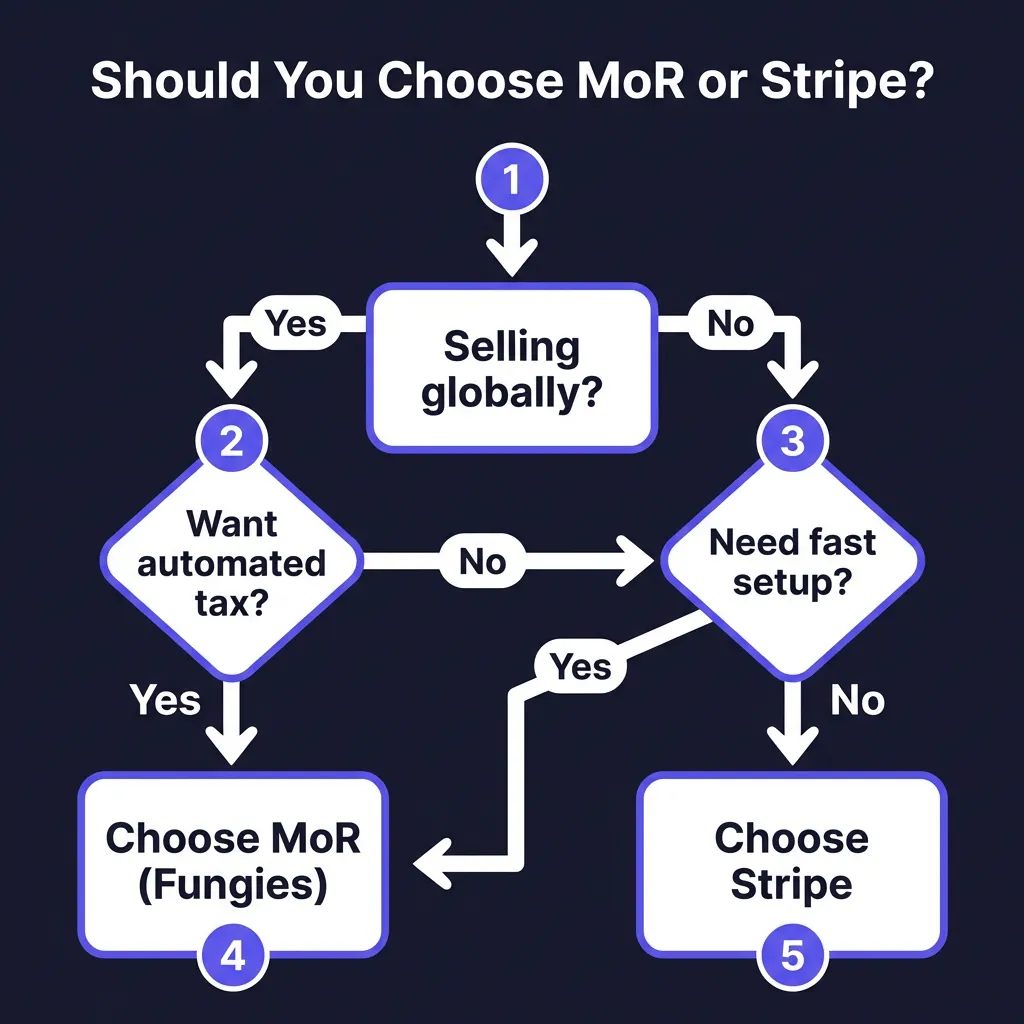
When to Choose a Merchant of Record
A Merchant of Record is the right choice if:
- You sell globally or plan to: If your customers could be anywhere, an MoR eliminates the tax registration barrier to international sales
- You want to avoid tax complexity: If researching VAT thresholds, nexus rules, and filing requirements sounds like a nightmare, an MoR handles it all
- You prefer predictable costs: All-inclusive pricing means no surprise tax bills or compliance costs
- You need to launch quickly: Get to market in days, not months, with full global compliance
- You want experts handling disputes: MoRs have dedicated teams for chargebacks and fraud, often achieving better win rates
- You’re an indie developer or small team: Without a finance department, managing global tax compliance yourself is impractical
MoR platforms like Fungies are built specifically for SaaS companies, indie developers, and digital product creators who want to focus on building great products rather than becoming tax compliance experts.
When to Choose Stripe
Stripe is the better option if:
- You primarily sell in one country: If 90%+ of customers are in the US and you only need to manage US sales tax, Stripe’s lower fees make sense
- You have dedicated finance resources: Large companies with finance teams and tax advisors can manage compliance internally
- You need maximum payment customization: Stripe’s APIs offer unmatched flexibility for custom checkout flows and payment logic
- You have existing tax infrastructure: If you’ve already registered for taxes in your key markets, switching to an MoR may not be worth it
- You process very high volumes: At enterprise scale, Stripe’s volume pricing can undercut MoR fees even after compliance costs
Stripe works best for US-focused businesses with simple tax situations, enterprise companies with dedicated compliance teams, or businesses with highly specialized payment requirements.
Stripe Managed Payments: The Future Option
In 2025, Stripe announced Stripe Managed Payments—a service that acts as a Merchant of Record. However, as of 2026, it remains in limited preview with several constraints:
- Limited availability (invite-only)
- Requires using Stripe Checkout (limits customization)
- Focused on subscription businesses
- Pricing not publicly disclosed
- Geographic coverage unclear
While this could become a viable MoR option in the future, it’s not a practical choice for most businesses today. Even when widely available, Stripe Managed Payments will likely prioritize businesses using Stripe’s native billing infrastructure, potentially limiting flexibility.
Real-World Scenarios: Which Should You Choose?
Scenario 1: Indie SaaS Developer
You’re a solo developer launching a productivity tool. You want to accept payments from day one, but you don’t know where your first 100 customers will come from. Setting up tax registrations in 50+ countries would cost more than your expected first-year revenue.
Recommendation: Merchant of Record. Start with Fungies or similar. Focus on building your product and finding customers, not researching Estonian VAT thresholds.
Scenario 2: US-Only B2B SaaS
You sell enterprise software to US companies only. You have a finance team and already use Avalara for tax calculation. Your checkout requires complex custom logic for enterprise quotes and PO handling.
Recommendation: Stripe. Your tax situation is simple (US-only), you have resources to manage compliance, and you need payment customization that MoR platforms may not support.
Scenario 3: Growing SaaS with Global Ambitions
You’re at $50K MRR, growing 10% monthly, with customers in 15 countries. You’re currently using Stripe but spending 10+ hours monthly on tax research and filing. You’re turning away customers from countries where you don’t have tax registrations.
Recommendation: Migrate to a Merchant of Record. The time savings and ability to sell globally will outweigh the higher transaction fees. Most MoRs offer migration tools to transfer existing subscriptions.
FAQ: Merchant of Record vs Stripe
Is Stripe a Merchant of Record?
No. Standard Stripe is a payment service provider, not a Merchant of Record. You remain the legal seller responsible for tax compliance, chargebacks, and regulatory requirements. Stripe Managed Payments (in limited preview) offers MoR functionality but isn’t widely available.
Do I need a Merchant of Record for my SaaS?
If you sell to customers in multiple countries, yes. Without an MoR, you must register for VAT/sales tax in each jurisdiction where you have customers. For EU sales, this means 27 different tax registrations. For US sales, you must monitor nexus thresholds in 45+ states. The complexity grows exponentially with your customer base.
Is Stripe cheaper than a Merchant of Record?
Stripe has lower per-transaction fees (2.9% + $0.30 vs 5% + $0.50), but this comparison is misleading for global businesses. When you factor in tax tool subscriptions ($200-500/month), accountant fees for filing ($150-300/hour), registration costs, and your time spent on compliance, an MoR often works out cheaper. For a business with $100K annual revenue selling globally, total costs are typically comparable or favor the MoR.
Can I use both Stripe and a Merchant of Record?
Generally no. You choose one provider to process payments for a given product. However, some businesses use Stripe for specific markets (like the US where they have tax registrations) and an MoR for international sales. This adds complexity but can optimize costs for high-volume businesses.
Can I switch from Stripe to a Merchant of Record later?
Yes. Most MoR platforms provide migration tools and support to transfer existing subscriptions and customer payment methods from Stripe. The process typically takes 1-2 weeks and maintains customer billing continuity. Many SaaS businesses start with Stripe and migrate to an MoR as they expand globally.
What happens if I don’t comply with tax regulations?
Non-compliance can result in penalties, interest charges, back taxes, and in severe cases, blocked payment processing or legal action. Tax authorities worldwide are increasing enforcement on digital businesses. In 2026, the risk of non-compliance far exceeds the cost of using an MoR.
Conclusion
The choice between Stripe and a Merchant of Record fundamentally comes down to where you sell and how much operational complexity you want to manage. Stripe offers lower fees, unmatched customization, and powerful APIs—but you handle all tax and compliance yourself. A Merchant of Record costs more per transaction but eliminates tax headaches, enables instant global selling, and reduces legal risk.
For SaaS companies targeting international customers, a Merchant of Record is usually the better long-term choice. The higher transaction fees are offset by eliminated compliance costs, faster global expansion, and the ability to focus on your product rather than tax law. In 2026, with tax authorities worldwide tightening enforcement, using an MoR isn’t just convenient—it’s a competitive advantage.
If you’re selling globally or planning to expand internationally, the question isn’t whether you can afford an MoR. It’s whether you can afford the time, complexity, and risk of managing global tax compliance yourself.
Ready to Simplify Your Payment Compliance?
Join hundreds of SaaS companies using Fungies.io — automated tax compliance, 50+ payment methods, global Merchant of Record.
No credit card required