Paddle vs Stripe Comparison 2026: Complete Guide for SaaS
Choosing between Paddle and Stripe for SaaS in 2026? This complete comparison breaks down pricing, tax handling, and when to choose each — plus why Fungies might be the better alternative.
Choosing between Paddle and Stripe for your SaaS payments in 2026? You’re not alone. This is one of the most common decisions SaaS founders face — and the choice you make impacts everything from your tax compliance burden to your development resources and profit margins.
In this comprehensive comparison, I’ll break down the real differences between these two payment giants, when to choose each, and why a growing number of SaaS companies are looking at alternatives like Fungies.io that combine the best of both worlds.
The Fundamental Difference: Payment Processor vs Merchant of Record
Before diving into features and pricing, you need to understand the core architectural difference between these platforms.
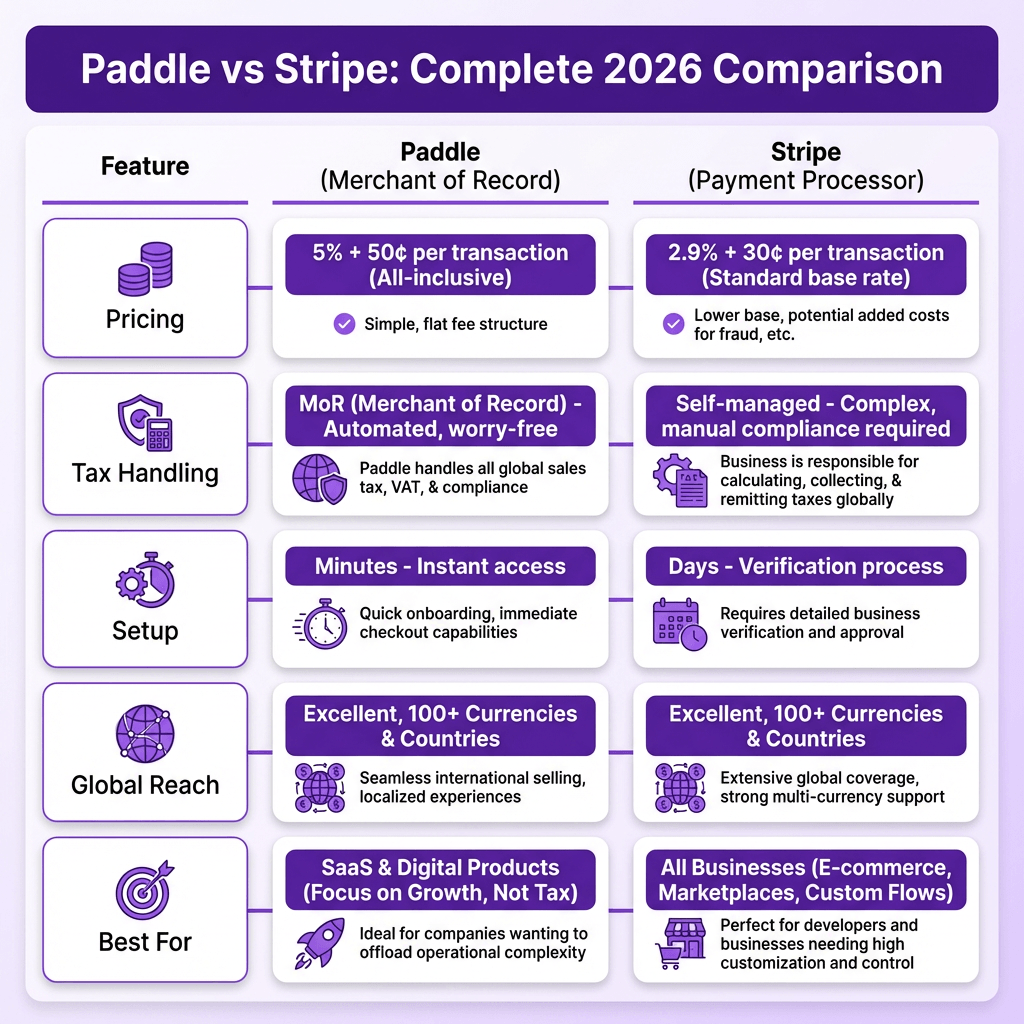
Stripe is a payment processor. This means they handle the technical side of charging cards and moving money — but you remain the merchant of record. You’re responsible for sales tax registration, collection, filing, and remittance in every jurisdiction where you have customers. In the US alone, that’s potentially 45+ state registrations. For EU VAT, you’ll need to navigate OSS (One-Stop Shop) schemes.
Paddle is a Merchant of Record (MoR). They act as the reseller of your software. Your customer buys from Paddle, not from you. Paddle handles all tax compliance, fraud prevention, and regulatory requirements. You get a simple payout, minus their fees.
This distinction isn’t just technical — it’s legal and financial. With Stripe, tax liability rests on your shoulders. With Paddle, it doesn’t.
Pricing Comparison: The Real Numbers
Let’s talk numbers. At first glance, Stripe looks cheaper:
- Stripe: 2.9% + 30¢ per transaction
- Paddle: 5% + 50¢ per transaction
But this comparison is misleading. With Stripe, you need to factor in additional costs:
- Tax compliance software (TaxJar, Quaderno): $50-300/month
- Tax registration fees: $500-2,000 per jurisdiction
- Ongoing filing costs: $100-500/month per jurisdiction
- Fraud prevention tools (Radar): 5¢ per transaction
- Subscription billing (Stripe Billing): 0.5% on recurring payments
For a SaaS doing $50K MRR with global customers, Stripe’s “cheaper” rate often ends up costing more when you factor in the operational overhead of tax compliance.
Feature Breakdown: What You Actually Get
Stripe’s Strengths
- Developer Experience: Best-in-class APIs, extensive documentation, and powerful customization options
- Flexibility: Build exactly the checkout experience you want
- Ecosystem: Massive integration marketplace
- Lower Base Fees: 2.9% + 30¢ is hard to beat for simple transactions
- Instant Payouts: Get your money faster (for a fee)
Paddle’s Strengths
- Tax Compliance: Complete MoR protection — no tax headaches
- All-in-One: Payments, subscriptions, invoicing, and tax in one platform
- Global Reach: Built-in support for 200+ countries
- Fraud Protection: Included at no extra cost
- Faster Time-to-Market: Minimal integration work required
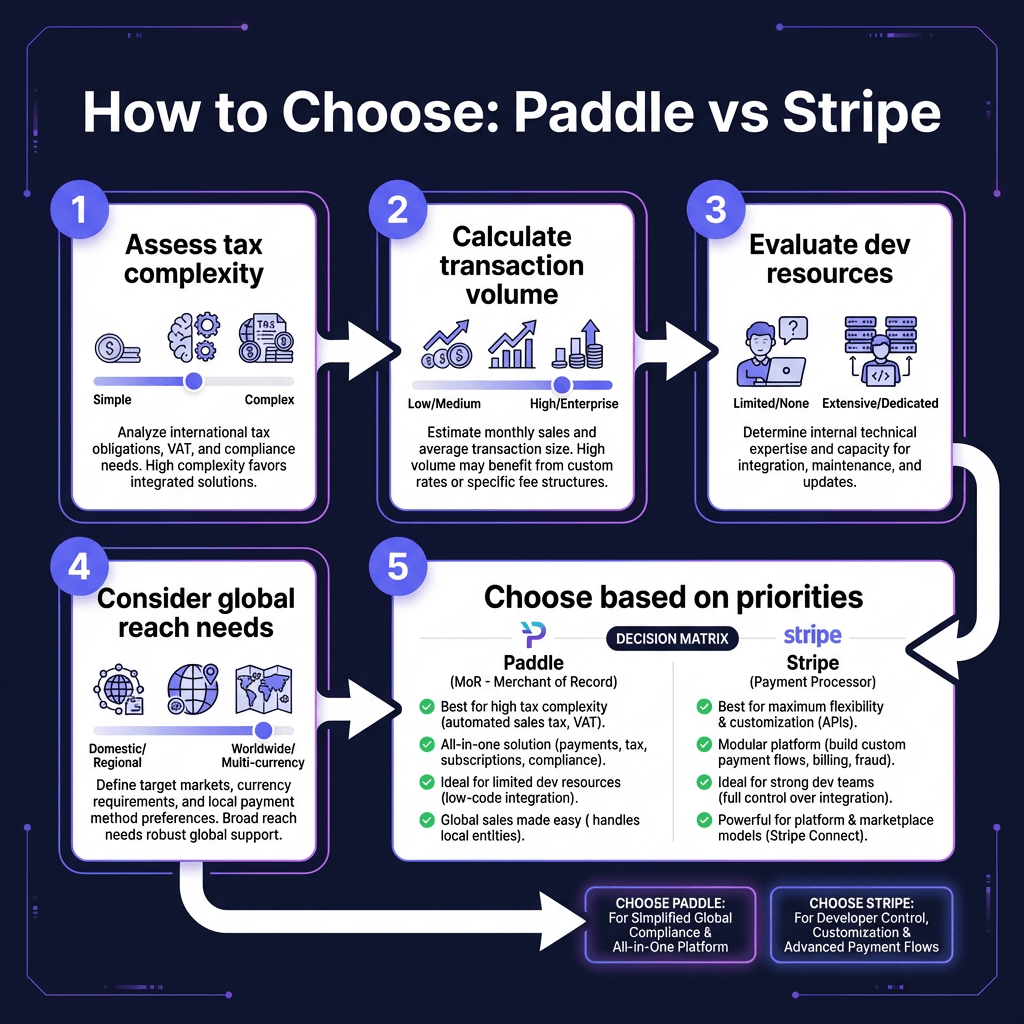
When to Choose Stripe
Choose Stripe if:
- You have dedicated developer resources
- You want complete control over the checkout experience
- Your customers are primarily US-based (simpler tax landscape)
- You have low transaction volumes (under $10K/month)
- You already have tax compliance infrastructure in place
When to Choose Paddle
Choose Paddle if:
- You want to focus on building product, not tax compliance
- You have global customers (especially EU, UK, Australia)
- You value speed of implementation over customization
- You don’t have in-house tax expertise
- You want an all-in-one solution without multiple vendors
The Hybrid Approach: Best of Both Worlds?
Some savvy founders use a hybrid approach: Stripe for US/domestic transactions (where tax compliance is simpler) and Paddle for international transactions (where MoR protection eliminates the biggest headaches).
This can optimize costs while minimizing compliance burden — but it adds complexity. You’ll need to maintain two integrations and reconcile payouts from both platforms.
Consider the Alternative: Fungies.io
What if you could get Stripe’s developer-friendly approach with Paddle’s MoR protection — at a competitive price?
Fungies.io offers exactly that:
- Transparent Pricing: 5% + $0.50 per transaction — no hidden fees
- Full MoR Protection: We handle all tax compliance globally
- Modern APIs: Clean, well-documented integration
- No Monthly Fees: Pay only when you make sales
- Built for SaaS: Subscription management, dunning, and analytics included
For bootstrapped SaaS founders and indie developers, Fungies hits the sweet spot between Stripe’s flexibility and Paddle’s simplicity.
Simplify Your SaaS Payments with Fungies
Get the best of both worlds — transparent pricing like Stripe with MoR protection like Paddle. Fungies handles tax compliance automatically.
No credit card required • 5% + $0.50 per transaction
FAQ: Paddle vs Stripe
Can I switch from Stripe to Paddle?
Yes, but migrating existing subscriptions requires careful planning. Paddle offers migration support, and the process typically takes 1-2 weeks for active subscriptions.
Does Paddle support custom checkout flows?
Paddle offers customization options, but not to the extent of Stripe. If you need complete control over every pixel of your checkout, Stripe is the better choice.
Is Stripe really cheaper than Paddle?
For the transaction itself, yes. But when you factor in tax compliance costs, fraud tools, and subscription billing add-ons, the total cost of ownership often favors Paddle for global SaaS businesses.
Which is better for startups?
It depends on your team’s expertise. Technical teams with tax knowledge often prefer Stripe. Non-technical founders or those wanting to move fast typically choose Paddle or alternatives like Fungies.
Can I use both Stripe and Paddle?
Yes, some companies use Stripe for US customers and Paddle for international. This hybrid approach requires more infrastructure but can optimize costs.
Final Verdict
There’s no universal “winner” between Paddle and Stripe — it depends on your specific situation:
- Choose Stripe if you value flexibility, have dev resources, and are prepared to handle tax compliance
- Choose Paddle if you want simplicity, global tax compliance handled, and faster time-to-market
- Consider Fungies if you want competitive pricing with full MoR protection and modern developer experience
The payment landscape in 2026 is more competitive than ever. Take advantage of free trials, test integrations, and choose the platform that aligns with your team’s strengths and your business goals.