Paddle vs Stripe vs Fungies.io for SaaS: The Complete 2026 Guide
Compare Paddle, Stripe, and Fungies.io for your SaaS in 2026. Tax compliance, pricing, features, and which platform saves you the most time and money.
Here’s a number worth sitting with: for a SaaS business doing $50k/month, picking the wrong payment platform could cost you over $7,000 a year. That’s a senior developer’s freelance budget. Gone. Because you picked the wrong vendor at launch and never revisited it.
In 2026, the SaaS payments space has three clear contenders: Stripe, Paddle, and Fungies.io. They’re not interchangeable. They serve different types of founders at different stages. And if you’re still treating this as a “just pick Stripe” decision, you’re probably leaving money — and sanity — on the table.
I’ve gone deep on all three. Let’s break it down properly.
What’s the Difference? MoR vs PSP — Why It Actually Matters
This is the part most founders skip, and then regret later.
Stripe is a Payment Service Provider (PSP). It moves money from your customer’s card to your bank account. It does this extremely well. But that’s basically where Stripe’s responsibility ends. Tax compliance? That’s on you. VAT registration across 27 EU countries? Your problem. Chargeback disputes? You’re dealing with them.
Paddle is a Merchant of Record (MoR). When Paddle acts as your MoR, they legally become the seller in every transaction. Your customers are technically buying from Paddle, not from you. That means Paddle owns the tax liability, handles fraud disputes, remits VAT across every jurisdiction, and takes care of PCI compliance. You just get a payout.
Fungies.io is also a Merchant of Record — but built with a more modern, developer-first architecture. Like Paddle, Fungies takes on the legal and tax burden. Unlike Paddle, Fungies offers more flexible billing models, a cleaner API experience, and pricing that’s actually designed with indie and early-stage SaaS founders in mind.
Why does the MoR distinction matter so much? Because the global tax landscape is a nightmare. As of 2026, 25 U.S. states treat SaaS as taxable — each with its own rules and filing deadlines. Add EU VAT, Australian GST, Canadian HST, and you’re looking at dozens of registrations, filings, and currency-specific rules. An MoR handles all of that automatically. A PSP like Stripe doesn’t touch it.
For a solo developer or a 2-person team, this distinction can literally determine whether you can legally sell internationally without a tax attorney on retainer.
Pricing Deep Dive — Real Numbers
Let’s stop pretending “2.9% + $0.30” is the full story. Here’s what you’re actually paying across all three platforms.
Stripe
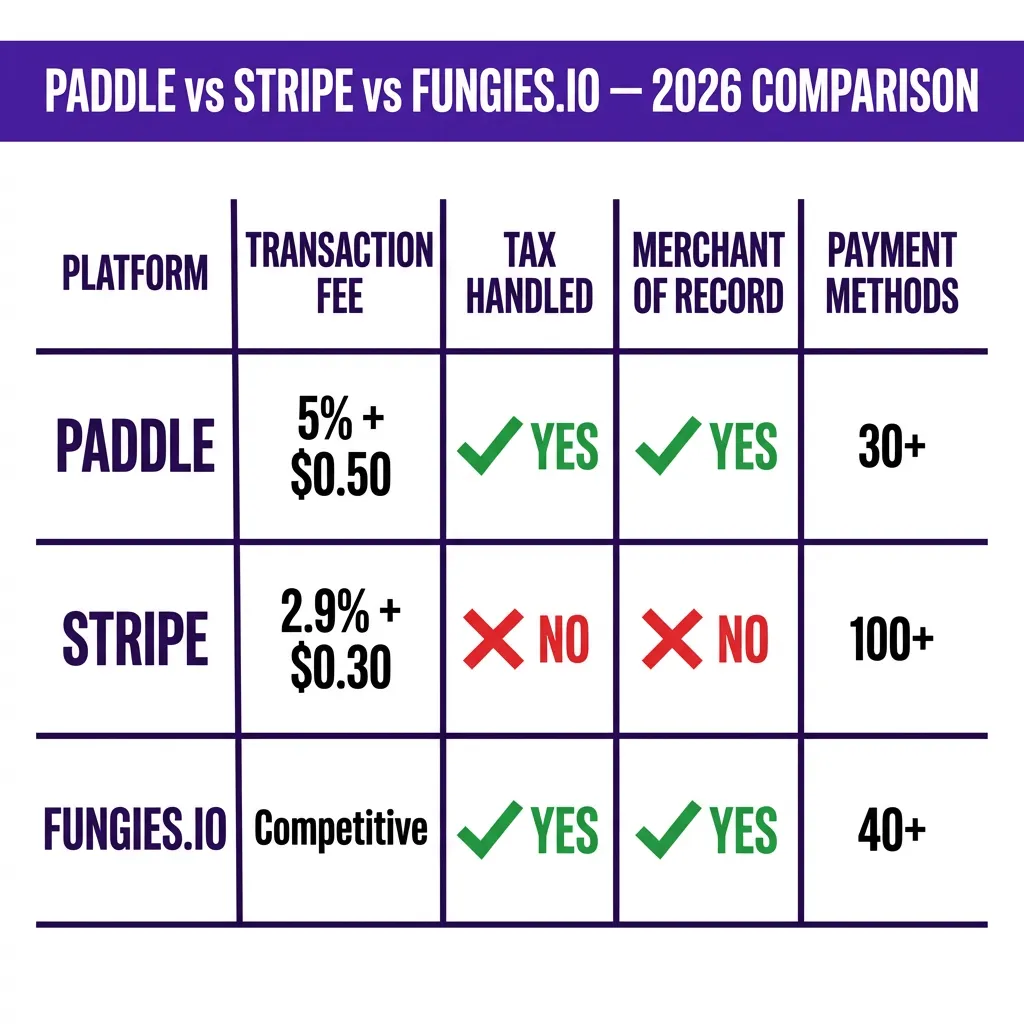
Base processing fee: 2.9% + $0.30 per transaction
Stripe Tax (calculation only): +0.5% per transaction
Tax filing tool (e.g., TaxJar/Avalara): $99–$299/month
Radar fraud protection (advanced): +$0.02 per transaction
International cards: +1.5%
Chargeback handling: $15 per dispute
For a $50k MRR SaaS with a mix of US and international customers, your real Stripe cost can land closer to 4.5–5.5% when you add everything up. That’s before developer time to build and maintain compliance infrastructure.
Paddle
Transaction fee: 5% + $0.50 per transaction
Tax compliance: Included
Fraud protection: Included
Chargebacks: Paddle absorbs the liability
International: Covered under the MoR model
Paddle looks expensive at first glance. But once you factor in what you’re not paying for — tax software, compliance consultant, fraud tools, chargeback fees — the math often evens out, or tips in Paddle’s favor for high-volume international sellers.
Fungies.io
Transaction fee: Competitive flat rate (see fungies.io/pricing for current rates)
Tax compliance: Included (full MoR coverage)
Fraud protection: Included
Chargebacks: Fungies handles disputes
No monthly minimums or setup fees for indie/early-stage founders
Fungies.io is designed specifically to be accessible at the early stage. You’re not paying enterprise minimums to get started. You get the full MoR stack — tax, fraud, compliance — without Paddle’s per-transaction pricing overhead.
Feature Comparison
| Feature | Stripe | Paddle | Fungies.io |
|---|---|---|---|
| Merchant of Record | ❌ No | ✅ Yes | ✅ Yes |
| Automatic Tax Compliance | ❌ Partial (Stripe Tax) | ✅ Full | ✅ Full |
| Global VAT / GST Remittance | ❌ No | ✅ Yes | ✅ Yes |
| Fraud Protection Included | ⚠️ Basic (Radar paid) | ✅ Yes | ✅ Yes |
| Chargeback Liability | ❌ You cover it | ✅ Paddle covers it | ✅ Fungies covers it |
| Subscription Management | ✅ Yes (Billing) | ✅ Yes | ✅ Yes |
| Developer API Quality | ⭐⭐⭐⭐⭐ | ⭐⭐⭐⭐ | ⭐⭐⭐⭐⭐ |
| Payment Methods | 100+ | 30+ | 40+ |
| Custom Checkout / Embed | ✅ Yes | ⚠️ Limited | ✅ Yes |
| Affiliate / Referral Tools | ❌ No (third-party) | ⚠️ Basic | ✅ Built-in |
| Setup Complexity | High | Medium | Low |
| Best For | Custom builds | Enterprise SaaS | Indie & early-stage SaaS |
Stripe wins on raw payment method breadth and developer flexibility. Paddle wins on compliance robustness. Fungies.io threads the needle — MoR benefits with a developer experience that doesn’t feel like you’re configuring a legacy enterprise product.
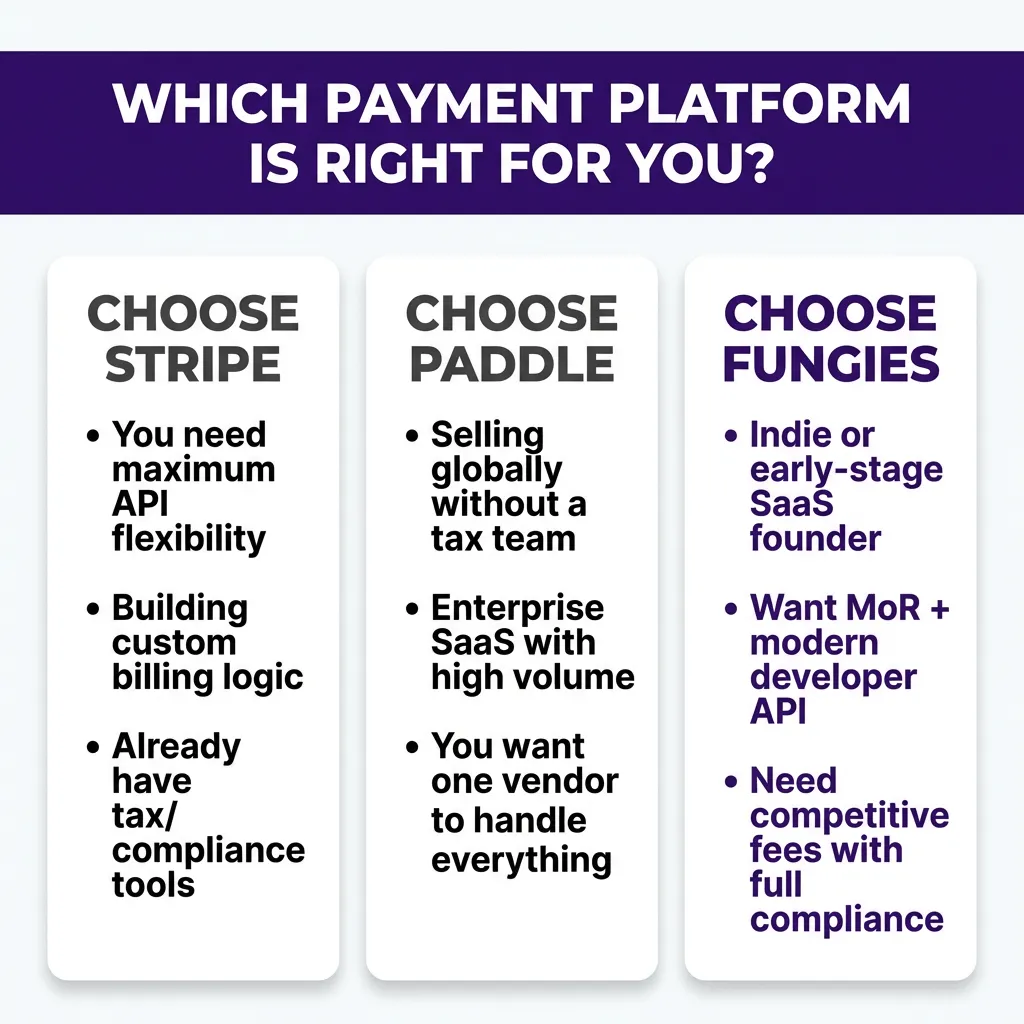
Paddle vs Stripe vs Fungies — When to Use Each
Choose Stripe if…
You’re building something deeply custom. Stripe’s APIs are genuinely world-class. If your billing logic is complex — usage-based pricing, complex proration, custom billing cycles — Stripe gives you the tools to build exactly what you want. You’ll need to handle taxes yourself (or with a tool like Stripe Tax + Avalara), but if you already have a compliance team or you’re US-only, that’s manageable.
Stripe also makes sense if you’re building a marketplace or platform where you need to split payments between multiple vendors. Stripe Connect is best-in-class for that.
The honest caveat: Stripe has a steep setup curve. And “setup” never really ends — you’ll spend ongoing engineering time maintaining compliance integrations, webhook handlers, and tax workflows. That’s a real cost.
Choose Paddle if…
You’re already scaling globally and compliance is keeping your legal team up at night. Paddle is battle-tested for enterprise SaaS. They’ve been doing the MoR thing since 2012 and they’ve seen every edge case.
Paddle is particularly strong if you have a large catalog of subscription products and want one vendor to handle everything end-to-end. Their billing engine is mature. Their integrations with tools like HubSpot and Salesforce are solid.
The honest caveat: Paddle’s pricing adds up. At 5% + $0.50, you’re paying a meaningful premium at scale. And their checkout customization has historically been more limited than Stripe’s. Paddle Billing (their newer product) improves this, but the migration path from Paddle Classic is messy.
Choose Fungies.io if…
You’re an indie developer or an early-stage SaaS founder who wants the tax and compliance safety net without paying enterprise rates or spending weeks on integration. Fungies.io is built specifically for this use case.
It’s also a strong pick if you want built-in affiliate/referral tooling — something neither Stripe nor Paddle handles natively. And if you care about checkout conversion, Fungies offers embeddable checkout that you can fully control.
The honest pitch: you get the full MoR stack at a stage where it’d be irresponsible to build all of that yourself. Ship faster, sell globally from day one, and let Fungies handle the compliance headache.
Migration & Integration
Migrating to Stripe
Stripe has excellent migration tooling. If you’re coming from another processor, they can import existing subscriptions and customer data with minimal disruption. The real challenge isn’t the technical migration — it’s rebuilding all the compliance infrastructure you previously outsourced.
If you’re moving from an MoR to Stripe, budget time to set up Stripe Tax, connect a tax filing service, and update your terms of service to reflect that you (not your MoR) are now the legal seller.
Migrating to Paddle
Migrating to Paddle is straightforward on paper — their onboarding team is helpful. The bigger challenge is Paddle’s checkout model. If you’re used to full checkout control with Stripe, Paddle’s more opinionated approach requires adjustment.
Note: If you’re on Paddle Classic and thinking about upgrading to Paddle Billing, the migration path is significant. Plan for it carefully.
Migrating to Fungies.io
Fungies.io is designed to be quick to integrate. Their REST API is clean and well-documented. You can embed a checkout in your app in a few hours. Subscription logic, webhooks, customer management — all covered. For most indie SaaS setups, a full migration from Stripe to Fungies can be done over a weekend.
There’s also a no-code path: you can use Fungies’s hosted checkout pages without any API work, which is useful if you want to test before you commit to a full integration.
FAQ
Is Stripe a Merchant of Record?
No. Stripe is a Payment Service Provider (PSP). As of 2026, Stripe has started offering some MoR-adjacent features through partnerships, but they are not a true MoR. Tax compliance and chargeback liability remain with you as the merchant.
Does Paddle handle US sales tax automatically?
Yes. Paddle handles US sales tax, EU VAT, Australian GST, and most other global consumption taxes automatically. As the MoR, Paddle is the legal seller and handles all remittance.
Is Fungies.io legit for SaaS payments?
Yes. Fungies.io is a legitimate Merchant of Record platform. They handle payment processing, tax compliance, VAT remittance, fraud protection, and chargebacks. They’re particularly focused on indie developers and early-stage SaaS founders.
Which is cheaper: Paddle or Stripe?
It depends. Stripe’s base rate (2.9% + $0.30) is lower than Paddle’s (5% + $0.50), but Stripe requires additional spend on tax tools, compliance infrastructure, and developer time. For internationally-focused SaaS, Paddle or Fungies often works out cheaper once you count the full stack.
Can I switch from Stripe to Fungies.io?
Yes. Fungies.io supports migration from Stripe. Their team can help you move existing subscribers without disrupting billing cycles. The integration is typically quick for standard SaaS subscription setups.
Does Fungies.io support one-time payments as well as subscriptions?
Yes. Fungies.io supports both one-time purchases and recurring subscriptions. You can also mix billing models within the same product catalog.
Conclusion — Pick the Right Tool for Your Stage
Here’s the honest summary:
Stripe is the right call if you need maximum customization and already have (or can afford) compliance infrastructure.
Paddle is the right call if you’re scaling fast, selling globally, and want one trusted vendor to own the compliance nightmare at enterprise scale.
Fungies.io is the right call if you’re building something lean and want to sell globally from day one, without the overhead.
Most indie SaaS founders and early-stage startups shouldn’t be wrestling with tax remittance and chargeback disputes. That’s not product work. It’s plumbing — and you can outsource the plumbing.
If you’re ready to launch — or if you’re tired of managing Stripe compliance on your own — create your free Fungies.io account and get your first sale live today. No setup fees. No monthly minimums. Full MoR compliance from the jump.
Sources
Paddle Pricing — paddle.com/pricing
Stripe Pricing — stripe.com/pricing
Fungies.io Pricing — fungies.io/pricing
TaxJar 2025 State of Sales Tax Report — taxjar.com
BlueSnap Global Payments Research 2025 — bluesnap.com
Fungies.io — Best MoR Platforms for SaaS 2026 — fungies.io