Product-Led Growth for SaaS: The Complete 2026 Guide to PLG Strategy
Learn how to implement product-led growth (PLG) in your SaaS business. Discover 2026 benchmarks, conversion rates, and the 5-step framework used by Slack, Figma, and Cursor to scale to billions.
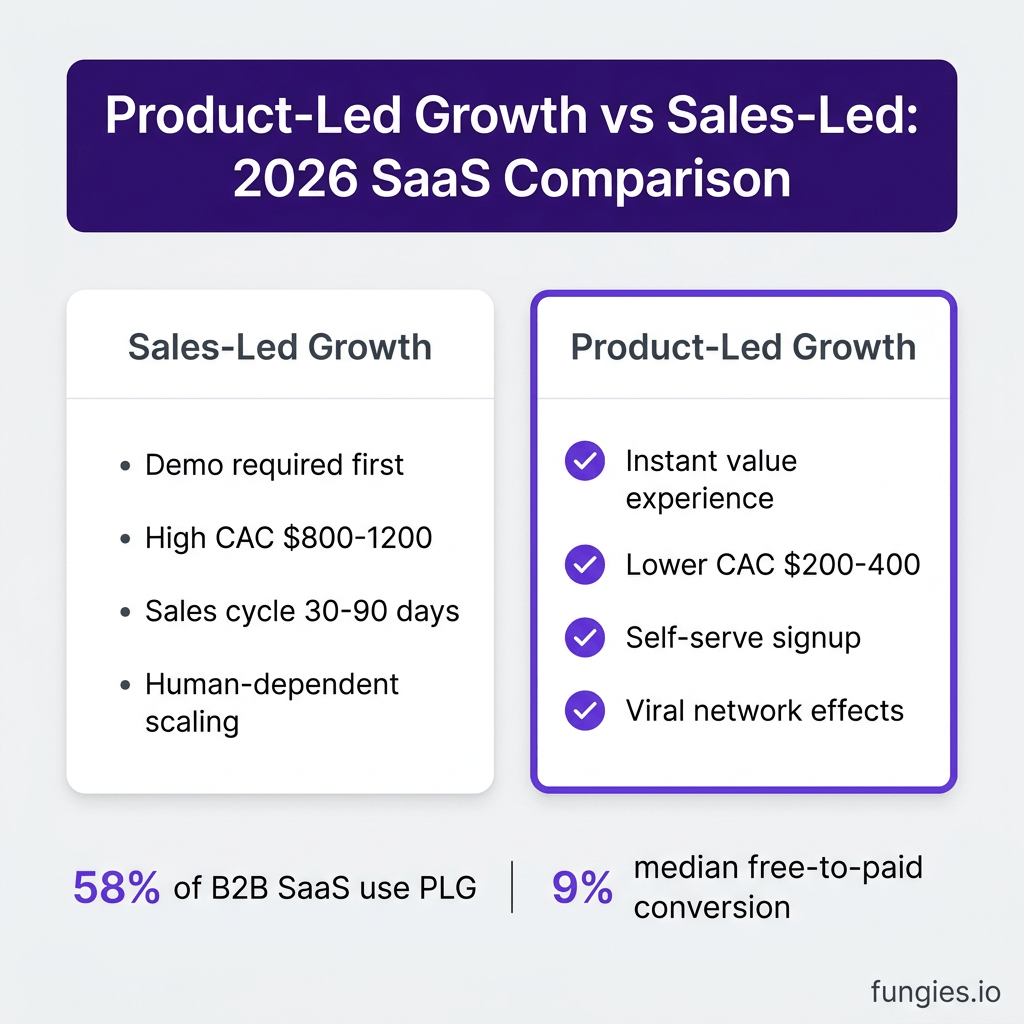
Here is a number that should change how you think about SaaS growth: 58% of B2B SaaS companies now run a product-led growth motion, and 91% of them plan to increase their investment this year. Yet most founders I talk to still equate PLG with simply offering a free trial. That is not product-led growth. That is just a pricing decision.
Product-led growth is a fundamental shift in how you acquire, activate, and retain customers. It is the difference between Calendly worth $3 billion with under 250 employees, and a sales-led competitor burning through venture capital trying to hire their way to growth. In this guide, I will break down exactly what PLG means in 2026, why it works, and how to implement it in your SaaS business.
What Is Product-Led Growth, Really?
Product-led growth (PLG) is a go-to-market strategy where the product itself becomes the primary driver of user acquisition, activation, retention, and revenue expansion. Instead of relying on salespeople to explain value, users experience that value directly — often before they ever speak to anyone on your team or pay a cent.
Here is the distinction most people miss: PLG is not about being “self-serve.” Self-serve is a feature of PLG, not the strategy itself. True PLG means every strategic decision — from onboarding flow to pricing page to feature prioritization — is driven by product usage data and optimized for time-to-value.
In a PLG model, your product does three jobs simultaneously:
- Acquisition engine: Users discover and sign up without sales intervention
- Activation guide: The onboarding experience delivers value quickly
- Conversion mechanism: Usage limits or feature gates naturally drive upgrades
Why PLG Matters in 2026
The economics of SaaS have shifted. Customer acquisition costs have risen 60% across the industry since 2022. Buyers are doing more research independently. And the companies winning are those that let prospects experience value before asking for commitment.
Consider these benchmarks from 2026:
- Median free-to-paid conversion across PLG models: 9%
- Freemium products convert visitors at 12% median vs opt-in trials at 18.2%
- Opt-out trials (requiring credit card) convert at 48.8%
- A 1% pricing improvement drives 12-13% more revenue — 4x the impact of 1% acquisition improvement
The data is clear: monetization beats acquisition. And PLG is the most efficient monetization engine in SaaS today.
The PLG Flywheel: Four Stages of Growth
Successful PLG companies do not think in funnels. They think in flywheels — self-reinforcing loops where each stage feeds the next. Here is the framework:
1. Activation
Activation is the moment a user experiences their first meaningful outcome. Not when they sign up. Not when they verify their email. When they actually get value. For Slack, it is sending 2,000 messages. For Canva, it is publishing a design. For Figma, it is collaborating with another user.
Your job is to reduce time-to-value (TTV) to under 5 minutes. Companies with sub-5-minute TTV achieve 13-16% visitor-to-signup conversion with freemium, compared to 7-8% for longer onboarding flows.
2. Adoption
Adoption happens when users integrate your product into their regular workflow. This requires removing friction, providing contextual guidance, and delivering continuous value. The best PLG companies use in-app messaging, personalized checklists, and progressive disclosure to guide users deeper into the product.
3. Adoration
Adoration is when users love your product enough to tell others. This is where viral loops kick in. Calendly grew because every meeting scheduled exposed the product to new users. Dropbox offered extra storage for referrals. Figma made collaboration seamless across organizations.
4. Advocation
Advocates are power users who actively promote your product. They write reviews, share on social, and bring their entire teams onboard. In PLG, your best users become your best salespeople — and you do not pay them commissions.
PLG Business Models: Choose Your Weapon
Not all PLG is created equal. There are three primary models, each with different conversion dynamics:
| Model | Description | Best For | Typical Conversion |
|---|---|---|---|
| Freemium | Free tier indefinitely with usage/feature limits | High-volume, viral products | 3-5% (good), 8-12% (great) |
| Free Trial (Opt-in) | Time-limited access, no credit card required | Complex products needing exploration | 4-6% (good), 10-15% (great) |
| Free Trial (Opt-out) | Time-limited access, credit card required | Established brands with trust | 25-50% (typical) |
Most successful PLG companies use a hybrid approach. They offer freemium for individual users, then layer in sales-assisted expansion for teams and enterprise accounts. This is how Slack, Zoom, and Notion scaled past $100M ARR.
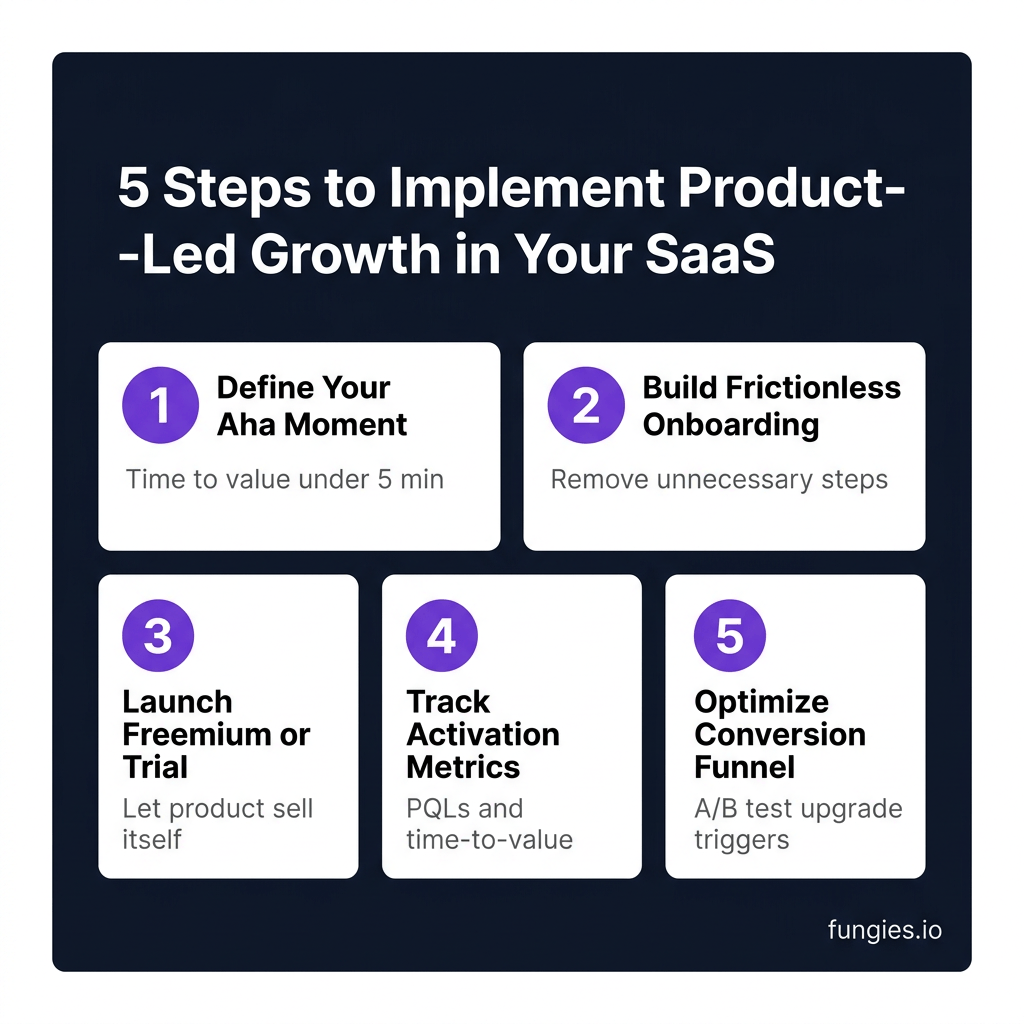
5 Steps to Implement PLG in Your SaaS
Step 1: Define Your Aha Moment
Before you build anything, identify the specific action that makes users say “this is exactly what I needed.” For Zoom, it is hosting your first successful meeting. For Notion, it is creating a page that replaces three other tools.
Use product analytics to find correlation between early actions and long-term retention. The action with the highest correlation is your activation event. Now optimize your entire onboarding flow to get users there as fast as possible.
Step 2: Build Frictionless Onboarding
Every field in your signup form, every verification email, every tutorial video adds friction. Audit your onboarding and remove anything that does not directly contribute to the aha moment.
Best practices from top PLG companies:
- Offer social login (Google, GitHub) to reduce password friction
- Use progressive profiling — collect data over time, not upfront
- Provide templates and defaults so users start with something valuable
- Remove empty states — pre-populate with sample data
Step 3: Launch Freemium or Free Trial
Choose your model based on your product complexity and target market. Freemium works best for products with network effects or viral potential. Free trials work better for complex B2B tools requiring setup.
The key is “value gating” — limit based on value received, not time elapsed. Slack limits message history. Canva limits premium templates. Figma limits private projects. Users hit the limit exactly when they are getting the most value, making the upgrade decision obvious.
Step 4: Track the Right Metrics
PLG requires a different metrics framework than sales-led growth. Here is what to track:
| Metric | Definition | Benchmark |
|---|---|---|
| Time to Value (TTV) | Minutes from signup to first meaningful outcome | Under 5 minutes |
| Activation Rate | % of signups reaching aha moment within 7 days | 20-40% |
| Product-Qualified Leads (PQLs) | Free users showing high engagement signals | Top 10-20% of active users |
| Free-to-Paid Conversion | % of free users upgrading to paid | 9% median, 15-25% elite |
| Net Revenue Retention (NRR) | Revenue from existing customers including expansion | Over 120% |
| Viral Coefficient | New users brought by each existing user | Over 0.3 |
Only 34% of PLG companies actually track activation metrics. Do not be in the 66% flying blind.
Step 5: Optimize Your Conversion Funnel
PLG conversion optimization never stops. A/B test your upgrade prompts, pricing page layout, and paywall messaging. Use behavioral triggers — when a user hits a limit, show the upgrade modal immediately, not in an email hours later.
Consider adding a “reverse trial” — give users premium features for 14 days, then downgrade them to free. Users who experience premium features are 3x more likely to upgrade than those who never tried them.
Real PLG Success Stories
Let us look at three companies that executed PLG flawlessly:
Slack: The Collaboration Flywheel
Slack’s genius was making the product better with every new user invited. The 10,000-message history limit on free plans created natural upgrade pressure exactly when teams were most engaged. Result: $1 billion ARR and a $27 billion acquisition.
Figma: Design for Teams
Figma made collaboration the core feature, not an add-on. Designers could share files with anyone, creating viral loops within organizations. The product was so good, Adobe tried to acquire them for $20 billion.
Cursor: The Fastest-Growing SaaS Ever
Cursor, the AI code editor, crossed $500 million ARR by mid-2025 and hit $2 billion ARR by February 2026 — the fastest SaaS company to reach those milestones. Their PLG motion combined instant value (AI suggestions from first keystroke), viral sharing (developers showing off AI-generated code), and seamless team expansion.
The $10M ARR Plateau and How to Break Through
Here is a reality most PLG enthusiasts won’t tell you: most B2B SaaS companies hit a growth plateau around $10M ARR when pure PLG mechanics stop scaling. Self-serve users resist upgrading to enterprise plans that require sales conversations.
The solution is a hybrid model. Keep PLG for acquisition and small team expansion, but add sales-assisted growth for enterprise deals. Zoom did this early. Slack did it after hitting the wall. The companies that succeed long-term build both motions in parallel.
Common PLG Mistakes to Avoid
After analyzing hundreds of SaaS companies, here are the most common PLG failures:
- Thinking PLG means no sales: The best PLG companies use sales for expansion, just not acquisition
- Optimizing for signups instead of activation: A million signups with 5% activation is worse than 100,000 signups with 40% activation
- Ignoring time-to-value: Up to 75% of users abandon products within the first week if they do not see value quickly
- Building without usage data: PLG requires deep analytics. If you cannot track the aha moment, you cannot optimize for it
- Setting limits too high or too low: Free tiers should be genuinely useful but create natural upgrade pressure at the right moment
FAQ: Product-Led Growth for SaaS
What is the average free-to-paid conversion rate for PLG SaaS?
The median free-to-paid conversion rate across PLG models is 9%. However, this varies significantly by model: freemium typically sees 3-5% (good) to 8-12% (great), while opt-in free trials convert at 4-6% (good) to 10-15% (great). Elite companies with optimized activation can hit 15-25%.
How long should my free trial be?
Most successful PLG companies use 14-day trials, though 7 days works for simpler products and 30 days for complex enterprise tools. The key is ensuring users have enough time to reach the aha moment and experience value, not following an arbitrary number.
Can B2B enterprise SaaS use PLG?
Absolutely. Figma, Slack, and Notion all serve enterprise customers with PLG motions. The strategy is “product-led entry, sales-assisted expansion” — let individuals and small teams adopt self-serve, then use sales to expand into enterprise deployments.
What is a Product-Qualified Lead (PQL)?
A PQL is a free user who has taken actions indicating high purchase intent — reaching usage limits, inviting team members, integrating with other tools, or repeatedly using core features. Companies that use PQLs see 3x higher free-to-paid conversion rates than those that do not.
How do I measure time-to-value (TTV)?
TTV measures the time from signup to first meaningful outcome. First, define what “value” means for your users — publishing a project, sending a message, completing a task. Then track the average time to that event. The 2026 benchmark across SaaS categories is 1 day, 12 hours, but elite PLG products achieve under 5 minutes.
Conclusion: Build Your PLG Engine
Product-led growth is not a trend. It is the dominant go-to-market strategy for modern SaaS, and the gap between companies using PLG effectively versus those still relying on sales-led motions is only widening.
The playbook is clear: define your aha moment, reduce time-to-value under 5 minutes, build viral loops into your product, and track activation metrics religiously. Start with self-serve, then layer in sales-assisted expansion as you scale.
If you are building a SaaS product and not thinking about PLG, you are leaving growth on the table. The companies winning in 2026 — Cursor, Figma, Notion, Calendly — all share one trait: their products are their best salespeople.
Ready to monetize your SaaS globally? Sign up for Fungies.io and launch your product with built-in global tax compliance, multiple payment methods, and a checkout experience designed for conversion.