10 Proven Ways to Reduce Customer Acquisition Cost (CAC) for SaaS in 2026
Discover 10 proven strategies to reduce customer acquisition cost for SaaS companies in 2026. Learn how top companies cut CAC by 50% through SEO, product-led growth, AI optimization, and retention focus. Includes industry benchmarks and actionable tactics.
Here’s a sobering thought: the average B2B SaaS company now spends $2.00 to acquire every $1.00 of new ARR. Customer acquisition costs have surged 222% over the past 8 years, with a 60% jump in just the last 5 years. If you’re running a SaaS business in 2026, CAC isn’t just another metric to track—it’s the difference between sustainable growth and burning through your runway.
But here’s the thing. Most founders approach CAC reduction backwards. They slash marketing budgets and pray. The smart ones? They get surgical about where their acquisition dollars go and who they’re targeting.
What Is Customer Acquisition Cost (CAC) in SaaS?
Customer Acquisition Cost is the total amount you spend to turn a stranger into a paying customer. The formula is straightforward:
CAC = Total Sales & Marketing Costs ÷ Number of New Customers Acquired
So if you spent $50,000 on sales and marketing last quarter and acquired 100 customers, your CAC is $500. Simple enough. But the devil’s in the details—what counts as “sales and marketing costs” varies by company, and most teams underestimate their true CAC by 30-40%.
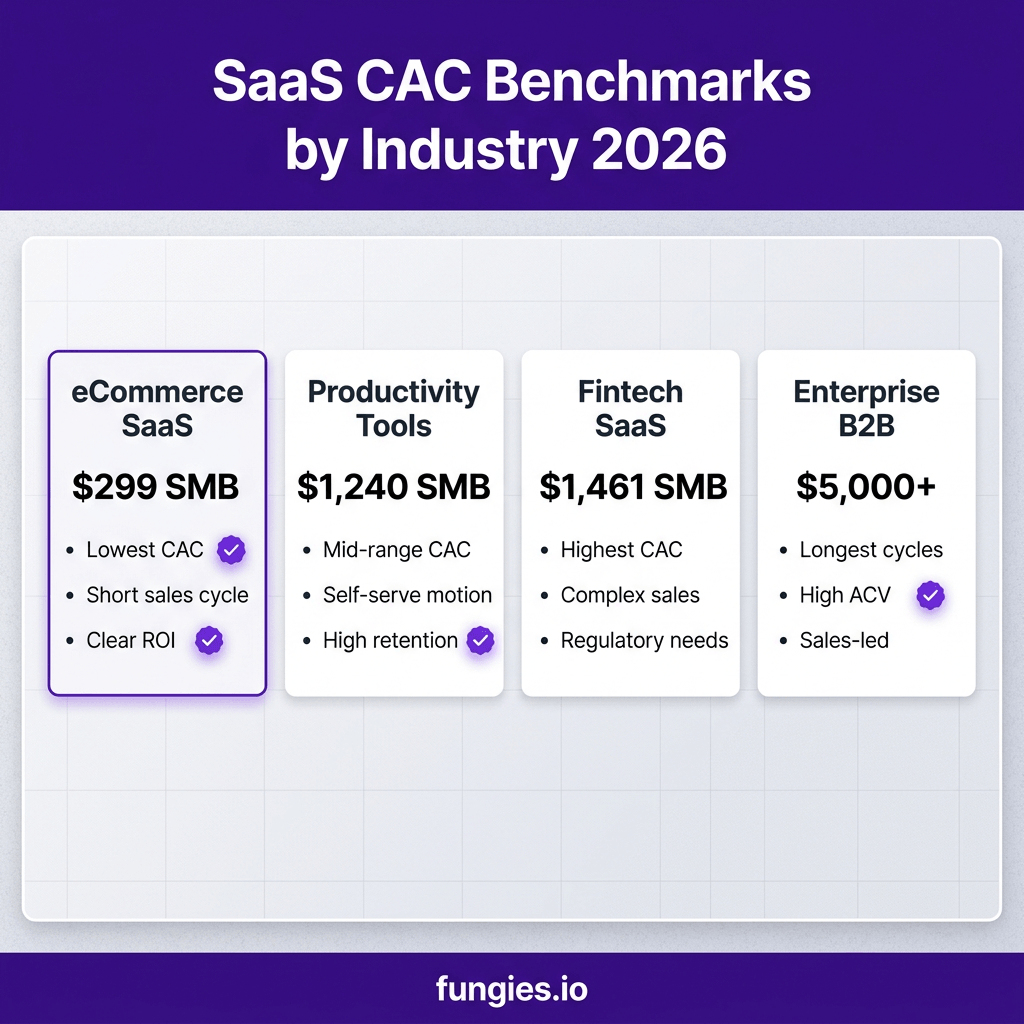
The 2026 benchmark data tells a clear story. Average B2B SaaS CAC sits at $702, but that’s misleading. Fintech SaaS companies face CAC as high as $1,461 for SMBs and $14,772 for enterprise deals. eCommerce SaaS enjoys the lowest at $299 for SMBs. Your vertical, sales motion, and target market matter enormously.
Why CAC Matters More Than Ever in 2026
Three forces are converging to make CAC the defining metric of 2026:
- Digital ad costs keep climbing. LinkedIn ad costs have surged 89% since 2019. Google CPCs in competitive SaaS keywords routinely hit $50-100. The paid acquisition playbook that worked in 2020 is bleeding money today.
- Sales cycles are lengthening. The average B2B SaaS sales cycle now spans 134 days—up from 107 days in early 2022. That’s 25% more touchpoints, more nurturing, more cost per deal.
- Investor expectations have shifted. The “growth at all costs” era is dead. VCs now want to see efficient growth—LTV:CAC ratios of 3:1 minimum, with payback periods under 12 months for SMB and under 18 months for enterprise.
Top-quartile SaaS companies spend approximately $1.00 to acquire $1 of ARR. Fourth-quartile companies spend $2.82. That efficiency gap isn’t just about spending less—it’s about spending smarter.
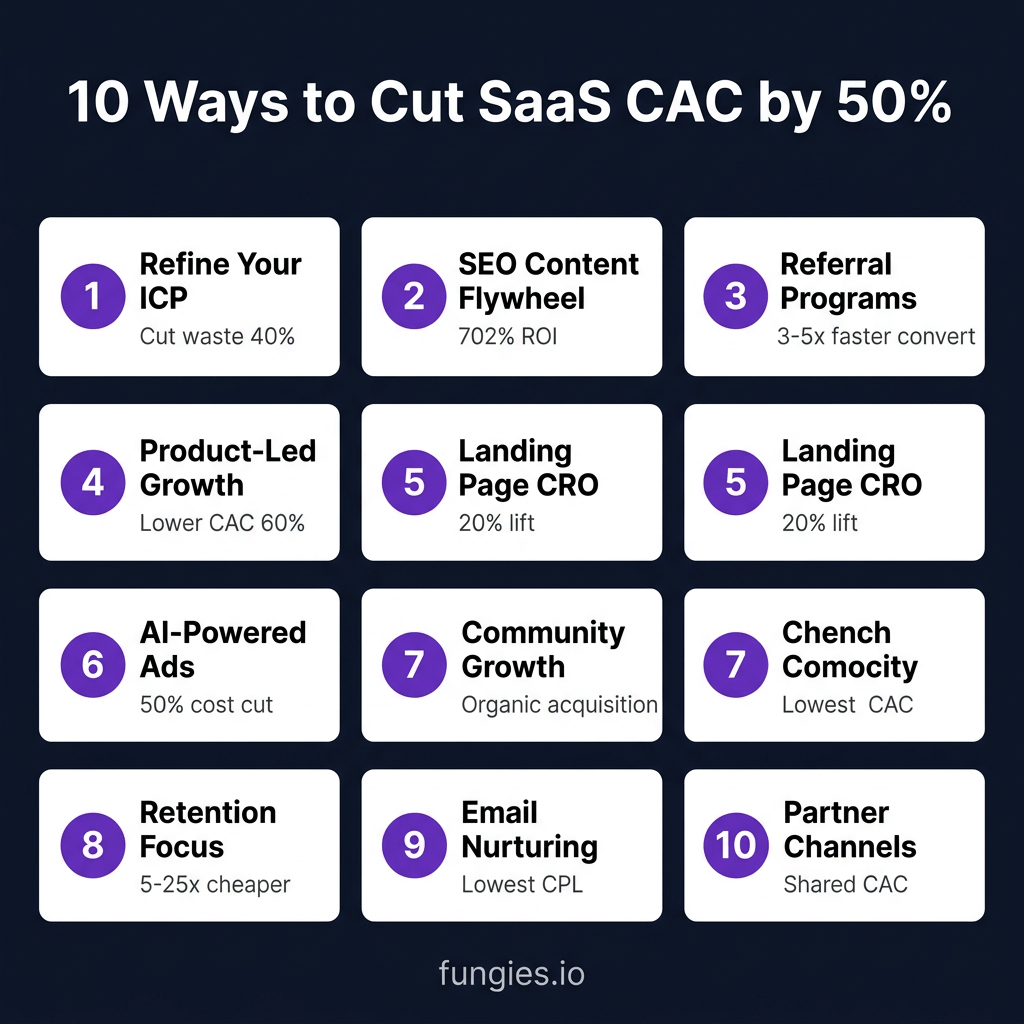
10 Proven Strategies to Reduce Your SaaS CAC
1. Refine Your ICP to Cut Waste by 40%
Most SaaS companies have a vague ICP. “Mid-market B2B companies” isn’t an ICP—it’s a demographic. A real ICP includes firmographic details (company size, industry, tech stack), psychographic traits (pain urgency, buying committee structure), and behavioral signals (how they research, what content they consume, which competitors they evaluate).
Companies that systematically refine their ICP see 30-40% reductions in wasted ad spend within 60 days. Why? Because they stop targeting “maybe” prospects and focus exclusively on high-intent, high-fit accounts. Start by analyzing your best customers—the ones with highest LTV, shortest sales cycles, and lowest support burden. What do they have in common? Double down there.
2. Build an SEO Content Flywheel (702% ROI)
B2B SaaS companies generate a 702% ROI from SEO. Not 70%. Not 170%. Seven hundred and two percent. The reason is simple: organic search CAC ranges from $647-$1,786, while paid B2B search averages $802—and that’s before you factor in the compounding nature of content.
A blog post you publish today keeps generating leads in month 6, month 12, month 24. A Google Ads campaign stops the moment you stop paying. The math isn’t close. Companies with mature SEO programs reduce customer acquisition costs by over 87% compared to paid-only strategies.
Focus on bottom-funnel content first—comparison pages (“YourProduct vs Competitor”), alternative pages (“Best Alternatives to Competitor”), and use-case specific guides. These convert at 3-5x the rate of top-funnel awareness content.
3. Launch a Referral Program That Actually Works
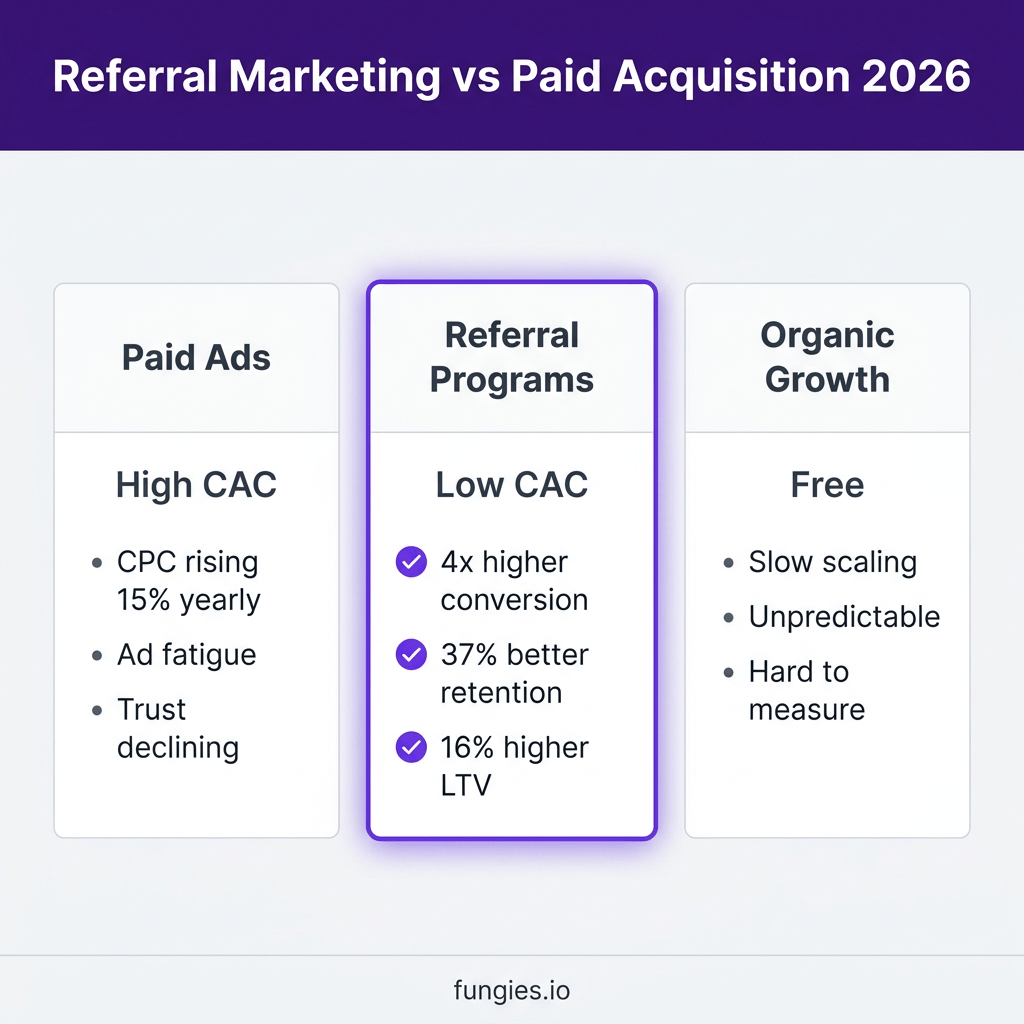
Referred customers convert 3-5x faster and retain 16% longer than customers from paid channels. Yet most SaaS referral programs are an afterthought—a buried link in the footer with weak incentives.
Effective referral programs have three elements: they reward both parties (the referrer and the referred), they trigger at moments of peak satisfaction (after a successful outcome, not during onboarding), and they make sharing effortless (one-click with pre-written messages).
Dropbox’s famous referral program drove 3900% growth. While you might not hit those numbers, a well-executed referral channel can drive 15-30% of new acquisitions at a fraction of your paid CAC.
4. Double Down on Product-Led Growth
Product-led growth (PLG) isn’t just a buzzword—it’s a fundamentally different CAC equation. When your product itself is the primary acquisition vehicle, you eliminate most sales and marketing overhead for the initial user activation.
Self-serve SaaS products typically see CAC between $100-$500, while sales-led enterprise deals exceed $5,000. The PLG companies achieving sub-$600 CAC aren’t magic—they’ve built products that sell themselves through free trials, freemium tiers, and viral loops.
Even if you’re not fully PLG, adding self-serve elements—a free trial, interactive demo, or sandbox environment—can significantly reduce CAC by qualifying prospects before they ever talk to sales.
5. Optimize Landing Pages for Conversion
You can cut your CAC by 20% without changing your ad spend—just by improving what happens after the click. Most SaaS landing pages convert at 2-5%. The best convert at 15-25%. That 5x difference flows directly to your CAC.
High-converting SaaS landing pages follow a pattern: clear above-the-fold value proposition, social proof from recognizable customers, specific benefit bullets (not features), a single prominent CTA, and objection-handling FAQs. They also load fast—every 1-second delay in page load drops conversions by 7%.
Run systematic A/B tests on headlines, CTAs, form fields, and social proof placement. Small improvements compound over time.
6. Leverage AI to Cut Acquisition Costs by 50%
Companies utilizing AI in their marketing and sales processes have witnessed up to 50% reduction in acquisition costs. The applications are broad: AI-powered ad bidding that optimizes in real-time, predictive lead scoring that prioritizes high-conversion prospects, chatbots that qualify leads 24/7, and content generation that accelerates SEO production.
The key is using AI to augment human judgment, not replace it. Let AI handle data analysis, pattern recognition, and repetitive tasks. Let humans handle strategy, creativity, and relationship building. The combination is where the 50% CAC reduction comes from.
7. Build a Community That Acquires for You
Community-led growth has emerged as one of the most powerful CAC reduction strategies. When your customers help each other, create content, and advocate for your product, you build an organic acquisition engine that runs on engagement rather than ad spend.
Notion, Figma, and Slack all leveraged community to drive millions in organic growth. Their users create templates, tutorials, and integrations that attract new users—effectively doing the marketing for them.
Start with a simple Discord or Slack community. Host regular AMAs, share exclusive content, and recognize top contributors. Over time, your community becomes a moat that competitors can’t replicate with ad spend.
8. Focus on Retention (It’s 5-25x Cheaper)
Here’s a statistic that should change how you think about CAC: acquiring new customers costs 5-25x more than retaining existing ones. Every customer you prevent from churning is a customer you don’t have to acquire (and pay for) again.
Retention improvements compound directly into CAC efficiency. If you extend average customer lifetime by 20%, your LTV:CAC ratio improves by 20%—without changing your acquisition spend at all.
Invest in onboarding optimization, proactive customer success, and expansion revenue. These are CAC reduction strategies disguised as retention plays.
9. Master Email Marketing (Lowest Cost Per Lead)
Among all digital marketing channels, email delivers the lowest cost per lead. It’s not glamorous, but it works. Email marketing CAC typically runs 40-60% lower than paid social and 70% lower than event marketing.
The key is segmentation and automation. Batch-and-blast newsletters are dead. Modern email marketing uses behavioral triggers—when a user takes action X, they get sequence Y. Product usage drops? Re-engagement sequence. Free trial ending? Conversion sequence. New feature launched? Adoption sequence.
Build lifecycle email programs that nurture leads from first touch to expansion. The ROI is unmatched.
10. Develop Strategic Partnerships
Partnership channels let you share CAC with complementary products. When HubSpot acquires a customer, that customer might also need a CRM integration, email tool, or analytics platform. Strategic partnerships put you in front of qualified prospects without the full acquisition cost.
Look for products that serve your ICP but don’t compete directly. Integration partnerships, co-marketing campaigns, and referral agreements can drive 10-20% of new acquisitions at significantly lower CAC than direct channels.
CAC Benchmarks by Industry: Where Do You Stand?
| Industry | SMB CAC | Mid-Market CAC | Enterprise CAC |
|---|---|---|---|
| eCommerce SaaS | $299 | $1,407 | $2,206 |
| Productivity & Tools | $1,240 | $2,800 | $4,500 |
| HR & Recruiting | $612 | $2,100 | $5,200 |
| Fintech SaaS | $1,461 | $4,903 | $14,772 |
| Healthcare SaaS | $800 | $2,400 | $6,800 |
Source: First Page Sage B2B SaaS CAC Report 2024
What “Good” CAC Looks Like: The Golden Ratios
Raw CAC numbers only tell part of the story. What matters is efficiency—how much value you get back for every dollar spent. Here are the benchmarks that matter:
- LTV:CAC Ratio: Aim for 3:1 minimum. Top performers hit 5:1 or higher. Below 3:1 and your unit economics don’t work.
- CAC Payback Period: Keep it under 12 months for SMB, under 18 months for enterprise. The faster you recover acquisition costs, the faster you can reinvest in growth.
- CAC Ratio (Sales & Marketing spend vs new ARR): Top-quartile companies spend $1.00 to acquire $1 of ARR. Fourth-quartile spend $2.82. Know where you stand.
FAQ: Reducing Customer Acquisition Cost
What is a good CAC for B2B SaaS?
The average B2B SaaS CAC is $702, but “good” depends on your ACV and LTV. A $500 CAC is excellent for a $50/month product with high retention. It’s terrible for a $500/month product with 12-month average lifetime. Focus on LTV:CAC ratio (aim for 3:1+) and payback period (under 12-18 months) rather than absolute CAC.
Why is CAC increasing for SaaS companies?
CAC has risen 222% over 8 years due to three factors: increased competition driving up ad costs (LinkedIn up 89% since 2019), longer sales cycles (134 days average, up from 107), and buyer behavior shifts (more research, more stakeholders, more touchpoints required).
How can I calculate my true CAC?
Include all sales and marketing expenses: salaries, commissions, ad spend, software, events, content production, and agency fees. Divide by new customers acquired in the same period. Most companies underestimate by 30-40% by excluding salaries or attributing all new revenue to new customers (don’t forget expansion and resurrection).
Is it better to reduce CAC or increase LTV?
Both matter, but retention improvements often have higher ROI than acquisition optimization. A 5% increase in retention can increase profitability by 25-95%. That said, if your CAC is 5x industry benchmarks, fix that first—there’s no LTV that justifies unsustainable acquisition costs.
What’s the fastest way to reduce CAC?
Refine your ICP and cut wasted spend on poor-fit prospects. Most SaaS companies can reduce CAC by 30-40% within 60 days simply by stopping campaigns that target unlikely converters. After that, invest in SEO (702% ROI) and conversion rate optimization (20% lifts are common).
Conclusion: Make CAC Your Competitive Advantage
Customer acquisition cost isn’t just a metric to track—it’s a strategic lever that determines whether your SaaS business thrives or dies. In 2026’s environment of rising ad costs and longer sales cycles, efficient acquisition is the ultimate competitive moat.
The companies winning right now aren’t necessarily spending less. They’re spending smarter—doubling down on SEO, building products that sell themselves, leveraging AI for efficiency, and creating communities that acquire customers organically.
Start with your ICP. Cut the waste. Build the flywheel. Your future self (and your runway) will thank you.
Ready to streamline your SaaS operations and focus on growth? Get started with Fungies.io—the Merchant of Record platform that handles payments, tax compliance, and checkout so you can focus on what matters: acquiring customers efficiently.
Sources
- GTM 80/20 – 38 Customer Acquisition Cost Statistics for B2B SaaS 2026
- First Page Sage – B2B SaaS Customer Acquisition Cost Report 2024
- BenchmarkIT – 2025 SaaS Benchmarks
- Userpilot – Average Customer Acquisition Cost Analysis
- Genesys Growth – CAC Benchmarks for Marketing Leaders
- Amra & Elma – SaaS Customer Acquisition Statistics