How to Reduce SaaS Churn: The Complete 2026 Guide with Data-Backed Strategies
Discover proven strategies to reduce SaaS churn in 2026. Learn data-backed tactics from 76M+ subscribers across 1,000+ companies. Includes benchmarks, prevention strategies, and actionable frameworks to improve retention.
Here’s a sobering number: $136 billion. That’s how much revenue SaaS companies lost to churn in 2025 alone. If you’re running a SaaS business, churn isn’t just a metric — it’s the silent killer that determines whether you scale or stall.
I’ve spent years analyzing retention data across hundreds of SaaS companies. The patterns are clear: most churn is preventable, but only if you know what to look for and when to act. This guide compiles the latest 2026 benchmarks from Recurly (76M+ subscribers), Churnkey (15M subscriptions), and ChartMogul (3,974 companies) to give you a playbook that actually works.
What Is SaaS Churn (And Why It Matters More Than Ever)
Churn rate measures the percentage of customers or recurring revenue you lose within a set period. Simple enough. But here’s what most founders miss: a 5% monthly churn rate compounds to 46% annual customer loss. At 10% monthly, you’re replacing over 70% of your customer base every year just to stay flat.
The cost of acquiring a new customer is 5-7x higher than retaining an existing one. Bain & Company’s research found that a 5% improvement in customer retention can increase profits by 25% to 95%. In 2026’s competitive landscape, where CAC payback periods have stretched to 18 months for growth-stage SaaS, retention isn’t just important — it’s existential.
SaaS Churn Benchmarks: Where Do You Stand?
Before you can reduce churn, you need to know what “good” looks like for your specific situation. Churn benchmarks vary dramatically by company size, pricing model, and vertical.
Churn by Company Stage
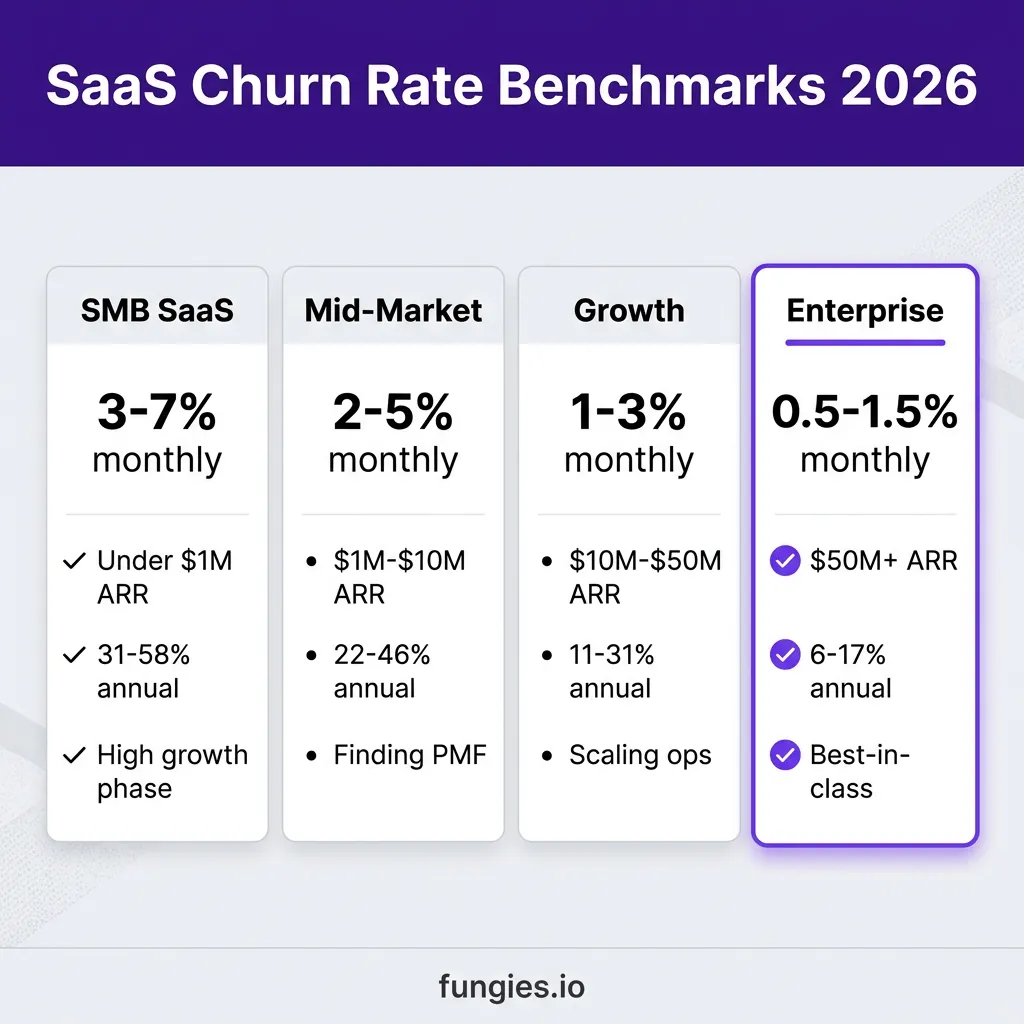
| Segment | Monthly Churn | Annual Churn | Notes |
|---|---|---|---|
| SMB SaaS (<$1M ARR) | 3-7% | 31-58% | High growth, less PMF |
| Mid-Market ($1M-$10M) | 2-5% | 22-46% | Finding product-market fit |
| Growth ($10M-$50M) | 1-3% | 11-31% | Scaling operations |
| Enterprise ($50M+) | 0.5-1.5% | 6-17% | Deep integrations, longer contracts |
Source: Optifai Pipeline Study 2026 (N=939 B2B SaaS companies)
Churn by Pricing Model
| Pricing Model | Typical Monthly Churn | Key Insight |
|---|---|---|
| Freemium to paid | 5-10% | Low commitment, high experimentation |
| Month-to-month | 3-6% | Easy cancellation, low switching costs |
| Annual contracts | 1-2% | 50% lower churn vs monthly |
| Multi-year/enterprise | 0.3-1% | Deep integration, high switching costs |
Annual plans don’t just reduce churn — they make customers 2x more profitable. The psychology is simple: annual commitments eliminate monthly decision points and give customers more time to experience value before renewal.
The Real Causes of SaaS Churn (And What Actually Drives Them)
Understanding why customers leave is more actionable than simply measuring how many leave. According to aggregated industry surveys and post-churn analyses, here’s what drives B2B SaaS churn in 2026:
| Cause of Churn | % of Churned Customers | Detectable Before Cancel? |
|---|---|---|
| Poor onboarding / slow time-to-value | 23% | Yes — 3-6 weeks early |
| Lack of product engagement over time | 21% | Yes — login frequency drops |
| Unresolved support issues | 16% | Yes — ticket sentiment shifts |
| Price sensitivity / budget cuts | 14% | Sometimes — downgrades first |
| Switched to competitor | 12% | Rarely — sudden drop-off |
| Missing features / unmet needs | 9% | Sometimes — feature requests |
| Involuntary (payment failures) | 5% | Yes — card expiring |
Here’s the critical insight: the top two causes (poor onboarding and declining engagement) are detectable through product usage data weeks before cancellation. Companies that track feature-level usage identify at-risk accounts 3-6 weeks earlier than those relying on billing data alone.
5 Data-Backed Strategies to Reduce SaaS Churn
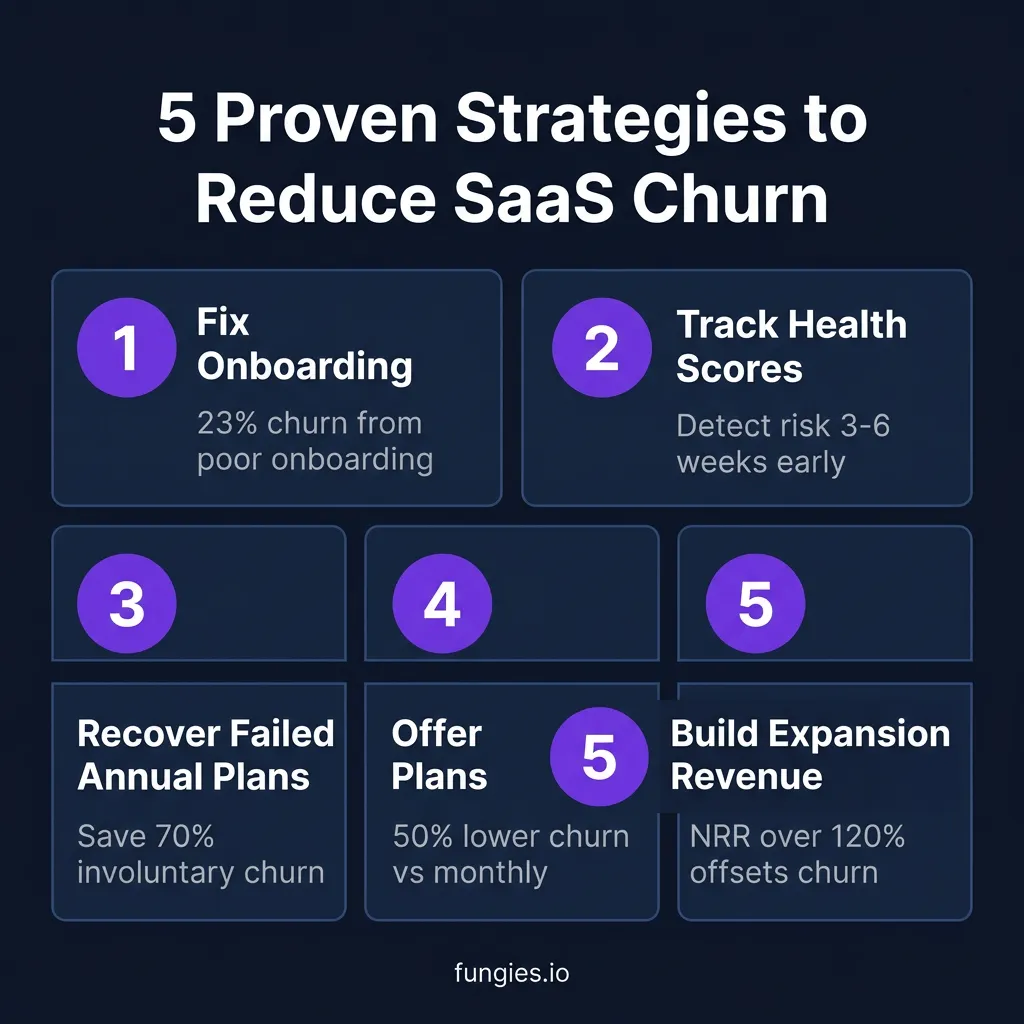
1. Fix Your Onboarding (23% of Churn Starts Here)
Poor onboarding is the single biggest cause of SaaS churn. Companies with strong onboarding (time-to-first-value under 7 days) see 50% lower churn rates than those that don’t. The first 90 days are make-or-break: 44% of subscription cancellations happen within this window.
What to do:
- Map your “aha!” moment — the specific action where users experience core value
- Design onboarding to get users to that moment within 48 hours, not 2 weeks
- Use progressive disclosure — don’t show every feature at once
- Send behavior-triggered emails based on where users get stuck
- Offer in-app guidance and tooltips for complex workflows
86% of customers say they’re more likely to stay loyal to a business that invests in good onboarding content. It’s not a nice-to-have — it’s your first and best defense against churn.
2. Build a Customer Health Score System
The most predictive churn signals, ranked by lead time before cancellation:
- Login frequency decline (3-6 weeks lead time) — strongest predictor across all segments
- Feature usage contraction (2-4 weeks) — customers evaluating alternatives
- Support ticket sentiment shift (2-3 weeks) — negative CSAT correlates with 30-day churn
- Billing downgrades (1-2 weeks) — often the last step before cancellation
- NPS score drop (4-8 weeks) — detractors churn at 3-5x the rate of promoters
No single signal is sufficient. The most effective retention teams combine these into a composite health score that weighs multiple data sources, then trigger automated workflows the moment a customer crosses a risk threshold. Companies using health score models consistently outperform single-metric approaches.
3. Recover Involuntary Churn (The Hidden 5-40%)
Involuntary churn — subscriptions lost to failed payments rather than conscious cancellation — accounts for 20-40% of total churn across subscription businesses, and up to 68% in subscription boxes. This is entirely preventable revenue loss.
Why payments fail:
- Insufficient funds (~50%) — soft decline, retryable
- Risk management / fraud detection (25-30%) — hard decline
- Card issues — expired, lost, stolen (10-15%)
Recovery tactics that work:
- Smart payment retries — up to 89% recovery rate
- Dunning campaigns (email + SMS) — 42% average recovery
- Proactive card update reminders before expiration
- Multiple payment method backup options
Overall, 70% of detected involuntary churn is recoverable. The software industry alone recovered $155 million through payment recovery tools in 2025. If you’re not running retry logic and dunning campaigns, you’re leaving real money on the table.
4. Push Annual Plans (50% Churn Reduction)
Annual plans reduce churn by roughly half compared to monthly billing. The data is consistent across every dataset: annual subscribers are about 2x more profitable and have 8.5% annual churn vs 16% for month-to-month.
How to incentivize annual:
- Offer 15-20% discount for annual commitment
- Position annual as the “smart choice” in your pricing page
- Default to annual in your signup flow (with monthly as option)
- Highlight the savings prominently
- Add annual-only perks (priority support, early access)
Net Revenue Retention runs 10-20 percentage points higher for annual plans. If you can move even 30% of your monthly customers to annual, you’ll see a meaningful impact on your churn rate.
5. Build Expansion Revenue to Offset Churn
Here’s the ultimate churn hack: achieve negative net churn. This happens when expansion revenue from existing customers (upsells, seat growth, usage increases) outpaces losses from cancellations.
Net Revenue Retention benchmarks:
- Below 90% — below average, concerning
- 100-110% — good, healthy growth from existing base
- Above 120% — best-in-class, grows without new sales
Companies with NRR above 120% can grow revenue even with zero new customer acquisition. Snowflake and Datadog achieve 120-130%+ NRR by combining low gross churn with strong expansion mechanics.
Expansion tactics:
- Usage-based pricing that grows with customer success
- Seat-based models that expand with team growth
- Proactive outreach when customers hit usage limits
- Clear upgrade paths with demonstrated value
What to Do When Customers Try to Cancel
Even with perfect prevention, some customers will hit your cancellation flow. What you do in those moments matters. Churnkey analyzed nearly 2 million saved subscriptions and found what actually works:
| Retention Offer | Effectiveness | When to Use |
|---|---|---|
| Discounts | 53% of accepted offers | Price-sensitive customers, budget cuts |
| Subscription pauses | 19% acceptance rate | Seasonal businesses, temporary needs |
| Plan changes / downgrades | 7% acceptance rate | Feature mismatch, over-purchased |
Pauses are particularly effective. When companies offer a “pause before cancel” option, usage rises 337%. Three out of four subscribers who pause eventually return. If you don’t offer pauses, you’re forcing temporary problems into permanent cancellations.
Win-back timing matters too. ChartMogul analyzed 4.78 million returning customers: 45% of win-backs happen within 30 days, 66% within 90 days. After 90 days, returns drop off sharply. The first month post-churn is your highest-leverage window for re-engagement.
FAQ: Reducing SaaS Churn
What’s a “good” churn rate for B2B SaaS?
For B2B SaaS, a good monthly churn rate is under 1% (under 11% annually). However, this varies by company stage: SMB SaaS might see 3-5% monthly as acceptable, while enterprise should target under 0.5%. The key is benchmarking against similar companies and improving over time.
How do I calculate churn rate correctly?
Customer churn = (Customers lost in period / Customers at start of period) × 100. Revenue churn = (MRR lost in period / MRR at start of period) × 100. Track both — they tell different stories. A company can have 5% customer churn but 2% revenue churn if they’re losing small customers and keeping big ones.
What’s the difference between voluntary and involuntary churn?
Voluntary churn is when customers actively choose to cancel. Involuntary churn is when subscriptions end due to failed payments, expired cards, or billing errors. Voluntary churn requires product or experience improvements. Involuntary churn requires payment recovery systems. Track them separately.
How quickly should I get users to their “aha!” moment?
Ideally within the first session, definitely within 48 hours. Companies with time-to-first-value under 7 days see 50% lower churn. Every day of delay increases the risk that users lose interest or get distracted.
Can I achieve negative churn as an early-stage startup?
It’s difficult but possible. Early-stage companies typically have NRR around 98% (slight contraction). The path to negative churn usually requires: (1) product-market fit, (2) clear expansion mechanics, and (3) a customer base large enough for expansion to offset losses. Focus first on gross churn — get that under 5% annually before optimizing for expansion.
Conclusion: Make Retention Your Growth Engine
Churn reduction isn’t just about keeping customers — it’s about building a sustainable growth engine. A 1% reduction in monthly churn has compounding effects: $20K saved per year at $2M ARR, $100K at $10M ARR. The ROI on retention tooling averages 3.2x.
The companies winning in 2026 aren’t just acquiring customers efficiently. They’re keeping them longer, expanding them faster, and turning retention into a competitive advantage. Start with onboarding — fix that 23% of churn caused by poor time-to-value. Layer in health scoring to catch at-risk customers early. Recover the involuntary churn you’re currently leaking. Push annual plans to lock in commitment. And build expansion revenue to achieve negative net churn.
Your churn rate is a choice. Make the right ones.
Ready to streamline your SaaS billing and reduce involuntary churn? Create your free Fungies account and get built-in dunning, smart retry logic, and global payment recovery — so you can focus on building products customers love.
Sources
- Recurly — Churn Rate Benchmarks 2026 (2,200 merchants, 76M subscribers)
- Churnkey — State of Retention 2025 (15M subscriptions, 3M cancellation sessions)
- ChartMogul — SaaS Retention Report 2026 (3,974 companies)
- Optifai — B2B SaaS Churn Benchmarks (939 companies)
- SubJolt — Churn Rate Benchmarks by Industry
- Perly — SaaS Churn Rate Statistics 2026