7 Best Revenue Recognition Software for SaaS in 2026: Complete Comparison Guide
Compare the 7 best revenue recognition software for SaaS in 2026. Includes LedgerUp, Maxio, Zuora, Chargebee, and Stripe with pricing, features, and ASC 606 compliance details.
SaaS finance teams lose an average of 9% of MRR to revenue leakage caused by manual revenue recognition errors and spreadsheet-based tracking. For a company doing $5M ARR, that’s $450,000 in unrecognized or misreported revenue every year. As ASC 606 compliance requirements tighten and audit scrutiny increases, spreadsheets aren’t just inefficient — they’re a liability.
Revenue recognition software automates the complex process of recognizing subscription and usage-based revenue over time, ensuring GAAP compliance while giving finance teams real-time visibility into their true financial position. In this guide, we’ll compare the 7 best revenue recognition software platforms for SaaS companies in 2026, with detailed feature breakdowns, pricing, and selection criteria.
What Is Revenue Recognition Software?
Revenue recognition software automates how SaaS companies recognize revenue from customer contracts over time. Unlike traditional accounting tools built for one-time sales, these platforms handle the unique complexities of subscription billing: multi-year contracts, usage-based pricing, tiered plans, and performance obligations spread across months or years.
Under ASC 606 (and IFRS 15), revenue can only be recognized when control of goods or services transfers to the customer. For SaaS, this means recognizing subscription revenue monthly as the service is delivered — not when cash is collected. Revenue recognition software automates this allocation, generates audit-ready reports, and ensures compliance with evolving accounting standards.
The 7 Best Revenue Recognition Software for SaaS in 2026
1. LedgerUp — Best for AI-Powered Contract Analysis
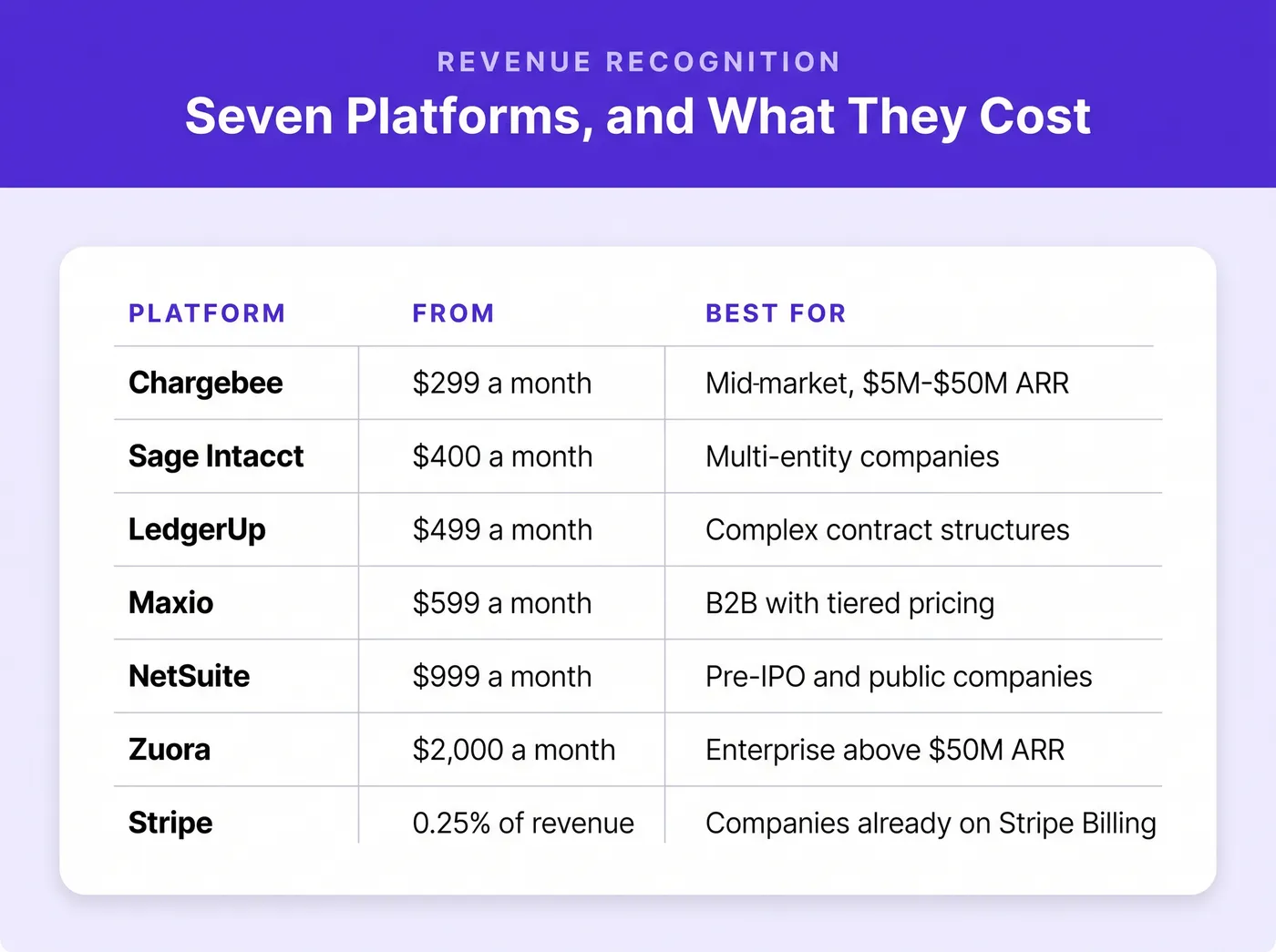
LedgerUp uses AI to extract revenue terms from contracts automatically, eliminating manual data entry. It handles complex multi-element arrangements, usage-based pricing, and hybrid models with minimal configuration.
- Best for: SaaS companies with complex contract structures
- Starting price: $499/month
- ASC 606 ready: Yes
- Key differentiator: AI contract parsing and automated revenue schedules
2. Maxio — Best for B2B SaaS with Hybrid Pricing
Maxio (formerly SaaSOptics + Chargify) combines subscription billing with advanced revenue recognition. It excels at handling hybrid pricing models that mix subscriptions with usage-based components.
- Best for: B2B SaaS with complex pricing tiers
- Starting price: $599/month
- ASC 606 ready: Yes
- Key differentiator: Built-in billing + revenue recognition integration
3. Zuora — Best for Enterprise-Scale Operations
Zuora is the established leader for enterprise SaaS revenue management. It handles massive transaction volumes, multi-currency operations, and complex revenue allocation across global entities.
- Best for: Enterprise SaaS ($50M+ ARR)
- Starting price: Custom (typically $2,000+/month)
- ASC 606 ready: Yes
- Key differentiator: Enterprise-grade scalability and global tax support
4. Chargebee Revenue Recognition — Best for Mid-Market
Chargebee’s revenue recognition module integrates seamlessly with its billing platform, making it ideal for mid-market SaaS companies that want unified billing and revenue management without enterprise complexity.
- Best for: Mid-market SaaS ($5M-$50M ARR)
- Starting price: $299/month (add-on to billing)
- ASC 606 ready: Yes
- Key differentiator: Tight integration with Chargebee billing
5. Stripe Revenue Recognition — Best for Stripe-First Companies
For companies already using Stripe for payments, Stripe Revenue Recognition offers a native add-on that automatically generates revenue schedules from Stripe billing data. Simple setup, no additional integrations needed.
- Best for: Startups using Stripe Billing
- Starting price: 0.25% of recognized revenue
- ASC 606 ready: Yes
- Key differentiator: Zero-configuration for Stripe users
6. Sage Intacct — Best for Multi-Entity SaaS
Sage Intacct combines core accounting with advanced revenue recognition capabilities. It’s ideal for SaaS companies with multiple subsidiaries or complex entity structures requiring consolidated reporting.
- Best for: Multi-entity SaaS companies
- Starting price: $400+/month
- ASC 606 ready: Yes
- Key differentiator: Full ERP with native revenue recognition
7. NetSuite — Best for Public Company Preparation
Oracle NetSuite offers comprehensive revenue recognition for SaaS companies preparing for IPO or acquisition. Its audit trails, SOX compliance features, and advanced reporting meet the strictest standards.
- Best for: Pre-IPO and public SaaS companies
- Starting price: $999+/month
- ASC 606 ready: Yes
- Key differentiator: Public company-grade compliance and audit support
How to Choose Revenue Recognition Software
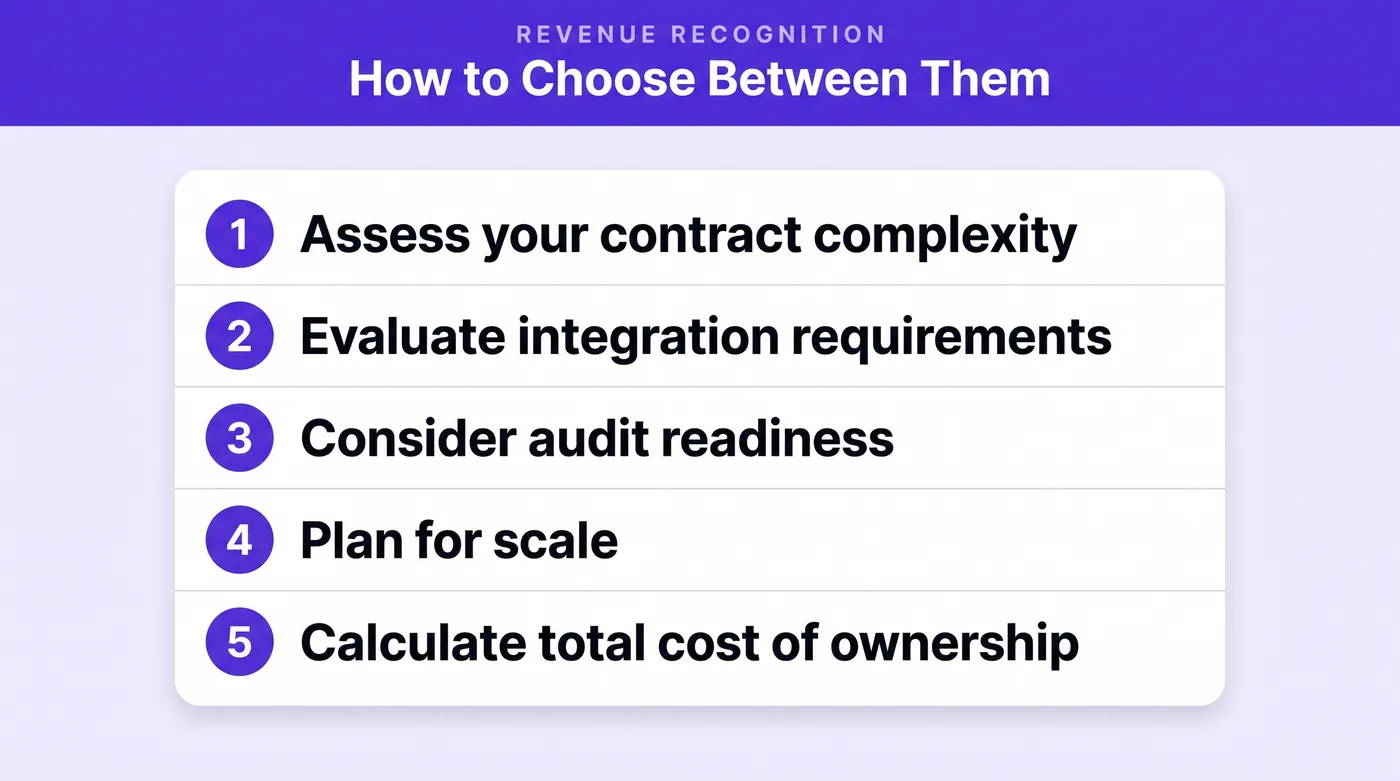
Selecting the right revenue recognition platform depends on your company’s size, complexity, and growth stage. Here’s a decision framework:
1. Assess Your Contract Complexity
Simple month-to-month subscriptions need less sophisticated tools than multi-year enterprise deals with professional services, usage components, and variable pricing. Match the software complexity to your actual contract mix.
2. Evaluate Integration Requirements
Your revenue recognition tool must integrate with your billing system, CRM, and general ledger. Native integrations (like Stripe Revenue Recognition with Stripe Billing) reduce implementation time and error risk.
3. Consider Audit Readiness
If you’re preparing for a Series B, IPO, or annual audit, prioritize platforms with built-in ASC 606 compliance, audit trails, and SOC 2 certification. The cost of inadequate audit support far exceeds software pricing.
4. Plan for Scale
A tool that works at $1M ARR may break at $10M. Consider your 24-month growth trajectory and choose a platform that scales without requiring a painful migration.
5. Calculate Total Cost of Ownership
Beyond subscription fees, factor in implementation costs, training time, ongoing maintenance, and the cost of errors from manual workarounds. A more expensive tool that eliminates manual processes often pays for itself.
Key Revenue Recognition Statistics for 2026
- 9% of MRR is lost annually to revenue leakage from manual processes
- 61% of SaaS companies have adopted hybrid pricing models requiring complex revenue allocation
- $450K average cost of audit findings related to revenue recognition errors for mid-market SaaS
- 14-day average close time for companies with automated revenue recognition vs. 8+ days for spreadsheet-based teams
- 73% of SaaS CFOs cite revenue recognition automation as a top priority for 2026
Frequently Asked Questions
What is ASC 606 and why does it matter for SaaS?
ASC 606 is the accounting standard governing revenue recognition from contracts with customers. For SaaS companies, it requires recognizing subscription revenue over the contract period as services are delivered, not when cash is received. Non-compliance can trigger audit findings, restatements, and valuation impacts.
Can I use QuickBooks or Xero for SaaS revenue recognition?
Basic accounting tools can handle simple subscription revenue, but they lack the automation for complex SaaS scenarios: usage-based pricing, multi-element arrangements, deferred revenue tracking, and ASC 606 compliance reporting. Most SaaS companies outgrow these tools by $2-3M ARR.
How much does revenue recognition software cost?
Pricing ranges from $299/month for mid-market solutions like Chargebee to $2,000+/month for enterprise platforms like Zuora. Some providers charge a percentage of recognized revenue (e.g., Stripe at 0.25%). Implementation costs typically add $5,000-$50,000 depending on complexity.
What’s the difference between billing software and revenue recognition software?
Billing software handles invoicing and payment collection. Revenue recognition software determines when that revenue can be reported on financial statements according to accounting standards. Some platforms (Maxio, Chargebee) combine both; others specialize in one function.
When should a SaaS company implement revenue recognition software?
Implement when: (1) Monthly close takes more than 5 days, (2) You’re preparing for a priced funding round, (3) Revenue exceeds $2M ARR with complex contracts, (4) You’re using spreadsheets for revenue schedules, or (5) Audit readiness is a priority.
Conclusion
Revenue recognition software has evolved from a back-office nicety to a strategic requirement for scaling SaaS companies. The right platform eliminates manual processes, ensures ASC 606 compliance, and gives finance teams real-time visibility into the metrics that matter.
For most SaaS companies, the decision comes down to contract complexity and growth stage: startups using Stripe should consider Stripe Revenue Recognition; mid-market B2B SaaS will find Maxio or Chargebee ideal; enterprises preparing for IPO should evaluate Zuora or NetSuite.
Whichever platform you choose, implement it before revenue complexity outpaces your finance team’s capacity. The cost of waiting — in audit risk, reporting delays, and missed insights — far exceeds the investment in proper tooling.
Ready to Simplify Your Revenue Operations?
Join hundreds of SaaS companies using Fungies.io — automated tax compliance, revenue recognition support, and global Merchant of Record services.
No credit card required
Sources
- Maxio 2025 Pricing Trends Report
- Chargebee Revenue Recognition Guide
- ASC 606 Implementation Guidelines (FASB)
- Zylo 2026 SaaS Management Index