SaaS Billing Models: The Complete Guide to Choosing the Right Pricing Strategy in 2026
Discover the best SaaS billing models for 2026. Compare seat-based, usage-based, flat-rate, tiered, and hybrid pricing. Learn how 77% of large software companies are adopting usage-based pricing and find the right model for your product.
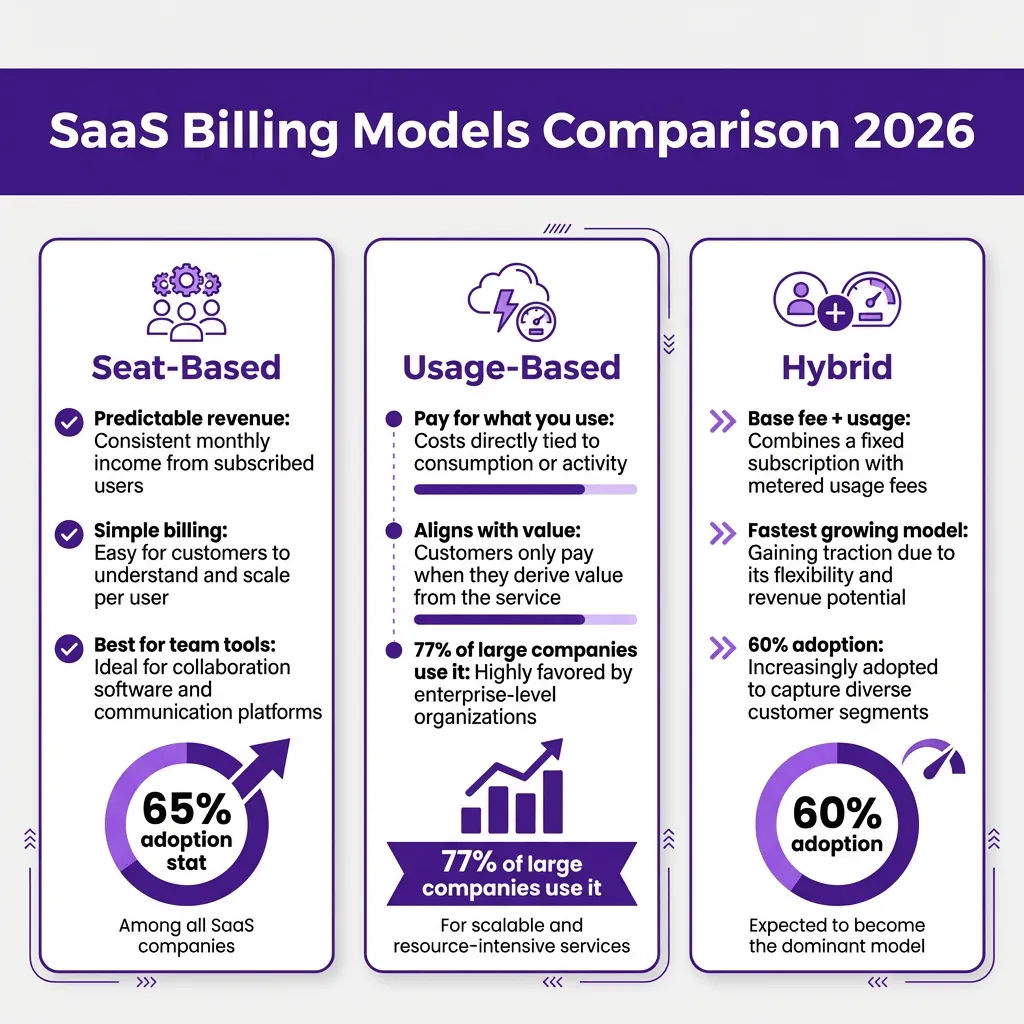
Here’s a number that should wake you up: 77% of the largest software companies have already incorporated usage-based pricing into their revenue models. If you’re still charging per seat for everything, you might be leaving serious money on the table.
I’ve spent years watching SaaS pricing evolve from simple flat-rate subscriptions to complex hybrid models. The shift isn’t just theoretical—it’s happening right now, reshaping how customers buy software and how vendors grow revenue.
The truth? There’s no single “best” billing model. What works for a team collaboration tool falls flat for an API service. What succeeds for enterprise sales might kill a self-serve product.
In this guide, I’ll break down every major SaaS billing model, when each makes sense, and how to choose the right approach for your specific product. No fluff, just practical frameworks you can apply today.
What Are SaaS Billing Models?
A SaaS billing model is how you charge customers for access to your software. It defines the relationship between value delivered and price paid. Get this wrong, and you’ll struggle with adoption, churn, or revenue growth. Get it right, and pricing becomes a competitive advantage.
Historically, most SaaS companies defaulted to seat-based pricing. You pay per user, simple as that. But the landscape has fragmented dramatically. Today, successful SaaS businesses choose from (or combine) several distinct approaches:
- Seat-based pricing: Charge per user account
- Usage-based pricing: Charge for consumption (API calls, storage, compute)
- Flat-rate pricing: One price for unlimited access
- Tiered pricing: Feature bundles at different price points
- Hybrid pricing: Combination of base fee plus usage
Each model creates different incentives for both you and your customers. Understanding these dynamics is essential before making any pricing decision.
Why Your Billing Model Matters More Than You Think
Your billing model isn’t just about how you collect money. It shapes your entire business:
Customer Acquisition
Usage-based pricing lowers barriers to entry. A customer can start small, pay almost nothing, and scale as they grow. This “land and expand” approach works brilliantly for products where value increases with adoption.
Seat-based pricing, on the other hand, forces upfront commitment. If your product requires team adoption to deliver value, per-seat pricing filters out solo users who won’t stick around.
Revenue Predictability
Here’s the trade-off: seat-based and flat-rate models give you predictable recurring revenue. You know exactly what each customer pays monthly. Usage-based models introduce variability—revenue fluctuates with customer activity.
For finance teams and investors, predictability matters. But customers increasingly prefer flexibility over predictability. According to recent data, 78% of companies with usage-based pricing adopted it within the last five years. The market is voting with its wallet.
Product-Market Fit Signals
Your billing model reveals how well you understand your value metric. If customers happily pay per seat, you’ve found a team-wide value proposition. If they prefer usage-based billing, your value scales with consumption.
Mismatched billing models create friction. I’ve seen SaaS companies struggle with 40% churn simply because they charged per seat when customers wanted usage-based pricing.
The 5 Core SaaS Billing Models Explained
1. Seat-Based Pricing (Per-User)
This is the classic SaaS model. You charge a fixed amount for each user account. Slack charges $7.25 per user monthly. Notion charges $10. Simple, predictable, easy to understand.
Best for: Collaboration tools, CRMs, project management software—any product where value increases with team adoption.
Pros:
- Predictable revenue for both vendor and customer
- Simple to implement and explain
- Revenue grows as customer teams expand
- Easy to forecast and budget
Cons:
- Creates “seat sharing” friction (users sharing logins to save money)
- Doesn’t capture value from heavy vs. light users
- Can limit adoption within organizations
- Less effective for AI and automation tools where “users” don’t map to value
Real example: HubSpot uses seat-based pricing for their CRM but adds usage limits on certain features. This hybrid approach captures team growth while monetizing heavy usage.
2. Usage-Based Pricing
You charge based on actual consumption—API calls, gigabytes stored, minutes transcribed, tokens processed. AWS pioneered this model. Twilio scaled to billions using it.
Best for: Infrastructure services, APIs, data processing, AI tools—any product where costs scale with usage and value is directly measurable.
Pros:
- Aligns pricing perfectly with customer value
- Low barrier to entry—customers pay as they grow
- Captures revenue from high-volume customers
- Natural expansion revenue as usage increases
Cons:
- Revenue becomes unpredictable
- Customers experience “bill shock” if usage spikes
- Harder to forecast cash flow
- Requires sophisticated metering infrastructure
Real example: OpenAI charges per token for API usage. A startup might spend $50/month initially, then scale to $50,000/month as their product grows. The pricing grows with customer success.
3. Flat-Rate Pricing
One price, unlimited usage. Basecamp famously charges $99/month flat regardless of team size. No per-seat fees, no usage limits.
Best for: Products with low marginal costs, strong differentiation, and a clear value proposition that doesn’t scale linearly with usage.
Pros:
- Extremely simple to understand and sell
- No usage anxiety for customers
- Predictable revenue
- Differentiation from per-seat competitors
Cons:
- Leaves money on the table with large customers
- Hard to justify for resource-intensive products
- Can attract unprofitable power users
- Limited expansion revenue opportunity
4. Tiered Pricing
You create feature bundles at different price points. Starter, Professional, Enterprise. Each tier unlocks more functionality.
Best for: Products with clear feature differentiation across customer segments. Works well when you can identify distinct use cases (solo users vs. teams vs. enterprises).
Pros:
- Captures different willingness-to-pay across segments
- Creates clear upgrade paths
- Simplifies decision-making for customers
- Allows feature differentiation without custom development
Cons:
- Feature gating can frustrate users
- Requires careful tier design—too many tiers confuse, too few leave money on table
- Enterprise tiers often require sales involvement
5. Hybrid Pricing
This is the fastest-growing model. You combine a base subscription fee with usage-based overages. Think: $29/month base fee plus $0.01 per API call over the included limit.
Best for: Most modern SaaS products, especially those serving both small and large customers. Over 60% of SaaS companies now use some form of hybrid pricing, up from under 30% in 2021.
Pros:
- Predictable base revenue with expansion upside
- Aligns costs with value for heavy users
- Flexible for different customer profiles
- Reduces bill shock while capturing usage value
Cons:
- More complex to implement and explain
- Requires sophisticated billing infrastructure
- Can confuse customers if not communicated clearly
Real example: Intercom combines seat-based pricing with usage-based elements for AI features. Their base plan includes a certain number of AI resolutions; overages are charged per resolution.
SaaS Billing Models Comparison Table
| Model | Revenue Predictability | Value Alignment | Implementation Complexity | Best For |
|---|---|---|---|---|
| Seat-Based | High | Medium | Low | Team collaboration tools |
| Usage-Based | Low | High | High | APIs, infrastructure, AI |
| Flat-Rate | High | Low | Low | Simple productivity tools |
| Tiered | Medium | Medium | Medium | Multi-segment products |
| Hybrid | Medium | High | High | Most modern SaaS |
How to Choose the Right Billing Model for Your SaaS
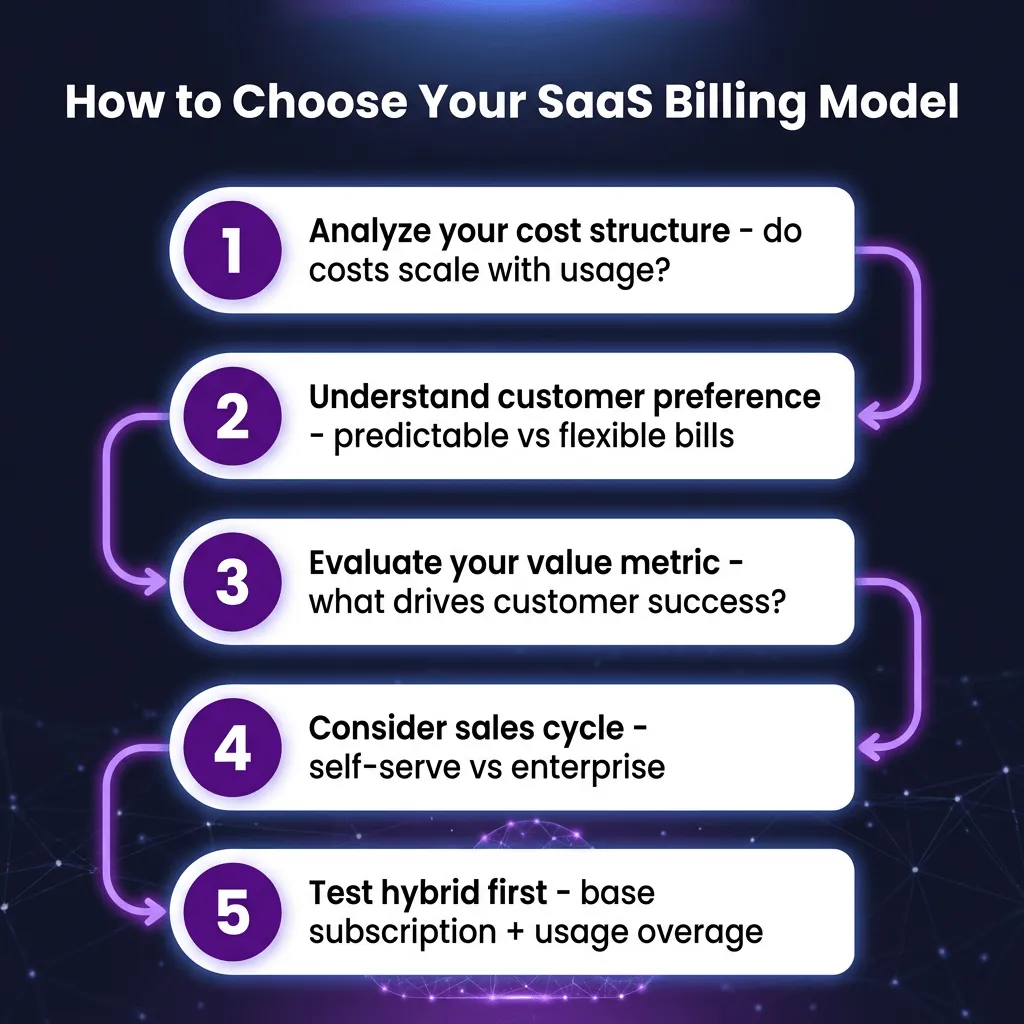
After analyzing hundreds of SaaS pricing strategies, I’ve developed a simple framework for choosing your billing model. Ask yourself these five questions:
1. How Do Your Costs Scale?
If serving more usage costs you significantly more (compute, storage, bandwidth), usage-based pricing makes sense. You transfer variable costs to customers.
If adding customers costs you almost nothing extra (productivity software, collaboration tools), seat-based or flat-rate pricing works better. Usage-based pricing would leave money on the table.
2. What Drives Customer Value?
Identify your value metric—the specific action that correlates with customer success. For email marketing, it’s emails sent. For cloud storage, it’s gigabytes stored. For AI transcription, it’s minutes processed.
Your billing model should align with this value metric. If value scales with usage, charge for usage. If value is team-wide, charge per seat.
3. What Do Your Customers Prefer?
Enterprise customers often prefer predictable bills for budgeting. Startups and developers often prefer usage-based pricing to minimize upfront costs.
Talk to your customers. Run surveys. Test different models. The best billing model is the one your customers actually want to pay.
4. What’s Your Sales Motion?
Self-serve products benefit from simple, transparent pricing. Seat-based or usage-based models work well here.
Enterprise sales with custom contracts can handle more complex hybrid models. You have sales engineers to explain the pricing and negotiate terms.
5. Can You Handle the Complexity?
Usage-based and hybrid pricing require sophisticated metering, billing, and revenue recognition systems. If you’re early-stage, simpler might be better.
Platforms like Fungies handle complex billing models—including hybrid pricing with base fees plus usage overages—without requiring you to build custom infrastructure.
The AI Factor: Why Billing Models Are Changing
Here’s something that surprised me: AI is accelerating the shift to usage-based and hybrid pricing faster than anyone predicted.
Traditional seat-based pricing doesn’t work for AI features. If one user generates 10,000 AI responses while another generates 10, charging the same per-seat fee makes no sense. The costs are completely different.
This is why we’re seeing companies like Intercom, Notion, and GitHub Copilot adopt hybrid models:
- Intercom: Seat-based base + usage-based AI resolutions
- Notion: Per-seat pricing + AI credit packs
- GitHub Copilot: Flat subscription + usage limits
- OpenAI: Pure usage-based for API, subscription tiers for ChatGPT
If you’re building AI features into your product, you need a billing model that can handle variable compute costs. Hybrid pricing is becoming the default.
Implementation: Building Your Billing Infrastructure
Choosing a billing model is only half the battle. You also need the infrastructure to execute it. Here’s what you need for each model:
Seat-Based Implementation
- User authentication and account management
- Simple subscription management
- Basic invoicing
- Proration handling for mid-cycle changes
Complexity: Low. Most payment processors handle this out of the box.
Usage-Based Implementation
- Real-time usage metering
- Event tracking and aggregation
- Flexible billing calculations
- Usage alerts and thresholds
- Revenue recognition for variable amounts
Complexity: High. You’ll likely need specialized billing software.
Hybrid Implementation
- Everything from seat-based and usage-based
- Complex pricing logic
- Multiple revenue streams to track
- Advanced reporting and analytics
- Flexible entitlements and feature gating
Complexity: Very high. Most companies use dedicated billing platforms.
If you’re building this yourself, expect to spend months on infrastructure. Alternatively, a Merchant of Record like Fungies handles hybrid billing, tax compliance, and global payments in one integration.
Common Billing Model Mistakes to Avoid
I’ve seen founders make the same pricing mistakes repeatedly. Here are the big ones to avoid:
Mistake 1: Copying Competitors Blindly
Just because your competitor charges per seat doesn’t mean you should. Their cost structure, customer base, and value proposition might be completely different. Analyze your own situation before deciding.
Mistake 2: Ignoring Customer Feedback
If customers constantly ask for usage-based pricing, listen. If they complain about bill shock from usage spikes, address it. Your billing model should evolve based on real customer behavior.
Mistake 3: Making It Too Complex
Hybrid pricing is powerful, but over-engineering it confuses customers. Keep your pricing simple enough that a customer can understand it in 30 seconds. If you need a calculator to explain your pricing, it’s too complex.
Mistake 4: Not Testing Before Scaling
Test new billing models with a subset of customers before rolling out company-wide. Run pricing experiments. Measure the impact on conversion, expansion, and churn. Data beats intuition.
FAQ: SaaS Billing Models
What’s the most popular SaaS billing model in 2026?
Hybrid pricing is now the most popular model, with over 60% of SaaS companies using some combination of base subscription plus usage-based charges. Pure seat-based pricing is declining as AI and automation make user counts less relevant to value.
Should startups use usage-based pricing?
Usage-based pricing can work well for startups if your costs scale with usage and customers prefer pay-as-you-go. However, it creates revenue unpredictability that can stress early-stage cash flow. Many startups begin with seat-based pricing and add usage components as they scale.
How do I transition from one billing model to another?
Grandfather existing customers on their current plans while offering new pricing to new customers. Communicate changes clearly and well in advance. Consider offering existing customers a discount to switch voluntarily. Never force immediate changes that surprise customers.
What’s the best billing model for AI products?
Most AI products use hybrid pricing—a base subscription for access plus usage-based charges for AI consumption (tokens, API calls, compute time). This captures the variable costs of AI while providing predictable base revenue.
How do I handle billing for enterprise customers?
Enterprise customers often require custom contracts with negotiated terms. Many SaaS companies publish standard pricing for SMBs but offer “Contact Sales” for enterprise tiers. This allows flexibility for volume discounts, custom terms, and negotiated SLAs.
Conclusion: Your Billing Model Is a Growth Lever
Your SaaS billing model isn’t just a way to collect money—it’s a strategic tool that shapes customer acquisition, revenue growth, and competitive positioning.
The shift from seat-based to usage-based and hybrid pricing isn’t a fad. It’s a structural evolution driven by cloud economics, AI adoption, and the need for better value alignment. Companies that adapt will capture more revenue and retain customers longer.
Start by understanding your value metric. Choose a billing model that aligns pricing with customer success. Build (or buy) the infrastructure to execute it flawlessly. And never stop testing and refining.
If you’re ready to implement flexible billing models without building complex infrastructure, Fungies provides hybrid billing, global tax compliance, and payment processing in one platform. Focus on your product—we’ll handle the billing complexity.