SaaS Chargeback Protection: The Complete 2026 Guide for Founders
Learn how to protect your SaaS from chargebacks in 2026. Discover prevention strategies, true cost breakdowns, and proven frameworks to minimize disputes and protect your MRR.
Chargebacks are the silent revenue killer for SaaS businesses. While you’re focused on acquiring customers and building features, disputes can erode 1-3% of your monthly recurring revenue (MRR) without warning. In 2026, with subscription commerce growing 18% year-over-year, understanding chargeback protection isn’t optional — it’s essential for sustainable growth.
This guide breaks down everything SaaS founders need to know about chargeback protection: what chargebacks really cost, why SaaS companies are uniquely vulnerable, and proven strategies to prevent disputes before they happen.
What Are Chargebacks and Why Do They Matter for SaaS?
A chargeback occurs when a customer disputes a transaction with their bank or credit card issuer, forcing a reversal of the payment. Unlike refunds — which are handled directly between merchant and customer — chargebacks bypass you entirely and can happen months after the original transaction.
For SaaS businesses, chargebacks present unique challenges:
- Subscription complexity: Customers may forget about recurring charges, leading to “friendly fraud” disputes
- Digital delivery: Without physical products, proving delivery is harder
- High velocity: Monthly billing means more transaction volume and more opportunities for disputes
- Customer lifetime value: A single chargeback cancels months of carefully nurtured customer relationships
The True Cost of Chargebacks for SaaS Companies
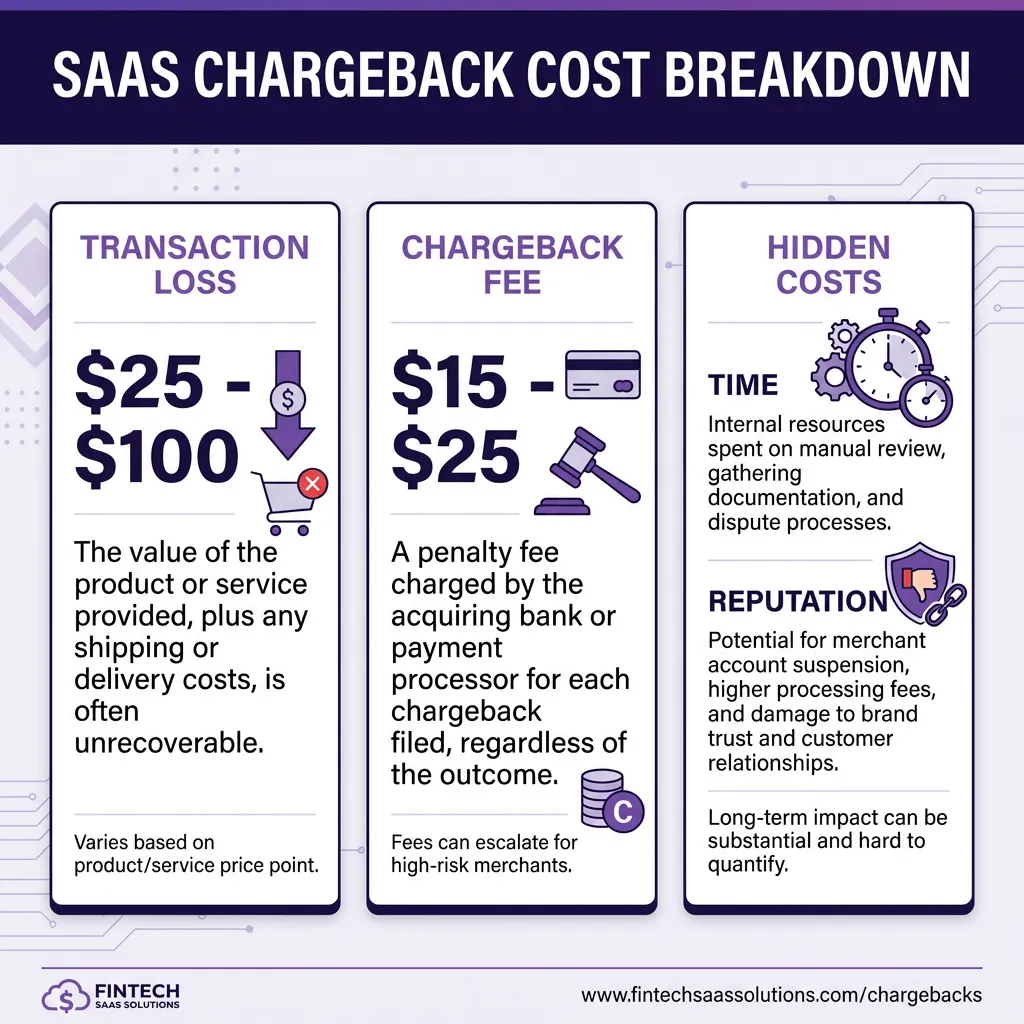
Most founders underestimate chargeback costs by 3-5x. Here’s the real math:
Direct Costs
- Lost transaction revenue: $25-$100+ depending on your plan price
- Chargeback fees: $15-$25 per dispute (non-refundable even if you win)
- Representation fees: $5-$15 if you fight the dispute
Hidden Costs
- Time investment: 2-4 hours per dispute gathering evidence and responding
- Payment processor penalties: Exceed 1% chargeback ratio and face higher fees or account termination
- Reputation damage: High dispute ratios signal risk to payment networks
- Customer acquisition cost (CAC) loss: You paid to acquire that customer — now they’re gone plus you’re out the dispute costs
For a SaaS company doing $50,000 MRR with a 1.5% chargeback rate, that’s $750 in lost revenue monthly — plus $225 in fees, plus 15-30 hours of team time. Annual impact: $11,700+ in direct costs and 180-360 hours of lost productivity.
Why SaaS Companies Face More Chargebacks
SaaS businesses encounter specific chargeback triggers that other industries rarely face:
1. Subscription Confusion
Customers sign up for free trials, forget to cancel, then dispute the charge when the billing hits. Or they don’t recognize the charge on their statement because your billing descriptor isn’t clear.
2. Friendly Fraud
Legitimate customers use the service, then claim fraud to get free access. This is especially common with digital products where “delivery” is hard to prove.
3. Family Fraud
A team member’s family member sees the charge, doesn’t recognize it, and initiates a dispute. Common with B2B SaaS where the cardholder isn’t the end user.
4. Service Dissatisfaction
Instead of requesting a refund through proper channels, frustrated customers go straight to their bank. This bypasses your customer service team entirely.
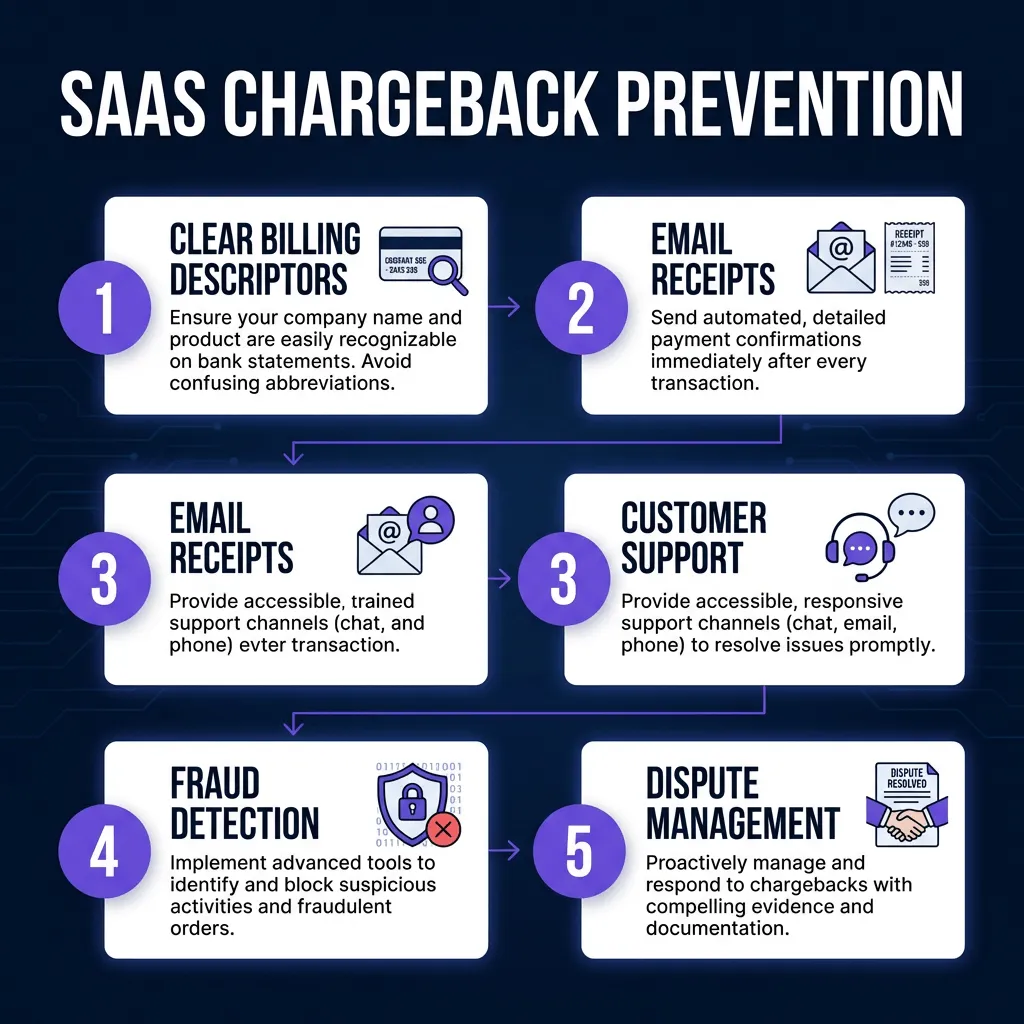
The 5-Step SaaS Chargeback Prevention Framework
Prevention beats reaction every time. Here’s a battle-tested framework to minimize disputes:
Step 1: Clear Billing Descriptors
Your billing descriptor is what customers see on their credit card statement. Make it unmistakable:
- Include your company name (not just a parent company or DBA)
- Add a support phone number or URL
- Use descriptors like “YOURCOMPANY.COM” or “YOURCOMPANY SAAS”
- Test how it appears on statements (different banks format differently)
Bad: “PAYMENT PROCESSOR LLC”
Good: “FUNGIES.IO SAAS 1-800-123-4567”
Step 2: Proactive Email Receipts
Send detailed receipts immediately after every transaction:
- Clear description of what was purchased
- Billing amount and date
- Next billing date (for subscriptions)
- Easy-to-find cancellation link
- Support contact information
Step 3: Exceptional Customer Support
Most chargebacks happen because customers couldn’t get help when they needed it. Make support frictionless:
- Respond to inquiries within 24 hours (faster for billing questions)
- Offer multiple contact channels (email, chat, phone)
- Proactively reach out to customers who haven’t logged in after signing up
- Make refunds easy — a refund costs far less than a chargeback
Step 4: Fraud Detection
Implement basic fraud screening:
- Velocity checks (multiple transactions from same IP/card)
- Geolocation mismatches (billing address vs. IP location)
- 3D Secure authentication for high-risk transactions
- AVS (Address Verification Service) and CVV checks
Step 5: Dispute Management System
When disputes happen, respond fast and thoroughly:
- Set up real-time chargeback alerts (Ethoca, Verifi)
- Maintain detailed transaction records
- Document customer communication history
- Submit compelling evidence within network timeframes
- Track win rates and adjust strategies
Chargeback Protection Tools and Services
Several categories of tools can help protect your business:
Fraud Prevention Platforms
- Sift: Machine learning-based fraud detection
- Signifyd: Guaranteed fraud protection with chargeback reimbursement
- Kount: AI-powered identity and fraud prevention
Chargeback Management Services
- Chargeback Gurus: End-to-end dispute management
- Midigator: Automated chargeback prevention and response
- Justt: AI-powered dispute resolution for SaaS
Merchant of Record (MoR) Solutions
The most comprehensive protection comes from using a Merchant of Record like Fungies. As the legal seller of record, the MoR assumes liability for chargebacks, handles dispute management, and maintains relationships with payment networks. You get paid while they handle the complexity.
Protect Your SaaS Revenue with Fungies
Built-in chargeback protection, fraud detection, and global tax compliance — so you can focus on growth, not disputes.
No credit card required
Understanding Chargeback Reason Codes
Different chargeback reason codes require different responses. Here are the most common for SaaS:
| Reason Code | Description | Prevention Strategy |
|---|---|---|
| 10.4 (Visa) / 4837 (MC) | No Cardholder Authorization | Strong customer authentication, clear billing descriptors |
| 10.5 (Visa) / 4863 (MC) | Fraud — Card Not Present | Fraud detection tools, 3D Secure |
| 13.2 (Visa) / 4854 (MC) | Cancelled Recurring Transaction | Clear cancellation flows, reminder emails |
| 13.3 (Visa) / 4855 (MC) | Goods/Services Not as Described | Accurate marketing, clear feature documentation |
| 13.5 (Visa) / 4853 (MC) | Credit Not Processed | Fast refund processing, clear refund policies |
When to Fight vs. Accept a Chargeback
Not every chargeback is worth fighting. Here’s a decision framework:
Fight When:
- You have clear evidence of service delivery (login logs, usage data)
- The customer never contacted support
- It’s clear friendly fraud (customer used the service extensively)
- The amount justifies the time investment
Accept When:
- You lack documentation of service delivery
- The customer has a legitimate complaint
- The dispute amount is small relative to time costs
- Your chargeback ratio is already low
FAQ: SaaS Chargeback Protection
What is a good chargeback rate for SaaS?
Industry average is 0.5-1.0%. Anything under 0.5% is excellent. Above 1% triggers processor scrutiny, and above 1.5% puts you at risk of penalties or account termination.
How long do customers have to dispute a charge?
Typically 120 days from the transaction date, though some reason codes allow up to 540 days. For subscriptions, the clock often starts from the most recent charge.
Can chargebacks be prevented entirely?
No — some level of chargebacks is inevitable in any card-not-present business. However, with proper prevention strategies, you can reduce your rate by 60-80%.
What’s the difference between a refund and a chargeback?
A refund is initiated by the merchant and returns the customer’s money directly. A chargeback is initiated by the cardholder through their bank, bypassing the merchant entirely and incurring additional fees.
Does using a Merchant of Record eliminate chargeback risk?
A Merchant of Record doesn’t eliminate chargebacks — customers can still dispute transactions. However, the MoR handles the dispute process, absorbs the liability, and protects your merchant account and relationship with payment networks.
Conclusion: Building a Chargeback-Resistant SaaS
Chargebacks are a cost of doing business in SaaS, but they don’t have to be a significant drain on your revenue. By implementing clear billing practices, proactive customer communication, fraud detection, and a solid dispute management process, you can keep your chargeback rate well below industry averages.
For founders who want to focus on product and growth rather than payment disputes, a Merchant of Record solution like Fungies provides comprehensive protection — handling fraud prevention, dispute management, and liability so you don’t have to.
The bottom line: invest in prevention now, or pay much more in lost revenue and operational costs later. Your future self (and your balance sheet) will thank you.