Global Checkout Localization for SaaS in 2026: How Local Payment Methods Boost Conversion by 51%
20% of customers abandon a purchase the moment they don’t see their preferred payment method at checkout. That’s not a UX problem. That’s a revenue problem — and it’s entirely avoidable. Paddle’s data makes the math brutal: enabling local payment methods increases checkout conversion from 4.3% to 6.5% — a 51% lift from a single
20% of customers abandon a purchase the moment they don’t see their preferred payment method at checkout. That’s not a UX problem. That’s a revenue problem — and it’s entirely avoidable.
Paddle’s data makes the math brutal: enabling local payment methods increases checkout conversion from 4.3% to 6.5% — a 51% lift from a single infrastructure change. Companies with multi-currency enabled grow 7% faster than those without. And yet most SaaS founders ship globally with a checkout that only works well in two or three markets.
This guide breaks down exactly how SaaS checkout localization works in 2026, which local payment methods matter in which markets, how to implement them without months of engineering work, and why a Merchant of Record is the fastest path to a truly localized checkout.
What Is SaaS Checkout Localization?
Checkout localization is the process of adapting your payment experience to match the specific preferences, currencies, compliance rules, and trust signals of each target market.
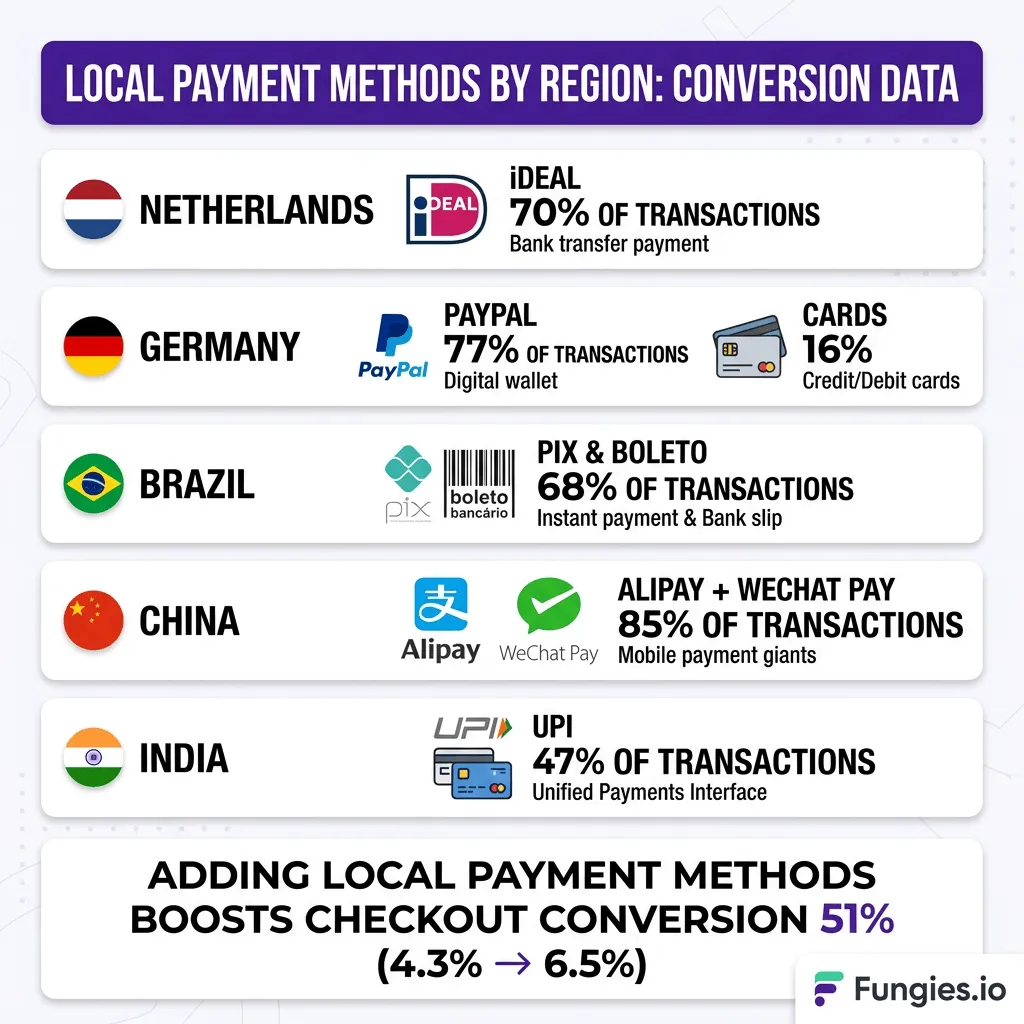
It’s not just translation. A French user seeing prices in EUR, with SEPA Debit as a payment option, in a checkout that displays the French VAT label correctly — that’s localization. A German user seeing PayPal prominently (because 77% of German online transactions go through PayPal) — that’s localization.
The gap most SaaS companies have: their product works globally, their marketing is localized, but their checkout is still a US-first card-only experience. That’s exactly where revenue leaks.
In 2026, leading SaaS companies have shifted from a “global product, local marketing” model to a “global product, local monetization” model. The checkout is now a revenue infrastructure layer — not just a form at the end of the funnel.
Why Your Global Checkout Is Losing Revenue Right Now
Here’s what’s happening at your checkout when you don’t localize:
A developer in the Netherlands visits your pricing page, picks a plan, clicks “Subscribe,” and sees only Visa/Mastercard. She prefers iDEAL — the method that powers 70% of Dutch online transactions. She closes the tab. You’ve just lost a customer who was ready to pay.
Repeat that scenario across Germany (PayPal-first), Brazil (PIX and boleto), India (UPI), and Southeast Asia (GrabPay, GCash) — and you start to see the scale of the problem.
The specific failure points:
- Limited payment method coverage — buyers can’t use their preferred method and abandon at the final step
- Currency mismatch — prices in foreign currencies create FX anxiety and reduce willingness to complete purchases
- Inconsistent UX — address fields, date formats, and form layouts built for US customers create friction everywhere else
- Missing trust signals — unfamiliar checkout experiences feel risky even when the product itself is excellent
- Regulatory friction — missing tax displays, wrong VAT handling, or absent compliance labels create legal and UX issues
According to PPRO, the global e-commerce market hit $8.3 trillion in 2025 — a 55% increase since 2021. The merchants capturing that growth aren’t necessarily building better products. They’re building better checkouts.
The Payment Methods That Actually Matter by Region
Understanding where your users are tells you exactly which payment methods you need. Here’s the breakdown that matters for SaaS in 2026:
| Region | Key Payment Methods | Market Share | Notes |
|---|---|---|---|
| Germany | PayPal, SEPA Direct Debit, Klarna | PayPal: 77% of online transactions; Cards: 16% | Most card-averse major market in Europe |
| Netherlands | iDEAL, PayPal | iDEAL: 70% of online transactions | iDEAL is non-negotiable for Dutch customers |
| Brazil | PIX, Boleto Bancário, Credit cards | PIX + Boleto: ~68% of online transactions | PIX is real-time and growing fast post-2023 |
| China | Alipay, WeChat Pay | ~85% of digital transactions | Cards largely irrelevant; wallets dominate |
| India | UPI, Cards, Wallets | UPI: 47%+ of digital payments | UPI growing 20%+ YoY; RuPay for cards |
| Poland | BLIK, Przelewy24, Cards | BLIK: 64% of mobile payments | BLIK is one-time code — no card details needed |
| Southeast Asia | GrabPay, GCash, OVO, TrueMoney | Wallets dominant in PH, ID, TH | Highly fragmented — country by country |
| US/UK/Canada | Credit/debit cards, PayPal, Apple/Google Pay | Cards: 57% (US) | Cards still king; BNPL growing fast |
| Middle East | Tabby, Tamara, Cards, Mada | BNPL growing; Sharia compliance important | Tabby/Tamara for installment-preferred buyers |
The pattern is clear: outside the US and UK, credit cards are not the default. Building a card-only checkout and calling it “global” is leaving real money behind in nearly every growth market.
The Multi-Currency Problem (And Why It’s Worse Than You Think)
Payment methods are one side of the coin. Currency display is the other.
CSA Research found that 40% of consumers never buy from websites in other languages. The equivalent stat for currency: when prices are shown in a foreign currency, FX uncertainty drives a significant share of users away — especially for larger purchases like annual SaaS plans.
The fix isn’t just showing prices in local currency. It’s the combination:
- Display prices in local currency
- Accept payment in that currency
- Handle the FX conversion and settlement on your end
Paddle’s data shows that companies with multi-currency enabled grow 7% faster than those without. For SaaS companies selling $500–$5,000/year plans, that’s a meaningful difference in close rates — especially in markets like Germany, France, and Japan where pricing ambiguity reduces purchase confidence.
How SaaS Checkout Localization Affects Your Conversion Funnel
Let’s put concrete numbers to the opportunity:
| Checkout Type | Avg Conversion Rate | Abandonment Cause |
|---|---|---|
| Card-only, USD, no local methods | ~4.3% | Missing payment methods, FX anxiety |
| Local payment methods enabled | ~6.5% | 51% improvement over baseline |
| Local currency + local methods | ~7.5–9% | Compound lift from both optimizations |
On $100K MRR, moving from 4.3% to 6.5% checkout conversion isn’t just a percentage point. That’s roughly $50K in additional monthly revenue from the same traffic — captured by fixing the checkout infrastructure, not by spending more on ads.
20% of cart abandonments globally happen specifically because the customer’s preferred payment method wasn’t available. That’s the most avoidable type of churn there is.
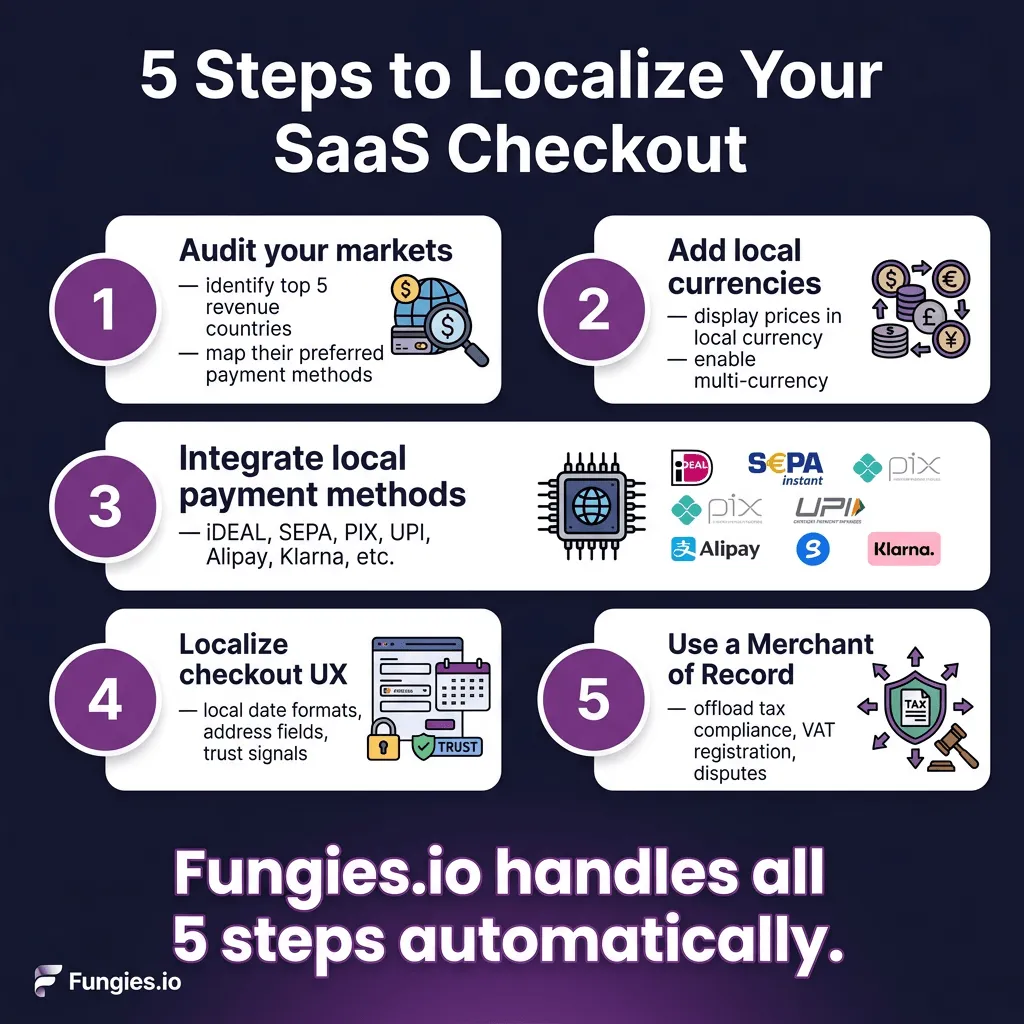
The 5-Step Checkout Localization Playbook
Step 1: Audit Your Revenue by Geography
Before you add payment methods, know where your customers actually are. Pull your last 12 months of transaction data and identify your top 10 revenue-generating countries. Then map each country to its dominant payment method(s) using the table above.
Prioritize the markets where you have existing users but lower-than-expected conversion rates. That gap often means the checkout isn’t localized enough for that market.
Step 2: Enable Multi-Currency Pricing
Display prices in local currency. This means EUR for eurozone, GBP for the UK, BRL for Brazil, INR for India, and so on. Don’t just show a converted amount — price intentionally in local markets. Round to psychologically clean numbers ($29 USD → €27, not €26.73).
If you’re pricing in USD globally, A/B test local currency pricing in your top 3 non-US markets. The conversion lift is typically significant enough to justify the infrastructure work within the first month.
Step 3: Integrate the Payment Methods That Matter in Your Markets
Based on your audit:
- Europe: Add SEPA Direct Debit, iDEAL, Klarna, BLIK, Przelewy24
- Brazil: Add PIX and Boleto Bancário
- Asia: Add Alipay, WeChat Pay, GrabPay, UPI
- Global: Add Apple Pay, Google Pay as wallet options everywhere
- BNPL: Add Klarna (Europe/US), Tabby/Tamara (Middle East) for higher-priced plans
The traditional DIY approach means a separate integration, maintenance burden, and legal entity for each method. That’s months of engineering time per market.
Step 4: Localize the Checkout UX
Payment methods aren’t the only localization layer. The checkout form itself needs to feel local:
- Date formats (DD/MM/YYYY vs MM/DD/YYYY)
- Address field order (country-specific postal code placement)
- Tax ID fields (VAT number in EU, CNPJ in Brazil, PAN in India)
- Local trust badges and security certifications
- Language — the checkout copy should match the user’s language preference
Step 5: Handle Tax Compliance Per Market
This is where most founders underestimate the complexity. Selling to a German customer means charging German VAT (19%). Selling to a Brazilian business means navigating ISS, COFINS, and PIS. Selling to an Indian consumer means GST.
If you’re the seller of record, you need to register for VAT/GST in each market where you exceed local thresholds, file returns, and remit taxes. That’s a full-time compliance operation at global scale.
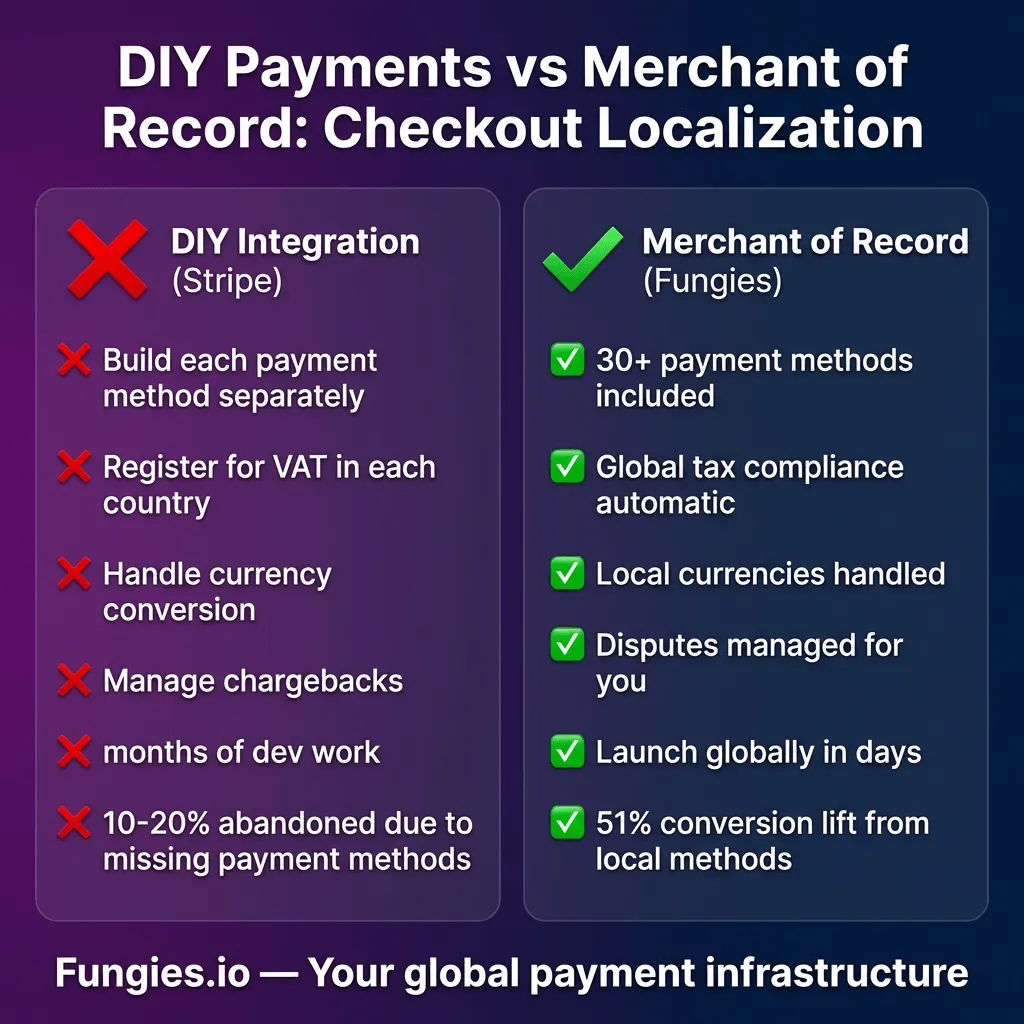
DIY vs Merchant of Record: The Build vs Buy Decision
Here’s the honest tradeoff for SaaS checkout localization in 2026:
| Capability | DIY (Stripe + manual) | Merchant of Record (Fungies) |
|---|---|---|
| Local payment methods | Each method = separate integration + maintenance | 30+ methods included, auto-updated |
| Multi-currency | Requires custom FX layer + settlement logic | Handled automatically |
| Global VAT/GST compliance | Register + file in each country (12-18 countries for serious scale) | MoR is the seller — your liability is zero |
| Chargeback handling | You manage disputes per card network rules | MoR handles all disputes |
| PSD2/SCA compliance | Implement 3D Secure per region | Handled by MoR infrastructure |
| Time to launch globally | 6–18 months of engineering | Days to weeks |
| Engineering overhead | High — ongoing maintenance per method/country | Zero — fully managed |
The DIY path works if you have a dedicated payments engineering team, are processing $5M+ MRR, and have specific requirements that off-the-shelf MoRs can’t meet. For everyone else — especially indie SaaS, bootstrapped teams, and early-stage companies — a Merchant of Record is the only sensible path to real checkout localization.
The engineering cost of DIY localization across 10 markets is conservatively 6–12 months of a senior engineer’s time. At $150K/year fully loaded, that’s $75K–$150K in opportunity cost before you’ve captured a single additional conversion.
How Fungies Handles Checkout Localization
Fungies is a Merchant of Record built specifically for digital products and SaaS. What that means for checkout localization:
- 30+ local payment methods included out of the box — iDEAL, SEPA, PIX, UPI, Alipay, Klarna, PayPal, Apple Pay, Google Pay, and more
- Multi-currency pricing — display and charge in local currencies across 130+ countries
- Automatic global tax compliance — Fungies is the seller of record, so VAT, GST, and sales tax are handled, calculated, collected, and remitted on your behalf
- No-code checkout setup — embed a localized checkout in hours, not months
- Chargeback protection — disputes are managed by Fungies, not your team
The result: a developer from India, a creator from Brazil, and an enterprise buyer from Germany all see a checkout that feels native to their market — without you writing a single line of payment-specific code.
Key Takeaways
- Local payment methods boost checkout conversion by 51% (4.3% → 6.5%) — this is the single highest-ROI payment optimization available
- 20% of checkout abandonment happens because the preferred payment method isn’t available — it’s the most avoidable revenue leak in SaaS
- Payment preferences vary dramatically: 77% of Germans use PayPal, 70% of Dutch use iDEAL, 85% of Chinese use Alipay or WeChat Pay
- Multi-currency pricing adds a 7% growth rate differential — not offering local currency is a tax on your international revenue
- DIY localization across 10 markets costs 6–18 months of engineering; a Merchant of Record handles it in days
FAQ
What is SaaS checkout localization?
SaaS checkout localization is the process of adapting your payment experience to each target market — offering local payment methods, prices in local currencies, locally-appropriate checkout UX, and compliant tax handling. It goes well beyond translation and directly impacts conversion rates and international revenue.
Which local payment methods should I add first?
Start with your highest-revenue non-US markets. For most SaaS companies, the first priorities are: PayPal and SEPA for Europe, iDEAL for the Netherlands, PIX for Brazil, and UPI for India. Apple Pay and Google Pay are worth adding globally as they reduce friction for mobile users in all markets.
Do I need to register for VAT in every country I sell to?
If you’re the seller of record, yes — once you exceed the local VAT registration threshold. EU OSS (One Stop Shop) simplifies this for EU countries, but you still need to register. The alternative is using a Merchant of Record like Fungies, which acts as the seller and handles all VAT registration, collection, and remittance on your behalf.
How does a Merchant of Record help with checkout localization?
A Merchant of Record becomes the legal seller of your products to end customers. This means the MoR handles all tax compliance, payment method integrations, currency conversion, and dispute resolution. You get a globally localized checkout without the engineering overhead or legal liability — and you can launch globally in days instead of months.
Conclusion
Your product is already global. Your traffic is already international. The question isn’t whether to localize your checkout — it’s how quickly you can do it and how much revenue you’re leaving behind in the meantime.
The data is unambiguous: local payment methods, local currencies, and a frictionless checkout experience convert at 51% higher rates than a card-only US-first approach. That’s not a marginal improvement. That’s a structural revenue lever most SaaS founders haven’t pulled yet.
The fastest path to a genuinely localized checkout in 2026 is a Merchant of Record. Fungies gives you 30+ payment methods, multi-currency support, and full global tax compliance — without a dedicated payments engineering team.
Start selling globally with Fungies today →
References
- Paddle: Local payment methods: how to unlock them at scale
- Paddle: SaaS localization: the guide to grow faster globally
- Nexway: SaaS Checkout Localization Best Practices for Global Growth
- Dodo Payments: Why Localized Payment Methods Are Important for Higher Conversions
- PPRO: Retail payments: Why local payment methods drive global conversion
- PayPro Global: What is SaaS Payment Localization?
- CSA Research: 40% of consumers never buy from websites in other languages (2024)