SaaS Checkout Optimization: The Complete 2026 Guide to Reducing Abandonment and Increasing Conversions
Learn how to optimize your SaaS checkout for maximum conversion. This complete guide covers checkout abandonment statistics, 6 optimization pillars, embedded vs hosted checkout comparison, and proven recovery strategies backed by real data.
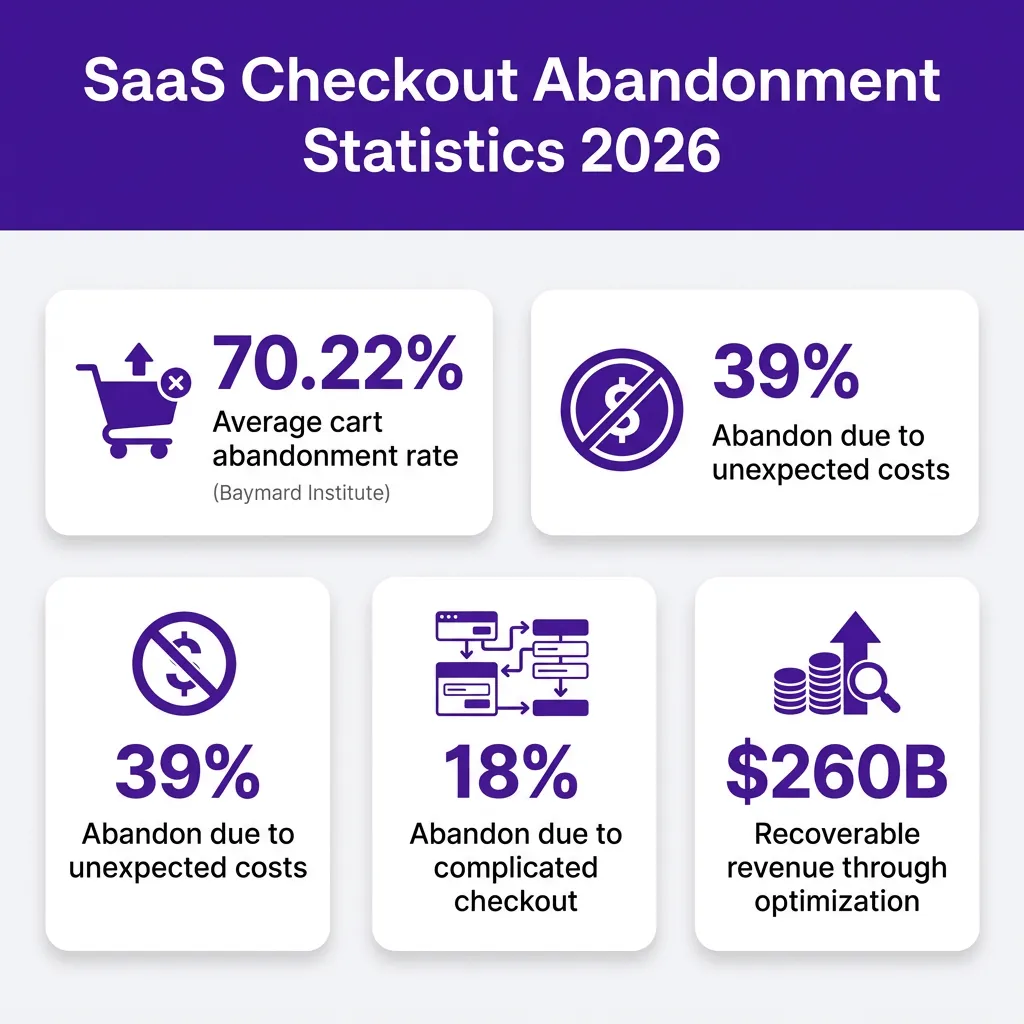
Here is a sobering statistic: 70.22% of online shoppers abandon their cart before completing a purchase. For SaaS companies, that translates to millions in lost recurring revenue. But here is the kicker — Baymard Institute research shows that $260 billion in recoverable revenue is left on the table every year due to poor checkout design.
I have spent years optimizing checkout flows for SaaS products, and I will tell you this: most founders obsess over their pricing page but completely neglect what happens when someone clicks “Buy Now.” That is a costly mistake. In this guide, I will walk you through exactly how to optimize your SaaS checkout for maximum conversion — backed by real data and battle-tested strategies.
What Is SaaS Checkout Optimization?
SaaS checkout optimization is the systematic process of reducing friction in your payment flow to increase the percentage of users who complete a purchase. It is not just about making things look pretty — it is about removing obstacles that stop people from giving you money.
The checkout process starts the moment a user decides to buy and ends when payment is confirmed. Every step in between is an opportunity for optimization — or abandonment. According to Baymard Institute, the average large ecommerce site can gain a 35.26% increase in conversion rate through better checkout design alone.
Why Checkout Abandonment Kills SaaS Revenue
Before we dive into solutions, let us understand the problem. Not all cart abandonment is fixable — about 43% of users are just browsing with no intent to buy. But the remaining 57%? Those are solvable abandonments that represent real revenue.
Here is why users actually abandon checkouts, according to Baymard Institute research:
- 39% — Extra costs too high (shipping, tax, fees)
- 21% — Delivery was too slow
- 19% — Did not trust the site with credit card information
- 19% — Site wanted them to create an account
- 18% — Too long or complicated checkout process
- 15% — Returns policy was not satisfactory
- 15% — Website had errors or crashed
- 14% — Could not see or calculate total order cost upfront
- 10% — Not enough payment methods
- 8% — Credit card was declined
For SaaS specifically, the dynamics are slightly different but equally painful. You do not have shipping costs, but you do have tax surprises. You do not have delivery times, but you do have forced account creation. And that 18% who abandon due to complicated checkout? That is pure UX failure.
The 6 Pillars of SaaS Checkout Optimization
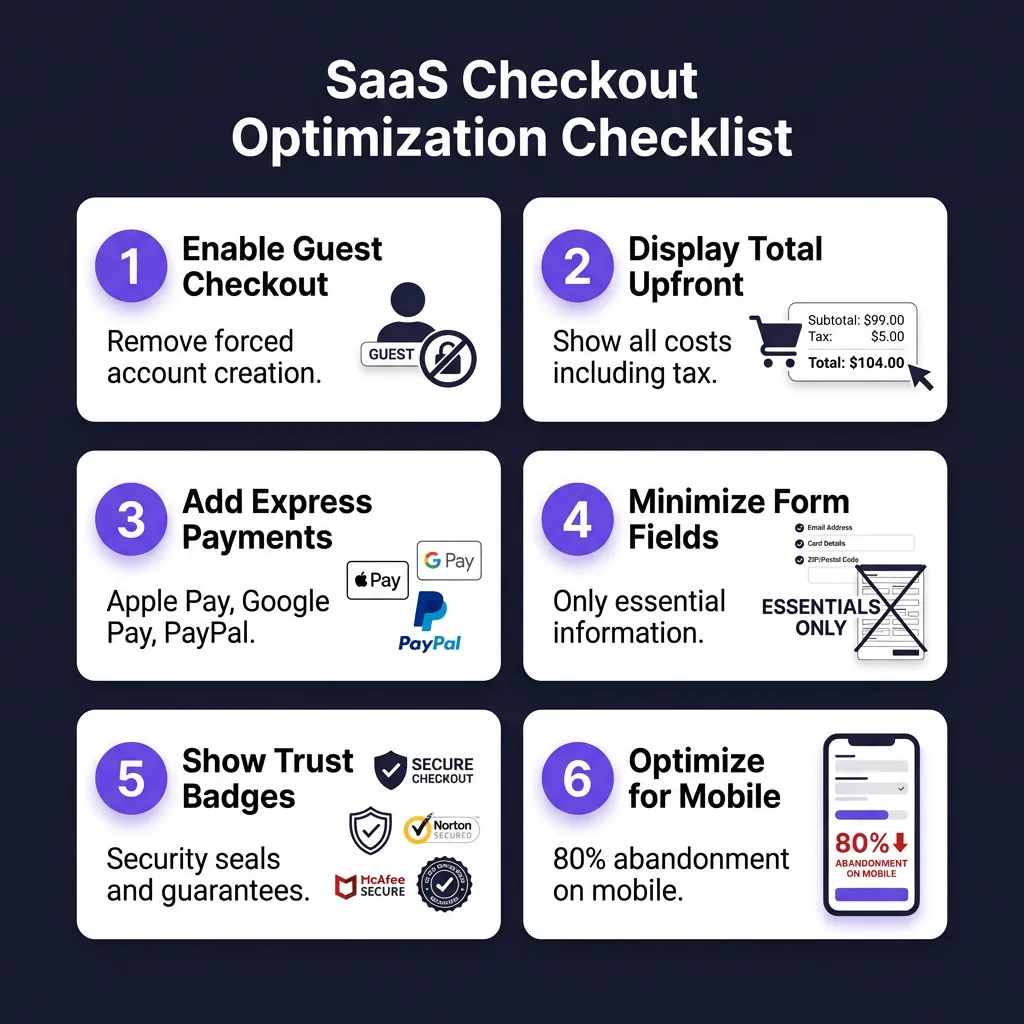
After optimizing dozens of SaaS checkout flows, I have identified six core pillars that drive conversion. Nail these, and you will see immediate results.
1. Enable Guest Checkout (Remove Account Creation Barriers)
Here is a truth that hurts: 19% of users abandon carts because they are forced to create an account. For a user evaluating your SaaS, creating a password and filling out a profile is a major hurdle.
The solution is simple — offer guest checkout. If your SaaS model requires an account for product delivery, implement a post-purchase registration flow. After payment is confirmed, the user is psychologically committed and far more willing to spend 30 seconds creating an account to access their purchase.
Guest checkout can increase conversions by up to 20%, according to industry data. That is a massive gain for a simple change.
2. Display Total Cost Upfront (Eliminate Surprise Fees)
The number one reason for cart abandonment? 39% of users leave because of unexpected costs. For SaaS companies, this usually means tax — VAT, sales tax, or other regional taxes that appear at the final step.
Your pricing page shows $99/month. Your checkout shows $118.80 with VAT. That is a 20% surprise, and users hate surprises.
The fix: show the total price including all taxes on your pricing page. If you serve global customers, use geolocation to display the correct price for their region. Transparency builds trust, and trust converts.
3. Add Express Payment Options (Apple Pay, Google Pay, PayPal)
Mobile commerce is huge, and mobile abandonment is worse — 80% on mobile vs 73% on desktop. One major reason? Typing credit card details on a phone is painful.
Express payment options like Apple Pay, Google Pay, and PayPal solve this. They reduce checkout to a single tap or click. According to research, PayPal has an 88.7% checkout conversion rate — significantly higher than standard card payments.
Buy Now, Pay Later (BNPL) options like Klarna or Affirm can also help. For orders over $100, BNPL reduces cart abandonment by 20%.
4. Minimize Form Fields (Aim for 7-8 Essential Fields)
Baymard Institute research shows that an ideal checkout flow contains just 12-14 form elements (7-8 if only counting form fields). Yet the average US checkout flow contains 23.48 form elements.
That is nearly double the optimal amount. And 18% of users abandon due to a too-long checkout process.
Audit every field in your checkout. Ask: Is this absolutely necessary to complete the transaction? If not, remove it. For SaaS, you typically need: email, name, payment details. That is it. Everything else can be collected post-purchase.
5. Build Trust with Security Signals
19% of users abandon because they do not trust the site with their credit card information. In the SaaS world, you are often a relatively unknown brand asking for money. Trust signals matter.
Place visual trust signals prominently near the final call-to-action:
- SSL certificate badges
- Accepted payment logos (Visa, Mastercard, PayPal)
- Money-back guarantee seals
- Customer testimonials or review counts
- Security certifications (PCI DSS compliance)
Keep the language simple. Instead of “We utilize 256-bit AES encryption and are PCI DSS Level 1 compliant,” say “We use bank-level security to keep your information safe.” Users understand that.
6. Optimize for Mobile (80% Abandonment Rate)
Mobile checkout abandonment hits 80% compared to 73% on desktop. The reasons are clear: smaller screens, harder typing, slower connections.
Your mobile checkout needs to be ruthlessly simple:
- Use large, thumb-friendly buttons
- Enable autofill for form fields
- Support digital wallets (Apple Pay, Google Pay)
- Use a step-by-step flow for clarity
- Test on real devices, not just browser emulators
Embedded vs. Hosted Checkout: Which Converts Better?
One major decision for SaaS founders is whether to use an embedded checkout (on your site) or a hosted checkout (redirect to Stripe/PayPal). Here is the breakdown:
| Feature | Embedded Checkout | Hosted Checkout |
|---|---|---|
| User Experience | Seamless, stays on your site | Redirect to external page |
| Brand Control | Full customization | Limited to provider branding |
| Development Effort | Higher (requires integration) | Lower (simple redirect) |
| PCI Compliance | More complex (SAQ A-EP) | Simple (provider handles it) |
| Conversion Rate | Typically 10-15% higher | Baseline |
| Mobile Experience | Better (no redirect friction) | Redirect can confuse users |
Embedded checkout generally converts better because it keeps users in your product experience. There is no jarring redirect, no confusion about where they are, and no trust drop-off from leaving your domain.
However, hosted checkout is faster to implement and shifts PCI compliance burden to the provider. For early-stage SaaS, that tradeoff might make sense. As you scale, the conversion gains from embedded checkout become worth the investment.
Abandoned Cart Recovery: Turning Losses Into Wins
Even with perfect checkout optimization, some users will abandon. The key is having a recovery strategy. Abandoned cart emails work — they achieve 39.07% open rates and 10.7% conversion rates.
Here is a proven 3-day email sequence:
Day 1: The Help Email (1 hour after abandonment)
Subject: “Did something go wrong with your checkout?”
Focus on customer service. Offer help with technical issues. No discount yet — just genuine assistance. Send from a real person, not a noreply address.
Day 2: The Reminder Email (24 hours after)
Subject: “Your subscription is waiting”
Gentle reminder with soft urgency. “Your cart expires in 48 hours.” Include a direct checkout link that prefills their information.
Day 3: The Final Offer (72 hours after)
Subject: “Last chance: 20% off your first month”
This addresses price sensitivity. Use a unique coupon code to track effectiveness. If they do not convert after this, add them to your nurture sequence instead of pushing harder.
Measuring Checkout Success: Key Metrics
You cannot optimize what you do not measure. Here are the metrics that matter for SaaS checkout optimization:
| Metric | Benchmark | What It Tells You |
|---|---|---|
| Checkout Initiation Rate | 5-15% of pricing page visitors | How compelling your pricing/plans are |
| Checkout Completion Rate | 25-40% | Overall checkout effectiveness |
| Step-by-Step Drop-off | Less than 10% per step | Where users are getting stuck |
| Payment Success Rate | 95%+ | Technical reliability |
| Mobile vs Desktop Completion | Within 5% of each other | Mobile optimization status |
| Average Time to Complete | Under 2 minutes | Checkout complexity |
Set up funnel tracking in your analytics tool to see exactly where users drop off. If 40% abandon at the payment step, you have a trust or technical issue. If they drop at account creation, you know what to fix.
Common SaaS Checkout Mistakes to Avoid
Before we wrap up, here are the most common mistakes I see SaaS founders make with their checkout:
1. The Login Wall
Requiring users to create an account before they can see pricing or checkout. This kills conversion. Let them buy first, onboard later.
2. The Tax Surprise
Adding VAT or sales tax at the final step. Users feel tricked. Display all-in pricing from the start.
3. The Mobile Afterthought
Designing for desktop and hoping mobile works. With 80% mobile abandonment, mobile-first checkout design is essential.
4. The Trust Vacuum
No security badges, no testimonials, no guarantees. In a world of data breaches, users need reassurance.
5. The One-Size-Fits-All Payment
Only accepting credit cards. Different users prefer different payment methods. Offer choices.
FAQ: SaaS Checkout Optimization
What is a good checkout completion rate for SaaS?
A good SaaS checkout completion rate is between 25-40%. The average across all ecommerce is around 30%, but SaaS products with clear value propositions and optimized checkouts can hit 40% or higher.
How much revenue can checkout optimization recover?
Baymard Institute estimates that $260 billion in revenue is recoverable globally through better checkout design. For individual SaaS companies, a 35% increase in conversion rate is achievable through checkout optimization alone.
Should I use embedded or hosted checkout?
Embedded checkout typically converts 10-15% better but requires more development effort. Hosted checkout is faster to implement. For early-stage SaaS, start with hosted and migrate to embedded as you scale.
How many form fields should my checkout have?
Aim for 7-8 form fields maximum. Baymard Institute research shows this is the optimal number for conversion. Every additional field increases abandonment risk.
Do abandoned cart emails actually work?
Yes. Abandoned cart emails achieve 39% open rates and 10.7% conversion rates on average. Top performers see 65% open rates and significantly higher conversions.
Conclusion: Your Checkout Is a Growth Lever
Most SaaS founders treat checkout as an afterthought. That is a mistake. With 70% abandonment rates and $260 billion in recoverable revenue on the table, checkout optimization is one of the highest-ROI activities you can invest in.
Start with the basics: remove forced account creation, display total costs upfront, add express payment options, minimize form fields, and build trust signals. Then measure, test, and iterate.
At Fungies, we have built an embedded checkout specifically designed for SaaS conversion — with guest checkout, automatic tax calculation, express payments, and global compliance built in. If you are looking to optimize your checkout without the engineering overhead, get started with Fungies and see the difference an optimized checkout can make.
Sources
- Baymard Institute — 50 Cart Abandonment Rate Statistics 2026
- PayPro Global — How to Reduce SaaS Cart Abandonment
- Dodo Payments — Checkout Optimization: 15 Tactics to Boost Conversion Rates
- Swell — 35 Cart Abandonment Statistics Every Ecommerce Business Needs to Know
- Digital Applied — Cart Abandonment Statistics 2026: 100+ Data Points