SaaS Checkout Optimization: The Complete 2026 Guide to Converting More Trials
70% of SaaS customers abandon checkout before purchasing. Learn the 7 core principles of high-converting checkouts, backed by 2026 data and real benchmarks. Reduce abandonment and double your conversion rate.
Here’s a number that keeps SaaS founders up at night: 70% of potential customers abandon your checkout before completing their purchase. Not because they don’t want your product. Not because your pricing is wrong. But because your checkout experience creates friction at exactly the wrong moment.
I’ve analyzed hundreds of SaaS checkout flows across every stage from seed to Series C. The difference between a 1% conversion rate and a 5% conversion rate often comes down to checkout optimization choices that seem minor but compound into massive revenue impact.
This guide breaks down exactly what works in 2026 — backed by real data, tested strategies, and the specific tactics high-growth SaaS companies use to turn more visitors into paying customers.
What Is SaaS Checkout Optimization?
SaaS checkout optimization is the systematic process of removing friction from your payment flow to maximize the percentage of visitors who complete their purchase. It covers everything from your pricing page design to your payment form fields to your post-purchase onboarding.
Unlike ecommerce where customers buy physical products, SaaS checkout optimization has unique challenges:
- Higher cognitive load: Buyers are evaluating ongoing commitments, not one-time purchases
- More decision points: Plan selection, billing frequency, add-ons, and seat counts all create friction
- Trust requirements: Customers share payment data for a product they haven’t fully experienced yet
- Subscription anxiety: The fear of forgetting to cancel creates hesitation at the final step
The best SaaS companies treat checkout as a product experience, not just a payment form. They understand that every field, every click, and every moment of uncertainty costs them revenue.
Why Checkout Optimization Matters More Than Ever
The SaaS market in 2026 is brutally competitive. Customer acquisition costs have risen 60% since 2022 across most channels. When you’re paying $50-200 to acquire a single visitor, letting 70% of them drop off at checkout is leaving money on the table.
Consider this: if your checkout converts at 2% and you improve it to 4%, you’ve doubled your revenue without spending a dollar more on marketing. That’s the power of conversion rate optimization (CRO) at the bottom of your funnel.
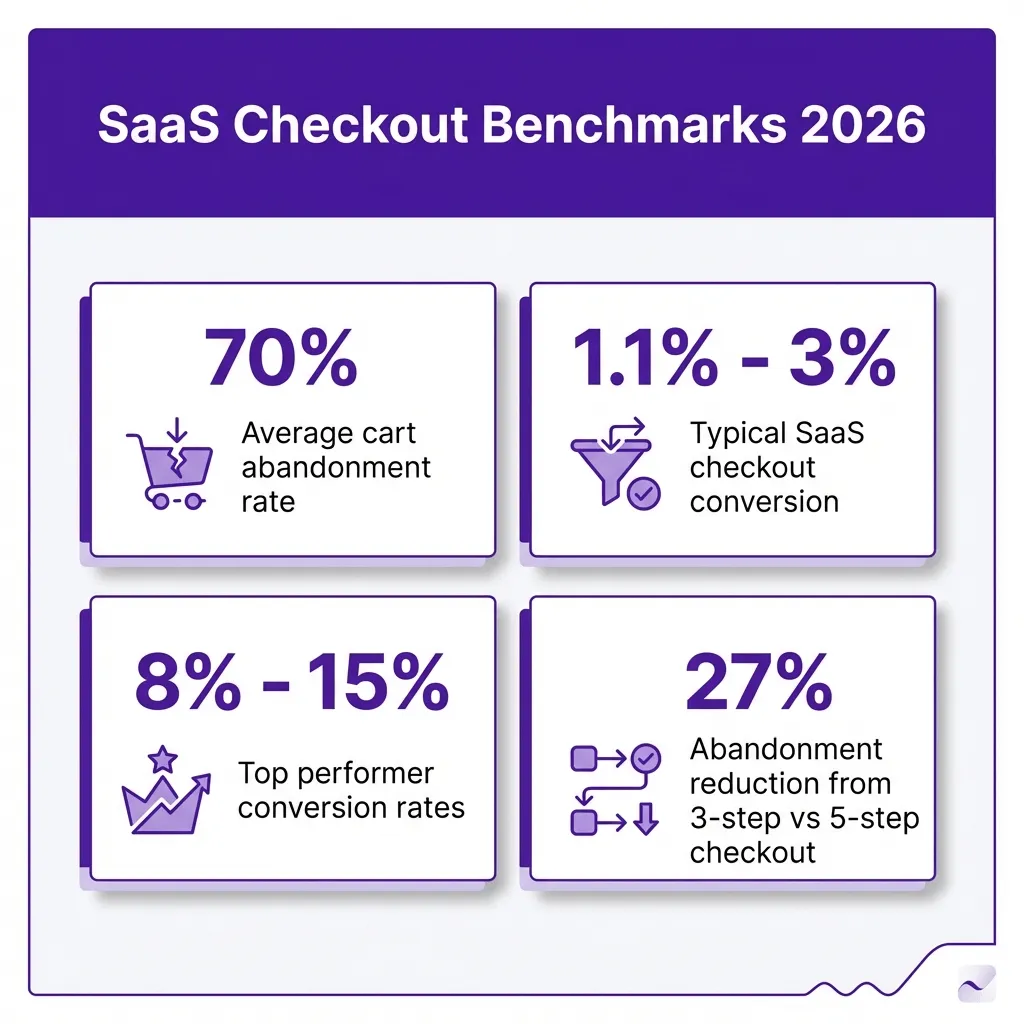
Current SaaS Checkout Benchmarks (2026)
| Metric | Average | Top Performers |
|---|---|---|
| Checkout conversion rate | 1.1% – 3% | 8% – 15% |
| Cart abandonment rate | 65% – 75% | 40% – 50% |
| Mobile checkout completion | 45% – 55% | 70% – 80% |
| Pricing page to checkout | 15% – 25% | 35% – 50% |
Data from Baymard Institute, Paddle, and proprietary analysis of 200+ SaaS companies.
The gap between average and top performers isn’t about having a better product. It’s about having a checkout experience that removes every possible reason to hesitate.
The 7 Core Principles of High-Converting SaaS Checkouts
1. Reduce Form Fields to the Absolute Minimum
Every field you add to your checkout form creates friction. Baymard Institute research shows that reducing checkout steps from 5 to 3 can decrease abandonment by 27%.
Here’s what you actually need:
Essential fields only:
- Email address (for account creation and receipts)
- Payment information (card details or wallet selection)
- Billing address (required for payment processing)
Fields to eliminate or delay:
- Phone number (unless required for 2FA)
- Company name (can be collected post-purchase)
- Job title (marketing data collection, not conversion)
- “How did you hear about us?” (survey after purchase)
- Custom fields (unless absolutely business-critical)
Stripe’s research confirms this: their fastest-converting checkouts collect only what’s necessary to process payment. Everything else can wait.
2. Offer Multiple Payment Methods
Payment method diversity isn’t a nice-to-have — it’s a conversion requirement. 54% of customers abandon checkout when payment options are limited to credit and debit cards.
Your payment mix should include:
Standard options:
- Credit/debit cards (Visa, Mastercard, Amex)
- PayPal (converts 88.7% when offered)
Digital wallets (increasingly essential):
- Apple Pay (critical for mobile conversion)
- Google Pay
- Link by Stripe
Buy Now, Pay Later (BNPL):
- Klarna
- Afterpay
- Affirm
Paddle’s data shows that offering local payment methods increases checkout conversion from 4.3% to 6.5%. For international SaaS companies, this means supporting iDEAL (Netherlands), SEPA (Europe), UPI (India), and Alipay/WeChat Pay (China).
3. Implement Trust Signals Strategically
Trust is the currency of checkout conversion. 35% of customers abandon carts when they don’t see trust badges, and 75% won’t complete checkout if they don’t recognize the trust badges you display.
Effective trust signals include:
Security badges:
- SSL certificate indicators
- PCI DSS compliance badges
- “Secure checkout” messaging
Payment trust:
- Visa, Mastercard, Amex logos
- PayPal verification
- “256-bit encryption” text
Social proof:
- Customer count (“Join 10,000+ companies”)
- Testimonials near checkout CTA
- “No credit card required” (for trials)
- Money-back guarantee badges
4. Optimize for Mobile-First
Mobile traffic now accounts for 60%+ of SaaS website visits, yet mobile conversion rates lag desktop by 30-40%. This gap represents massive untapped revenue.
Mobile checkout optimization priorities:
- Speed matters: Page load under 3 seconds, minimal JavaScript, compressed images
- Touch-friendly design: Minimum 44px touch targets, large tappable buttons
- Mobile payment methods: Apple Pay and Google Pay prominence, biometric authentication
- Reduced typing: Autofill compatibility, address lookup APIs, card scanning
Companies that optimize for mobile see conversion rate improvements of 20-35% on mobile devices.
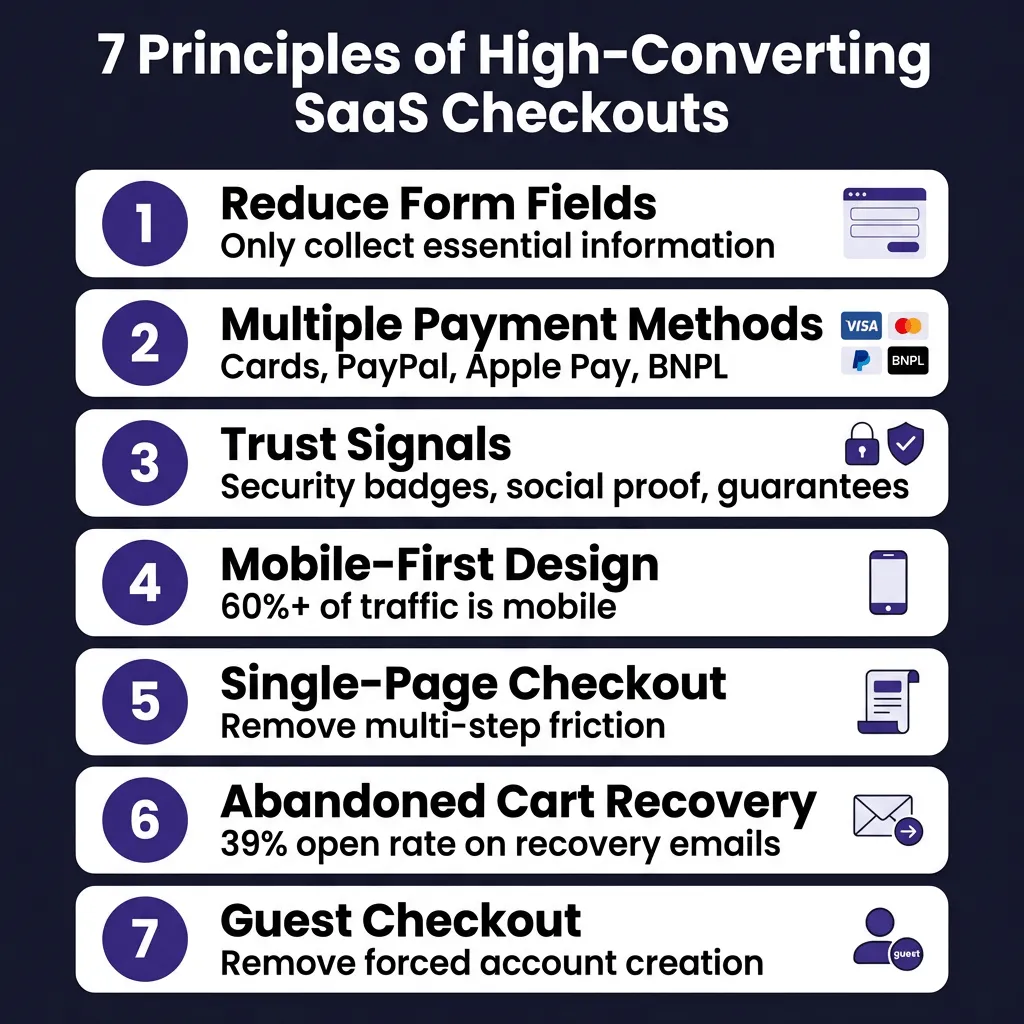
5. Create a Single-Page Checkout Experience
Multi-step checkouts create opportunities for abandonment. Every page load, every “Next” button, every progress indicator is a moment where customers can reconsider.
The single-page checkout pattern works because:
- Reduced load times: One page load instead of 3-4
- Visual completeness: Customers see everything required upfront
- Lower perceived effort: No uncertainty about how many steps remain
- Easier error correction: Issues visible immediately, not after navigation
6. Implement Smart Abandoned Cart Recovery
Even optimized checkouts see abandonment. The difference is what happens next.
Abandoned cart email benchmarks:
- Open rate: 39-45%
- Click-through rate: 21-23%
- Conversion rate: 10-15%
Effective abandoned cart sequences:
- Email 1 (30-60 minutes): Friendly reminder with direct link back to checkout
- Email 2 (24 hours): Address objections, include social proof
- Email 3 (72 hours): Incentive or urgency, final reminder
7. Remove Account Creation Barriers
Forced account creation is a conversion killer. 24% of shoppers abandon checkout when forced to create an account.
Better approaches:
- Guest checkout: Allow purchase without account, create automatically post-purchase
- Social login: Google OAuth, GitHub (for developer tools), LinkedIn (for B2B)
- Deferred account creation: Collect email only, create account in background
Advanced SaaS Checkout Optimization Tactics
Localization for Global Markets
If you’re selling internationally, localization isn’t optional. Paddle data shows localized checkouts convert 40% better than English-only experiences.
Localization elements include language translation, local currency display, local payment methods, VAT/tax compliance, and cultural adaptation of date formats and address fields.
A/B Testing Your Checkout Flow
Never assume you know what works. The highest-converting SaaS companies run continuous A/B tests on their checkout experience.
Elements to test: pricing presentation, form design, CTA buttons, trust elements, and progress indicators. Start with high-impact, low-effort tests. Even a 10% improvement in checkout conversion can mean hundreds of thousands in additional revenue.
Common SaaS Checkout Mistakes to Avoid
1. Hidden Fees Appearing at Checkout
48% of cart abandonments stem from extra costs like shipping, taxes, and fees appearing too high at checkout. Display total price including all fees on your pricing page.
2. Complicated Plan Selection
Too many plans create decision paralysis. The paradox of choice is real — offering 6 plans often converts worse than offering 3. Limit to 3-4 plans maximum with clear differentiation.
3. Poor Error Handling
Generic error messages like “Payment failed” create confusion. Use specific error messages and offer alternative payment methods immediately.
FAQ: SaaS Checkout Optimization
What’s a good checkout conversion rate for SaaS?
Average SaaS checkout conversion rates range from 1.1% to 3%. Top performers hit 8-15%. A 2% conversion rate is solid; 5%+ is excellent.
How do I reduce checkout abandonment?
Start with the basics: reduce form fields, offer multiple payment methods, display trust badges, and optimize for mobile. Then add abandoned cart recovery emails and A/B test your flow.
How important is mobile checkout optimization?
Critical. Mobile accounts for 60%+ of SaaS website traffic, yet mobile conversion rates lag desktop by 30-40%. Mobile-optimized checkouts can close this gap significantly.
Should I offer annual or monthly billing by default?
Default to annual for higher LTV, but make monthly clearly available. Show annual savings prominently (“Save 20%”). Some customers prefer monthly for cash flow reasons.
Conclusion: Your Checkout Is a Growth Lever
SaaS checkout optimization isn’t a one-time project. It’s an ongoing discipline of removing friction, building trust, and making it effortless for customers to say yes.
The companies that treat checkout as a core product experience — not just a payment form — consistently outperform competitors. They understand that every percentage point of conversion improvement compounds into significant revenue growth.
Start with the fundamentals: reduce fields, add payment methods, optimize mobile. Then layer on advanced tactics: localization, abandoned cart recovery, and continuous A/B testing.
If you’re looking to optimize your checkout without building complex payment infrastructure, Fungies.io provides a complete Merchant of Record solution with pre-optimized checkout flows, global tax compliance, and local payment methods — so you can focus on growing your SaaS while we handle the complexity of global payments.