SaaS Customer Acquisition Strategy: The Complete 2026 Guide to Scaling Efficiently
Discover proven SaaS customer acquisition strategies for 2026. Learn how to optimize CAC, choose between PLG and sales-led growth, and build a sustainable acquisition engine that drives efficient growth.
Here’s a sobering statistic: customer acquisition costs have risen 40-60% since 2023. For SaaS companies fighting for every dollar of runway, this isn’t just a metric—it’s an existential threat. The average B2B SaaS company now spends between $802 and $1,500 to acquire a single customer, with some enterprise-focused platforms burning $2,000+ per deal.
But here’s what most founders miss: the companies winning in 2026 aren’t outspending their competitors. They’re out-thinking them. They understand that sustainable SaaS growth requires a customer acquisition strategy that balances immediate revenue needs with long-term efficiency.
What Is SaaS Customer Acquisition Strategy?
A SaaS customer acquisition strategy is your systematic approach to attracting, engaging, and converting potential users into paying customers. Unlike traditional software sales, SaaS acquisition happens across a continuous lifecycle—awareness, consideration, activation, conversion, and expansion.
The strategy encompasses every touchpoint: from the blog post that ranks #1 on Google to the onboarding email that pushes users toward their first “aha moment.” It’s not just about getting signups. It’s about getting qualified signups who stick around.
In my experience working with growth-stage SaaS companies, the difference between a 3:1 LTV:CAC ratio (healthy) and a 1:1 ratio (bleeding cash) often comes down to strategy fundamentals that get skipped in the rush to scale.
Why Customer Acquisition Strategy Matters More Than Ever
The SaaS landscape in 2026 looks dramatically different from even two years ago. Competition has intensified across virtually every vertical. Buyers are more skeptical, doing more research before committing. And the old playbook of “raise money, pour it into paid ads, figure out unit economics later” has stopped working.
Consider these realities:
- Rising CAC: New customer CAC ratios increased 14% in 2024 alone, according to Benchmarkit data
- Longer sales cycles: B2B buyers now engage with 13+ pieces of content before making a decision
- Expansion dependency: For companies over $50M ARR, expansion revenue represents 50%+ of new ARR
- Channel saturation: Paid social CPMs have doubled in many SaaS verticals since 2022
Without a deliberate strategy, you’re not just inefficient—you’re vulnerable. A diversified acquisition approach insulates you from platform algorithm changes, ad cost inflation, and competitive pressure.
The 5-Phase SaaS Customer Acquisition Funnel
Before diving into specific channels, let’s map the journey your prospects take. Understanding this funnel is essential because different strategies excel at different stages.
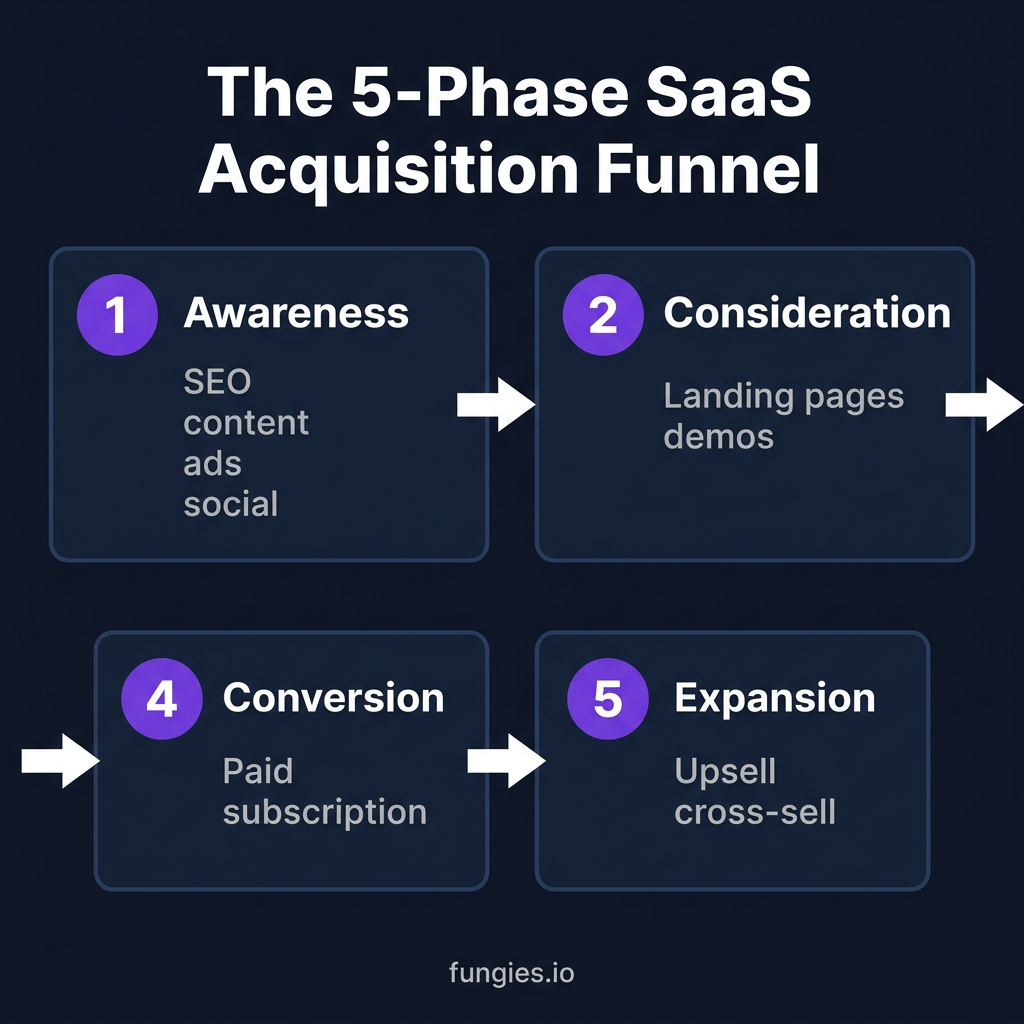
Phase 1: Awareness
This is top-of-funnel territory. Your prospect has a problem but doesn’t know you exist. Your goal isn’t conversion—it’s visibility and credibility. Content marketing, SEO, social media, and targeted advertising all play here.
The best awareness strategies educate first, sell second. A prospect who learns something valuable from your content carries positive associations into later funnel stages.
Phase 2: Consideration
Now they know you exist and are evaluating whether your solution fits their needs. This is where comparison content, case studies, detailed feature pages, and webinars shine. Your prospect is comparing you to competitors and alternatives (including doing nothing).
Phase 3: Activation
The prospect takes action—signing up for a free trial, freemium account, or demo. This is the critical bridge between interest and revenue. Your onboarding experience here determines whether they become a customer or churn before paying.
Phase 4: Conversion
The prospect becomes a paying customer. For self-serve products, this happens through in-app upgrades. For sales-led motions, it requires proposals, negotiations, and contracts. Either way, this is where acquisition costs get realized.
Phase 5: Expansion
Here’s where SaaS acquisition gets interesting. Your existing customers upgrade, buy add-ons, or expand seats. For mature SaaS companies, expansion revenue often exceeds new customer revenue. Smart acquisition strategies don’t stop at the first sale—they optimize for lifetime value.
Product-Led vs. Sales-Led: Choosing Your Growth Motion
Every SaaS customer acquisition strategy sits somewhere on the spectrum between product-led growth (PLG) and sales-led growth (SLG). Understanding where your product belongs is foundational.
Product-Led Growth (PLG)
In PLG, your product is the primary acquisition driver. Users discover value through free trials or freemium tiers before ever talking to sales. Think Slack, Notion, or Figma.
Best for: Products with quick time-to-value, self-serve onboarding, and viral potential. Lower price points ($10-100/month) work better here.
Acquisition advantages: Lower CAC, faster scaling, wider top-of-funnel. Users experience value before buying, reducing sales friction.
Sales-Led Growth (SLG)
In SLG, sales teams guide prospects through demos, custom proposals, and negotiated contracts. Think Salesforce, Workday, or enterprise cybersecurity platforms.
Best for: Complex products requiring customization, high price points ($10K+ ACV), and enterprise buyers with procurement processes.
Acquisition advantages: Higher ACV, better fit qualification, relationship-driven expansion. You control the narrative and can address complex objections directly.
The Hybrid Approach
Most successful SaaS companies in 2026 run hybrid motions. They use PLG to land users efficiently, then layer in sales touchpoints for expansion and enterprise deals. This “product-led sales” model captures the best of both worlds.
Customer Acquisition Channels: A Data-Driven Comparison
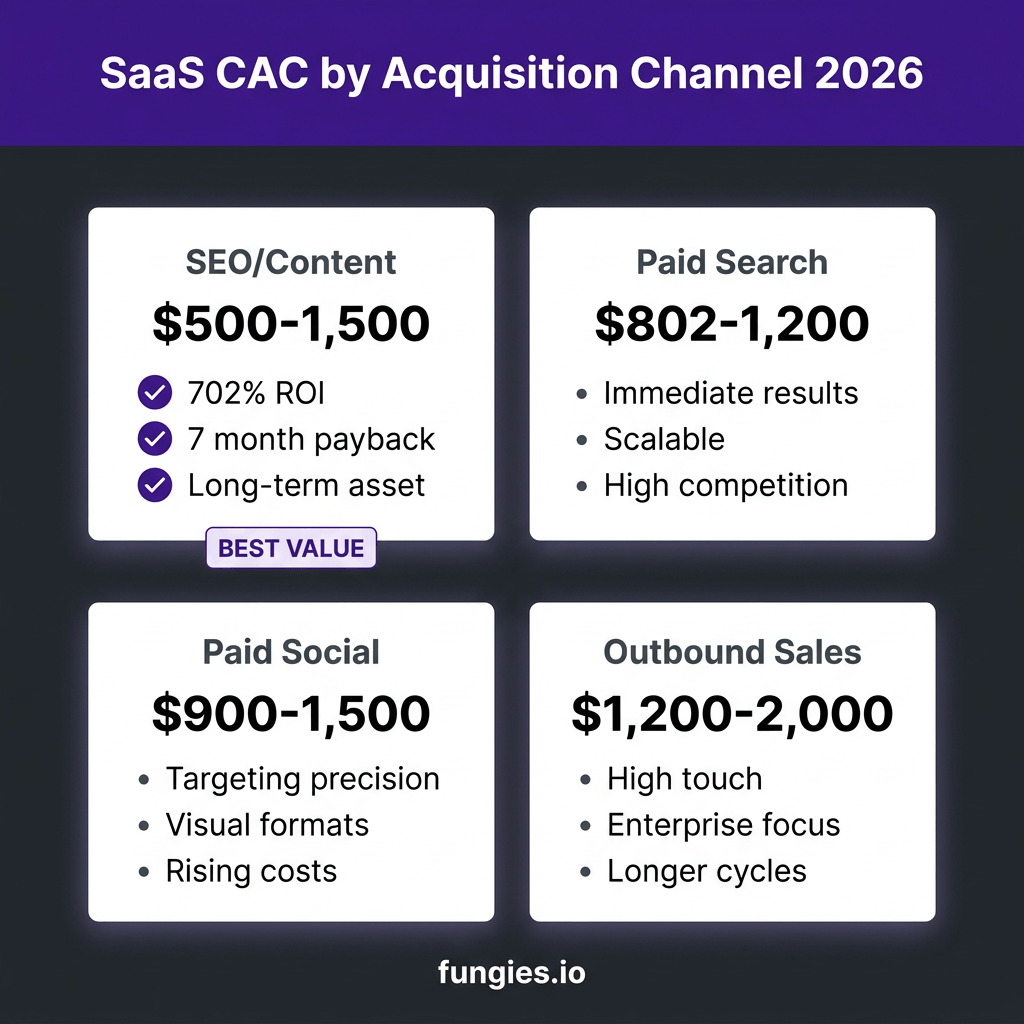
Let’s get specific about where to invest your acquisition budget. Here’s how the major channels stack up for B2B SaaS in 2026:
| Channel | Avg CAC | Time to ROI | Scalability | Best For |
|---|---|---|---|---|
| SEO/Content | $500-1,500 | 7-12 months | High (long-term) | Sustainable growth |
| Paid Search | $802-1,200 | Immediate | High | Intent capture |
| Paid Social | $900-1,500 | 1-3 months | Medium | Awareness + retargeting |
| Outbound Sales | $1,200-2,000 | 3-6 months | Medium | Enterprise deals |
| Partner/Affiliate | $300-800 | 2-4 months | Medium | Trust leverage |
| Product-Led Viral | $50-200 | Immediate | High (if product fits) | Network effect products |
Organic Channels: The Long Game That Pays Off
SEO and content marketing deliver a 702% ROI for B2B SaaS with a break-even time of just 7 months. That’s not a typo. While paid channels stop working the moment you stop paying, content compounds.
The strategy is straightforward but requires patience:
- Target high-intent keywords your ideal customers search
- Create genuinely useful content that solves real problems
- Build topical authority through content clusters
- Optimize for conversions, not just traffic
Honestly, most SaaS companies underinvest here because the payoff isn’t immediate. That’s exactly why it’s an opportunity. While competitors burn cash on ads, you can own the organic real estate that drives sustainable growth.
Paid Channels: Scaling with Precision
Paid acquisition isn’t dead—it’s just more expensive. The key is disciplined targeting and relentless optimization. Don’t spray and pray.
For Google Ads, focus on high-intent keywords. Someone searching “best CRM for real estate” is closer to buying than someone who saw a Facebook ad. For LinkedIn, use account-based targeting to reach decision-makers at specific companies. For Reddit and Twitter, lean into community-native formats that don’t feel like ads.
The rule of thumb: if you can’t achieve at least a 3:1 LTV:CAC ratio within 6 months, that channel isn’t working.
Partnerships and Affiliates: Leveraged Growth
Partner and affiliate programs offer some of the lowest CAC in SaaS—often $300-800 per customer. Why? Because you’re leveraging trust that already exists.
A recommendation from a trusted industry publication or complementary tool carries more weight than any ad. The challenge is building genuine relationships and offering compelling commission structures (typically 20-30% recurring for SaaS).
Key Metrics to Track
You can’t optimize what you don’t measure. Here are the essential metrics for evaluating your SaaS customer acquisition strategy:
Customer Acquisition Cost (CAC)
Formula: Total Sales & Marketing Costs ÷ Number of New Customers Acquired
Track CAC by channel to understand where you’re getting the most efficient growth. A blended CAC across all channels masks important variations.
Lifetime Value (LTV)
Formula: Average Revenue Per User × Gross Margin ÷ Monthly Churn Rate
LTV tells you how much you can afford to spend on acquisition. The higher your LTV, the more channels become viable.
LTV:CAC Ratio
The golden metric. A 3:1 ratio or higher indicates healthy unit economics. Below 3:1, you’re likely burning too much cash. Above 5:1, you might be underinvesting in growth.
Payback Period
How many months until you recover your CAC? For SaaS, 12 months or less is the benchmark. Longer payback periods strain cash flow and increase risk.
Net Revenue Retention (NRR)
NRR above 100% means your existing customers generate more revenue over time through expansion. This fundamentally changes your acquisition math—you can afford higher CAC because customers become more valuable.
Building Your Acquisition Strategy: A Practical Framework
Ready to build or refine your strategy? Here’s a framework that works:
Step 1: Define Your Ideal Customer Profile (ICP)
Be specific. “B2B companies” isn’t an ICP. “Series A SaaS companies with 20-100 employees, $1-5M ARR, using Stripe for billing, struggling with international tax compliance” is. The tighter your ICP, the more efficient your acquisition.
Step 2: Map the Buyer Journey
Understand how your ICP researches solutions, what questions they ask, and where they hang out online. This informs channel selection and messaging.
Step 3: Choose Your Primary Motion
PLG, SLG, or hybrid? This decision shapes everything from team structure to tooling to metrics.
Step 4: Diversify Your Channel Mix
Don’t depend on a single channel. A healthy mix might be 40% organic, 30% paid, 20% partnerships, 10% outbound. Adjust based on what works for your specific product and market.
Step 5: Build Feedback Loops
Connect acquisition data to revenue data. Which channels bring customers who stick around and expand? Which bring churners? Optimize for quality, not just quantity.
Common Mistakes to Avoid
I’ve seen these patterns destroy otherwise promising SaaS companies:
- Chasing vanity metrics: 10,000 signups mean nothing if none convert to paid
- Ignoring payback period: A 24-month payback might look acceptable on paper but will kill your cash flow
- Underinvesting in retention: It’s 5-25x cheaper to retain than acquire—don’t ignore expansion revenue
- Copying competitors: What works for a $100M ARR company won’t work for you
- Neglecting organic: Paid scales until it doesn’t. Organic is your insurance policy
FAQ: SaaS Customer Acquisition Strategy
What is a good CAC for SaaS?
For B2B SaaS, average CAC ranges from $802 to $1,500 depending on your target market and sales motion. Enterprise products often see $2,000+ CAC, while self-serve tools can achieve sub-$500 CAC. What matters more than absolute CAC is your LTV:CAC ratio—aim for 3:1 or higher.
How long should my CAC payback period be?
Ideally 12 months or less. Longer payback periods strain cash flow and increase the risk that customers churn before you recover acquisition costs. If your payback period exceeds 18 months, you need to either reduce CAC or improve monetization.
Should I focus on PLG or sales-led growth?
It depends on your product and market. PLG works best for products with quick time-to-value, self-serve onboarding, and lower price points. Sales-led fits complex products, high ACVs, and enterprise buyers. Most successful SaaS companies eventually adopt a hybrid model.
What’s the best customer acquisition channel for SaaS?
There’s no universal answer. SEO/content offers the best long-term ROI (702% for B2B SaaS), but takes months to mature. Paid search captures high-intent traffic immediately. The best strategy diversifies across multiple channels rather than depending on one.
How do I reduce my customer acquisition cost?
Focus on three levers: (1) Improve conversion rates at each funnel stage, (2) Double down on your highest-performing channels, and (3) Increase customer lifetime value through better retention and expansion. Often, the fastest CAC reduction comes from stopping underperforming campaigns.
Conclusion: Acquisition Is Just the Beginning
A winning SaaS customer acquisition strategy doesn’t just bring in new users—it brings in the right users efficiently and sets them up for long-term success. In 2026’s competitive landscape, the companies that thrive will be those that treat acquisition as a system, not a series of tactics.
Start with your unit economics. Know your CAC, LTV, and payback period by channel. Build a diversified mix that balances immediate results with sustainable growth. And never forget that acquisition is just the first chapter—the real value comes from customers who stay and expand.
Ready to streamline your SaaS payments and focus on growth? Get started with Fungies.io—the merchant of record platform that handles global tax compliance, so you can focus on acquiring customers, not navigating regulations.