SaaS Customer Retention Strategy: The Complete 2026 Guide to Reducing Churn and Maximizing LTV
Learn proven SaaS customer retention strategies for 2026. Discover churn benchmarks by segment, the 5-step retention framework, and key metrics like NRR and LTV:CAC that drive sustainable growth.
Here’s a number that should keep every SaaS founder awake at night: the median New Customer CAC Ratio hit $2.00 in 2024. That means teams now spend two dollars for every new dollar of ARR they bring in—up 14% in just one year. Meanwhile, the average B2B SaaS company loses 3.5% of customers every month, translating to roughly 35% annual churn.
But here’s what the growth-at-all-costs crowd missed: companies with Net Revenue Retention (NRR) above 110% can grow from existing customers alone. In 2026, retention isn’t just about keeping customers—it’s the primary growth engine.
What Is SaaS Customer Retention (And Why It Matters More Than Ever)
Customer retention is the percentage of customers who stick with your product over a given period. Simple enough. But in SaaS, it’s the difference between a sustainable business and a leaky bucket that burns cash faster than you can raise it.
Here’s the math that matters: acquiring a new customer costs 5-25x more than retaining an existing one. And retained customers don’t just stick around—they spend more. According to 2026 benchmarks, expansion revenue from existing customers now drives the majority of growth for best-in-class SaaS companies.
The stakes are even higher now. With capital more expensive and sales cycles longer, investors aren’t just asking about your growth rate. They want to know: How efficiently are you growing? What’s your payback period? How much revenue do you retain?
The 2026 SaaS Retention Landscape: Benchmarks by Segment
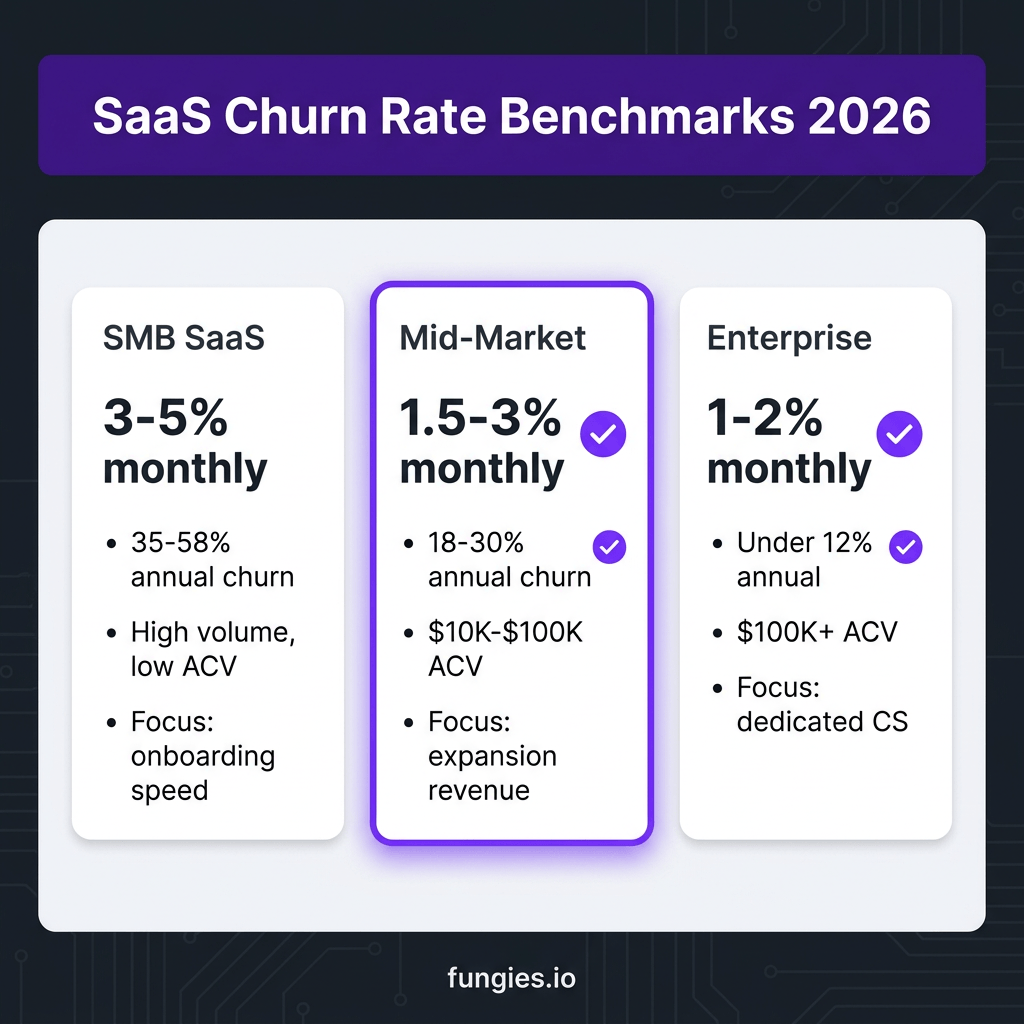
Not all SaaS businesses should aim for the same retention targets. Your benchmarks depend heavily on your target market and average contract value (ACV). Here’s what the data from 939 B2B SaaS companies tells us:
| Segment | Monthly Churn | Annual Churn | Target NRR | LTV Range |
|---|---|---|---|---|
| SMB ($0-10K ACV) | 3-5% | 35-58% | 100-105% | $15K-$40K |
| Mid-Market ($10-100K) | 1.5-3% | 18-30% | 105-115% | $80K-$200K |
| Enterprise ($100K+) | 1-2% | Under 12% | 115%+ | $300K-$1M+ |
| Best-in-Class (All) | Under 1% | Under 10% | 120%+ | Varies |
Enterprise SaaS companies with ACVs above $100K maintain dramatically lower churn—often under 1% monthly. But don’t let that fool you into thinking SMB is a bad business. The key is matching your retention strategy to your segment.
Why Customers Churn: The Real Reasons (Not Excuses)
Before you can fix retention, you need to understand why customers leave. After analyzing churn data from hundreds of SaaS companies, five patterns emerge consistently:
1. Poor Onboarding (The Silent Killer)
Here’s a sobering stat: 70% of churn happens in the first 90 days. Customers who don’t reach their “aha moment”—that first taste of value—within the first week are significantly more likely to cancel. Companies with time-to-first-value under 7 days see 50% lower churn rates than those taking longer.
2. Involuntary Churn (The Hidden Opportunity)
Up to 40% of churn stems from payment failures—expired cards, insufficient funds, or billing issues. This is called involuntary churn, and it’s the easiest to fix. AI-powered dunning sequences recover 2-4x more revenue than traditional retry logic.
3. Lack of Product Stickiness
If your product isn’t integrated into daily workflows, customers can leave without disruption. The most retentive SaaS products become infrastructure—think Slack, Notion, or Salesforce. They’re woven into how teams operate.
4. Misaligned Expectations
When sales overpromises features that don’t exist or timelines that aren’t realistic, churn is inevitable. The fix isn’t just better product—it’s better alignment between sales, marketing, and customer success.
5. Wrong Fit Customers
Sometimes churn is healthy. If you’re acquiring customers who were never a good fit for your product, they’ll leave eventually. The goal isn’t zero churn—it’s predictable churn from the right customers.
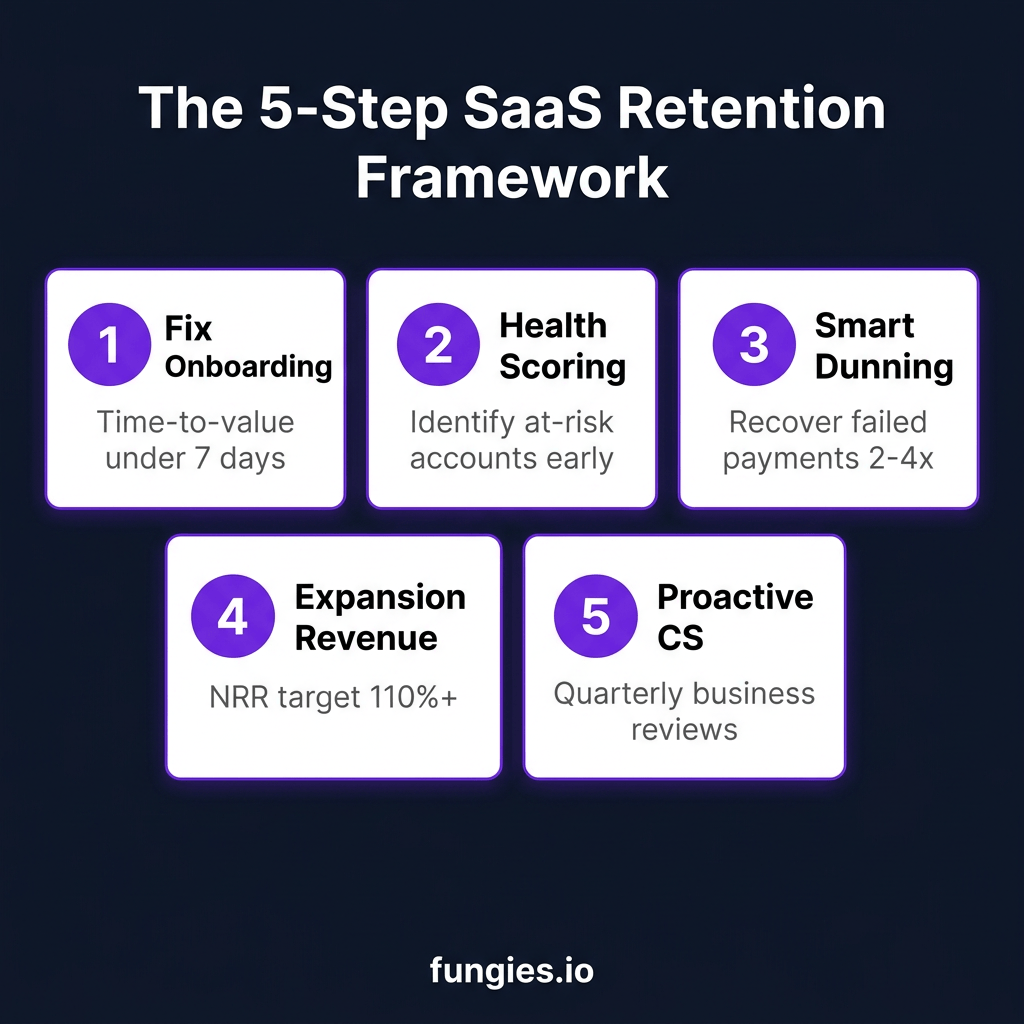
The 5-Step SaaS Retention Framework
Now let’s get tactical. Here’s a framework that works across company sizes, based on what’s actually driving results in 2026:
Step 1: Fix Your Onboarding (Time-to-Value Under 7 Days)
Your onboarding isn’t a product tour—it’s a value delivery system. The best SaaS companies use welcome surveys to capture the user’s role, goal, and context before they’ve had a single conversation. This lets you route users to the most relevant experience.
Key tactics:
- Implement progressive onboarding—don’t show everything at once
- Use checklists with progress indicators to drive completion
- Send behavior-triggered emails based on feature adoption
- Offer in-app guidance for complex workflows
Step 2: Implement Health Scoring (Identify At-Risk Accounts)
You can’t save customers you don’t know are struggling. Health scoring combines product usage data, support tickets, NPS responses, and billing history into a single risk indicator.
A simple health score might include:
- Login frequency (weight: 30%)
- Core feature usage (weight: 40%)
- Support ticket sentiment (weight: 15%)
- NPS score (weight: 15%)
Flag accounts dropping below a threshold for proactive outreach.
Step 3: Fix Involuntary Churn (Smart Dunning)
This is the lowest-hanging fruit in retention. When a payment fails:
- Retry intelligently (not just every day—time retries around payroll cycles)
- Send personalized emails from a human, not a billing system
- Make updating payment methods frictionless (in-app, not just email)
- Consider offering a grace period for good customers
Modern dunning tools can recover 15-25% of failed payments that would otherwise churn.
Step 4: Drive Expansion Revenue (NRR Above 110%)
The best SaaS companies don’t just retain customers—they grow with them. Net Revenue Retention above 100% means you’re expanding existing accounts faster than you’re losing them.
Expansion strategies that work:
- Usage-based pricing that grows with customer success
- Seat-based expansion for team collaboration tools
- Feature tiers that unlock as customers mature
- Quarterly business reviews to identify upsell opportunities
Step 5: Build Proactive Customer Success
Reactive support waits for customers to complain. Proactive CS reaches out before problems escalate. This means:
- Quarterly business reviews for mid-market and enterprise
- Automated check-ins at key milestones (30, 60, 90 days)
- Product usage reports showing ROI delivered
- Executive business reviews for strategic accounts
Key Retention Metrics Every SaaS Team Should Track
You can’t improve what you don’t measure. Here are the metrics that matter for retention:
| Metric | Formula | Good Benchmark | Why It Matters |
|---|---|---|---|
| Logo Retention Rate | (Start – Churned) / Start | >90% annual | Shows customer loyalty |
| Net Revenue Retention | (Start + Exp – Churn) / Start | >110% | Growth from existing base |
| Gross Revenue Retention | (Start – Churn) / Start | >85% | Revenue stability without expansion |
| LTV:CAC Ratio | LTV / CAC | >3:1 | Unit economics health |
| CAC Payback Period | CAC / Monthly Gross Margin | <12 months | Cash efficiency |
| Time-to-Value | Sign-up to first value moment | <7 days | Onboarding effectiveness |
Retention by Company Stage: What Changes
Your retention strategy should evolve as you grow. Here’s how priorities shift:
Seed Stage ($0-1M ARR)
Focus: Product-market fit and onboarding. You’re still learning why customers stay or leave. Interview every churned customer. Don’t worry about perfect metrics—worry about finding 10 customers who absolutely love your product.
Series A ($1-10M ARR)
Focus: Repeatable retention processes. This is when you implement health scoring, formalize onboarding, and build your first customer success function. Target: 95%+ logo retention, 100%+ NRR.
Series B+ ($10M+ ARR)
Focus: Expansion revenue and efficiency. At this stage, growth comes from existing customers. Build dedicated CS teams, implement quarterly business reviews, and optimize for NRR above 110%. Target: <12 month CAC payback.
Common Retention Mistakes (And How to Avoid Them)
I’ve seen SaaS companies make the same retention errors repeatedly. Here are the big ones:
Mistake 1: Focusing Only on Logo Churn
Logo churn (customers leaving) gets all the attention. But revenue churn matters more. A customer who downgrades from $500/month to $50/month hurts almost as much as one who cancels. Track both.
Mistake 2: Ignoring Involuntary Churn
Up to 40% of churn is preventable payment failures. Fix your dunning process before building complex retention playbooks.
Mistake 3: Treating All Customers the Same
Your $10/month self-serve customer needs a completely different experience than your $50,000/year enterprise account. Segment your retention approach.
Mistake 4: Measuring Retention Too Late
If you’re only measuring retention at 12 months, you’re flying blind. Track leading indicators: activation rate, feature adoption, and engagement trends. These predict churn before it happens.
FAQ: SaaS Customer Retention
What is a good churn rate for SaaS?
For B2B SaaS, a good monthly churn rate is under 3% for SMB, 1.5-3% for mid-market, and 1-2% for enterprise. Best-in-class companies achieve under 1% monthly churn. Annual churn benchmarks are 35% for SMB, 18-30% for mid-market, and under 12% for enterprise.
What is Net Revenue Retention (NRR)?
NRR measures revenue from existing customers including expansions, contractions, and churn. An NRR above 100% means you’re growing from existing customers alone. Top-quartile SaaS companies achieve 110-120% NRR.
How do I calculate customer lifetime value (LTV)?
The standard formula is: LTV = Average Revenue Per User (ARPU) × Gross Margin % × Average Customer Lifetime. For SaaS, a healthy LTV:CAC ratio is at least 3:1, with 5:1+ indicating strong efficiency.
What’s the difference between gross and net retention?
Gross Revenue Retention (GRR) measures revenue retained from existing customers excluding expansion. Net Revenue Retention (NRR) includes expansion revenue. GRR shows stability; NRR shows growth potential.
How can I reduce churn in the first 90 days?
Focus on time-to-first-value. Use welcome surveys to personalize onboarding, implement progress checklists, send behavior-triggered emails, and offer proactive support. Companies with time-to-value under 7 days see 50% lower churn.
Conclusion: Retention Is the New Growth
The era of growth-at-all-costs is over. In 2026, efficient growth wins. And the most efficient growth comes from customers who stay, expand, and advocate.
Start with your onboarding. Fix involuntary churn. Implement health scoring. Build a proactive customer success function. Track the right metrics. Do this, and you’ll build a SaaS business that doesn’t just grow—it compounds.
Ready to build a SaaS business with world-class retention? Get started with Fungies—the merchant of record platform that handles payments, tax compliance, and billing infrastructure so you can focus on keeping customers happy.