SaaS Customer Success Strategy: The Complete 2026 Guide to Driving Retention and Growth
Learn how to build a SaaS customer success strategy that drives retention, reduces churn, and increases Net Revenue Retention (NRR). Complete 2026 guide with metrics, frameworks, and best practices.
Here’s a sobering statistic: 40% of SaaS revenue now comes from renewals and expansion, not new sales. Yet most founders still obsess over acquisition while treating customer success as an afterthought. That’s a costly mistake.
In 2026, the companies winning in SaaS aren’t just building great products—they’re engineering systematic approaches to making customers successful. Customer success has evolved from a support function into a strategic growth engine. And if you’re not treating it that way, you’re leaving money on the table.
What Is SaaS Customer Success Strategy?
Customer success in SaaS isn’t about answering support tickets faster. It’s a proactive, outcome-focused approach that ensures your customers achieve measurable results with your product.
Here’s the difference: customer support reacts to problems. Customer success anticipates them. Support asks “How can I fix this?” Success asks “How do we ensure they never need to ask that question?”
A proper SaaS customer success strategy spans the entire customer lifecycle—from the moment someone signs up through onboarding, adoption, retention, expansion, and advocacy. It’s not a department. It’s a company-wide mindset.
The goal? Turn customers into power users who can’t imagine working without your product. When you nail this, churn drops, expansion revenue grows, and your net revenue retention (NRR) climbs above 100%—the hallmark of a healthy SaaS business.
Why Customer Success Matters More Than Ever in 2026
The SaaS landscape has shifted dramatically. Acquisition costs have risen 60% since 2022. Buyers are more skeptical. Competition is fiercer. In this environment, keeping existing customers isn’t just nice to have—it’s survival.
Consider these data points from 2025 research:
- The average SaaS company loses 5-7% of customers annually to churn
- A 5% reduction in churn can increase profits by 25%
- Companies with NRR above 110% command significantly higher valuations
- 23% of SaaS churn happens because users don’t understand how to use the product
Zoom provides a compelling example. They’ve maintained an online monthly churn rate of just 2.7%—well below industry averages. How? Relentless focus on user experience, continuous product innovation, and strategic customer engagement. The result is predictable recurring revenue that investors love.
Honestly, if you’re not investing in customer success in 2026, you’re essentially accepting that every dollar you spend on acquisition will leak out the back door. That’s not a growth strategy. That’s a treadmill.
The 5 Metrics That Actually Matter
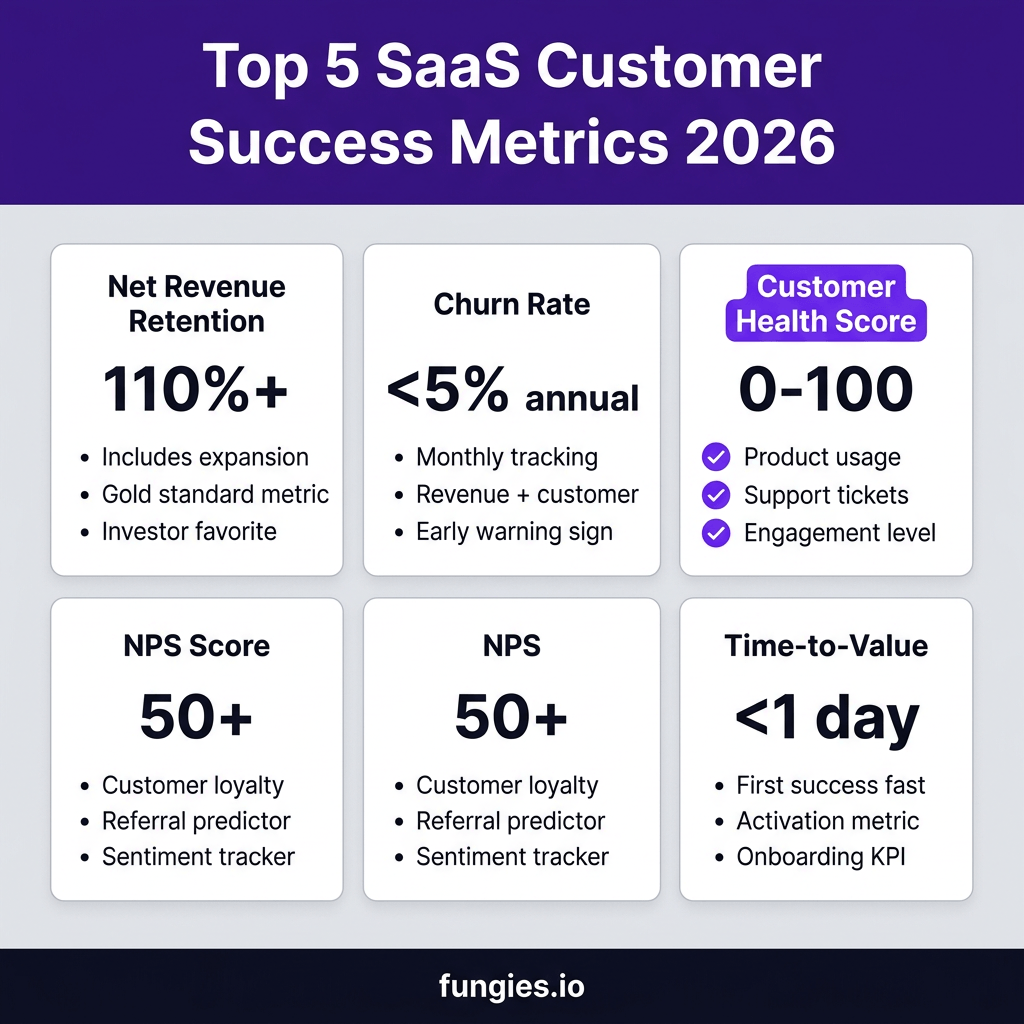
Not all metrics are created equal. I’ve seen teams drown in dashboards while missing the signals that actually predict churn. Here are the five metrics that should drive your customer success strategy:
1. Net Revenue Retention (NRR)
NRR is the gold standard metric for SaaS customer success. It measures how much revenue you retain and grow from existing customers, factoring in expansion (upsells, cross-sells) and losses (churn, downgrades).
Formula: (Starting MRR + Expansion – Contraction – Churn) / Starting MRR × 100
Top-performing SaaS companies maintain NRR above 110%. If your NRR is below 100%, you’re shrinking even when you’re acquiring new customers. Fix this first.
2. Churn Rate (Customer and Revenue)
Track both customer churn (percentage of customers lost) and revenue churn (percentage of recurring revenue lost). They tell different stories. You might lose few customers but many dollars—or vice versa.
For B2B SaaS, aim for annual churn below 5% (monthly below 0.4%). For SMB-focused products, 5-7% annual is more realistic. Anything higher signals a fundamental problem with product-market fit or onboarding.
3. Customer Health Score
This composite metric combines product usage, support ticket volume, engagement levels, and NPS into a 0-100 score. It’s your early warning system.
Customers scoring below 40 need immediate attention. Those above 80 are expansion candidates. The key is making this score actionable—triggering automated workflows when scores drop below thresholds.
4. Net Promoter Score (NPS)
NPS measures customer loyalty by asking: “How likely are you to recommend us?” Scores above 50 are excellent. Below 30 indicates serious satisfaction issues.
But don’t just track the score—analyze the qualitative feedback. Detractors (scores 0-6) will tell you exactly what’s broken. Passives (7-8) reveal missed opportunities. Promoters (9-10) are your expansion and advocacy engine.
5. Time-to-Value (TTV)
TTV measures how quickly new users experience meaningful value from your product. In my experience, this is the most underappreciated metric in SaaS.
Here’s why it matters: 40-60% of users who sign up never return after their first login. They didn’t experience enough value to come back. Every day you add to TTV is a day customers can churn before seeing your product’s worth.
Best-in-class SaaS products achieve TTV under 1 day. Some get users to their “aha moment” within minutes. That’s not accidental—it’s engineered.
Building Your Customer Success Strategy: A 6-Step Framework
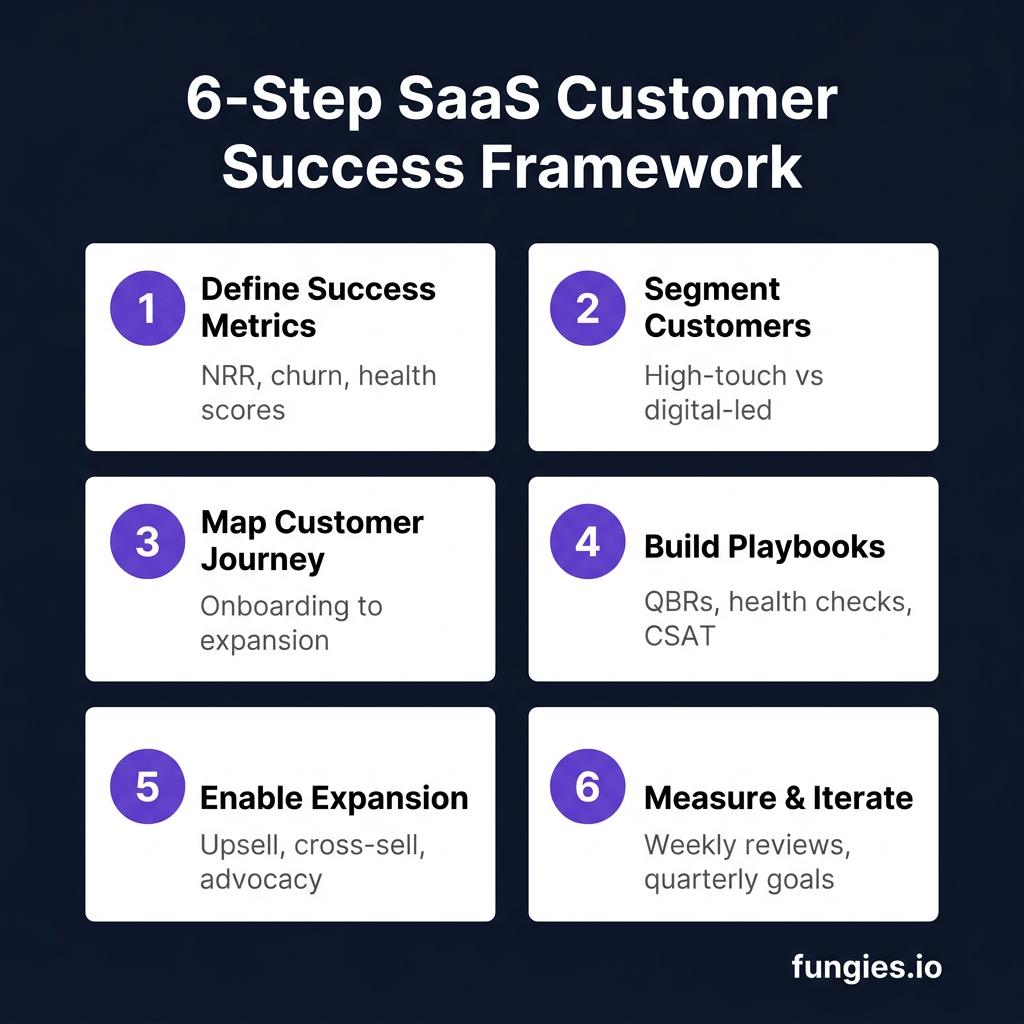
Now let’s get tactical. Here’s the framework I use with SaaS companies to build customer success programs that actually move the needle:
Step 1: Define What Success Looks Like
Before you can help customers succeed, you need to define success. What outcomes should customers achieve? What does “fully adopted” look like? What milestones indicate they’re on track?
This isn’t about product features—it’s about business outcomes. A project management tool doesn’t succeed when users create tasks. It succeeds when teams ship projects faster. A billing platform succeeds when finance teams close books in hours, not days.
Interview your best customers. Ask: “What specific result did our product help you achieve?” Their answers become your success definitions.
Step 2: Segment Your Customers
Not all customers need the same level of attention. Segment by:
- Contract value: High-value accounts get dedicated CSMs; smaller accounts get digital-led programs
- Product complexity: Enterprise deployments need white-glove onboarding; self-serve products need in-app guidance
- Customer maturity: Startups need different playbooks than Fortune 500s
- Use case: Different outcomes require different success paths
This segmentation determines your engagement model. High-touch for strategic accounts. Low-touch for mid-market. Tech-touch for long-tail. Get this wrong and you’ll either burn resources or miss opportunities.
Step 3: Map the Customer Journey
Document every stage from signup to renewal:
- Onboarding: First login to first value
- Activation: Core feature adoption
- Engagement: Regular usage patterns
- Retention: Renewal decisions
- Expansion: Upsell and cross-sell opportunities
- Advocacy: Referrals and case studies
At each stage, identify: What does the customer need? What could go wrong? What signals indicate success or risk? This becomes your playbook foundation.
Step 4: Build Your Playbooks
Playbooks are your standardized processes for driving success at each journey stage. They should include:
- Onboarding playbooks: Welcome sequences, training schedules, milestone check-ins
- Health check playbooks: Quarterly business reviews (QBRs), usage audits, satisfaction surveys
- Risk mitigation playbooks: At-risk account identification, escalation procedures, win-back campaigns
- Expansion playbooks: Upsell triggers, cross-sell opportunities, advocacy asks
The key is making these repeatable without being robotic. Customers should feel guided, not processed.
Step 5: Enable Expansion Revenue
Here’s something that might surprise you: the best time to sell is when customers are succeeding. Not at renewal. Not during QBRs. When they’re actively getting value.
Build expansion into your success strategy:
- Identify usage patterns that indicate readiness for more features
- Create upgrade paths that feel like natural next steps, not sales pitches
- Train CSMs to spot expansion signals and have value-based conversations
- Automate in-app prompts when users hit plan limits
Companies like HubSpot excel here—they use product usage data to identify when users are ready for advanced features, then facilitate timely, relevant upsells. The result? Expansion revenue that compounds over time.
Step 6: Measure, Iterate, Improve
Customer success isn’t set-and-forget. You need:
- Weekly operational reviews: Health score changes, at-risk accounts, upcoming renewals
- Monthly metric reviews: NRR, churn, CSAT trends
- Quarterly strategic reviews: Playbook effectiveness, team performance, goal progress
Use this data to continuously refine your approach. Double down on what’s working. Kill what’s not. Adapt as your product and market evolve.
Customer Success Tools: What You Actually Need
The customer success tech stack has exploded. Here’s what matters:
| Tool Category | Purpose | Examples |
|---|---|---|
| Customer Success Platform | Health scoring, playbooks, journey orchestration | Gainsight, ChurnZero, Vitally |
| Product Analytics | Usage tracking, feature adoption, funnel analysis | Amplitude, Mixpanel, Heap |
| In-App Engagement | Guided tours, tooltips, announcements | Pendo, Appcues, WalkMe |
| Feedback & NPS | Survey distribution, sentiment analysis | Delighted, SurveyMonkey, Typeform |
| Communication | Email, chat, meeting scheduling | Intercom, Zendesk, Calendly |
Start with product analytics and a simple health score. Add complexity only when you’ve outgrown spreadsheets. I’ve seen teams spend six figures on Gainsight before they had 50 customers. That’s backwards.
Common Customer Success Mistakes to Avoid
I’ve watched dozens of SaaS companies struggle with customer success. Here are the patterns that keep showing up:
Mistake 1: Hiring CSMs Too Late
Founders often wait until churn becomes painful before hiring customer success. By then, you’ve already lost the customers who could have been saved. Start with customer success when you have 10 customers, not 100.
Mistake 2: Making CS a Cost Center
If your CS team is measured on ticket resolution time, you’ve got a support team with a fancy title. Customer success should own NRR, expansion revenue, and net retention. Give them revenue targets.
Mistake 3: Ignoring Product Signals
The best predictor of churn isn’t a survey—it’s product usage. Customers who stop logging in will cancel. Build health scores around actual behavior, not sentiment.
Mistake 4: One-Size-Fits-All Approach
Your $50k ACV enterprise customer needs a different experience than your $50/month self-serve user. Segment your approach or you’ll serve neither well.
Mistake 5: Focusing on Renewal, Not Success
Renewal is an outcome. Success is the process. If you only engage customers 90 days before renewal, you’re not doing customer success—you’re doing account management. And customers see right through it.
FAQ: SaaS Customer Success Strategy
What’s the difference between customer success and customer support?
Customer support is reactive—it responds to problems customers report. Customer success is proactive—it anticipates needs and guides customers toward outcomes. Support fixes issues. Success prevents them.
When should a SaaS startup hire its first CSM?
Hire your first customer success hire when you have 10-20 customers and churn becomes measurable. Earlier if you’re selling complex enterprise software. Later if you’re purely self-serve. The key signal: you’re spending more time on retention than acquisition.
What is a good Net Revenue Retention (NRR) for SaaS?
Top-quartile SaaS companies maintain NRR above 110%. Below 100% means you’re shrinking even as you acquire customers. Aim for 100-105% as a minimum viable threshold, 110%+ as a sign of product-market fit and healthy expansion.
How do you reduce time-to-value (TTV)?
Map your user’s “aha moment”—the first time they experience core value. Then ruthlessly eliminate everything between signup and that moment. Use progressive onboarding, in-app guidance, and pre-populated templates. Trello famously reduced TTV by cutting steps to first board creation.
Should customer success own expansion revenue?
Yes. In modern SaaS, customer success teams that own expansion significantly outperform those that don’t. When CSMs are incentivized on NRR and expansion (not just retention), they proactively identify growth opportunities. Just ensure they have the training to have commercial conversations.
Conclusion: Make Customer Success Your Growth Engine
The SaaS companies winning in 2026 have figured out something important: acquisition gets you customers. Success keeps them. And in a world of rising CAC and fierce competition, retention is the new growth.
Building a customer success strategy isn’t about buying expensive software or hiring armies of CSMs. It’s about systematically understanding what your customers need to succeed, then engineering your product and processes to deliver it.
Start with the metrics that matter. Define success for your customers. Build playbooks that scale. And never stop iterating.
Your future revenue depends on it.
Ready to build a SaaS business with built-in success? Get started with Fungies.io—the merchant of record platform that handles payments, tax compliance, and checkout so you can focus on making customers successful.
Sources
- Vena Solutions – 2025 SaaS Churn Rate Benchmarks
- Focus Digital – Average Churn Rate by Industry SaaS 2025
- ChurnZero – 2025 Customer Success Trends
- Gainsight – Why Customer Success Is Critical to Revenue Growth
- Fincome – 5 Customer Success Metrics to Optimize Your SaaS Strategy
- Hiver – SaaS Customer Success Complete Guide 2025
- Candu – Best SaaS Onboarding Examples 2025