SaaS Free Trial vs Freemium: Which Model Converts Better in 2026? (The Data)
Here’s a number that should make you rethink your pricing page: free trials convert at 14–25% on average. Freemium? 3.7%. That’s not a typo. Free trial users are 4–6x more likely to become paying customers than freemium users. And yet, plenty of SaaS founders still default to freemium because “Slack did it” or “Spotify did
Here’s a number that should make you rethink your pricing page: free trials convert at 14–25% on average. Freemium? 3.7%.
That’s not a typo. Free trial users are 4–6x more likely to become paying customers than freemium users. And yet, plenty of SaaS founders still default to freemium because “Slack did it” or “Spotify did it” — without asking whether those companies share anything with their product.
The SaaS free trial vs freemium debate has a definitive answer for most founders. It just depends on your product. This guide breaks it down with the actual data, real examples, and a decision framework you can use in 20 minutes.
What’s the Actual Difference Between Free Trial and Freemium?
These two models get conflated constantly. They’re not the same thing.
A free trial gives users full (or near-full) access to your product for a fixed period — typically 7, 14, or 30 days. After that, they pay or they leave. The urgency is built in.
Freemium gives users permanent access to a limited version of the product, indefinitely and at no cost. They can use it forever — they just hit feature limits or usage caps that make upgrading attractive.
The difference matters enormously for conversion mechanics, infrastructure cost, and sales motion. One model creates urgency. The other creates habit. Which you need depends on what you’re building.
The Conversion Rate Data (And Why It’s Often Misread)
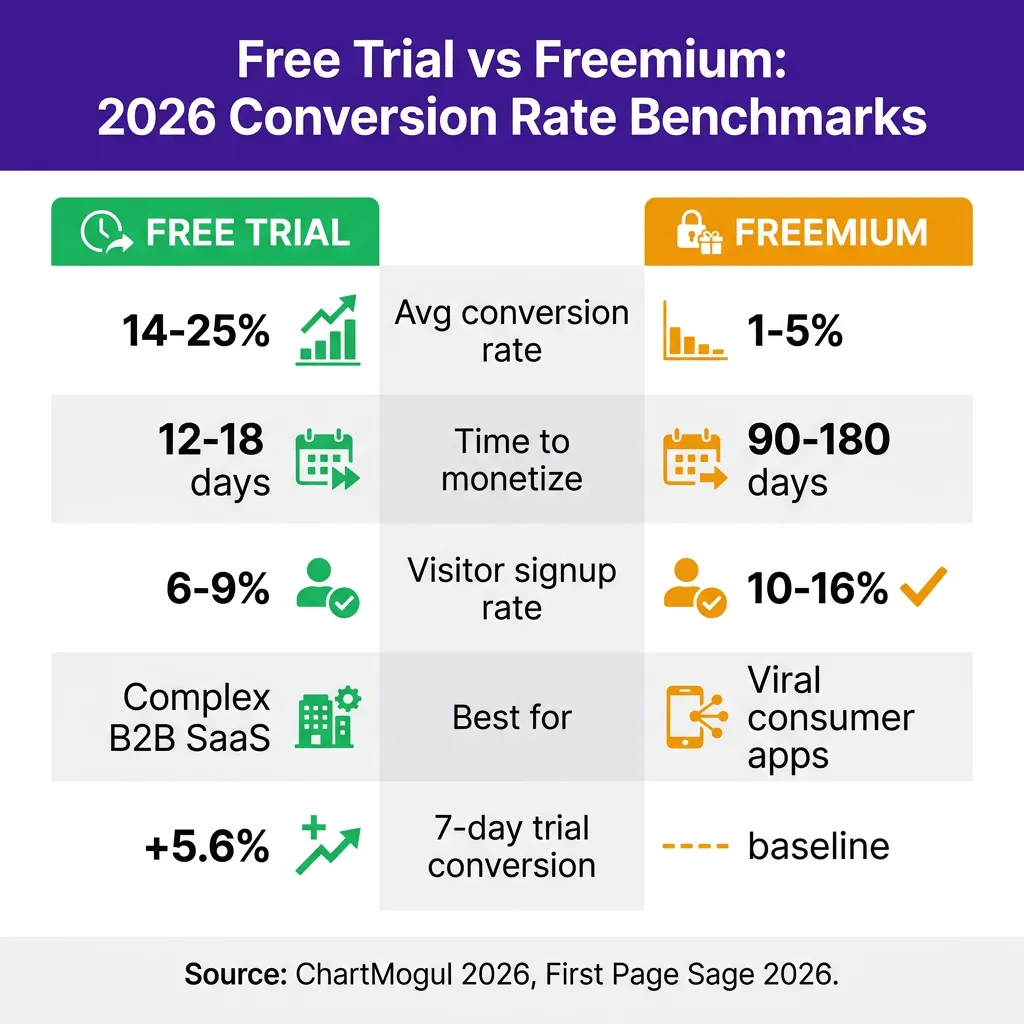
The headline stats from First Page Sage’s 2026 report:
| Model | Avg Conversion Rate | Visitor-to-Signup Rate | Time to Monetize |
|---|---|---|---|
| Free Trial (opt-in) | 14–25% | 6–9% | 12–18 days |
| Free Trial (opt-out) | 48–52% | 18–25% | 7–14 days |
| Freemium | 3.7% | 10–16% | 90–180 days |
The opt-out trial numbers (where you enter payment info upfront and get charged unless you cancel) are eye-watering — but they come with higher churn from involuntary conversions. The opt-in trial range of 14–25% is the honest benchmark for most SaaS founders to target.
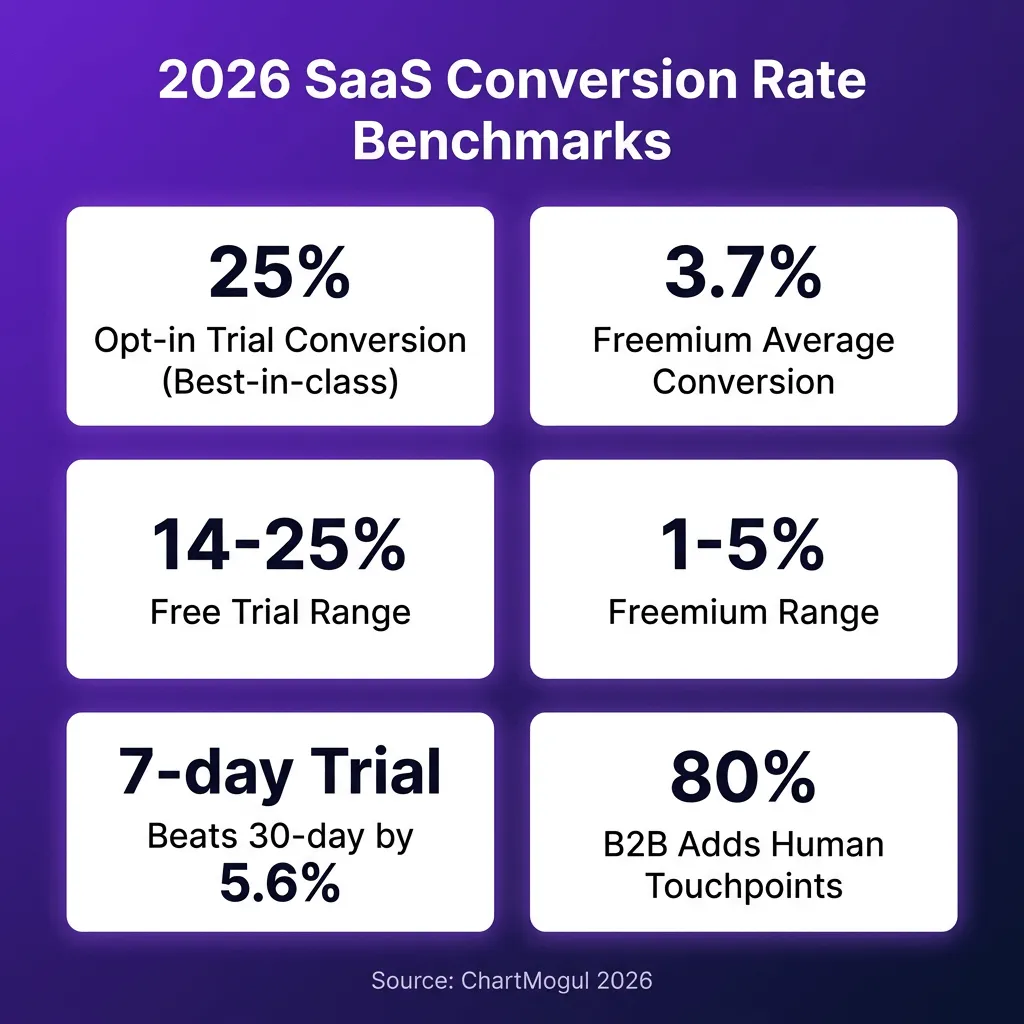
ChartMogul’s 2026 analysis of 200 B2B products found something interesting: 80% of B2B SaaS products with free trials include human touchpoints — an in-app chat, a sales call, or an onboarding email sequence. This isn’t a coincidence. It’s how the best-performing companies pump conversion rates above 25%.
Also worth noting: a 1 percentage point improvement in free-to-paid conversion produces roughly 15% more new revenue per trial cohort. Getting this right compounds fast.
Freemium: When the Math Actually Works
Freemium’s 3.7% average sounds terrible until you look at Slack, Spotify, and Dropbox.
Slack had around 30% of its users on paid plans at its peak growth phase — far above average — because it had something most SaaS products don’t: near-zero marginal cost per free user, and a collaboration mechanic that made the free tier naturally viral. Every free user who invited a teammate was also acquiring a new lead.
Spotify runs at roughly 2.5% freemium-to-paid conversion, which sounds dismal until you realize they have 600M+ users. The absolute numbers make 2.5% worth more than 25% on a smaller base.
The math of freemium works when:
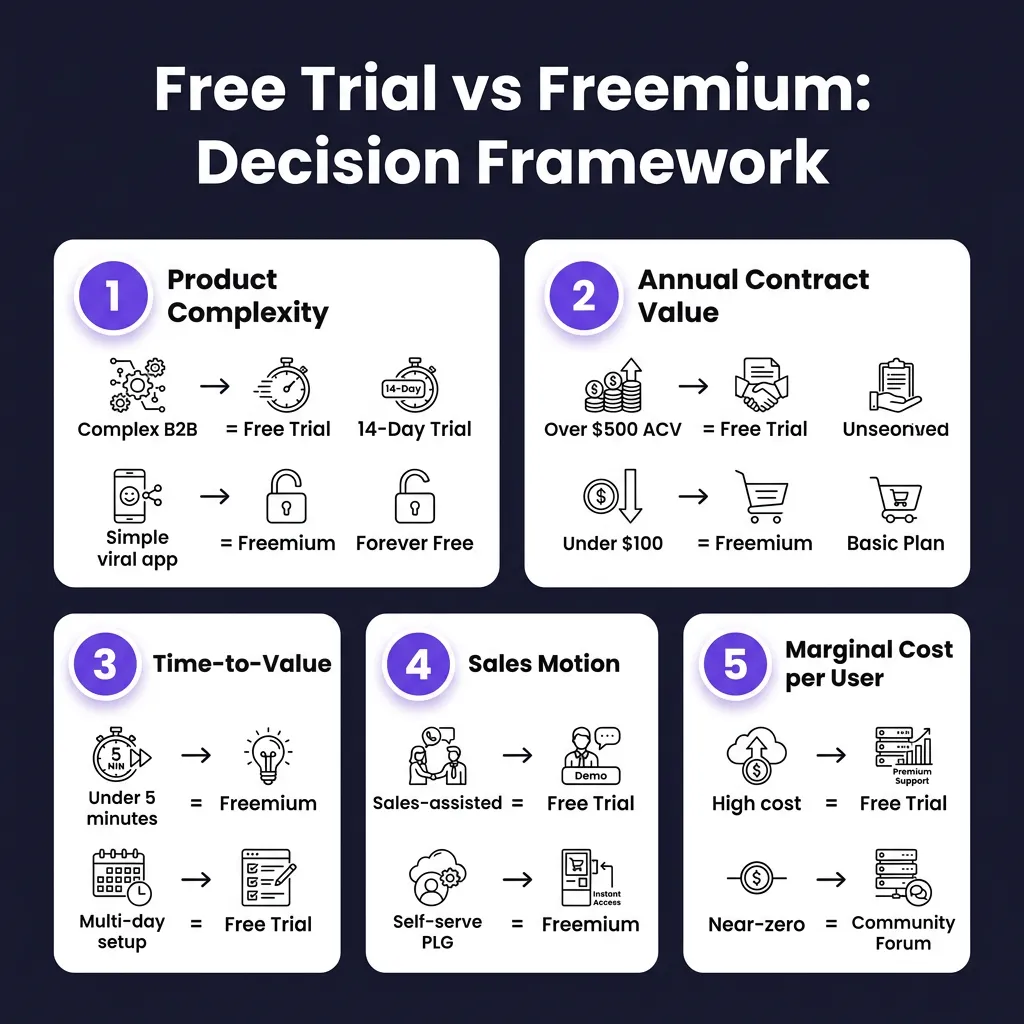
- Your marginal cost per free user is near zero. If you’re paying for storage, compute, or API calls per free user, freemium bleeds you.
- Your product has viral mechanics. Collaboration tools, creative tools, marketplaces — anything where free users recruit other users.
- Time-to-value is under 5 minutes. SaaS tools with sub-5-minute TTV achieve 13–16% visitor-to-signup conversion with freemium, vs 7–8% for trials. (SaaS Factor, 2026)
- Your product is habit-forming over time. Freemium’s 90–180 day monetization window requires users to actually keep using the product.
Freemium fails catastrophically when founders copy the model without the viral loop. A solo productivity tool for enterprise — no virality, high infrastructure cost per user — will bleed money on freemium indefinitely.
Free Trials: The Underused Weapon for B2B SaaS
If your ACV is above $500/year and your product requires setup, configuration, or integration — free trial is almost always the right answer.
Here’s why the conversion gap is so large: urgency. Trial users know they have a deadline. They’ll either invest time getting value from your product during the trial, or they won’t. That urgency sorts your users into real buyers and tire-kickers fast. Freemium users can stay on the fence indefinitely.
The trial length question gets debated endlessly. The data leans shorter:
| Trial Length | Conversion Impact | Best For |
|---|---|---|
| 7 days | +5.6% conversion, +7.9% revenue vs 30-day (A/B test data) | Simple products, strong onboarding |
| 14 days | Industry standard, highest engagement spike early | Most B2B SaaS |
| 30 days | Better for complex products with long TTV | Enterprise, multi-user setups |
The Science Says study found that 7-day trials (vs 30 days) produced 5.6% higher conversions, 6.4% better retention, and 7.9% higher revenue. The intuition: shorter trials create urgency without dragging out the decision cycle. Users who aren’t engaged by day 3 of a 30-day trial rarely convert on day 29.
The Hybrid Model: Best of Both Worlds?
The most sophisticated SaaS companies in 2026 don’t choose — they sequence.
The pattern that works: a time-limited trial of the full product, followed by a permanent freemium tier for users who don’t convert. You get trial urgency upfront, plus a freemium retention pool that keeps users in your ecosystem.
Notion, HubSpot, and Canva all operate some version of this. The data from a well-documented case study (CloudMetrics) is instructive: a company that ran freemium alone converted at 2.1%. After moving to a product-led growth hybrid model with personalized conversion triggers, they hit 7.4% and grew ARR from $1.2M to $14.8M. The LTV-to-CAC ratio went from 2.4x to 5.8x.
The catch: hybrid models are operationally complex. You need to design the free tier carefully (generous enough to demonstrate value, restricted enough to create upgrade desire), instrument your product for PLG signals, and build conversion flows for both paths.
Industry Benchmarks: What’s Normal for Your Category
Freemium conversion rates vary significantly by industry (First Page Sage, 2026):
| Industry | Visitor to Freemium | Freemium to Paid |
|---|---|---|
| Communications | 12.1% | 3.5% |
| CRM | 12.8% | 3.4% |
| Cybersecurity | 11.9% | 3.3% |
| Enterprise software | 11.8% | 3.4% |
| Developer tools | 14.2% | 4.1% |
| Collaboration | 15.8% | 5.2% |
Developer tools and collaboration software outperform because they have natural viral mechanics and community distribution. If you’re building in those categories, freemium makes more sense than if you’re building a compliance tool or enterprise CRM.
For free trials, OpenView Partners found that the median free trial-to-paid conversion rate is roughly twice that of freemium across product categories — approximately 14% vs 7%. The best-in-class B2B SaaS companies with opt-in trials clear 25%.
How Payments Factor Into Your Model Choice
Here’s the practical consideration most guides skip: your monetization model affects your payment infrastructure requirements.
Freemium at scale means you need to handle subscription upgrades, plan changes, prorated billing, and — if you’re selling globally — VAT, sales tax, and GST on paid conversions. Free trial to paid means you need reliable payment capture with retry logic and dunning management when trial conversions fail.
Both models get significantly more complex when you’re selling internationally. A customer in Germany converting from a free trial owes 19% VAT on their subscription. A user in Australia upgrading from freemium triggers GST obligations. If you’re collecting the money directly, you’re responsible for calculating and remitting those taxes in 100+ jurisdictions.
This is exactly why many SaaS founders — particularly those at the indie hacker or early-stage level — use a Merchant of Record instead of managing payments directly. An MoR becomes the legal seller in every market, handling tax registration, collection, and remittance automatically. Whether you run free trial or freemium, the upgrade conversion hits their infrastructure, not yours.
Platforms like Fungies.io handle this MoR layer at 5% + $0.50/transaction with zero monthly fees — which means you can launch either model without a finance team.
Key Takeaways
- Free trial typically converts 4–6x better than freemium (14–25% vs 3.7% average). If conversion rate is your north star, trial usually wins.
- Freemium works when you have viral mechanics, near-zero marginal cost per user, and sub-5-minute TTV. Without these, you’re funding a support base that doesn’t convert.
- Shorter trials often outperform longer ones. 7-day trials beat 30-day by 5.6% in at least one large-scale A/B test. 14 days is the safe default for most B2B products.
- Hybrid models (trial → freemium fallback) outperform either approach alone when implemented with proper PLG instrumentation and conversion triggers.
- Global sales tax compliance is a hidden cost of both models. If you’re selling internationally, factor in VAT/GST handling before you pick your payment stack.
FAQ
What’s the average free trial to paid conversion rate for SaaS?
For opt-in trials, the range is 14–25% with best-in-class B2B products hitting above 25%. Opt-out trials (where users provide payment info upfront) convert at 48–52%, but have higher involuntary churn. The 25% opt-in benchmark from First Page Sage is the most-cited target for 2026.
Is freemium or free trial better for B2B SaaS?
Free trial is almost always better for B2B SaaS with an ACV above $500/year. Freemium works for B2B when the product has strong viral mechanics (team collaboration tools, developer platforms) and near-zero marginal cost per free user. If neither of those is true, trial is the safer bet.
How long should a SaaS free trial be?
14 days is the industry standard for most B2B SaaS. 7-day trials outperform in A/B tests for simpler products with good onboarding. 30 days makes sense for complex products with multi-week time-to-value. The key: length should match how long it actually takes a user to experience your core value, not just an arbitrary number.
Can I run both a free trial and freemium at the same time?
Yes — and the best companies do. The hybrid pattern is: full-access trial for 14 days, then users who don’t convert drop to a permanent freemium tier. This captures trial urgency upfront while keeping non-converters in your ecosystem. Notion, Canva, and HubSpot all operate variants of this model.
Conclusion
The free trial vs freemium decision isn’t about what’s trendy — it’s about your product’s mechanics, your customer’s time-to-value, and your infrastructure economics.
Most B2B SaaS founders should default to free trial. Most viral consumer tools should default to freemium. If you’re building something in between — a collaboration product, a developer tool, a creator platform — the hybrid model is worth the complexity.
Whatever model you choose, make sure your payment infrastructure can handle global conversions cleanly. Ready to launch without tax headaches? Start with Fungies.io — it takes about 10 minutes to set up.
References
- First Page Sage, SaaS Freemium Conversion Rates: 2026 Report — https://firstpagesage.com/seo-blog/saas-freemium-conversion-rates/
- ChartMogul, Trial-to-Paid Conversion Benchmarks in SaaS: What Actually Works — https://www.pulseahead.com/blog/trial-to-paid-conversion-benchmarks-in-saas
- OpenView Partners, Freemium vs Free Trial: How to Know Which One to Pick — https://openviewpartners.com/blog/freemium-vs-free-trial/
- IdeaProof, Freemium vs Free Trial: Complete SaaS Comparison 2026 — https://ideaproof.io/versus/freemium-vs-paid-trial
- Science Says, The Optimal Free Trial Length — https://app.sciencesays.com/p/optimal-free-trial-length
- SaaS Factor, Freemium vs Trial Models in SaaS: What Really Boosts Conversions? — https://www.saasfactor.co/blogs/freemium-vs-trial-models-in-saas-what-really-boosts-conversions
- American Impact Review, Scaling a SaaS Business: The Role of Freemium Models — https://americanimpactreview.com/article/e2026022
- Ordway Labs, 14 Days vs 30 Days: Which SaaS Free Trial Length Drives More Conversions? — https://ordwaylabs.com/blog/saas-free-trial-length-conversion/