SaaS Growth Hacking: The Complete 2026 Guide to Engineering Explosive Growth
Discover the systematic growth hacking framework driving 50% annual growth rates for SaaS companies in 2026. Learn proven strategies to reduce CAC by 30-50%, optimize LTV:CAC ratios, and build sustainable growth systems backed by data from 939+ B2B SaaS companies.
Here’s a number that should keep every SaaS founder up at night: customer acquisition costs have exploded 60% over the past five years. The average B2B SaaS company now spends $205-$700+ to acquire a single customer. And yet, the smartest operators aren’t panicking. They’re achieving 30-50% CAC reductions through systematic growth hacking.
I’ve spent years analyzing what separates SaaS companies that scale efficiently from those that burn cash chasing vanity metrics. The difference isn’t budget size—it’s strategic precision. This guide breaks down the growth hacking framework that’s driving real results in 2026, backed by data from 939+ B2B SaaS companies.
What Is SaaS Growth Hacking (Really)?
Growth hacking isn’t about finding magical shortcuts or viral tricks that work once. It’s a systematic, data-driven approach to accelerating user acquisition, activation, and retention through rapid experimentation. The term originated in the startup world, but in 2026, it’s evolved into a mature discipline with clear frameworks and measurable outcomes.
Here’s what separates real growth hacking from generic marketing:
- Cross-functional execution: Growth hackers blend product, engineering, and marketing skills
- Quantified experiments: Every initiative has a hypothesis, success metric, and timeline
- Full-funnel focus: Not just acquisition—activation, retention, and revenue matter equally
- Scalable systems: Winning experiments become automated, repeatable processes
Product-led growth (PLG) companies exemplify this approach. According to 2025 data, PLG SaaS businesses achieve 50% annual growth rates compared to 21% for traditional sales-led companies. They don’t outspend competitors—they out-engineer them.
The AARRR Framework: Your Growth Hacking Blueprint
Every successful growth hacking operation I’ve analyzed follows some variation of the AARRR framework (also called Pirate Metrics). It maps the entire customer journey with specific metrics and optimization strategies for each stage.
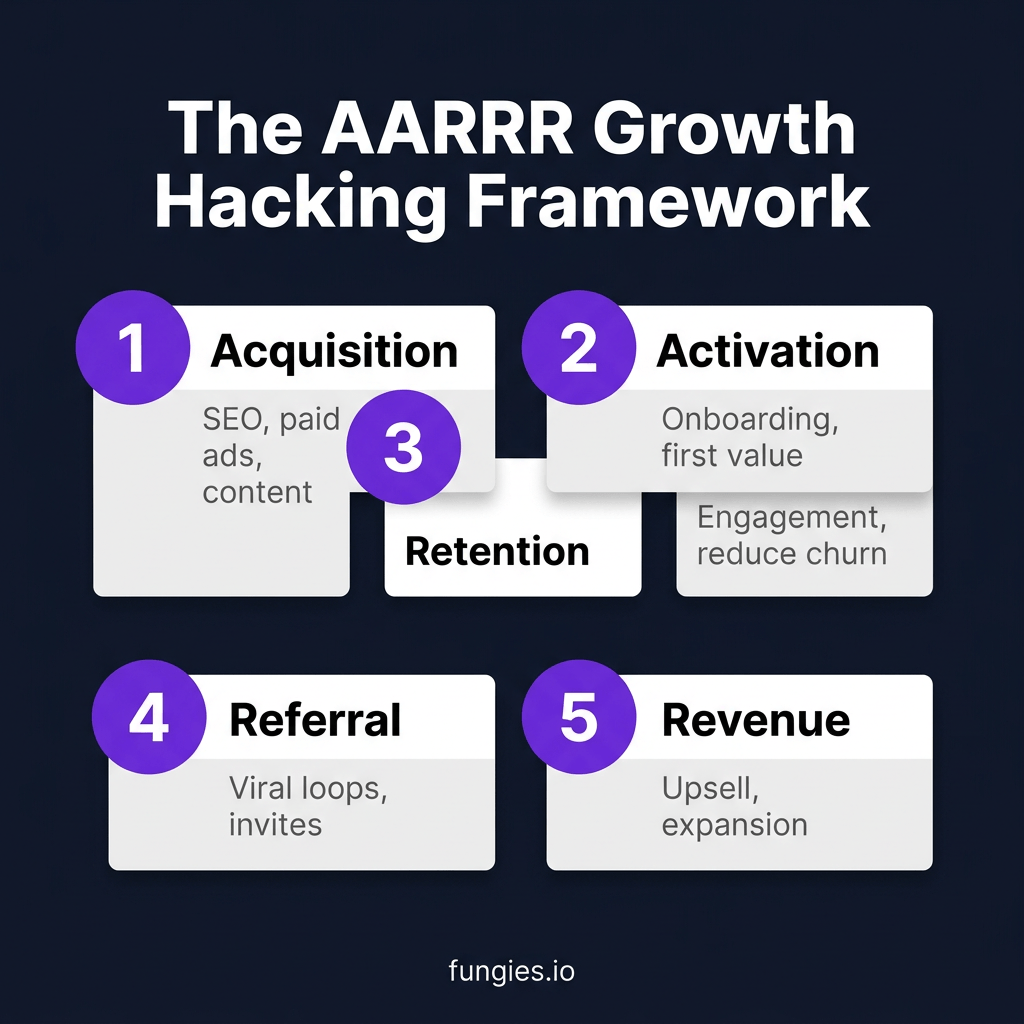
1. Acquisition: Getting the Right Users
Acquisition isn’t about traffic volume—it’s about finding users who actually need your product. The 2025 benchmarks reveal significant CAC variations by channel:
| Channel | Average CAC (B2B SaaS) | Best For |
|---|---|---|
| Organic Search (SEO) | $290 | Long-term, sustainable growth |
| Paid Search | $802 | High-intent, immediate conversions |
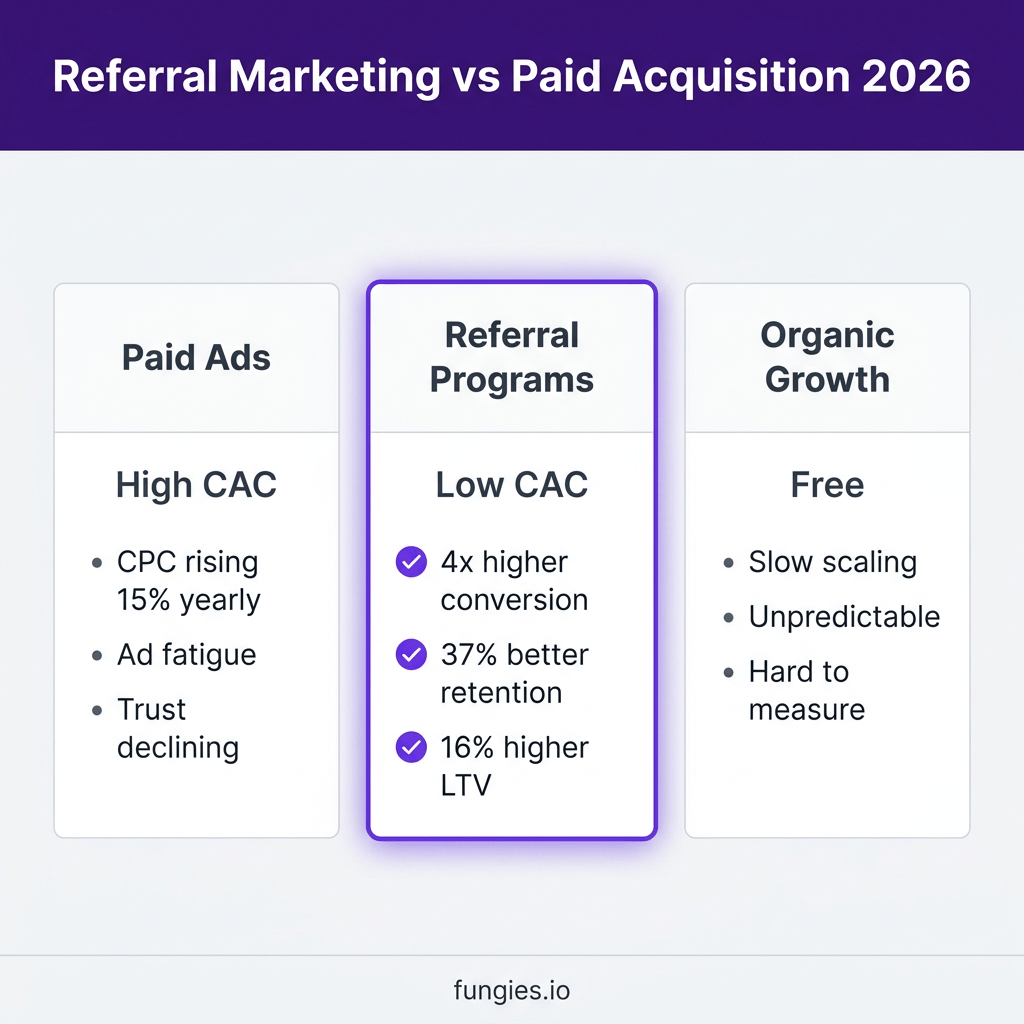
| Referral Programs | $150 | Leveraging existing customer trust |
| Content Marketing | $400-600 | Education-heavy buying cycles |
| Outbound Sales | $1,000+ | Enterprise deals |
The key insight? Companies achieving 3:1 LTV:CAC ratios don’t rely on single channels. They build diversified acquisition portfolios. When one channel’s efficiency drops (and they always do), others compensate.
2. Activation: The Critical First Experience
Here’s a stat that surprised me: 90% of users churn if they don’t see product value in the first week. Activation isn’t about feature tutorials—it’s about delivering the “aha moment” as fast as possible.
Companies with strong onboarding (time-to-first-value under 7 days) see 50% lower churn rates. The best onboarding experiences I’ve analyzed share these traits:
- Progressive disclosure: Show features as users need them, not all at once
- Personalized paths: Different user roles see different onboarding flows
- Quick wins: Users complete a meaningful task within minutes
- Contextual help: Assistance appears when users get stuck, not before
3. Retention: Where Growth Actually Lives
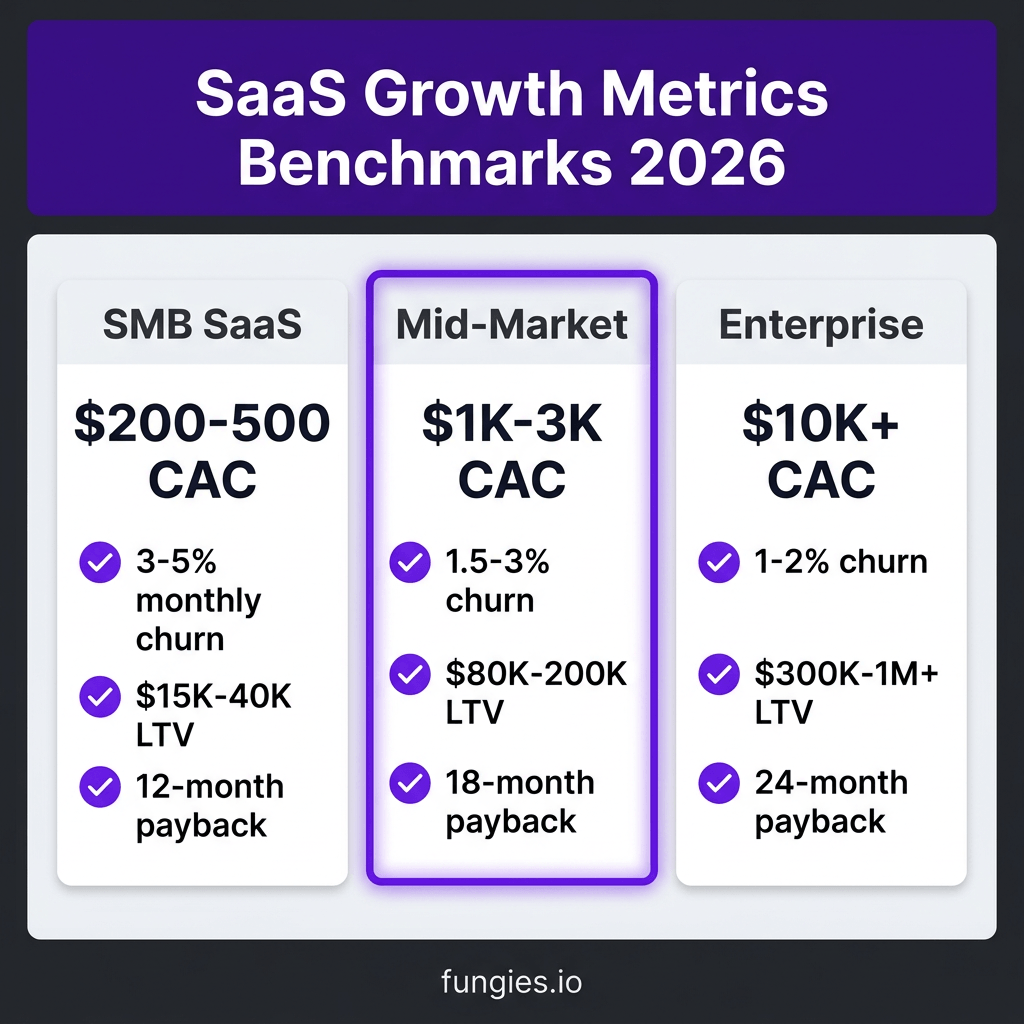
Retention is the foundation of sustainable SaaS growth. The 2025 Recurly Churn Report puts average B2B SaaS churn at 3.5% monthly (2.6% voluntary, 0.8% involuntary). But benchmarks vary dramatically by segment:
| Segment | Monthly Churn | Annual Churn | Best-in-Class |
|---|---|---|---|
| SMB | 3-5% | 31-46% | <2% |
| Mid-Market | 1.5-3% | 16-31% | <1.5% |
| Enterprise | 1-2% | 11-21% | <1% |
If your enterprise churn exceeds 10% annually, you have a fundamental product or customer success problem that no amount of marketing can fix.
The most effective retention strategies I’ve seen:
- Proactive health scoring: Identify at-risk accounts before they churn
- Expansion revenue focus: Top-quartile companies get 40%+ of new ARR from existing customers
- Product stickiness: Integrate into daily workflows so switching becomes painful
- Customer success investment: Companies with dedicated CS see 20-30% higher NRR
4. Referral: Engineering Viral Growth
Viral loops are the holy grail of growth hacking. When users naturally invite other users, your CAC approaches zero. But viral growth doesn’t happen by accident—it requires intentional product design.
The viral coefficient (K-factor) measures how many new users each existing user brings. K > 1 means exponential growth. K < 1 means linear growth that eventually plateaus. Most SaaS companies operate at 0.15-0.3, but the best achieve 0.5+.
Effective viral mechanics include:
- Collaboration invites: Slack, Notion, and Figma grew by making invites essential to product use
- Shared value: Dropbox’s referral program gave free space to both referrer and referee
- Public by default: Calendly links spread organically because they’re useful to recipients
- Template sharing: Canva and Notion let users share templates, exposing the product to new audiences
5. Revenue: Optimizing for Sustainable Growth
Revenue growth in 2026 is increasingly coming from existing customers. Expansion ARR now represents 40% of total new ARR for SaaS companies—and over 50% for companies above $50M ARR.
Net Revenue Retention (NRR) has become the defining metric for SaaS health:
- NRR < 100%: You’re shrinking even with new sales
- NRR 100-110%: Healthy but not exceptional
- NRR 110-120%: Top-quartile performance
- NRR 120%+: Best-in-class (Snowflake, Datadog territory)
The Metrics That Actually Matter
After analyzing hundreds of SaaS companies, I’ve identified the metrics that correlate most strongly with sustainable growth. Track these religiously:
LTV:CAC Ratio
The median B2B SaaS LTV:CAC ratio is 3.2:1. Here’s how to interpret yours:
- Below 3:1: Unsustainable unit economics—fix before scaling
- 3:1 to 4:1: Healthy, investable business
- 5:1+: Highly efficient, but possibly under-investing in growth
CAC Payback Period
This measures how many months it takes to recover acquisition costs. Cash-constrained startups should target under 12 months for SMB and under 18 months for mid-market. Enterprise can sustain 24+ months due to higher contract values.
Time-to-Value (TTV)
The time from signup to first meaningful outcome. Companies with TTV under 7 days see dramatically higher retention. Every day you add to TTV increases churn risk.
Advanced Growth Hacking Tactics for 2026
Now let’s get tactical. Here are the specific strategies driving results right now:
1. AI-Powered Personalization at Scale
Companies using AI for personalization report up to 7x higher conversion rates compared to traditional outbound. The key is using behavioral data to trigger the right message at the right time—not just inserting first names into templates.
Practical implementation:
- Use product usage data to identify expansion-ready accounts
- Trigger automated outreach based on feature adoption patterns
- Personalize onboarding flows by user role and use case
- A/B test AI-generated subject lines and content variations
2. Product-Led Sales (PLS)
The hybrid model combining PLG with sales touchpoints is dominating B2B SaaS. Users self-serve into the product, and sales engages based on product signals (feature usage, team size, integration activity) rather than form fills.
This approach achieves 3x higher ROI than outbound alone because prospects are already qualified by behavior.
3. Community-Led Growth
Building a community around your product creates defensible moats and organic acquisition. Companies like Notion, Figma, and Webflow have grown significantly through user-generated templates, plugins, and educational content.
The playbook: Enable power users to create value for other users, then make that value discoverable by prospects.
4. Usage-Based Pricing Optimization
Usage-based pricing adoption has accelerated as customers demand fairer pricing models. The key is finding the right value metric—one that scales with customer success, not just arbitrary limits.
Companies with well-designed usage pricing see higher expansion revenue and lower churn because costs align with value received.
Common Growth Hacking Mistakes to Avoid
I’ve seen brilliant growth strategies fail because of these avoidable errors:
Optimizing for Vanity Metrics
Traffic, downloads, and signups don’t pay bills. Focus on activated users, retained revenue, and LTV:CAC ratio. A smaller volume of highly qualified users beats a flood of tire-kickers.
Ignoring Unit Economics
Growth at any cost is dead. With rising CAC and tighter funding markets, sustainable unit economics are non-negotiable. If your LTV:CAC is below 3:1, fix that before pouring fuel on the fire.
Feature Bloat Over Core Value
Adding features to appeal to everyone usually appeals to no one. Double down on what makes users stick, then expand. The best SaaS companies do one thing exceptionally well before becoming platforms.
Neglecting Retention for Acquisition
It’s 5x cheaper to retain a customer than acquire a new one. Yet most growth teams focus 80% of effort on acquisition. Balance your investments—retention is where compounding happens.
Building Your Growth Hacking System
Here’s how to implement what we’ve covered:
Week 1-2: Audit Current Performance
- Calculate your true CAC by channel
- Measure time-to-value for new users
- Identify your activation milestone (the action that predicts retention)
- Benchmark churn against industry standards
Week 3-4: Prioritize Quick Wins
- Fix onboarding drop-offs (usually the biggest lever)
- Implement basic health scoring for at-risk accounts
- Set up automated dunning for failed payments
- Create referral incentives for power users
Month 2+: Systematic Experimentation
- Run 2-3 growth experiments per month
- Document hypotheses, results, and learnings
- Double down on winners, kill losers quickly
- Build playbooks from successful experiments
Frequently Asked Questions
What’s the difference between growth hacking and traditional marketing?
Growth hacking combines product, engineering, and marketing with a focus on rapid experimentation and full-funnel metrics. Traditional marketing often focuses on top-of-funnel awareness and brand building. Growth hacking optimizes for specific, measurable outcomes at every stage.
How long does it take to see results from growth hacking?
Quick wins like onboarding optimization can show results in weeks. Channel experiments typically need 30-60 days for statistical significance. Sustainable growth hacking is a continuous process, not a one-time project. The companies seeing 30-50% CAC improvements have been iterating for 6-12 months.
What’s a good LTV:CAC ratio for SaaS?
3:1 is the minimum threshold for sustainable SaaS growth. Below 3:1, unit economics don’t support scaling. 4:1 to 5:1 indicates healthy efficiency. Above 5:1 suggests you might be under-investing in growth and leaving market share on the table.
Should early-stage startups focus on growth hacking?
Early-stage companies should focus on product-market fit first. Growth hacking amplifies what’s working—it doesn’t fix fundamental product issues. Once you have 10+ customers who’d be “very disappointed” if your product disappeared, then layer in systematic growth.
How do I reduce churn in my SaaS business?
Start with onboarding—companies with time-to-value under 7 days see 50% lower churn. Implement health scoring to identify at-risk accounts early. Fix involuntary churn with smart dunning. Build product features that increase switching costs. Most importantly, ensure you’re selling to the right ICP—churn often stems from misaligned customer fit.
Conclusion: Growth Hacking Is a System, Not a Tactic
The era of quick-fix growth hacks is over. What works in 2026 is systematic, data-driven optimization across the entire customer journey. The companies winning aren’t chasing viral tricks—they’re building growth systems that compound over time.
Start with your metrics. Understand your LTV:CAC ratio, CAC payback period, and activation rates. Fix the biggest leaks first—usually onboarding and early retention. Then run disciplined experiments to optimize each stage of the funnel.
Remember: sustainable growth comes from delivering genuine value, not gaming metrics. Build a product people love, then use these frameworks to help more people discover it.
Ready to streamline your SaaS billing and focus on growth? Create your free Fungies account and get started with automated billing, tax compliance, and global payments in minutes.
Sources
- Optifai B2B SaaS Churn Rate Benchmarks 2026 – Data from 939 B2B companies
- Vitally SaaS Churn Benchmarks 2026 – 2025 Recurly Churn Report analysis
- First Page Sage SaaS CAC Payback Benchmarks 2025 – Industry CAC analysis
- Benchmarkit 2025 SaaS Performance Metrics – Growth and retention data
- Optifai B2B SaaS LTV Benchmarks – LTV:CAC ratio analysis
- Cobloom SaaS Growth Hacking Strategies – Tactical growth frameworks
- SevenAtoms Product-Led Growth Analysis – PLG growth rates and benchmarks
- Userpilot Customer Acquisition Strategies – Channel-specific CAC data