SaaS Growth Hacking: The Complete Guide to Viral Loops and Referral Programs (2026)
Learn how Dropbox grew 3900% in 15 months through viral loops. This complete guide covers viral coefficient formulas, referral program strategies, and proven growth hacking tactics for SaaS companies in 2026.
Here’s a stat that’ll make you rethink your entire growth strategy: Dropbox grew from 100,000 to 4 million users in just 15 months — not through paid ads, not through sales teams, but through a simple referral program. That’s a 3900% growth rate without spending a dollar on traditional marketing.
I’ve spent years running paid acquisition campaigns across every major platform. And honestly? Nothing — not Google Ads, not Meta, not LinkedIn — delivers ROI like a well-engineered viral growth loop. When your users become your sales force, your CAC drops to near zero and your growth becomes exponential, not linear.
What Is Growth Hacking, Really?
Growth hacking isn’t about shortcuts or black-hat tricks. It’s a mindset — a relentless focus on scalable, measurable growth through creative, low-cost strategies. Sean Ellis coined the term back in 2010 to describe how startups like Dropbox and Airbnb achieved explosive growth without traditional marketing budgets.
The core principle? Find leverage points in your product where user actions naturally drive more user acquisition. Instead of renting attention through ads, you build systems that compound over time.
Understanding Viral Loops: The Engine Behind Exponential Growth
A viral loop is a self-reinforcing cycle where every new user creates opportunities for more users to join. The user experiences value, shares the product, and the new user signs up — continuing the cycle.
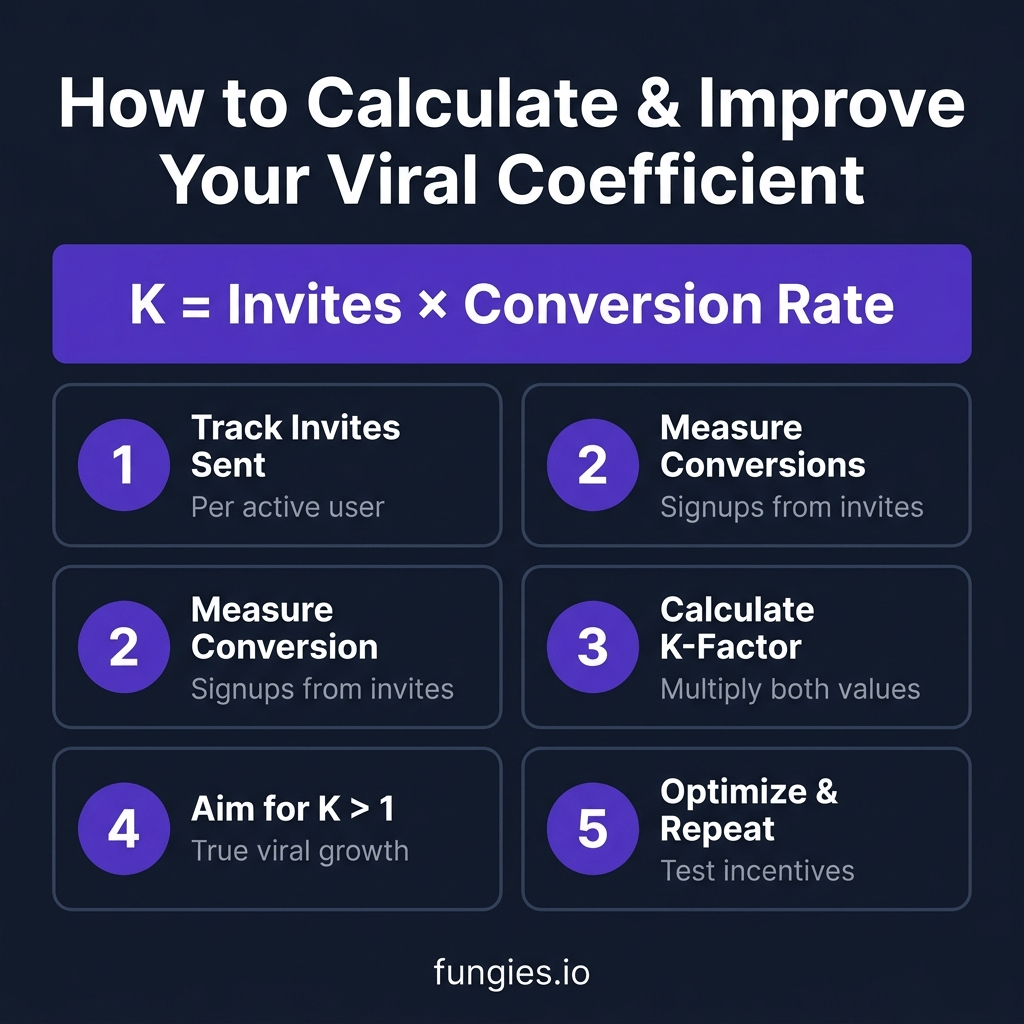
The math is simple but powerful. Your viral coefficient (K-factor) is calculated as:
Viral Coefficient = Average Invites Per User × Conversion Rate
When K > 1, you’ve achieved true viral growth. Each user brings in more than one new user, creating a snowball effect. At K = 0.5, you’re still getting meaningful growth — every two users bring in one more. At K = 0.2, referral becomes a nice-to-have channel rather than a growth engine.
Why Referral Programs Outperform Traditional Marketing
The data doesn’t lie. According to research from Referral Factory and SaaSquatch, referred users deliver:
- 16% higher lifetime value than users acquired through other channels
- 18% lower churn rate — referred customers stick around longer
- 4x higher conversion rates compared to cold traffic
- 30% more leads when companies launch structured referral programs
Why? Trust. When a friend recommends a product, that recommendation carries instant credibility that no ad can match. You’re not interrupting someone’s feed — you’re entering through a trusted introduction.
The Anatomy of High-Performing SaaS Referral Programs
After analyzing dozens of successful programs, I’ve identified the components that separate viral hits from forgotten experiments:
1. Double-Sided Incentives (Non-Negotiable)
Single-sided rewards where only the referrer benefits are leaving money on the table. The referrer feels good about helping a friend AND gets rewarded. The friend gets an exclusive offer they couldn’t get elsewhere. Both parties win.
Dropbox nailed this: referrers got 500MB bonus storage. New users got 500MB extra too. Everyone benefited from participating.
2. Incentives That Compound Product Value
The best rewards aren’t cash — they’re features that make the product more valuable. Dropbox gave storage. Uber gave ride credits. Airbnb gave travel credits. These rewards naturally lead users deeper into the product, increasing retention while driving acquisition.
3. Frictionless Sharing Mechanics
If sharing takes more than two clicks, you’ve already lost most users. The referral process needs to be embedded naturally in the user journey — after moments of success, not buried in settings menus.
Case Studies: How the Best Did It
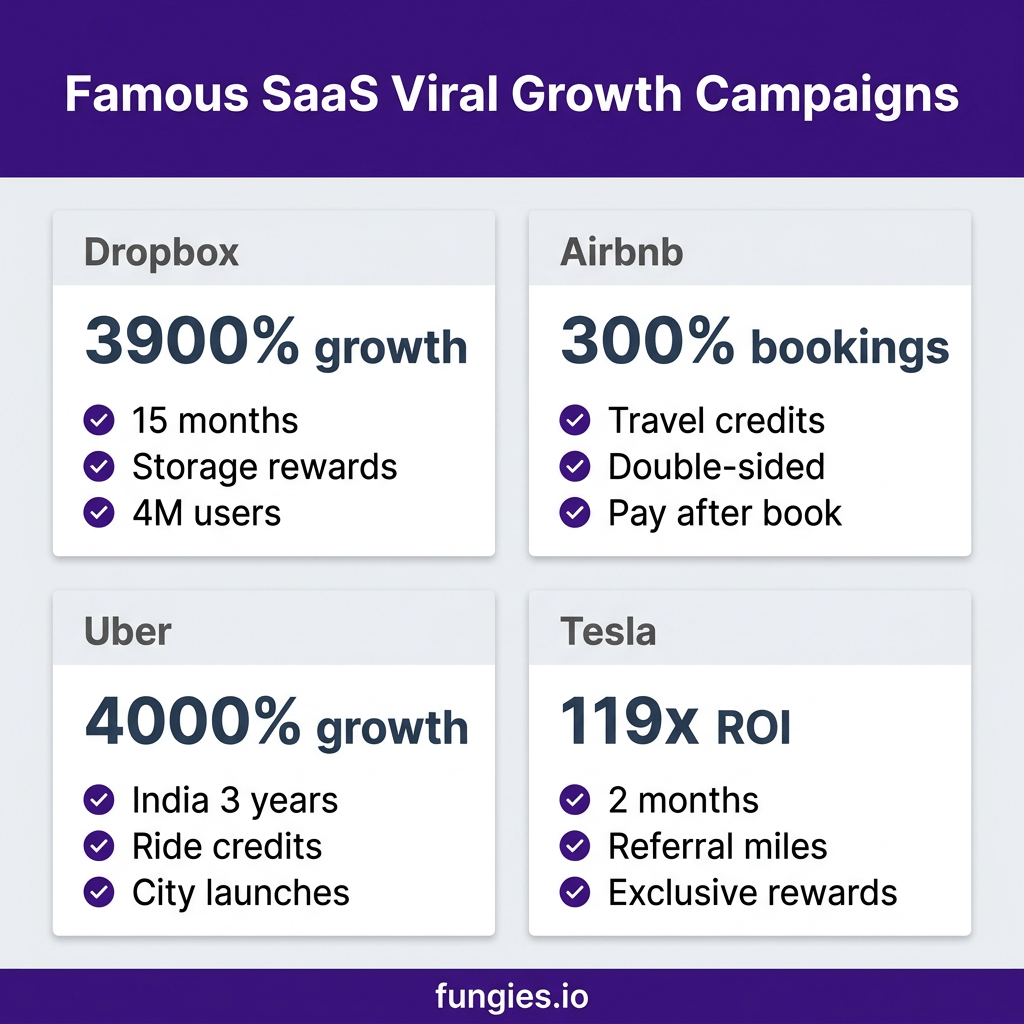
| Company | Strategy | Results | Key Insight |
|---|---|---|---|
| Dropbox | Storage bonuses for both sides | 100K → 4M users in 15 months | Product-value rewards > cash |
| Airbnb | Travel credits, pay after booking | 300% boost in bookings | Post-conversion rewards reduce risk |
| Uber | Ride credits for city launches | 4000% growth in India (3 yrs) | Local viral loops scale globally |
| Tesla | Referral miles + exclusive perks | 119x ROI in 2 months | Status rewards drive super-fans |
| PayPal | Cash bonuses for signups | 100M users by 2002 | Direct cash works for fintech |
Building Your Viral Growth Engine: A Step-by-Step Framework
Ready to build your own viral loop? Here’s the framework I use with SaaS companies:
Step 1: Identify Your “Aha Moment”
Users share products after experiencing real value. For Facebook, it was adding 7 friends in 10 days. For Slack, it was sending 2,000 messages. Find the moment your users truly “get” your product — that’s when you ask for the referral.
Step 2: Design Your Incentive Structure
Ask yourself: What do my power users want more of? If you’re a productivity tool, maybe it’s seats or storage. If you’re a communication platform, maybe it’s message history or advanced features. The reward should pull users deeper into your product, not away from it.
Step 3: Build the Viral Loop Into Your Product
Don’t treat referrals as an afterthought. Build sharing into the core workflow:
- Collaboration features that require inviting others (Notion, Figma)
- Content that users want to share publicly (Loom videos, Typeform surveys)
- Network effects that improve with more users (Calendly, Zoom)
Step 4: Track and Optimize Your K-Factor
You can’t improve what you don’t measure. Track these metrics religiously:
- Invites per user: How many people does each user invite?
- Conversion rate: What percentage of invites convert to signups?
- Viral cycle time: How long from invite to active user?
- Referral revenue: What’s the actual revenue from referred users?
Step 5: Test and Iterate
Viral loops aren’t “set and forget.” Test different incentives, messaging, and timing. Small changes — like moving your referral prompt from settings to the dashboard — can double participation rates.
Product-Led Growth: The Perfect Partner for Viral Loops
Product-led growth (PLG) and viral loops are made for each other. In a PLG model, the product itself drives acquisition, conversion, and expansion. Users self-serve, experience value, and naturally invite others.
The most successful PLG companies — Slack, Notion, Figma, Loom — all built viral loops into their core product experience. Notion’s template gallery, Figma’s real-time collaboration, Loom’s shareable videos — these aren’t features. They’re growth engines disguised as features.
According to SaaS Mag’s 2026 analysis, 65% of B2B SaaS buyers now prefer a blend of product-led and sales-led experiences. The companies winning in this landscape are those that make viral sharing the default, not an option.
Common Viral Loop Mistakes (And How to Avoid Them)
I’ve seen plenty of referral programs fail. Here are the most common pitfalls:
Mistake 1: Asking Too Early
Don’t ask for referrals during onboarding. Users haven’t experienced value yet. Wait until they’ve hit your “aha moment” — typically after their first success with your product.
Mistake 2: Complicated Reward Structures
If users need a spreadsheet to understand your rewards, you’ve failed. Keep it simple: “Invite a friend, get $20 credit. They get $20 too.” Clarity beats complexity every time.
Mistake 3: Ignoring the Friend Experience
The referred user’s experience matters as much as the referrer’s. If the signup flow is broken or the landing page is confusing, your viral loop dies before it starts.
FAQ: SaaS Viral Growth and Referral Programs
What is a good viral coefficient for SaaS?
A viral coefficient above 1.0 indicates true viral growth where each user brings in more than one new user. Most successful SaaS companies operate between 0.3 and 0.7, which still provides meaningful growth when combined with other channels. Anything above 0.2 is worth investing in.
How long does it take to see results from a referral program?
Most SaaS companies see initial referral activity within 30 days of launch, but it takes 3-6 months to optimize and reach steady-state performance. The key is continuous testing of incentives, messaging, and placement.
Should B2B SaaS companies use referral programs?
Absolutely. B2B referrals often outperform B2C because the stakes are higher and trust matters more. Referred B2B customers typically have 25% higher lifetime value and 20% lower acquisition costs than non-referred customers.
What’s better: cash rewards or product credits?
Product credits generally win for SaaS because they increase engagement and retention while driving acquisition. Cash rewards attract deal-seekers who churn quickly. Product rewards attract users who actually want your solution.
How do I calculate my current viral coefficient?
Track the number of invites sent per active user over a given period, then multiply by your invite-to-signup conversion rate. If 100 users send 300 invites (3 per user) and 60 of those invites convert (20% rate), your K-factor is 0.6.
Ready to Build Your Viral Growth Engine?
Viral growth isn’t magic — it’s engineering. The companies that master it don’t rely on luck. They build systematic loops, measure obsessively, and optimize relentlessly.
The best part? You don’t need a massive budget to start. Dropbox built their legendary referral program with minimal engineering resources. What they had was clarity: a simple incentive, a clear value proposition, and a product worth sharing.
If you’re building a SaaS product and want to accept payments globally without the headache of tax compliance, VAT, and payment infrastructure, check out Fungies.io. We handle the complexity so you can focus on building products people want to share. Flat 5% + $0.50 per transaction. No monthly fees. No hidden charges.
Sources
- Prefinery: 10 Successful Startup Referral Program Examples
- Viral Loops: Referral Program Best Practices 2025
- Beyond Labs: SaaS Referral Growth Strategies
- Wall Street Prep: Viral Coefficient Formula
- Monetizely: Viral Coefficient as North Star Metric
- SaaS Mag: Product-Led Growth 2026
- ProductLed: Growth Loops for PLG