10 SaaS Pricing Mistakes Costing You Revenue (and How to Fix Them) in 2026
Discover the 10 most common SaaS pricing mistakes costing companies 43% in potential revenue. Learn how underpricing, static pricing, and poor value metrics hurt growth—and get actionable fixes backed by data from 500+ SaaS companies.
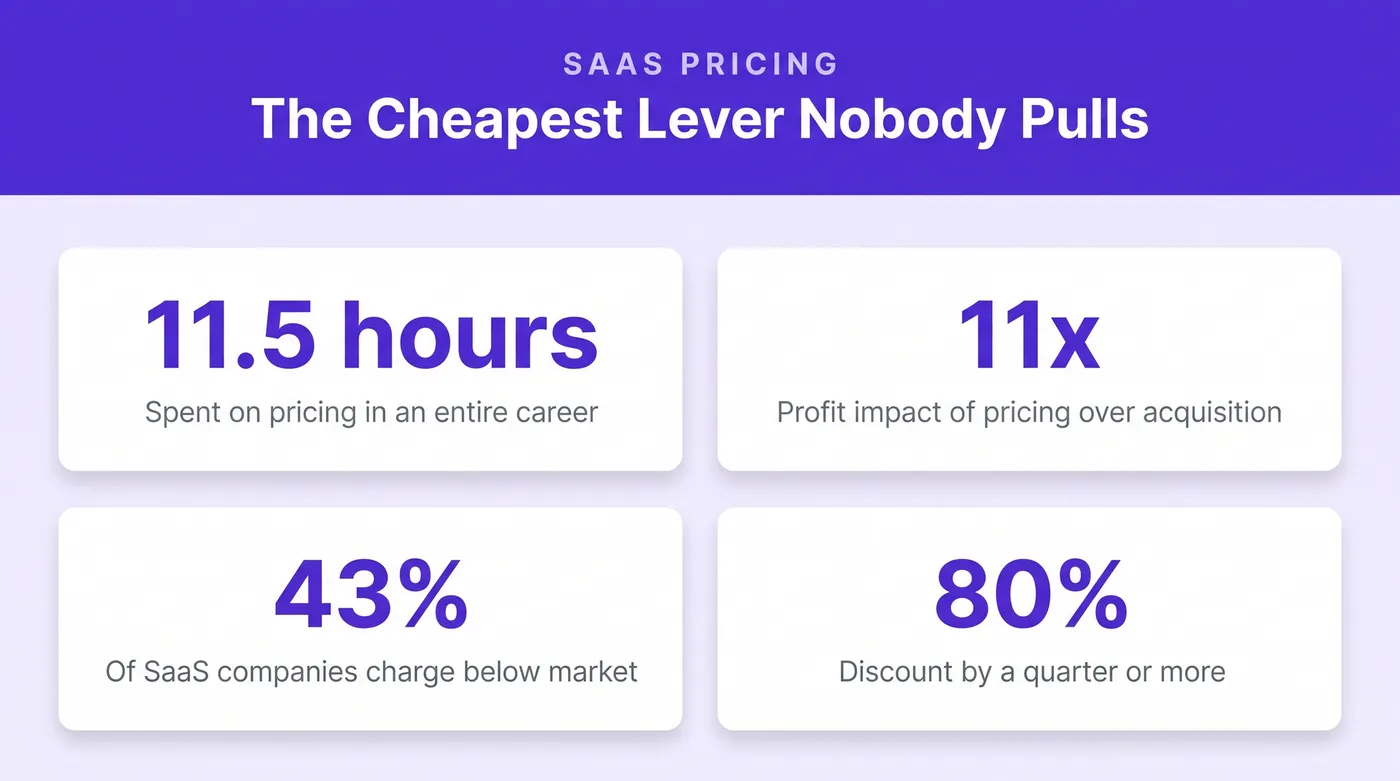
Here’s a sobering thought: executives spend just 11.5 hours on pricing strategy over their entire business lifetime. That’s less time than most people spend choosing a new laptop. Yet according to Price Intelligently, a mere 1% improvement in pricing delivers 11x more profit impact than a 1% improvement in customer acquisition.
I’ve seen SaaS founders obsess over their onboarding flow, their landing page copy, their ad targeting—but treat pricing as an afterthought. They copy competitors, pick numbers that “feel right,” or worse, underprice out of fear. The result? Millions in lost revenue and stunted growth.
Why SaaS Pricing Mistakes Cost You More Than You Think
Pricing isn’t just about how much you charge—it’s a strategic signal about your value, your positioning, and your target market. Get it wrong, and you’re not just leaving money on the table. You’re attracting the wrong customers, setting unsustainable unit economics, and making future pivots exponentially harder.
Research from OpenView Partners shows that 43% of SaaS companies believe they’re charging less than the market would bear. That’s nearly half of all SaaS businesses systematically undervaluing their own products. And the cost compounds: a company with $10M ARR losing 12% to pricing inefficiency forfeits $1.2M annually—$12M over ten years.
In this guide, I’ll break down the 10 most common SaaS pricing mistakes I see in the wild, backed by real data from 500+ SaaS companies. More importantly, I’ll show you exactly how to fix each one.
1. Underpricing Your Product Out of Fear
This is the most widespread mistake in SaaS, and honestly, it’s the most understandable. You’re new. You’re competing against established players. You worry that charging more will scare customers away. So you price low, hoping to win on value.
Here’s the problem: low prices don’t just reduce revenue—they reduce perceived value. Customers use price as a quality signal. When you charge $9/month for something competitors sell for $99, prospects assume yours is inferior. You’re not winning on value; you’re losing on credibility.
The data: According to OpenView’s 2022 SaaS Benchmarks, 43% of SaaS companies underprice relative to market willingness to pay. Companies that raise prices strategically while communicating value see minimal churn impact and significant revenue gains.
How to fix it: Start with value-based pricing. Calculate the ROI your product delivers. If you save customers 10 hours per month at $50/hour, that’s $500 in monthly value. Price at 10-20% of delivered value—so $50-100/month. HubSpot has successfully raised prices multiple times by pairing increases with clear value communication.
2. Not Using a Value Metric That Scales
A value metric is the unit that ties your price to customer value—seats, API calls, contacts processed, storage used. Without one, you’re stuck with flat pricing that doesn’t capture expansion revenue as customers grow.
ProfitWell data shows SaaS businesses using value metrics grow 38% faster than those with flat pricing. Why? Because their revenue scales automatically with customer success. When your customers grow, you grow.
How to fix it: Identify what unit correlates with customer value. For email marketing, it’s contacts. For analytics, it’s events tracked. For infrastructure, it’s compute hours. Mailchimp’s subscriber-based pricing perfectly illustrates this—costs increase with email list size, directly correlating with value received.
3. Offering Too Many Pricing Tiers
More choice seems better, right? Wrong. Columbia University research shows excessive choices reduce purchase likelihood by up to 40%. When prospects face 5+ pricing tiers with overlapping features, they experience decision paralysis—and often bounce.
The industry standard is 3-4 tiers. Research shows companies typically offer an average of 3.5 tiers. Three tiers work well for simple products (Basic, Professional, Enterprise), while four accommodate more complex segmentation.
How to fix it: Audit your current tiers. Can you consolidate without losing meaningful differentiation? Slack’s pricing page exemplifies clarity: Pro, Business+, and Enterprise Grid—each clearly designed for specific company sizes. Aim for distinct value propositions per tier, not feature bloat.
4. Setting Prices Without Customer Research
Most SaaS founders set pricing in a vacuum. They calculate costs, check competitors, and pick a number. They never actually ask customers what they’d pay.
This is backwards. Your pricing should reflect customer-perceived value, not your cost structure. According to Price Intelligently, companies that align pricing with customer-perceived value metrics reduce sales cycle length by 30% and increase win rates by 25%.
How to fix it: Conduct pricing interviews. Ask prospects: “At what price would this feel expensive but still worth it?” and “At what price would this feel so cheap you’d question quality?” Use the Van Westendorp Price Sensitivity Meter to find optimal price points.
5. Treating Pricing as “Set and Forget”
Markets evolve. Competitors adjust. Customer willingness to pay changes. Static pricing leads to missed opportunities and competitive vulnerability.
ProfitWell research shows SaaS companies that test pricing at least once per year grow 2-4x faster than those that don’t. Yet most companies set pricing at launch and never revisit it.
How to fix it: Schedule quarterly pricing reviews. Track MRR, ARR, conversion rates by tier, churn by tier, and LTV by segment. Companies reviewing pricing quarterly grow 23% faster than those reviewing annually. Zoom continuously refines pricing as they enter new market segments.
6. Heavy Discounting to Close Deals
Nearly 80% of SaaS companies discount by 25% or more to acquire customers. It seems like a quick win—close the deal, hit the quota. But discount customers are 3-5x more likely to churn.
Why? Because discount-seekers are price-sensitive, not value-seeking. They’ll churn when a cheaper alternative appears. Plus, discounted customers rarely expand or upgrade—they’re trained to expect deals.
How to fix it: Implement discount guardrails. No more than 10% for early-stage customers, 5% for renewals. Require executive approval for exceptions. Build competitive positioning instead—when customers ask for discounts, explain unique value. Companies maintaining pricing discipline grow 18% faster with 12% higher gross margins.
7. Ignoring Geographic Pricing Localization
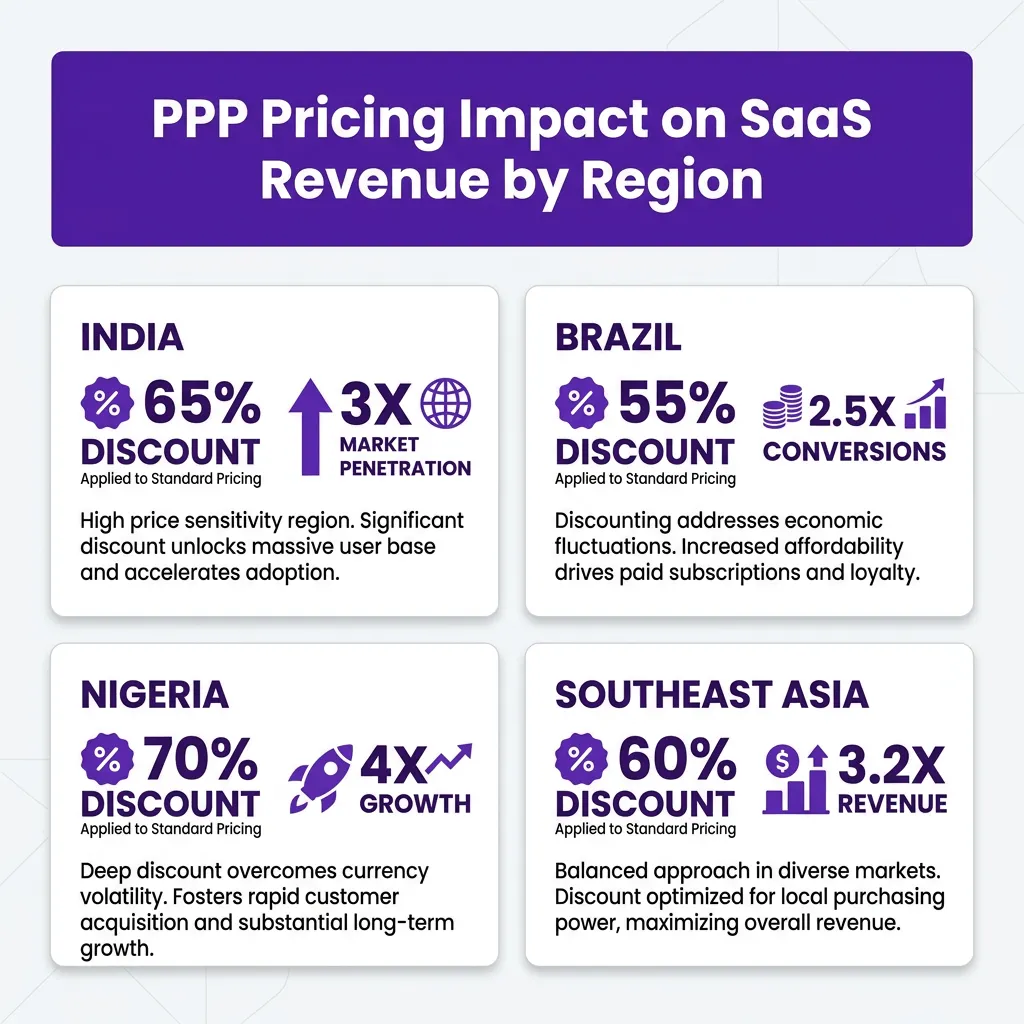
Charging the same price globally ignores purchasing power parity. A $99/month plan is affordable for US companies but prohibitive for equal-sized companies in Southeast Asia or Eastern Europe.
Litmus discovered that prospects in non-US regions “didn’t feel comfortable paying for a product in a different currency; they didn’t necessarily trust us.” After implementing localized pricing, they improved conversion rates in emerging markets by 35%.
How to fix it: Implement regional pricing: US/Western Europe at full price, Eastern Europe at 40-50% discount, Southeast Asia at 50-60% discount, India at 60-70% discount. Bill in local currency—customers are 2-3x more likely to purchase when billed in their local currency.
8. Failing to Account for CAC in Pricing
Customer Acquisition Cost (CAC) varies dramatically by segment. Enterprise customers might cost $2,000 to acquire; SMB customers $200. If you price without considering these differences, you create fundamentally unprofitable unit economics.
According to Insight Partners, healthy SaaS businesses should maintain an LTV:CAC ratio of at least 3:1. Many companies price without considering acquisition costs, creating a model that loses money on every customer.
How to fix it: Calculate CAC by segment. Set pricing that supports healthy unit economics: Enterprise can support $2,000-3,000 CAC, Mid-Market $500-1,000, SMB $150-300. Salesforce maintains premium pricing that supports significant acquisition costs while delivering substantial lifetime value.
9. Poor Communication During Price Changes
Cursor AI’s 2024 pricing change is a cautionary tale. They changed AI pricing models but failed spectacularly in communication—multiple contradictory blog posts, confusing pricing pages, and a CEO apology with refunds after massive backlash.
A well-communicated pricing change improves retention by 10-15%. A poorly communicated one triggers 5-10% churn—a 20% swing from communication alone.
How to fix it: Develop a communication plan 2-3 weeks before rollout. Segment messaging by customer impact. Provide 60-90 day notice, grandfather options for 12 months, and implement in stages (10% → 50% → 100%). Companies with documented communication plans experience 60% less churn during pricing changes.
10. Not Tracking Pricing Health Metrics
You can’t optimize what you don’t measure. Most SaaS companies track MRR and churn but ignore pricing-specific metrics: conversion rates by tier, expansion revenue by segment, discount rates, and pricing page engagement.
Without these metrics, you’re flying blind. You won’t know which tiers are cannibalizing each other, which segments are most price-sensitive, or when it’s time to adjust.
How to fix it: Build a pricing dashboard tracking: MRR/ARR by tier, conversion rates by tier and cohort, churn rates by pricing tier, customer lifetime value by segment, net revenue retention, and expansion revenue. Review monthly and adjust quarterly.
Comparison: How Pricing Mistakes Impact Your Metrics
| Pricing Mistake | Revenue Impact | Growth Impact | Churn Impact |
|---|---|---|---|
| Underpricing | -43% potential revenue | Stunted ARR growth | Higher price-sensitive churn |
| No Value Metric | Missed expansion revenue | -38% growth rate | Neutral |
| Too Many Tiers | -40% conversion | Slower acquisition | Neutral |
| Static Pricing | Missed optimization | -2-4x slower growth | Neutral |
| Heavy Discounting | Lower ASPs | Unsustainable | +3-5x churn rate |
| No Localization | -25-40% global revenue | Limited TAM | Neutral |
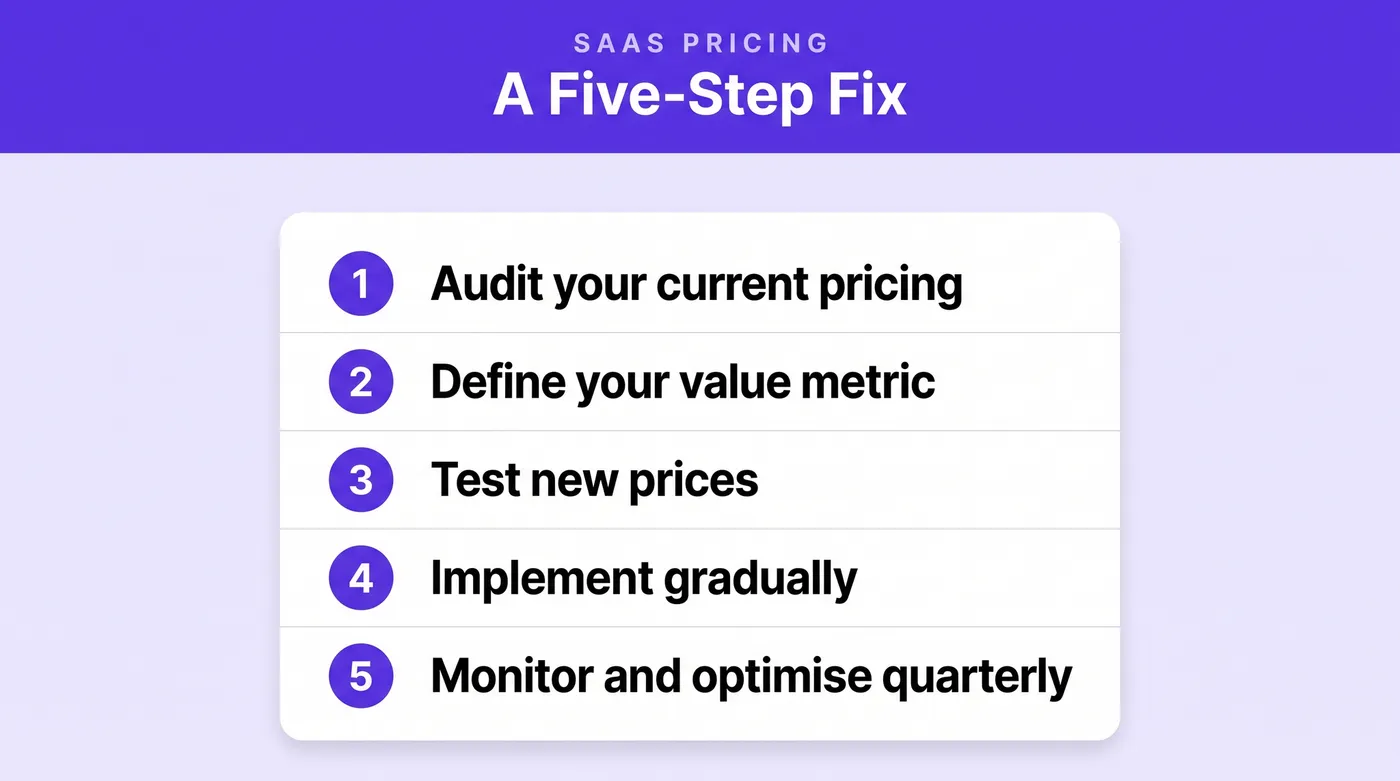
How to Fix Your SaaS Pricing: A 5-Step Framework
If you’ve recognized your company in these mistakes, don’t panic. Pricing optimization is a journey, not a destination. Here’s a practical framework to get started:
Step 1: Audit Your Current Pricing
Review your current pricing against the mistakes above. Calculate your LTV:CAC ratio by segment. Identify which tiers are performing and which are cannibalizing. Survey customers about perceived value versus price.
Step 2: Define Your Value Metric
Identify the unit that correlates with customer value. Test multiple metrics to see which tracks with satisfaction, retention, and willingness to pay. Make it transparent—customers should understand exactly what they’re paying for.
Step 3: Test New Prices
Run A/B tests on 10-20% of traffic with different price points, tier structures, and messaging. Monitor conversion, trial-to-paid, and early retention. Let data guide decisions, not gut feeling.
Step 4: Implement Gradually
Roll out pricing changes in stages: 10% of new customers first, then 50%, then 100%. This prevents catastrophic failures and allows iteration based on real feedback. Grandfather existing customers when possible.
Step 5: Monitor and Optimize Quarterly
Establish a pricing optimization flywheel. Review metrics quarterly. Run 1-2 pricing tests per year. Build pricing into board meetings. Treat pricing as the strategic lever it is.
Frequently Asked Questions About SaaS Pricing
How often should I review my SaaS pricing?
Early-stage companies should review pricing quarterly and adjust every 6 months. Mature companies should review quarterly but adjust every 6-12 months. According to Maxio research, companies reviewing pricing quarterly grow 23% faster than those reviewing annually.
What’s the ideal number of pricing tiers?
The industry standard is 3-4 tiers. Research shows companies typically offer an average of 3.5 tiers. More than 5 tiers creates analysis paralysis and reduces conversion. Three tiers work well for simple products; four tiers accommodate more complex segmentation.
How do I know if I’m underpricing?
Signs you’re underpricing: 43% of SaaS companies believe they charge less than the market would bear. If your conversion rate is extremely high (>20%), if customers rarely ask about pricing during sales calls, or if you’ve never raised prices, you’re likely underpricing.
What’s a healthy LTV:CAC ratio?
The ideal minimum is 3:1—earn three dollars over customer lifetime for every dollar spent acquiring. Top quartile performers achieve 5:1 or higher. Companies with LTV:CAC below 3:1 struggle to achieve profitability without significant pricing or efficiency improvements.
Should I offer annual discounts?
Yes, annual discounts are standard practice. Typical discounts range from 15-20% for annual versus monthly billing. Annual billing reduces churn by 20-30% (5-10% annually vs. 30-50% for monthly), improves revenue predictability from 60-70% to 80-90%, and reduces payment processing fees by 83%.
Conclusion: Pricing Is Your Highest-Leverage Growth Tool
Pricing isn’t a back-office function—it’s a strategic growth driver. The data is clear: companies that treat pricing as a continuous optimization process grow 2-4x faster than those that don’t.
Start by auditing your current pricing against the 10 mistakes above. Pick one or two to fix this quarter. Run tests. Measure results. Iterate.
Remember: a 1% improvement in pricing delivers 11x more profit impact than a 1% improvement in acquisition. Yet most founders spend 90% of their strategic energy on acquisition and treat pricing as an afterthought. Don’t be most founders.
If you’re building a SaaS business and want to focus on growth—not billing complexity—check out Fungies.io. We handle payments, tax compliance, and checkout so you can focus on what matters: building a pricing strategy that captures the value you deliver.