SaaS Pricing Optimization: The Complete 2026 Guide to Maximizing Revenue
Learn how to optimize your SaaS pricing strategy in 2026. Discover value-based pricing, tiered models, usage-based pricing, and proven frameworks to increase revenue by 20-40% without losing customers.
Here’s a stat that should keep every SaaS founder up at night: 72% of ARR growth at mature SaaS companies now comes from price increases, not new customer acquisition. The SaaS pricing landscape has fundamentally shifted in 2025. Companies that treat pricing as a growth lever—not an afterthought—are pulling ahead while competitors leave money on the table.
I’ve spent years analyzing SaaS pricing strategies across hundreds of companies. The pattern is clear: most founders underprice by 20-40% because they’re copying competitors or guessing. This guide will show you how to optimize your SaaS pricing strategy using data, not gut feelings.
Why SaaS Pricing Optimization Matters More Than Ever
The 2025 SaaS market looks nothing like 2020. Subscription fatigue is real. Buyers are more price-sensitive. And AI has changed how software value is perceived. According to the latest benchmark data, SaaS companies raised prices by an average of 8-12% year-over-year in 2025. But here’s what separates the winners from the losers:
- Companies with optimized pricing grow 2x faster than those with static models
- Value-based pricing reduces sales cycles by 30% and increases win rates by 25%
- Hybrid pricing models (subscription + usage) show 21% median growth rates—the highest of any model
Your pricing strategy isn’t just about what you charge. It’s about how customers perceive value, how easily they can buy, and how naturally they expand over time. Get it wrong and you’re fighting an uphill battle for every dollar of revenue.
Understanding Modern SaaS Pricing Models
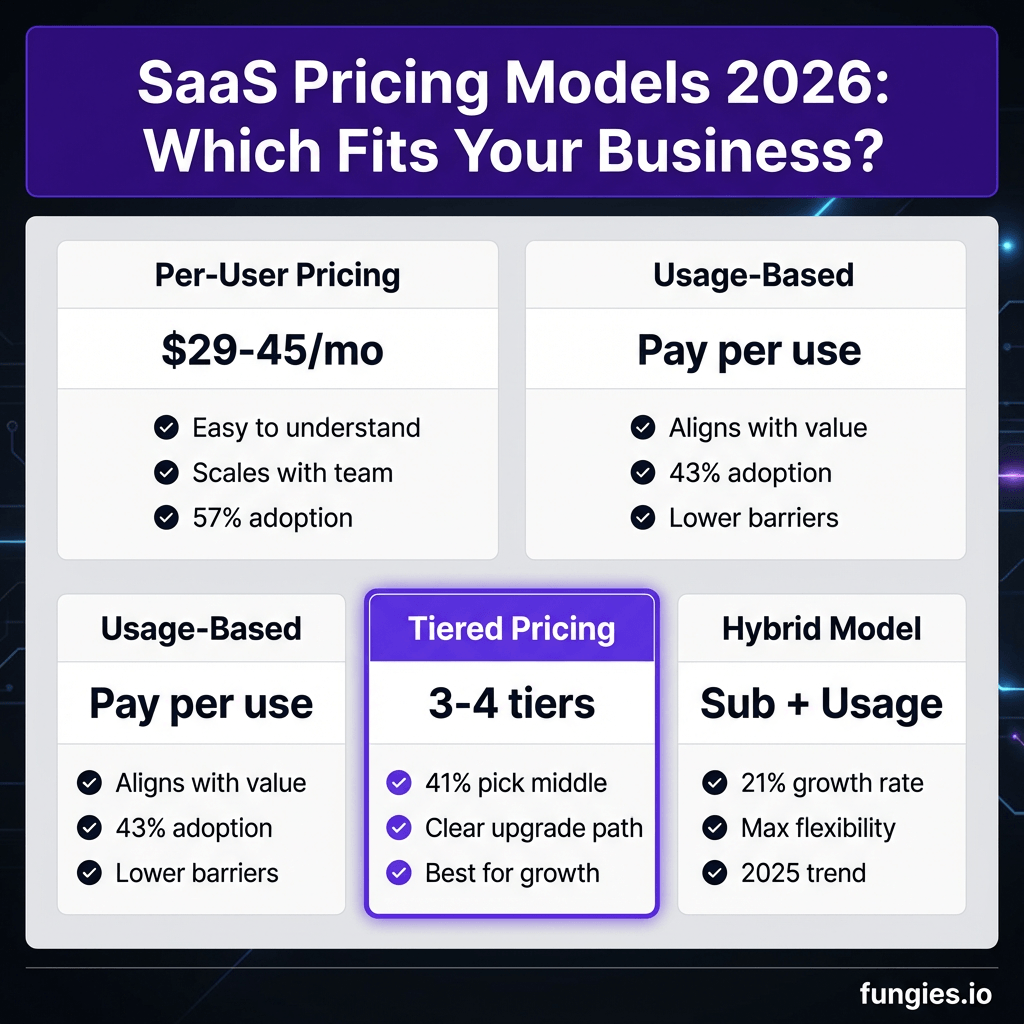
Before you can optimize, you need to understand the landscape. Here are the four dominant SaaS pricing models in 2026 and when each makes sense.
1. Per-User Pricing (Seat-Based)
This is the classic model: charge per user, per month. It’s simple, predictable, and still dominates with 57% of SaaS companies using it as their primary model. The median price point sits at $29/user/month for entry-level plans and $45/user/month across all segments.
Best for: Collaboration tools, CRMs, project management software—any product where value scales linearly with team size.
The catch: Seat-based pricing creates adoption friction. Customers hesitate to add users because every seat costs money. This can slow expansion revenue and encourage account sharing.
2. Usage-Based Pricing
Customers pay for what they actually use—API calls, storage, emails sent, compute hours. Usage-based pricing adoption has grown to 43% of SaaS companies, up from 35% in 2024.
Why it works: Perfect value alignment. Customers only pay when they get value. This lowers barriers to entry and can accelerate growth. AI-native companies especially favor this model.
The challenge: Revenue becomes harder to predict. Both you and your customers face forecasting complexity. You need robust metering infrastructure and clear usage dashboards.
3. Tiered Pricing (Feature-Based)
The three-tier structure—Basic, Pro, Enterprise—is the most common approach for a reason. Research shows 41.4% of customers choose the middle tier when presented with three options. This “Goldilocks effect” makes tiered pricing incredibly effective.
Best for: Most B2B SaaS products. Tiers naturally segment your market and create clear upgrade paths.
Pro tip: Name your middle tier something like “Professional” or “Growth” and label it “Most Popular.” Social proof drives conversions.
4. Hybrid Pricing Models
The fastest-growing approach combines subscription base fees with usage-based overages. Think: base platform fee + per-action charges. Hybrid models report the highest median growth rate at 21%.
Why hybrid wins: Predictable baseline revenue (the subscription) plus unlimited upside (usage). It captures value from both small customers who want predictability and large customers who scale usage.
| Pricing Model | Best For | Growth Rate | Complexity |
|---|---|---|---|
| Per-User | Team collaboration tools | 15-18% | Low |
| Usage-Based | APIs, infrastructure, AI tools | 19-22% | High |
| Tiered | Most B2B SaaS | 17-20% | Medium |
| Hybrid | Scaling SaaS companies | 21%+ | Medium-High |
The 5-Step SaaS Pricing Optimization Framework
Now let’s get tactical. Here’s the framework I use with SaaS companies to optimize pricing and capture 20-40% more revenue without losing customers.
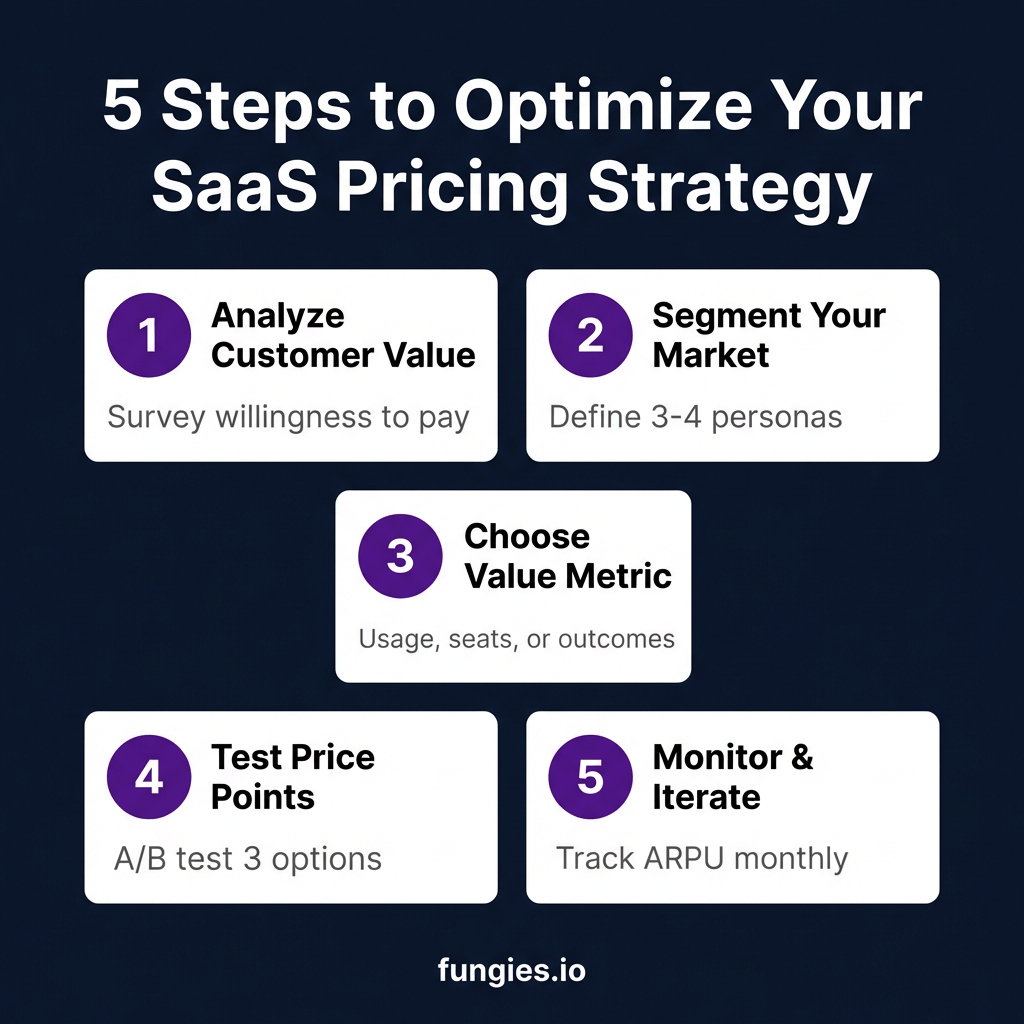
Step 1: Analyze Customer Perceived Value
Most founders price based on costs or competitors. This is backwards. Value-based pricing starts with understanding what your product is worth to customers.
Run willingness-to-pay surveys with these questions:
- “At what price would this be so expensive you’d never buy it?”
- “At what price would this be a bargain—too cheap to trust?”
- “What’s the maximum you’d pay while still feeling good about the purchase?”
Survey at least 50 customers across different segments. The data will reveal price sensitivity patterns you can’t guess.
Step 2: Segment Your Market
One-size-fits-all pricing leaves money on the table. Define 3-4 distinct customer segments based on:
- Firmographics: Company size, industry, geography
- Use case: What job are they hiring your product to do?
- Value received: How much ROI do they get?
- Buying process: Self-serve vs. sales-assisted
Each segment should have distinct needs, budgets, and willingness to pay. Your pricing tiers should map directly to these segments.
Step 3: Choose Your Value Metric
Your value metric is the unit you charge for. It should:
- Align with customer value (more usage = more value)
- Be easy to understand and predict
- Scale as customers grow
- Be hard to game or manipulate
Common value metrics include: users, API calls, contacts, projects, storage, compute hours, or outcomes achieved. The right metric depends on your product and how customers measure success.
Step 4: Test Price Points
Never launch a new price without testing. Run A/B tests on your pricing page with different price points, tier structures, and value propositions.
Key metrics to track:
- Conversion rate by tier
- Average revenue per user (ARPU)
- Free-to-paid conversion rate
- Churn by pricing tier
- Time to purchase
Test one variable at a time. Run each test for at least 2 weeks or until you hit statistical significance.
Step 5: Monitor and Iterate
Pricing optimization isn’t a one-time project. Market conditions change. Competitors evolve. Your product improves. You should review pricing quarterly and make adjustments based on data.
Track these pricing health metrics monthly:
- Net Revenue Retention (NRR): Are existing customers expanding or contracting?
- Gross Margin by Tier: Which pricing tiers are most profitable?
- Win Rate by Segment: Are you losing deals on price?
- Expansion Revenue: What percentage of new revenue comes from existing customers?
Common SaaS Pricing Mistakes to Avoid
I’ve seen the same pricing mistakes kill growth at dozens of SaaS companies. Here are the top five to avoid:
Mistake #1: Pricing Based on Competitors
When a customer asks “Why does your product cost $99/month?” and you answer “Because the market charges $99/month,” you’ve already lost. You missed the chance to articulate your unique value. Worse, your competitors might all be pricing wrong. Copying them just replicates their mistakes.
Mistake #2: Hiding Your Pricing
“Contact us for pricing” might seem like it filters out unqualified leads. In reality, it creates friction and kills conversions. Modern buyers want transparency. Show your pricing publicly unless you’re selling true enterprise software with complex custom deals.
Mistake #3: Too Many Tiers
Analysis paralysis is real. More than 4 pricing tiers confuses customers and reduces conversions. Stick to 3-4 clear options. If you need more complexity, use add-ons or enterprise tiers that require sales contact.
Mistake #4: Underpricing
Most SaaS founders underprice by 20-40%. They think lower prices will drive adoption. Instead, low prices signal low quality and attract price-sensitive customers who churn faster. Price for value, not for fear.
Mistake #5: Ignoring Expansion Revenue
Your pricing should make it easy for customers to grow with you. Build in natural upgrade triggers—usage limits, feature gates, user caps. Expansion revenue is the most profitable revenue because you already acquired the customer.
Freemium vs. Free Trial: Which Acquisition Model Works?
Your pricing strategy includes how you acquire customers. The two dominant models are freemium (free forever with limited features) and free trials (full access for limited time).
| Model | Visitor to Signup | Free-to-Paid Conversion | Best For |
|---|---|---|---|
| Freemium | 13-16% | 2-5% | Viral products, network effects |
| Free Trial (Opt-In) | 8-9% | 18-25% | Most B2B SaaS |
| Free Trial (Opt-Out) | 2-3% | 40-60% | Low-touch sales, high intent |
Here’s what the data shows: Freemium gets more signups but converts fewer to paid. Free trials get fewer signups but much higher conversion rates. For most B2B SaaS, free trials are the better choice.
However, a hybrid approach called the “reverse trial” is gaining traction. Users start with full premium access for 14 days, then downgrade to freemium if they don’t convert. This combines the best of both worlds.
AI and the Future of SaaS Pricing
AI is disrupting SaaS pricing in two ways. First, 44% of SaaS companies now charge for AI-powered features, often as premium add-ons. Second, AI enables dynamic pricing—adjusting prices in real-time based on demand, usage patterns, and customer behavior.
But the biggest shift is toward outcome-based pricing. Instead of charging for access or usage, some SaaS companies are experimenting with charging only when customers achieve specific results—revenue generated, costs saved, or goals hit.
This aligns incentives perfectly: you only make money when customers succeed. But it requires robust attribution and trust. The infrastructure isn’t there yet for most companies, but it’s coming.
FAQ: SaaS Pricing Optimization
How often should I review my SaaS pricing?
Review pricing quarterly and adjust annually at minimum. The SaaS market moves fast. Competitors change prices. Your product evolves. Customer expectations shift. Static pricing is leaving money on the table.
What’s the right price for a new SaaS product?
Start with value-based pricing research. Survey potential customers on willingness to pay. Price at the 75th percentile of what customers say they’d pay. You can always lower prices, but raising them is harder. Early customers who pay more are also more engaged and provide better feedback.
Should I show pricing on my website?
Yes, unless you’re selling complex enterprise software that requires custom quotes. Transparency builds trust. Hidden pricing creates friction. Modern buyers expect to see pricing before talking to sales. If you must hide enterprise pricing, show standard tiers publicly and add “Contact Us” only for custom plans.
How do I raise prices without losing customers?
Give advance notice (60-90 days), grandfather existing customers for 6-12 months, and clearly communicate added value. Frame the increase around new features, improved service, or market adjustments. Most customers expect periodic price increases. The ones who churn over small increases were likely price-sensitive and unprofitable anyway.
What’s the best pricing model for a bootstrapped SaaS?
Start with simple tiered pricing (3 tiers). It’s easy to implement, customers understand it, and it gives you room to grow. Avoid pure usage-based pricing early on—it creates revenue unpredictability that bootstrapped companies can’t afford. Focus on annual prepay to improve cash flow.
Conclusion: Make Pricing Your Growth Engine
SaaS pricing optimization isn’t about squeezing customers—it’s about capturing the value you create. The companies winning in 2026 treat pricing as a continuous experiment, not a set-it-and-forget-it decision.
Start with value. Segment your market. Choose the right model. Test relentlessly. And never stop iterating.
The data is clear: companies that optimize pricing grow faster, retain better, and build more sustainable businesses. Your pricing strategy is either a growth engine or a growth limiter. Which one is yours?
Ready to streamline your SaaS billing and payments? Create your free Fungies account and start accepting payments globally with built-in tax compliance. No monthly fees—just 5% + $0.50 per transaction.