SaaS Pricing Psychology: The Complete Guide to Converting More Customers in 2026
Discover the 7 psychological principles that drive SaaS purchasing decisions. Learn how to use charm pricing, anchoring, the decoy effect, and more to increase conversions by 30-50% without changing your product.
Here’s the uncomfortable truth about SaaS pricing: most founders spend months building their product and about 20 minutes deciding what to charge for it. They pick a number that “feels right,” copy a competitor, or worse—go with the lowest price they think customers will accept.
But pricing isn’t just about covering costs and adding a margin. It’s a psychological game where the numbers you choose directly shape how customers perceive your value, which plan they select, and whether they buy at all. Get it right, and you can increase revenue by 30-50% without changing a single feature. Get it wrong, and you’ll attract price-sensitive customers who churn the moment a cheaper alternative appears.
In this guide, I’ll break down the psychological principles that drive SaaS purchasing decisions—and show you exactly how to apply them to your pricing strategy.
Why SaaS Pricing Psychology Matters More Than Ever
The SaaS landscape in 2025 is brutally competitive. According to recent data, the average B2B buyer now evaluates 5-7 solutions before making a decision. Your pricing page isn’t just a list of costs—it’s a conversion tool that needs to overcome objections, communicate value, and guide visitors toward the plan that fits them best.
Here’s what the research shows: companies that systematically apply pricing psychology principles see conversion rate improvements of 15-40% compared to those that don’t. When you understand how the human brain processes price information, you can design pricing that works with cognitive biases instead of against them.
Figure 2: Pricing page elements that drive conversions
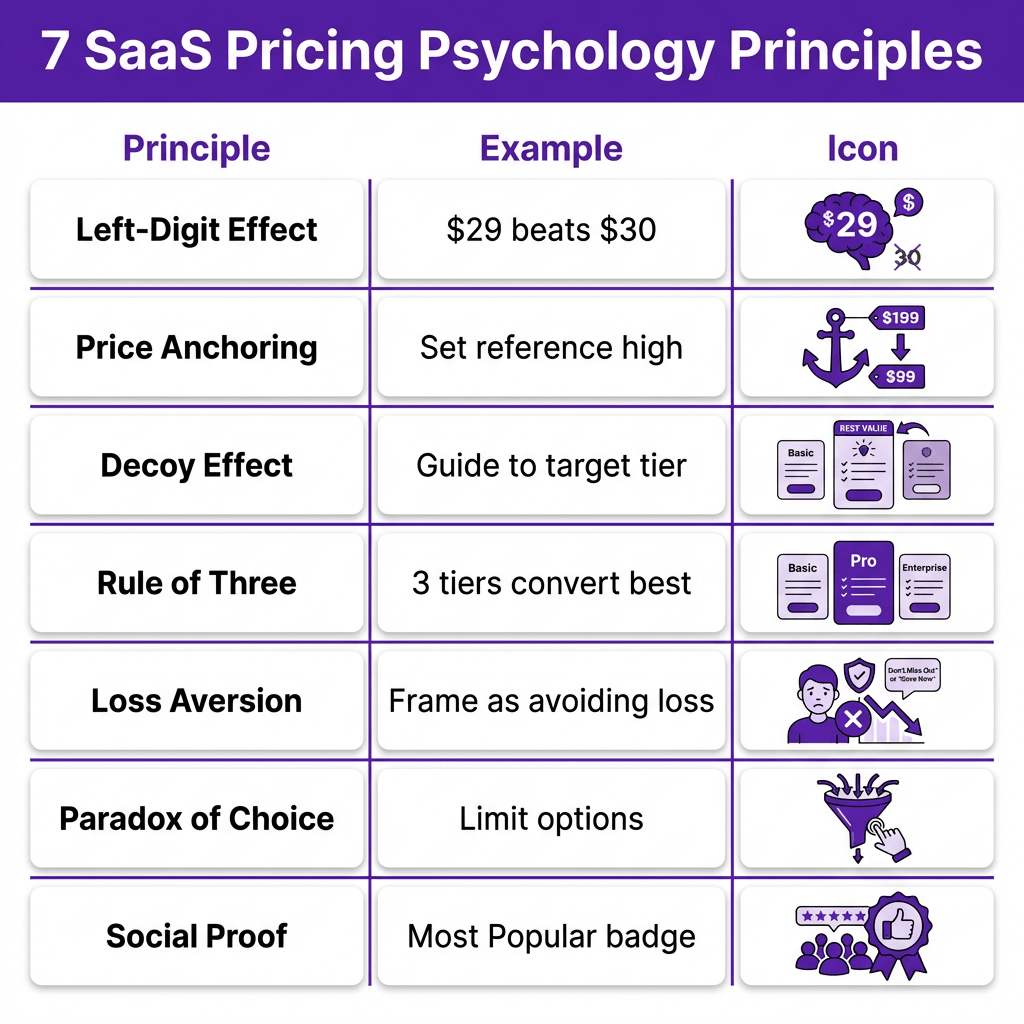
The 7 Psychological Principles Every SaaS Founder Should Know
Figure 1: Key psychological triggers in SaaS pricing decisions
1. The Left-Digit Effect: Why $29 Beats $30
Our brains process prices from left to right, and we anchor heavily on that first digit. This is why $29 feels significantly cheaper than $30, even though the difference is just one dollar. The effect is so powerful that studies have shown prices ending in 9 can increase sales by up to 24% compared to rounded prices.
How to apply it: Use charm pricing ($29, $49, $99) for your self-serve tiers. The psychological gap between $99 and $100 is massive in the buyer’s mind. However, be careful with enterprise pricing—round numbers ($500, $1,000) can signal quality and prestige for high-ticket plans.
2. Price Anchoring: Setting the Reference Point
Anchoring is the cognitive bias where we rely heavily on the first piece of information we receive. In pricing, this means the first price a customer sees becomes their reference point for evaluating everything else.
Here’s the strategy: always show your most expensive plan first, or lead with an annual price that’s prominently displayed. When a customer sees “$99/month” first, your “$49/month” plan suddenly feels like a bargain—even if $49 is actually your target price point.
How to apply it: Structure your pricing page with your highest-tier or annual plan most visible. Use strikethrough pricing to show savings (“$99 $49/month when billed annually”). The anchored high price makes the actual price feel like a win.
3. The Decoy Effect: Guiding Customers to Your Preferred Plan
The decoy effect is one of the most powerful—and underutilized—pricing psychology tactics. It works by introducing a third option that makes your target plan look like the obvious choice.
Here’s a classic example: Economist magazine once offered three subscriptions—web only ($59), print only ($125), and web + print ($125). The print-only option was clearly a decoy—nobody would choose it when they could get web + print for the same price. But here’s the magic: without the decoy, most people chose the cheap web-only option. With the decoy, the majority chose the expensive web + print option.
How to apply it: Create a middle tier that’s slightly worse value than your target tier. If you want customers to choose your $99/month “Growth” plan, price your “Starter” at $49 and your “Basic” at $79 with significantly fewer features. The $99 plan suddenly looks like smart value.
4. The Rule of Three: Why Three Tiers Work Best
Research consistently shows that three pricing tiers convert better than two or four. Why? Three options create a clear spectrum: “good,” “better,” and “best.” Two options force a binary choice that feels risky. Four or more create decision paralysis.
The pattern is remarkably consistent: roughly 20% choose the cheapest option, 60-70% choose the middle option, and 10-20% choose the most expensive. Your middle tier should be your target—the one you actually want most customers to buy.
How to apply it: Design your pricing around three clear tiers. Name them to suggest progression (Starter/Professional/Enterprise or Basic/Growth/Scale). Make your middle tier the “recommended” or “most popular” option with visual emphasis.
5. Loss Aversion: Framing Prices as Avoiding Loss
Humans feel losses about twice as intensely as equivalent gains. This is why “Don’t miss out on 20% savings” often outperforms “Save 20%.” The fear of losing something (even a discount) is more motivating than the prospect of gaining the same thing.
In SaaS pricing, this applies to annual discounts, limited-time offers, and feature access. A customer is more motivated to upgrade to avoid losing access to a feature than they are to gain that same feature.
How to apply it: Frame your annual discount as “Don’t pay 20% more monthly” rather than “Save 20% with annual.” Use trial countdowns that emphasize what they’ll lose. Show “You used 85% of your plan limit” to trigger upgrade urgency.
6. The Paradox of Choice: Reducing Decision Fatigue
More options don’t lead to more sales—they lead to decision paralysis. When faced with too many choices, customers often choose nothing at all. This is why the most successful SaaS companies limit their pricing to 3-4 clear options, even if they offer more flexibility behind the scenes.
The key is to make comparison easy. Customers should be able to understand the difference between plans in under 10 seconds. If they need a spreadsheet to decide, you’ve already lost many of them.
How to apply it: Limit visible tiers to 3 options maximum. Use clear differentiation (user counts, feature access, support levels). Add a “Contact Sales” for enterprise instead of showing complex custom pricing. Use comparison tables that highlight differences at a glance.
7. Social Proof: The Bandwagon Effect
We look to others to validate our decisions. When customers see that “10,000+ companies” use your product or that a plan is “Most Popular,” it reduces perceived risk and nudges them toward that choice.
The most effective social proof on pricing pages is specific and relevant. “Join 5,000+ SaaS companies” works better than “Join 5,000+ happy customers.” Logos of recognizable companies near your pricing build trust. Testimonials that mention specific ROI or time savings are gold.
How to apply it: Add “Most Popular” badges to your target tier. Include customer logos above or below your pricing table. Show specific numbers (“Trusted by 10,000+ teams”). Add testimonials that mention business outcomes, not just nice words about the product.
Designing Your Pricing Page for Maximum Conversion
Psychology principles are only effective if your pricing page is designed to support them. Here’s what the highest-converting SaaS pricing pages have in common:
Clear Value Proposition Above the Fold
Before showing prices, remind visitors why they’re here. Your headline should connect your product’s core value to the outcome they want. “Simple project management for growing teams” is better than “Choose Your Plan.”
Monthly/Annual Toggle with Savings Highlighted
Always offer annual billing—it improves cash flow and reduces churn. But make the savings visible. “Save 20%” next to the annual toggle is more effective than just showing the lower price. Some companies even show the equivalent monthly price for annual plans (“$39/month, billed annually”) to maintain the lower number while being transparent.
Feature Comparison Without Overwhelming
Comparison tables work, but keep them scannable. Group features into logical categories. Use checkmarks vs. dashes rather than yes/no text. Consider hiding less important features behind a “Show all features” toggle. Remember: the goal is to help customers decide, not to list every capability your product has.
Strategic CTAs
Your call-to-action buttons matter more than you think. “Start Free Trial” generally outperforms “Buy Now” for SaaS because it reduces commitment anxiety. For your middle tier (your target), consider using “Get Started” or “Start Growing” instead of generic “Choose Plan” text. Make the CTA button for your preferred plan more prominent—larger, contrasting color, or with a subtle animation.
Risk Reversal Elements
Reduce the perceived risk of signing up. “No credit card required,” “Cancel anytime,” and “14-day free trial” are proven trust builders. Money-back guarantees work even better—”30-day money-back guarantee” removes the fear of being locked into a bad decision.
Common SaaS Pricing Psychology Mistakes to Avoid
Even with the best intentions, many SaaS companies make these pricing psychology errors:
Hiding Pricing Behind “Contact Sales”
Unless you’re selling exclusively to enterprise, hiding your pricing creates friction and suspicion. Modern B2B buyers want to self-serve. At minimum, show starting prices or ranges. You can always add “Custom pricing for enterprise” with a contact option.
Leading with the Cheapest Plan
When you display your $9/month plan first, everything else feels expensive. Start with your most expensive or most popular plan. You can still have an affordable entry point, but don’t lead with it.
Feature-Heavy, Value-Light Descriptions
Don’t just list features—translate them into outcomes. “Unlimited projects” is a feature. “Manage all your client work in one place” is a benefit. Lead with benefits, support with features.
Ignoring the Power of Free Trials
Free trials reduce risk and let customers experience value before paying. The data is clear: SaaS companies with free trials convert at higher rates than those without. Your trial length should match your product’s time-to-value—if customers see results in 3 days, don’t make them wait 30.
Testing and Optimizing Your Pricing
Pricing isn’t a set-it-and-forget-it decision. The most successful SaaS companies continuously test and refine. Here’s how to approach it:
A/B Test Pricing Page Elements
Test different price points (yes, you can test different prices to different segments), plan names, CTA button text, and the order of your tiers. Even small changes can yield significant results. One company increased conversions by 25% simply by changing their middle tier from “Pro” to “Team.”
Survey Your Customers
Ask customers which plan they chose and why. Ask churned customers if pricing played a role. Run Van Westendorp price sensitivity surveys to find optimal price points. The insights from actual customers are more valuable than any theory.
Monitor Plan Distribution
If 80% of customers choose your cheapest plan, your pricing is probably too low or your tiers aren’t differentiated enough. Ideally, you want the majority in your middle tier, with healthy adoption of your premium option. If nobody chooses your top tier, it’s either priced too high or not offering enough additional value.
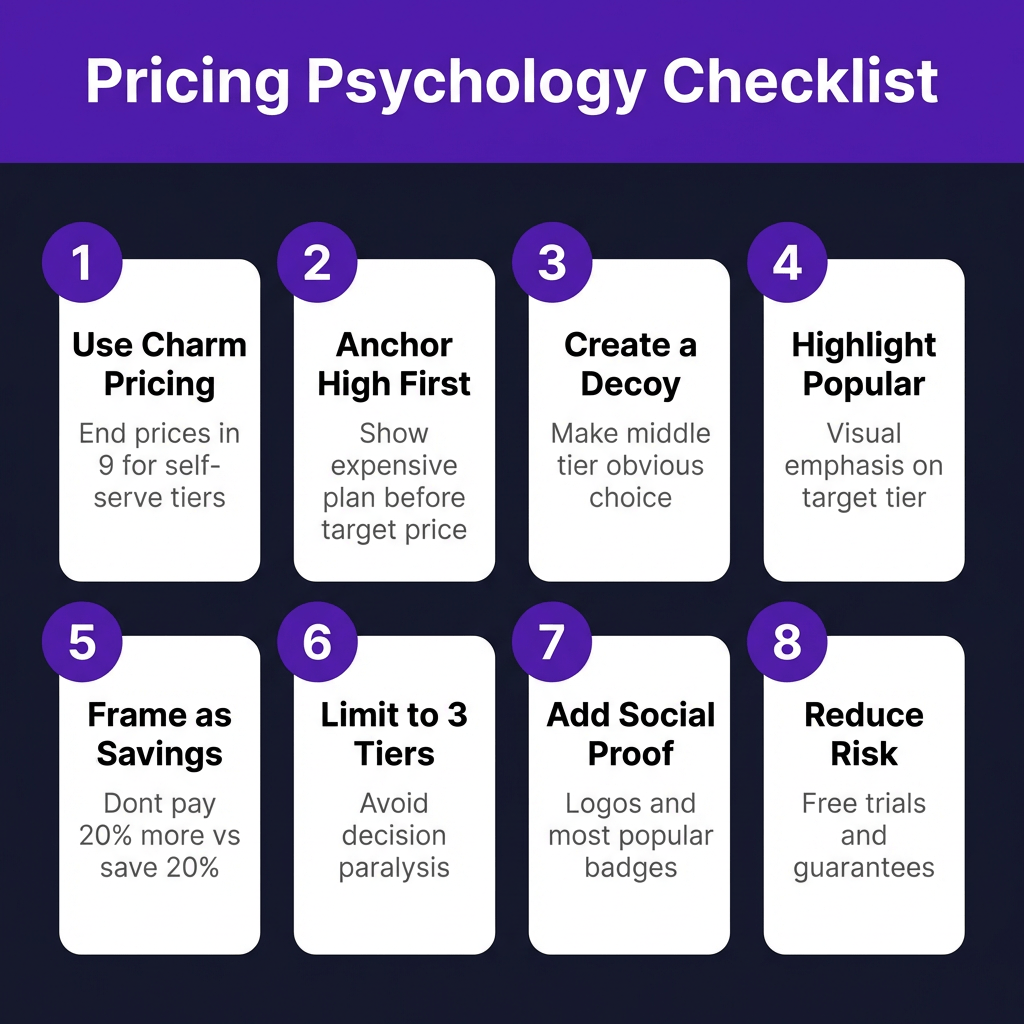
Putting It All Together: A Pricing Psychology Checklist
Before you finalize your pricing strategy, run through this checklist:
Are you using charm pricing ($29, $49, $99) for self-serve tiers?
Is your most expensive or annual plan prominently displayed first?
Do you have three clear tiers with obvious differentiation?
Is your middle tier visually highlighted as “Most Popular”?
Are you anchoring against a higher price before showing your target price?
Is your annual discount framed as avoiding loss rather than gaining savings?
Do you have clear, benefit-focused descriptions for each tier?
Are CTAs action-oriented and low-commitment (“Start Trial” vs “Buy Now”)?
Is social proof visible near your pricing?
Have you removed risk with guarantees or “no credit card required” messaging?
FAQ: SaaS Pricing Psychology
Should I show prices or ask visitors to contact sales?
Show prices unless you’re exclusively selling to enterprise customers with complex custom needs. Even then, show starting prices or ranges. Hidden pricing creates friction and drives away self-serve buyers who want to evaluate options independently.
How often should I change my SaaS pricing?
Most successful SaaS companies review pricing annually and make adjustments every 12-18 months. However, you should continuously test pricing page elements, plan structures, and messaging. Major price changes should be communicated well in advance to existing customers.
Is freemium a good pricing strategy?
Freemium works well for products with low marginal costs, viral potential, or long sales cycles. It can be a powerful acquisition tool, but make sure your free tier is genuinely limited—enough to show value, not enough to satisfy all needs. The goal is conversion, not charity.
What’s the best way to increase prices without losing customers?
Grandfather existing customers at their current rates while raising prices for new customers. Communicate value additions that justify the increase. Give advance notice (60-90 days) for any changes affecting existing customers. Consider offering annual prepay options to lock in current rates.
Should I use usage-based pricing or flat-rate pricing?
It depends on your product and customer base. Usage-based pricing aligns costs with value received and can reduce churn, but it introduces unpredictability that some customers dislike. Many successful SaaS companies use hybrid models—flat-rate tiers with usage limits or overage fees.
Conclusion: Your Pricing Is a Growth Lever
Pricing is one of the few growth levers that can impact your business immediately. Unlike product development or marketing campaigns, a pricing optimization can be implemented today and show results this month.
The key is to approach pricing strategically, not arbitrarily. Use the psychological principles in this guide to design pricing that guides customers toward the right plan, communicates value effectively, and maximizes both conversion and revenue.
Remember: your pricing sends a signal about your product’s value. Price too low, and you’ll attract customers who don’t value your solution. Price too high without justification, and you’ll scare away good prospects. The sweet spot is where your pricing reflects the transformation your product delivers—and makes customers feel smart for choosing you.
If you’re building a SaaS business and need a payment infrastructure that supports flexible pricing models—from subscriptions to usage-based billing—check out Fungies.io. We handle the complexity of global payments, tax compliance, and billing so you can focus on building a pricing strategy that converts.