SaaS Product-Led Growth: The Complete 2026 Guide to PLG Strategy
Product-led growth (PLG) is transforming how SaaS companies acquire customers. Learn the complete PLG framework, implementation steps, key metrics, and real examples from Figma, Slack, and Notion to build your own product-led strategy in 2026.
Here’s a number that should change how you think about SaaS growth: 83% of public SaaS companies that reached $100M ARR in their first five years use product-led growth models. That’s not a coincidence. It’s a signal that the old playbook—sales demos, lengthy procurement cycles, and expensive field teams—is being rewritten in real-time.
I’ve watched this shift happen over the past decade. When I started in marketing, the path to growth was clear: hire sales reps, book meetings, close deals. Today, the most successful SaaS companies flip that script entirely. Their product is their sales team. Their onboarding is their demo. Their free tier is their top-of-funnel.
This guide breaks down everything you need to know about product-led growth in 2026: what it actually means, how to implement it, the metrics that matter, and the mistakes that kill PLG initiatives before they get started.
What Is Product-Led Growth, Really?
Product-led growth (PLG) is a go-to-market strategy where the product itself drives customer acquisition, activation, retention, and expansion. Instead of relying on sales teams to explain value, you let users experience it directly. Instead of marketing campaigns generating leads, your free tier generates qualified users who already understand what you do.
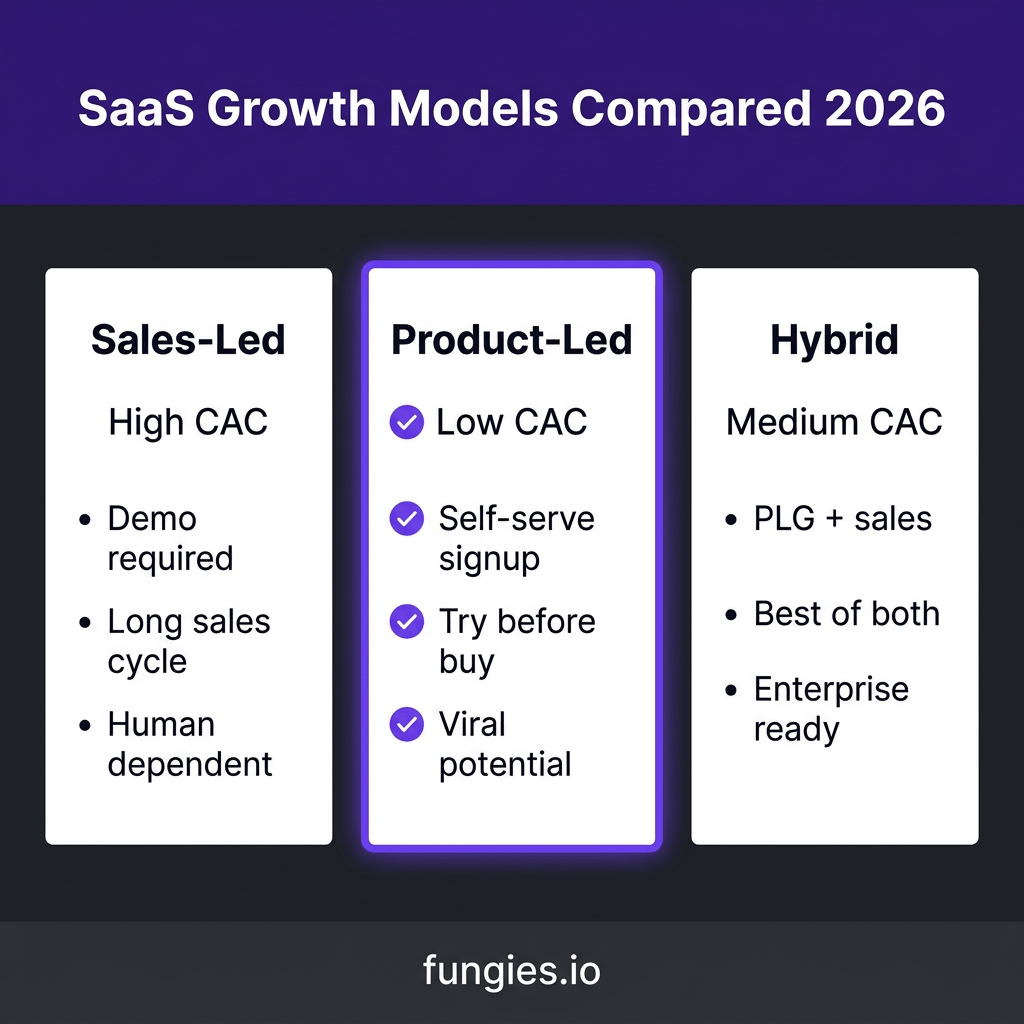
But here’s where most people get it wrong: PLG isn’t just about offering a free trial. It’s a fundamental restructuring of how you think about growth. In a traditional sales-led model, the funnel looks like this: Marketing generates leads → Sales qualifies and demos → Product team hopes users stick around. In PLG, the sequence changes: Product attracts users → Product activates them → Product drives expansion → Sales engages high-value accounts.
The difference is subtle but profound. In PLG, every product decision becomes a growth decision. Your signup flow isn’t just engineering—it’s your first sales touch. Your onboarding isn’t just UX—it’s your closing argument. Your feature limits aren’t just product management—they’re your upgrade triggers.
Why Product-Led Growth Matters in 2026
The shift toward PLG isn’t happening in a vacuum. Three major forces are driving it:
1. Buyer Behavior Has Changed
According to Gartner, 75% of B2B buyers prefer a rep-free sales experience. They don’t want to sit through demos or navigate procurement processes. They want to try the product, evaluate it on their own terms, and buy when they’re ready. This trend is even stronger among younger decision-makers who grew up with consumer apps that let them sign up and start using immediately.
2. CAC is Out of Control
Customer acquisition costs have risen 60-70% across SaaS in the past five years. Sales-led models require expensive headcount, longer payback periods, and complex infrastructure. PLG companies achieve 40-60% lower CAC by letting the product do the heavy lifting. When users self-serve into your product, you’re not paying sales commissions to acquire them.
3. The Best Companies Are Already Doing It
Look at the SaaS companies that have dominated the past decade: Slack, Zoom, Notion, Figma, Dropbox, Calendly, Loom. All product-led. All achieved massive scale with relatively small sales teams (at least initially). All made their products so compelling that users naturally wanted to share them with colleagues.
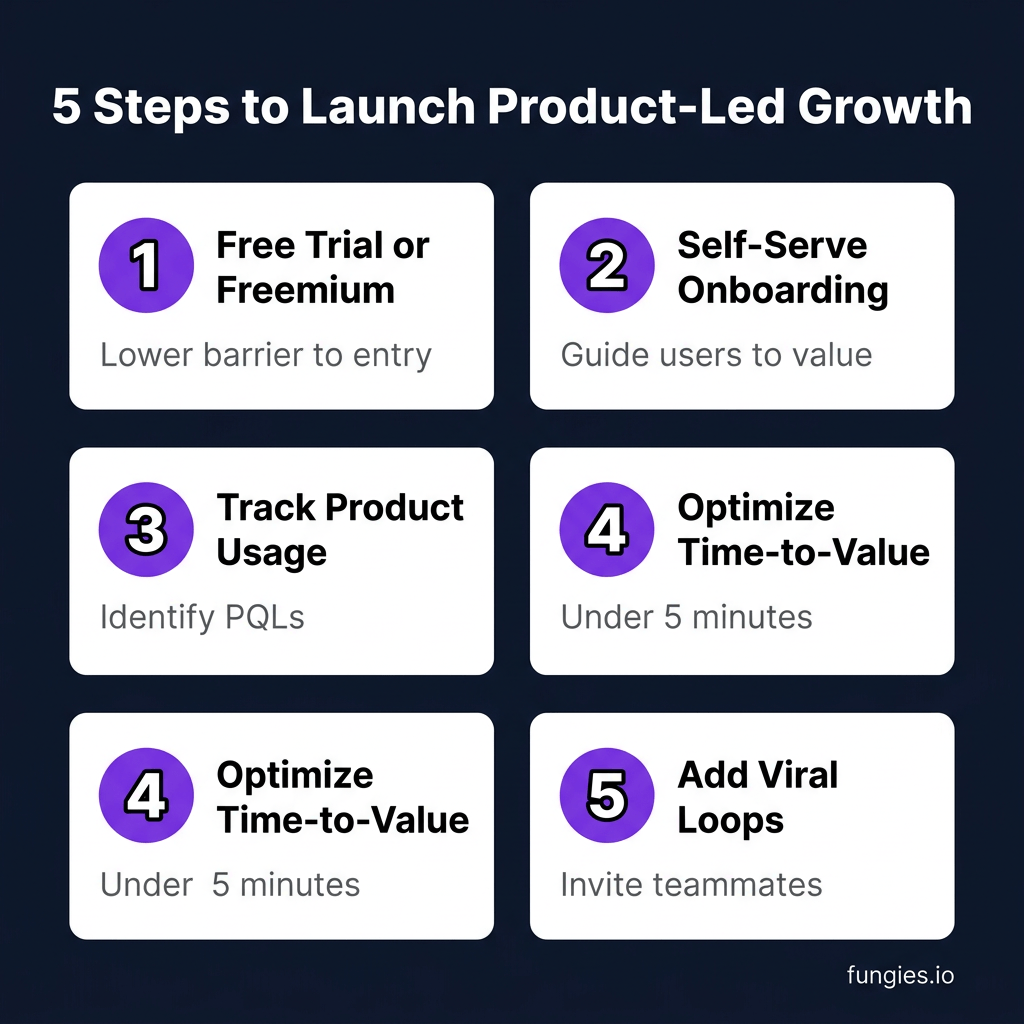
The Product-Led Growth Framework: 5 Core Components
Building a PLG strategy isn’t about copying what worked for Slack or Figma. It’s about understanding the underlying principles and applying them to your specific context. Here’s the framework that actually works:
1. Low-Friction Entry Point
Your entry point should require minimal commitment. This usually means either a free trial (time-limited access to full features) or a freemium model (perpetual free access to limited features). The choice between them depends on your product complexity and unit economics.
Free trials work best when your product delivers value quickly and you have clear upgrade triggers. Freemium works better when network effects matter (like Slack) or when the product naturally expands with usage (like Notion). The key metric here is time-to-value—how quickly can a new user experience something meaningful?
2. Self-Serve Onboarding
In a PLG model, you can’t rely on customer success managers to walk every user through setup. Your onboarding needs to be automated, contextual, and goal-oriented. The best PLG products guide users to their first “aha moment” within minutes, not days.
Think about Figma: you can sign up, create a design file, and start collaborating within 60 seconds. No tutorials forced on you. No mandatory setup wizard. Just immediate utility. That’s the bar.
3. Product-Qualified Leads (PQLs)
In sales-led growth, you track Marketing Qualified Leads (MQLs)—people who downloaded a whitepaper or attended a webinar. In PLG, you track Product-Qualified Leads (PQLs)—users who have taken specific actions in your product that indicate buying intent.
A PQL might be someone who hit a usage limit, invited 3+ teammates, used a premium feature, or reached a specific activation milestone. The key is identifying behavioral signals that correlate with conversion, then triggering sales outreach (or automated upgrade flows) at the right moment.
4. Viral Loops and Network Effects
The most powerful PLG products grow organically through usage. When a Calendly user sends a scheduling link, the recipient sees Calendly’s value. When a Loom user shares a video, the viewer experiences the product. When a Figma user invites a collaborator, that person becomes a potential customer.
These viral loops aren’t accidental. They’re engineered into the product experience. Your job is to identify moments where your product naturally touches non-users, then optimize those moments for conversion.
5. Expansion Revenue Mechanics
PLG isn’t just about acquisition—it’s about monetization. The best PLG companies make expansion feel natural. Usage-based pricing (pay for what you use), seat-based upgrades (add teammates), and feature gating (unlock advanced capabilities) all create organic upsell opportunities.
Net dollar retention (NDR) above 120% is common among successful PLG companies because the product itself drives expansion. Compare that to traditional SaaS where expansion often requires sales intervention.
How to Implement Product-Led Growth: A Practical Roadmap
Transitioning to PLG isn’t an overnight switch. It’s a systematic transformation of how you acquire and serve customers. Here’s the roadmap that works:
Phase 1: Audit Your Current State (Weeks 1-2)
Before changing anything, understand where you are. Map your current customer journey from first touch to expansion. Identify friction points, drop-off stages, and activation milestones. Interview recent customers about how they discovered you, what convinced them to try, and what almost made them leave.
Phase 2: Define Your Activation Metric (Weeks 3-4)
Your activation metric is the action that separates users who will stick around from those who won’t. For Slack, it’s sending 2,000 messages. For Dropbox, it’s uploading files to a shared folder. For Figma, it’s creating a design file with multiple collaborators.
Find yours by analyzing your most successful customers. What did they do in their first week that unsuccessful users didn’t? That’s your activation metric. Everything in your onboarding should drive toward that moment.
Phase 3: Build Your Free Offering (Weeks 5-8)
Decide between free trial and freemium based on your product characteristics. Free trials work when your value is immediately obvious and your sales cycle is short. Freemium works when network effects matter or when usage naturally compounds over time.
Whatever you choose, make sure your free offering delivers genuine value while creating natural upgrade pressure. The goal isn’t to give away everything—it’s to give away enough that users can’t imagine going back to their old workflow.
Phase 4: Instrument Your Product (Weeks 9-10)
You can’t improve what you don’t measure. Implement product analytics ( tools like Mixpanel, Amplitude, or Heap) to track user behavior. Set up event tracking for key actions: signups, activations, feature usage, invites sent, and upgrades.
Create dashboards for your core PLG metrics: activation rate, time-to-value, PQL conversion, free-to-paid conversion, and expansion revenue. Review these weekly.
Phase 5: Launch and Iterate (Ongoing)
PLG is never “done.” Launch your free offering to a limited audience first—maybe just new signups from a specific channel. Measure results, identify blockers, and iterate. Test different onboarding flows, pricing thresholds, and upgrade prompts.
Once you’ve proven the model with a subset of users, roll it out more broadly. But keep experimenting. The companies that win at PLG treat it as a continuous optimization problem, not a one-time project.
The Metrics That Matter in Product-Led Growth
PLG requires a different measurement framework than traditional SaaS. Here are the metrics that actually matter:
| Metric | What It Measures | Good Benchmark |
|---|---|---|
| Activation Rate | % of signups reaching key milestone | 20-40% |
| Time-to-Value | Minutes to first meaningful outcome | <5 minutes |
| Free-to-Paid Conversion | % of free users upgrading | 2-5% |
| PQL Conversion Rate | % of product-qualified leads converting | 15-25% |
| Net Dollar Retention | Revenue growth from existing customers | >120% |
| Viral Coefficient | New users generated per existing user | >0.3 |
| Payback Period | Months to recover CAC | <12 months |
Don’t try to optimize everything at once. Start with activation rate—if users don’t experience value, nothing else matters. Once that’s healthy, focus on free-to-paid conversion. Then expansion revenue.
Product-Led Growth Examples: What the Best Companies Do
Figma: Collaboration as Distribution
Figma’s PLG strategy centers on real-time collaboration. When a designer shares a Figma file, stakeholders experience the product without signing up. The “aha moment”—seeing designs update live—is immediate and powerful. Figma’s free tier is generous enough for individual use but naturally expands as teams grow.
Notion: Templates as Acquisition
Notion turned user-generated content into a growth engine. Their template gallery lets users discover the product through specific use cases—personal wikis, project trackers, content calendars. Each template demonstrates value while teaching users how to build in Notion. The freemium model limits blocks (content units), so power users naturally hit upgrade triggers.
Slack: Network Effects at Scale
Slack’s growth came from making workplace communication viral within organizations. The free tier allows unlimited users but limits message history. As teams adopt Slack, they naturally hit the 10,000 message limit and upgrade to preserve context. The product becomes more valuable as more colleagues join, creating natural expansion.
Loom: Async Video as Viral Loop
Loom’s genius is making every video a product demo. When you send a Loom video, the recipient watches it on Loom’s branded player. They experience the product’s core value—async video communication—without signing up. The free tier limits video length and storage, so heavy users naturally upgrade.
Common Product-Led Growth Mistakes to Avoid
After watching dozens of SaaS companies attempt PLG transitions, I’ve seen the same mistakes repeat:
Mistake 1: Giving Away Too Much
A generous free tier attracts users, but if they never need to upgrade, you’ve built a charity, not a business. The art of PLG is finding the line where free users get value but paid users get transformative value.
Mistake 2: Ignoring Sales Entirely
PLG doesn’t mean “no sales.” It means “product-first, sales-second.” Enterprise deals still need sales teams. High-value accounts still need touch. The difference is your sales team engages warm, qualified users instead of cold prospects.
Mistake 3: Optimizing for Signups Over Activation
Vanity metrics kill PLG initiatives. A 50% increase in signups means nothing if activation drops. Focus on the full funnel, not just the top. Better to have 1,000 signups with 30% activation than 10,000 signups with 5% activation.
Mistake 4: Treating PLG as a Marketing Tactic
PLG isn’t something the marketing team does. It’s a company-wide strategy that requires product, engineering, sales, and success to align. If your product team isn’t bought in, your PLG initiative will fail.
Frequently Asked Questions About Product-Led Growth
Is PLG right for every SaaS company?
No. PLG works best when your product delivers value quickly, can be used without training, and has natural viral or expansion mechanics. Complex enterprise software with long implementation cycles may still need a sales-led approach, though even those companies are adding PLG elements (like free trials or sandboxes).
How long does it take to see results from PLG?
Initial results—improved activation rates, more qualified leads—often appear within 30-60 days. But building a mature PLG motion takes 6-12 months of iteration. This is a marathon, not a sprint.
Should we eliminate our sales team?
Absolutely not. PLG and sales teams work together. Your product generates qualified leads; your sales team closes high-value deals. Companies like Slack and Zoom maintained robust sales teams even at peak PLG success—they just focused them on expansion and enterprise rather than initial acquisition.
What’s the difference between PLG and freemium?
Freemium is a pricing model; PLG is a go-to-market strategy. You can have freemium without PLG (if you still require sales demos). You can have PLG without freemium (using free trials instead). PLG is about letting the product drive growth, regardless of the specific pricing structure.
How do we measure PLG success?
Focus on these core metrics: activation rate (are users experiencing value?), free-to-paid conversion (are they willing to pay?), net dollar retention (are they expanding?), and payback period (is the economics sustainable?). Revenue growth matters, but only if the unit economics work.
Conclusion: Build Your Product-Led Growth Engine
Product-led growth isn’t a trend—it’s a fundamental shift in how SaaS companies win. The data is clear: PLG companies grow faster, with lower CAC, and better retention. But success requires more than adding a free tier. It requires rethinking your entire go-to-market strategy around the product experience.
Start with your activation metric. Build a free offering that delivers genuine value. Instrument everything. And most importantly, treat PLG as a company-wide transformation, not a marketing experiment.
If you’re ready to build a SaaS product that sells itself, start with Fungies. Our no-code checkout and billing infrastructure lets you focus on building a great product while we handle the payments complexity. Get started free—no credit card required.