SaaS Sales Tax by State 2026: The Complete Guide for Founders
Complete guide to SaaS sales tax by state in 2026. Learn which states tax SaaS, economic nexus thresholds, and 5 steps to compliance.
Sales tax compliance is one of the most complex challenges facing SaaS founders in 2026. With each state having different rules, rates, and nexus thresholds, staying compliant can feel overwhelming. This guide breaks down everything you need to know about SaaS sales tax by state in 2026.
Why SaaS Sales Tax Matters in 2026
The landscape for SaaS taxation has shifted dramatically. Following the 2018 South Dakota v. Wayfair Supreme Court decision, states gained the power to require sales tax collection from remote sellers based on economic nexus—not just physical presence. For SaaS companies selling nationwide, this means potential tax obligations in dozens of states.
In 2026, tax authorities are tightening enforcement. States are investing in audit technology and cross-referencing business registrations. Non-compliance can result in penalties, interest, and in some cases, personal liability for company officers. The cost of getting it wrong far exceeds the cost of compliance.
SaaS Sales Tax by State: The 2026 Breakdown
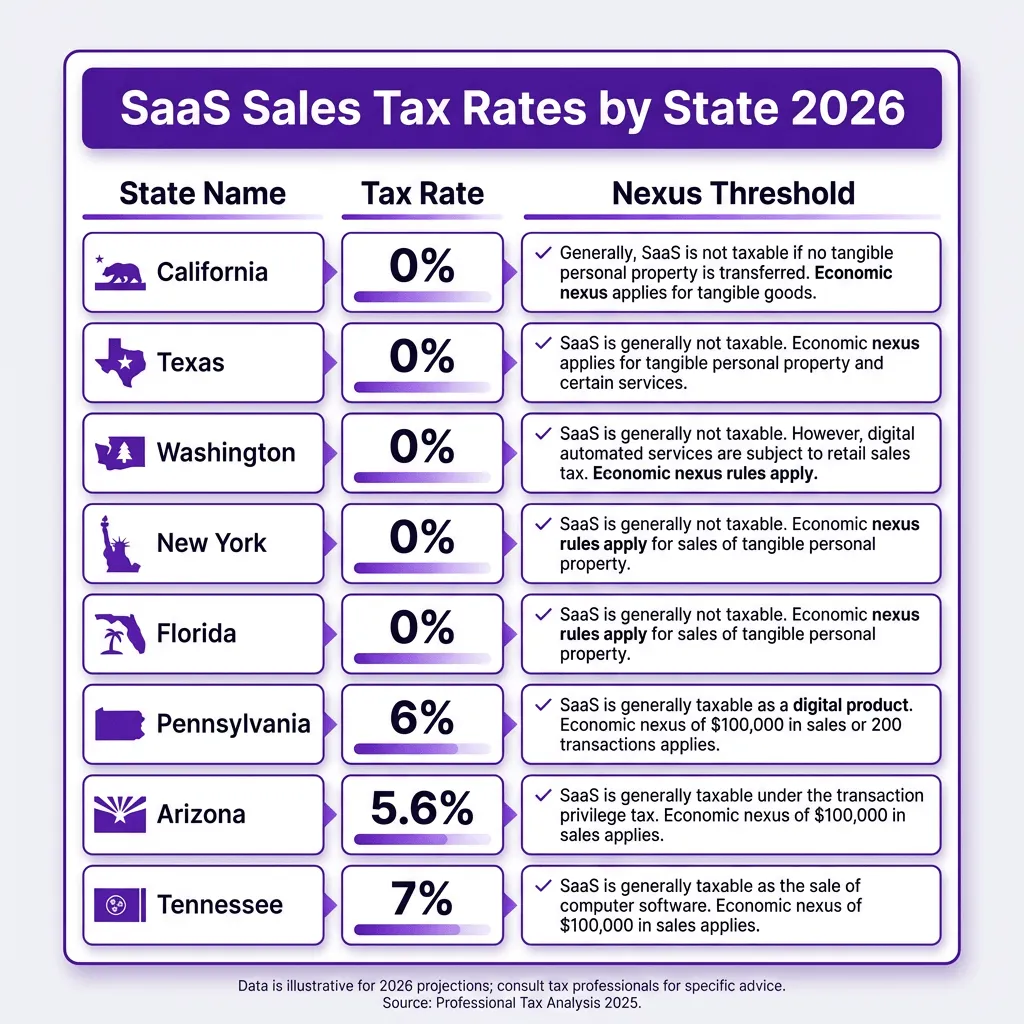
Not all states tax SaaS the same way. Some don’t tax it at all, while others treat it as tangible personal property. Here’s the current landscape:
States with No SaaS Sales Tax (0%)
These states either don’t have a sales tax or specifically exempt SaaS: Alaska, Delaware, Montana, New Hampshire, Oregon, California (most SaaS exempt), and Washington (most SaaS exempt). If you sell primarily to customers in these states, your compliance burden is significantly reduced.
States Taxing SaaS at Full Rates
States like New York, Texas, Florida, and Illinois generally tax SaaS at their standard sales tax rates, ranging from 4% to 7% before local taxes. New York, for example, taxes SaaS as pre-written software at 4% plus local rates. Texas taxes SaaS as a data processing service at 6.25%.
States with Partial or Conditional Taxation
Some states tax SaaS only in certain circumstances. Pennsylvania taxes SaaS at 6% when delivered electronically. Arizona taxes SaaS at 5.6% but has complex rules around bundled services. Tennessee taxes SaaS at 7% but exempts custom software development.
Economic Nexus Thresholds by State
Economic nexus determines when you must collect sales tax in a state, even without physical presence. Most states use one of two thresholds: $100,000 in annual sales OR 200 transactions. Some states use different amounts—Connecticut uses $100,000 and 200 transactions (both must be met), while California uses $500,000.
Tracking nexus across 50 states requires monitoring your sales by destination. A $50 subscription sold to 2,000 customers in a state triggers nexus in most jurisdictions. Many SaaS companies hit nexus thresholds faster than they expect, especially with low-priced monthly subscriptions.
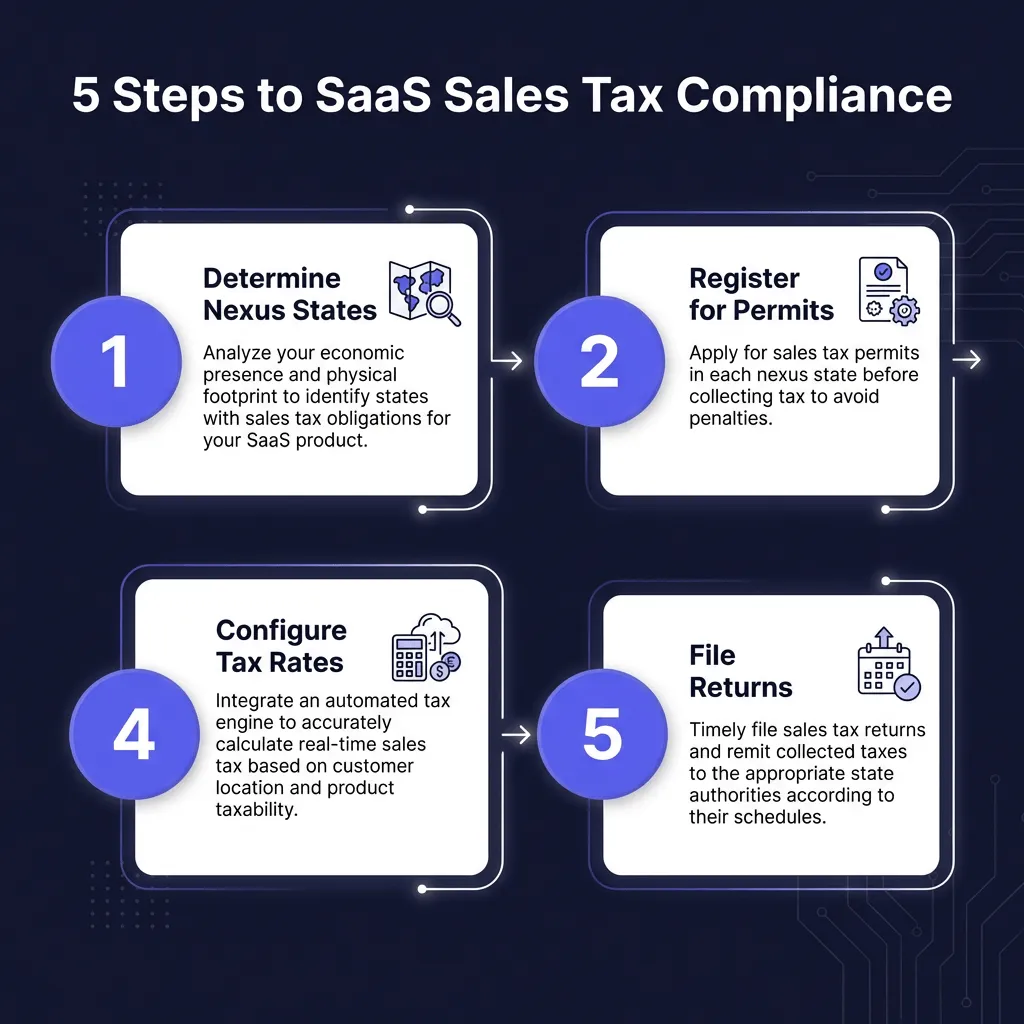
5 Steps to SaaS Sales Tax Compliance
Step 1: Determine Where You Have Nexus
Review your sales data by state for the past 12 months. Compare against each state’s economic nexus threshold. Document your analysis—auditors will want to see your methodology. Consider both sales revenue and transaction count, as some states use both metrics.
Step 2: Register for Sales Tax Permits
Once you determine you have nexus, register for a sales tax permit before collecting tax. Collecting tax without a permit is illegal in most states. Registration is typically done through the state’s Department of Revenue website. Processing times vary from immediate to several weeks.
Step 3: Configure Tax Rates in Your System
Set up your billing system to apply the correct tax rates based on customer location. SaaS is typically taxed based on where the customer receives the service—usually their billing address. You’ll need to track state, county, and local tax rates, as they can vary significantly within a state.
Step 4: Collect and Remit Sales Tax
Charge sales tax on taxable transactions and track it separately from your revenue. You’re essentially collecting tax on behalf of the state—you don’t keep it. Ensure your invoices clearly show the tax amount and your permit number. Most states require specific information on customer receipts.
Step 5: File Returns on Time
Filing frequencies vary by state and your sales volume—monthly, quarterly, or annually. Missing deadlines results in penalties and interest. Many states offer auto-filing for businesses with consistent tax liabilities. Keep detailed records for at least 3-4 years in case of audit.
Common SaaS Sales Tax Mistakes
The most common mistake is assuming you don’t have nexus. Many founders believe they need a physical office or employees in a state to owe tax. Economic nexus changed this—you can owe tax in states you’ve never visited. Other frequent errors include misclassifying SaaS (is it software or a service?), failing to update tax rates when they change, and not maintaining proper exemption certificates for B2B sales.
When to Automate Sales Tax Compliance
Manual sales tax management becomes unsustainable around 5-10 states. The complexity of tracking rates, filing deadlines, and regulatory changes multiplies quickly. Automation through a Merchant of Record or tax compliance platform handles nexus monitoring, rate calculations, filing, and remittance. For SaaS companies focused on growth, outsourcing compliance lets you focus on product and customers rather than tax codes.
Automate Your SaaS Tax Compliance
Fungies.io handles sales tax, VAT, and global compliance automatically. Focus on building your product, not navigating tax codes.
No credit card required • Global tax compliance included
FAQ: SaaS Sales Tax by State
Do I need to collect sales tax in every state where I have customers?
Only if you have nexus in that state. Nexus is typically triggered by exceeding economic thresholds ($100,000 in sales or 200 transactions annually in most states).
Is SaaS taxable in California?
Generally no—California exempts most SaaS from sales tax when delivered electronically and the customer doesn’t obtain permanent rights to the software.
What’s the difference between sales tax and VAT?
Sales tax is collected by the seller and remitted to the state. VAT (Value Added Tax) is common in Europe and collected at each stage of production. If you sell to EU customers, you’ll need to handle VAT separately from US sales tax.
Can I use a Merchant of Record to handle sales tax?
Yes—Merchant of Record platforms like Fungies.io become the legal seller of record, handling all tax compliance, collection, and remittance on your behalf.
Conclusion
SaaS sales tax by state in 2026 requires careful attention to nexus thresholds, taxability rules, and filing requirements. While the complexity can feel overwhelming, a systematic approach—determining nexus, registering for permits, configuring your billing system, and staying current with rate changes—keeps you compliant. For growing SaaS companies, automation through a Merchant of Record eliminates the burden entirely, letting you focus on what matters: building a great product.