Steam Alternatives for Indie Developers: The Complete 2026 Guide
Discover the best Steam alternatives for indie developers in 2026. Compare itch.io, Epic Games Store, GOG, Humble Bundle, and GameJolt to maximize your game’s revenue and reach.
Steam isn’t the only game in town anymore. While Valve’s platform still dominates PC gaming with over 120 million monthly active users, indie developers are increasingly looking elsewhere — and for good reason. The harsh reality? Over 50 new games launch on Steam every single day, making visibility a nightmare for small studios without massive marketing budgets.
I’ve spent years watching indie developers struggle to get noticed on Steam. The platform’s algorithm favors games that already have traction, creating a vicious cycle where popular titles get more visibility while hidden gems languish in obscurity. That’s why smart developers are diversifying their distribution strategy.
Why Consider Steam Alternatives?
Before diving into the alternatives, let’s be honest about Steam’s limitations. The 30% revenue cut is steep, especially when you’re already operating on thin margins. The $100 Steam Direct fee might not sound like much, but it’s a barrier when you’re bootstrapping. And most importantly, Steam’s discovery algorithm is notoriously fickle — I’ve seen great games get buried while mediocre titles with better marketing budgets soar.
Steam alternatives offer several advantages: lower revenue splits (some as generous as 90/10), more curated audiences that actually appreciate indie games, better developer support, and features tailored specifically for independent creators. Some platforms even handle tax compliance and global payments — which is where Fungies comes in as a Merchant of Record solution.
1. Itch.io — The Indie Developer’s Best Friend
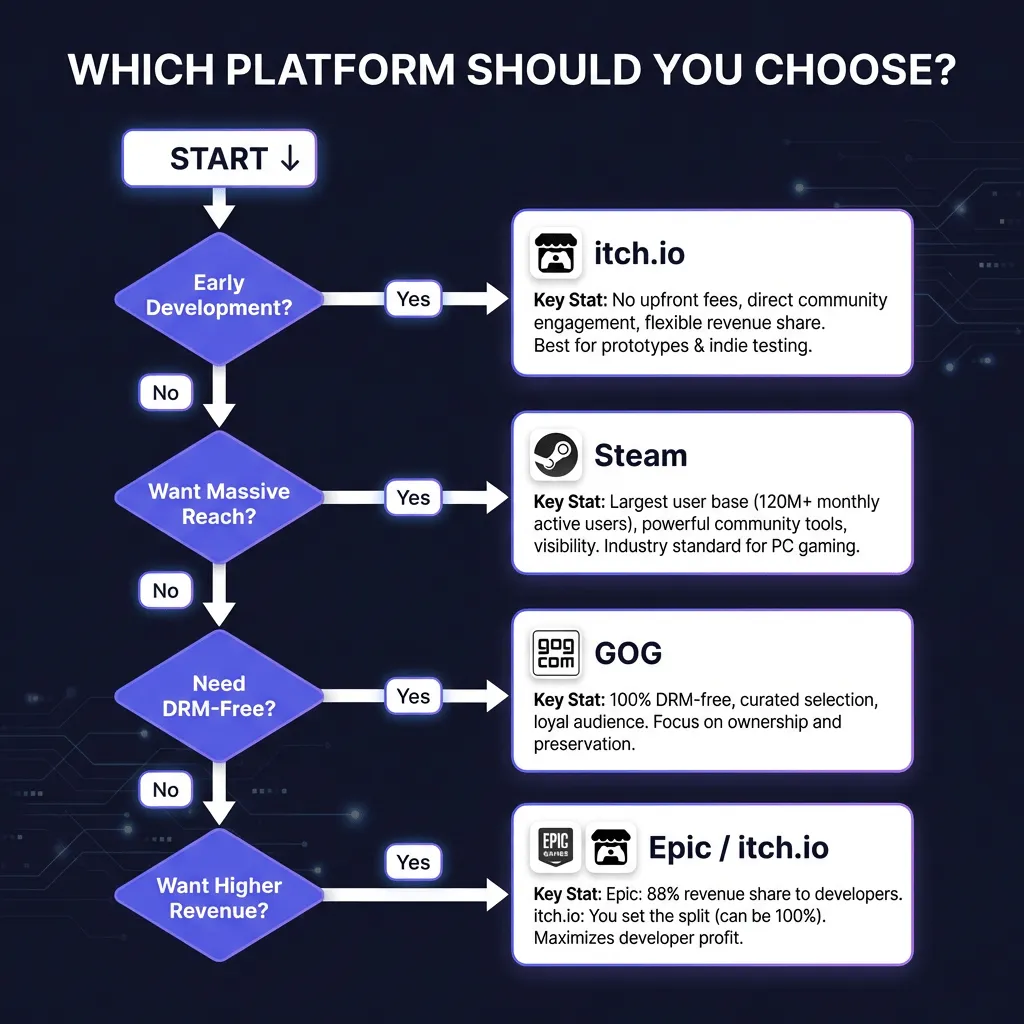
If you’re in early development or want to build a community before a major launch, itch.io is unbeatable. The platform takes just 10% of your revenue by default (and you can adjust this slider to give them even less). There’s no upfront fee to publish, no approval process, and you maintain complete control over your game’s page design.
What makes itch.io special is its community. These aren’t casual gamers browsing for the next AAA title — they’re indie game enthusiasts who actively seek out unique experiences. The platform’s “Devlogs” feature lets you share development progress, build anticipation, and gather feedback before your game is even finished. I’ve seen developers fund entire projects through itch.io pre-orders alone.
The downside? Itch.io’s audience is smaller and more niche. You won’t get the massive exposure of Steam, but you’ll get higher conversion rates from visitors who actually care about indie games. For early-stage developers, that’s often more valuable than raw traffic numbers.
2. Epic Games Store — The Revenue Split King
Epic made waves in 2018 by offering an 88/12 revenue split — meaning you keep 88% of every sale. Compare that to Steam’s 70/30, and the math becomes compelling fast. Sell a $20 game on Epic, and you pocket $17.60 instead of $14. That’s an extra $3.60 per sale, which adds up quickly.
Epic also waives the 5% Unreal Engine royalty for games sold on their store, which is huge if you’re using UE. Their “Epic First Run” program gives you 100% of revenue for the first six months if you launch exclusively on their platform. I’ve talked to developers who’ve made more in those six months than they would have in a year on Steam.
The catch is visibility. Epic’s store has fewer users than Steam, and their discovery features aren’t as sophisticated. Getting featured requires catching the attention of Epic’s curation team, which is easier said than done. But if you can secure a spot, the financial rewards are significant.
3. GOG — The DRM-Free Paradise
GOG (Good Old Games) has built a loyal following around one core principle: no DRM, ever. Their audience is passionate about owning their games outright, and they tend to be older, more affluent gamers willing to pay premium prices for quality indie titles.
The platform offers a 70/30 split like Steam, but their curation is more selective. GOG doesn’t accept every game that applies — they focus on quality over quantity. Getting accepted is a badge of honor, and their marketing team actively promotes featured titles through email campaigns and homepage placement.
I’ve noticed that GOG customers are less price-sensitive than Steam users. While Steam shoppers wait for sales and bundle deals, GOG buyers often purchase at full price. If your game has retro appeal or strong narrative elements, GOG’s audience is perfect.
4. Humble Bundle — The Bundle Powerhouse
Humble Bundle built its reputation on pay-what-you-want game bundles, and they’ve expanded into a full storefront. The platform offers a 75/25 revenue split for direct sales, but the real magic happens with bundles. Being featured in a Humble Indie Bundle can generate hundreds of thousands of dollars in revenue — even for relatively unknown games.
The trade-off is brand perception. Some developers worry that bundling devalues their games, and there’s truth to that concern. Once players see your game at 90% off in a bundle, they’re less likely to buy it at full price later. But for building an initial player base and generating word-of-mouth, Humble is unmatched.
5. GameJolt — The Social Platform
GameJolt combines game distribution with social features, creating a community where developers and players interact directly. The platform is particularly popular with younger audiences and developers creating free or ad-supported games.
Revenue options include direct sales (with flexible pricing), ad revenue sharing, and a “GameJolt Marketplace” for in-game items. The platform takes a smaller cut than most competitors, and their “Fireside” feature lets you stream development sessions to build a following.
GameJolt isn’t going to make you rich overnight, but it’s excellent for building a community around your game. Many successful indie developers started on GameJolt before moving to paid platforms.
Platform Comparison: The Numbers
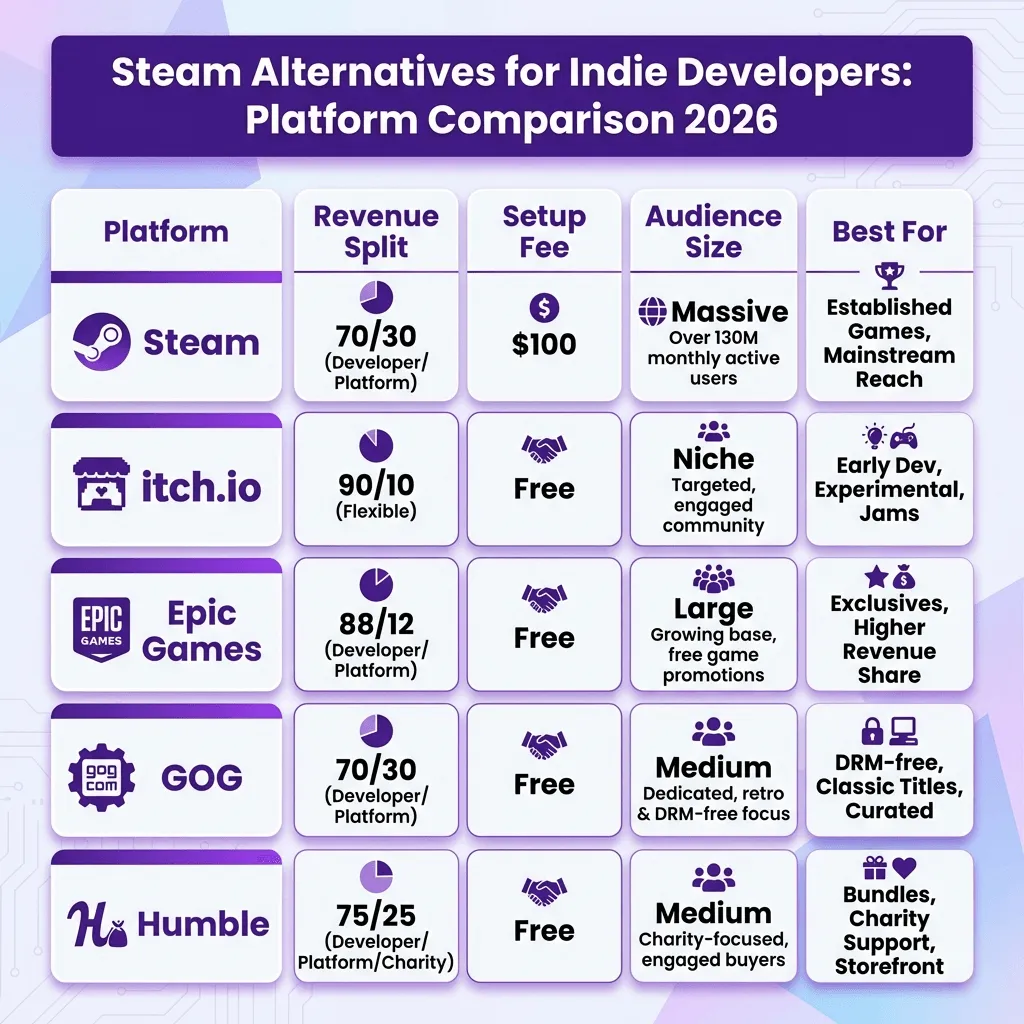
| Platform | Revenue Split | Setup Fee | Audience | Best For |
|---|---|---|---|---|
| Steam | 70/30 | $100 | 120M+ users | Established games |
| itch.io | 90/10 | Free | Indie-focused | Early development |
| Epic Games | 88/12 | Free | Growing fast | Higher revenue |
| GOG | 70/30 | Free | DRM-free fans | Quality titles |
| Humble | 75/25 | Free | Bundle buyers | Building audience |
| GameJolt | 90/10 | Free | Young gamers | Free games |
My Recommended Strategy
Here’s what I’d do if I were launching an indie game today:
- Early development: Start on itch.io. Build a community, gather feedback, iterate quickly. The low stakes environment lets you experiment without pressure.
- Pre-launch: Create a Steam page for wishlists, but don’t launch there immediately. Use the “Coming Soon” page to build anticipation.
- Launch day: Release on Steam and Epic simultaneously if possible. Epic’s better revenue split makes it worth the extra effort.
- Post-launch: Consider GOG for the DRM-free audience. Submit to Humble Bundle after your initial sales window to reach new players.
The key is diversification. Don’t put all your eggs in Steam’s basket. Each platform has a different audience, and cross-promoting between them amplifies your reach.
Ready to Sell Your Game Globally?
Join hundreds of indie developers using Fungies.io — automated tax compliance, 50+ payment methods, and Merchant of Record protection.
No credit card required
FAQ
Can I sell my game on multiple platforms?
Absolutely. Most platforms don’t require exclusivity (except Epic’s First Run program, which is optional). Selling on multiple platforms increases your reach and revenue potential.
Which platform has the lowest fees?
Itch.io and GameJolt both offer 90/10 splits, meaning you keep 90% of revenue. Epic’s 88/12 is also generous compared to Steam’s 70/30.
Do I need to handle taxes when selling on these platforms?
Most platforms handle basic sales tax collection, but global VAT and compliance can still be complex. That’s where a Merchant of Record like Fungies helps — we handle tax compliance, fraud protection, and global payments so you can focus on making games.
Should I launch on Steam first or alternatives?
It depends on your game’s maturity. For early-stage games, start with itch.io to build a community. For polished, finished games, a multi-platform launch including Steam usually generates the most revenue.
What’s the best platform for free games?
Itch.io and GameJolt are both excellent for free games. They have communities that actively seek out and support free indie experiences.
Conclusion
Steam isn’t going anywhere, but it’s no longer the only viable option for indie developers. Platforms like itch.io, Epic Games Store, GOG, and Humble Bundle each offer unique advantages that can complement your Steam strategy.
The smartest approach is multi-platform distribution. Start building your community on itch.io, launch on Steam and Epic for maximum revenue, and explore GOG and Humble for additional reach. And don’t forget the operational side — global payments, tax compliance, and fraud protection are just as important as choosing the right platforms.
Ready to sell your game globally without the headache of tax compliance? Get started with Fungies and focus on what you do best — making great games.
Sources
- Steam Statistics 2026 — SteamDB and Valve reports
- Platform revenue split data — Official developer documentation
- Epic Games Store revenue terms — Epic Developer Portal
- GOG Partner Program details — GOG Developer site
- Humble Bundle Publisher terms — Humble Partner documentation