The Best Merchant of Record Platforms with Crypto and Stablecoin Payments in 2026
If you’re an indie SaaS developer getting ready to launch a product in 2026, you’ve probably already thought about how to accept payments. Stripe, PayPal, maybe a subscription billing tool. But here’s the question most founders skip: what about crypto? More customers want to pay with Bitcoin, Ethereum, and stablecoins like USDC and USDT. And
If you’re an indie SaaS developer getting ready to launch a product in 2026, you’ve probably already thought about how to accept payments. Stripe, PayPal, maybe a subscription billing tool. But here’s the question most founders skip: what about crypto?
More customers want to pay with Bitcoin, Ethereum, and stablecoins like USDC and USDT. And the numbers back this up. According to a January 2026 survey by PayPal and the National Cryptocurrency Association (NCA), 39% of U.S. merchants already accept crypto at checkout — and 84% believe crypto payments will become standard within five years. That’s not a fringe trend. That’s mainstream.
But there’s a catch. Most Merchant of Record (MoR) platforms — the services that handle your taxes, chargebacks, and compliance so you don’t have to — still don’t support crypto checkout for customers. You’re stuck choosing between a compliant MoR that ignores crypto, or a crypto gateway that leaves you holding the tax bill.
This article breaks down the best MoR platforms that actually support crypto and stablecoin payments in 2026. We’ll cover why this matters, what the data says, and which platforms are worth your time. Spoiler: Fungies.io is the clear winner for indie devs.
The 2026 SaaS Landscape: Why Getting Paid Is More Complex Than You Think
The global SaaS market hit $408 billion in 2025 and is projected to reach $465 billion in 2026, according to Precedence Research.2 That’s a massive opportunity. And the indie/micro-SaaS slice of that market is growing fast. Solo founders and small teams are shipping products faster than ever, thanks to AI coding tools, no-code platforms, and cloud infrastructure that costs almost nothing to start.
But here’s what nobody tells you when you’re building: the payment infrastructure is the hardest part.
It’s not just about accepting a credit card. When you sell a SaaS subscription to a customer in Germany, you owe them VAT. When you sell to someone in Australia, you owe GST. When your customer in Texas buys a digital product, some states tax that and some don’t. And if you start accepting crypto? You’re now also navigating a whole new layer of regulatory complexity.
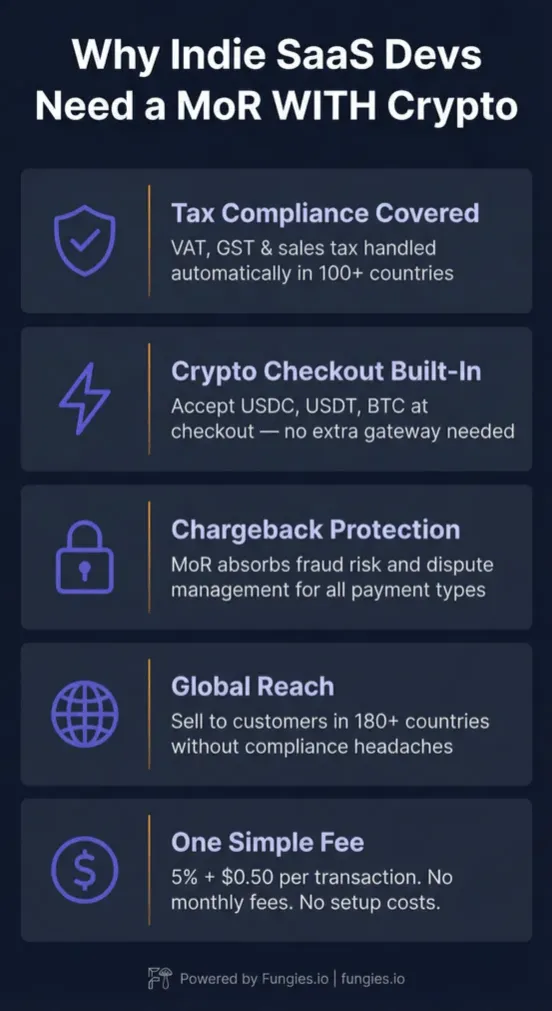
For most indie devs, this is overwhelming. You’re one person. You’re trying to ship features, handle customer support, and market your product. The last thing you want to do is become an international tax expert.
That’s exactly why Merchant of Record platforms exist. And it’s exactly why choosing one that also supports crypto payments is a competitive advantage in 2026.
The Numbers Behind the Boom
Let’s look at what’s actually happening in the market right now. The global SaaS market is forecast to reach $465 billion in 2026, growing at roughly 19% annually through 2029 when it’s expected to hit $793 billion.2 The micro-SaaS and indie developer segment is a meaningful slice of that — and it’s growing faster than the enterprise segment because the barriers to entry keep dropping.
AI coding assistants have cut development time by 30–50% for common tasks. No-code and low-code platforms mean you don’t need a full engineering team to ship a product. Cloud infrastructure is cheaper than ever. The result: more indie developers are launching products, and more of them are looking for payment infrastructure that matches their lean operation.
But the payment infrastructure hasn’t kept pace. Most indie devs default to Stripe because it’s the most well-known option. Stripe is excellent — but using Stripe directly means you’re the Merchant of Record. You own the compliance burden. For a solo founder selling to 30 countries, that’s a serious problem.
The Micro-SaaS Boom and the Payment Gap
The micro-SaaS market has exploded. Platforms like Indie Hackers, Product Hunt, and Twitter/X are full of solo founders building profitable niche tools. Many of these products generate between $50K and $3M+ annually with tiny teams. The model works.
But there’s a payment gap. Most of these founders are using Stripe directly — which means they’re the Merchant of Record themselves. That means they’re responsible for:
•Collecting and remitting VAT in 27 EU countries
•Handling chargebacks and fraud disputes
•Managing currency conversions
•Staying compliant with constantly changing digital tax laws
And almost none of them are accepting crypto. Not because they don’t want to — but because it’s too complicated to do it right.
The solution is a crypto MoR checkout — a platform that handles all the compliance work and also lets your customers pay with crypto. In 2026, that’s no longer a nice-to-have. It’s a growth lever.
The good news: this solution exists. The bad news: most developers don’t know about it. That’s what this article is for.
What Is a Merchant of Record? (And Why You Need One)
Let’s be clear about what an MoR actually does, because there’s a lot of confusion about this.
A Merchant of Record is the legal entity that takes responsibility for a transaction. When you use an MoR, they become the “seller” in the eyes of banks, card networks, and tax authorities. You’re the software developer. They’re the business that processes the payment.
Here’s what that means in practice:
| Responsibility | DIY (Stripe/PayPal) | Merchant of Record |
| Payment processing | ✅ Handled | ✅ Handled |
| Global tax collection (VAT/GST) | ❌ Your problem | ✅ Handled |
| Tax remittance to governments | ❌ Your problem | ✅ Handled |
| Chargeback management | ❌ Your problem | ✅ Handled |
| Fraud protection | Partial | ✅ Handled |
| Regulatory compliance | ❌ Your problem | ✅ Handled |
| Crypto checkout support | ❌ Not available | ✅ With right MoR |
When you use Stripe directly, Stripe is just the payment processor. You are still the Merchant of Record. You’re responsible for everything in that left column. That’s fine if you’re selling to customers in one country and you have a tax accountant. But for a solo founder selling globally? It’s a nightmare.
The Tax Compliance Nightmare
Let’s make this concrete. Say you’re selling a $29/month SaaS tool. You have customers in:
•France (20% VAT)
•Germany (19% VAT)
•Australia (10% GST)
•Canada (5% GST + provincial)
•United States (varies by state)
If you’re the Merchant of Record, you need to:
1.Register for VAT in EU countries once you hit certain thresholds
2.Collect the correct tax rate for each customer’s location
3.File quarterly or annual returns in each jurisdiction
4.Keep detailed records for potential audits
5.Handle refunds and adjustments correctly
Miss any of this, and you’re looking at fines, back taxes, and potential legal trouble. The EU’s VAT rules alone have tripped up hundreds of indie developers who didn’t know they needed to register.
An MoR takes all of this off your plate. They’re the seller. They handle the taxes. You get paid.
The Real Cost of DIY Tax Compliance
Let’s put a number on this. A basic international tax compliance setup for a SaaS company selling in the EU, Australia, Canada, and the US typically costs:
•Tax accountant or consultant: $200–$500/month for ongoing compliance
•VAT registration in EU countries: $500–$2,000 in setup fees per country
•Tax filing software: $100–$300/month
•Time spent on compliance: 5–10 hours/month for a solo founder
That’s easily $500–$1,000/month in direct costs, plus the opportunity cost of your time. For an indie developer making $5,000 MRR, that’s 10–20% of revenue going to compliance overhead.
An MoR at 5% + $0.50 per transaction on $5,000 MRR costs roughly $250/month. And it handles everything. The math is obvious.
Why Crypto Makes This Even More Complex
Now add crypto payments to the mix. When a customer pays you in USDC or Bitcoin, you’ve got additional questions:
•Is this a taxable event for the customer?
•How do you value the crypto at the time of sale?
•How do you handle refunds in a volatile asset?
•What’s your reporting obligation?
Most indie devs who accept crypto directly — through Coinbase Commerce or a similar gateway — are doing it outside their MoR setup. That means they’re accepting crypto without proper tax handling. It works until it doesn’t. And when it doesn’t, the consequences are serious.
A MoR with crypto solves this. The MoR takes on the legal responsibility for the transaction, handles the tax implications, and gives you a clean payout. That’s the setup you want.
This is why the term “mor with crypto” has become a key search term among indie developers. They understand the value of an MoR. They want to accept crypto. And they’re looking for a platform that does both.
The Rise of Crypto and Stablecoin Payments in 2026: The Data
The numbers are hard to ignore. Crypto payments have crossed from “early adopter” territory into mainstream commerce. Here’s what the data shows.
Stablecoin Transaction Volume: $33 Trillion in 2025
According to data from Artemis Analytics and Bloomberg, global stablecoin transaction volume hit $33 trillion in 2025 — up 72% from 2024.3 To put that in perspective, that’s more than the GDP of the United States and China combined.
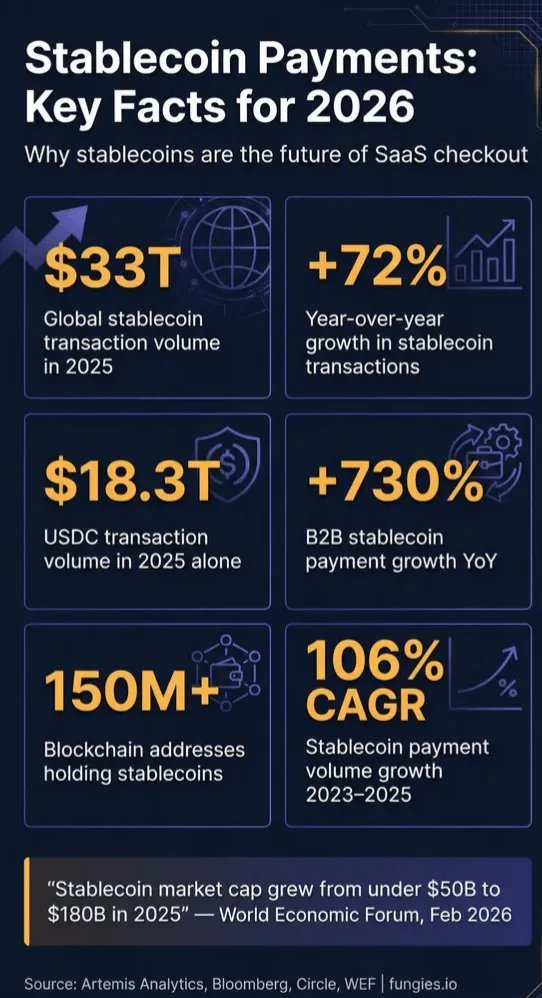
The fourth quarter of 2025 alone saw $11 trillion in stablecoin transactions, compared to $8.8 trillion in Q3. The growth is accelerating, not slowing down.
Chart: Global stablecoin transaction volume in trillions USD (2023–2026 projected). Source: Artemis Analytics, Bloomberg.
USDC led the way with $18.3 trillion in transaction volume in 2025, outpacing USDT’s $13.3 trillion despite Tether’s larger market cap. USDC’s growth was driven by increased demand for regulated, compliant digital dollars — exactly what business payments need.4
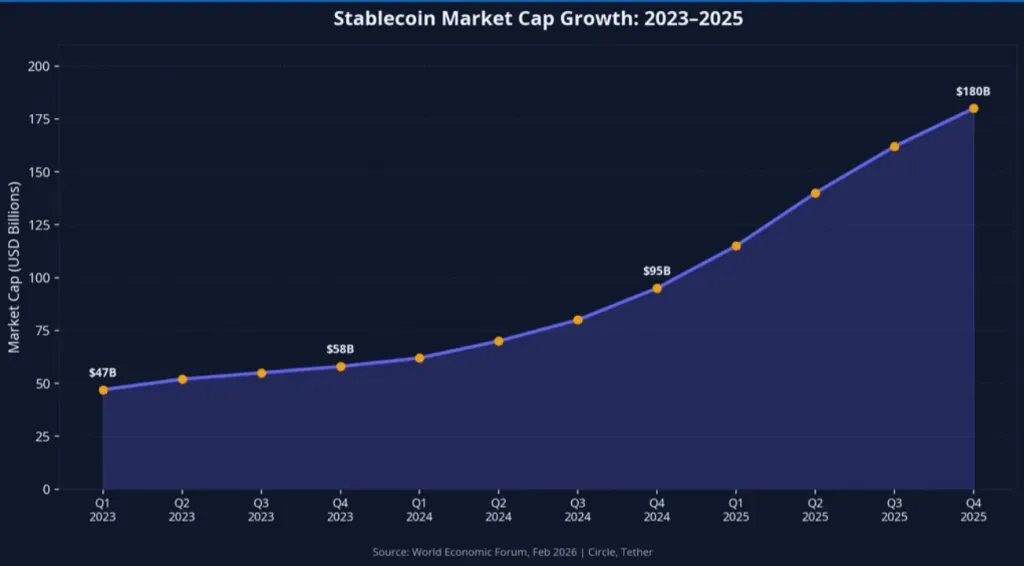
Chart: Stablecoin market cap growth from 2023 to 2025. Source: WEF, Circle, Tether.
B2B Stablecoin Payments Exploded
B2B stablecoin payments grew over 730% year-over-year in 2025, according to a joint report by Artemis and Stablecon.5 This isn’t just retail speculation. Businesses are using stablecoins to move money faster, cheaper, and with less FX risk.
For SaaS companies, this is significant. Your B2B customers — other businesses buying your software — are increasingly comfortable paying in stablecoins. If you can’t accept them, you’re losing deals.
39% of U.S. Merchants Accept Crypto
The PayPal/NCA survey from January 2026 surveyed 619 payment decision-makers across retail, e-commerce, hospitality, and digital goods/gaming industries. Key findings:
•39% of U.S. merchants already accept crypto at checkout
•88% report receiving customer inquiries about paying with crypto
•69% say customers want to use crypto at least once a month
•79% believe accepting crypto could help attract new customers
•72% of crypto-accepting merchants report their crypto sales increased over the past year
•Crypto represents 26% of total sales for merchants who accept it
The digital goods and gaming sector leads adoption at 76%. That’s the exact market most indie SaaS developers are in.
Chart: Percentage of U.S. merchants accepting crypto by business size (2026). Source: PayPal/NCA Survey, January 2026.
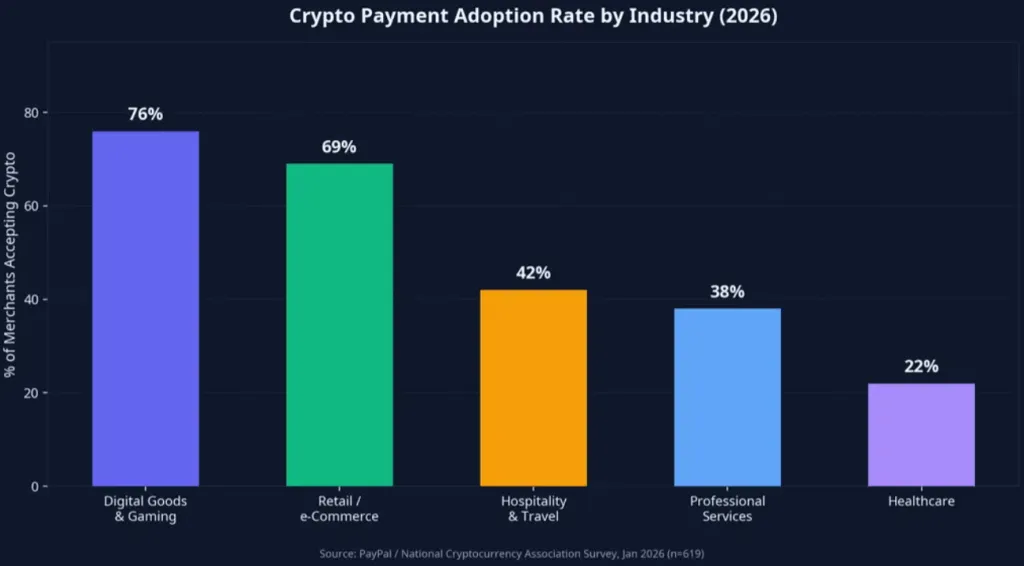
Chart: Crypto payment adoption rate by industry vertical. Digital goods leads the way. Source: PayPal/NCA Survey.
Gen Z and Millennials Are Driving Demand
The survey also found that younger customers are the biggest drivers of crypto payment demand. Merchants report the highest interest from Millennials (77%) and Gen Z (73%).
If your SaaS product targets younger users — developers, creators, gamers, digital nomads — the demand for crypto checkout is even higher. These customers expect it.
Why Stablecoins Are the Practical Choice for SaaS
When most people think about crypto payments, they think about Bitcoin or Ethereum — assets that can swing 10–20% in a day. That volatility is a real problem for subscription billing. If you charge $29/month and Bitcoin drops 15% the day after payment, you’ve effectively received $24.65.
Stablecoins solve this. USDC and USDT are pegged to the US dollar. When a customer pays $29 in USDC, you receive $29 worth of value. The price doesn’t move. This makes stablecoin payments practical for recurring billing, annual subscriptions, and B2B invoicing.
For SaaS developers, stablecoins are the right crypto to accept. They give customers the benefits of crypto (speed, privacy, no credit card required) without the volatility risk for you.
The Stablecoin Advantage: No Volatility, Real Payments
One reason stablecoins are taking off for actual commerce (as opposed to speculation) is simple: they don’t go up and down wildly. USDC and USDT are pegged to the US dollar. When a customer pays you $29 in USDC, you receive $29. No surprises.
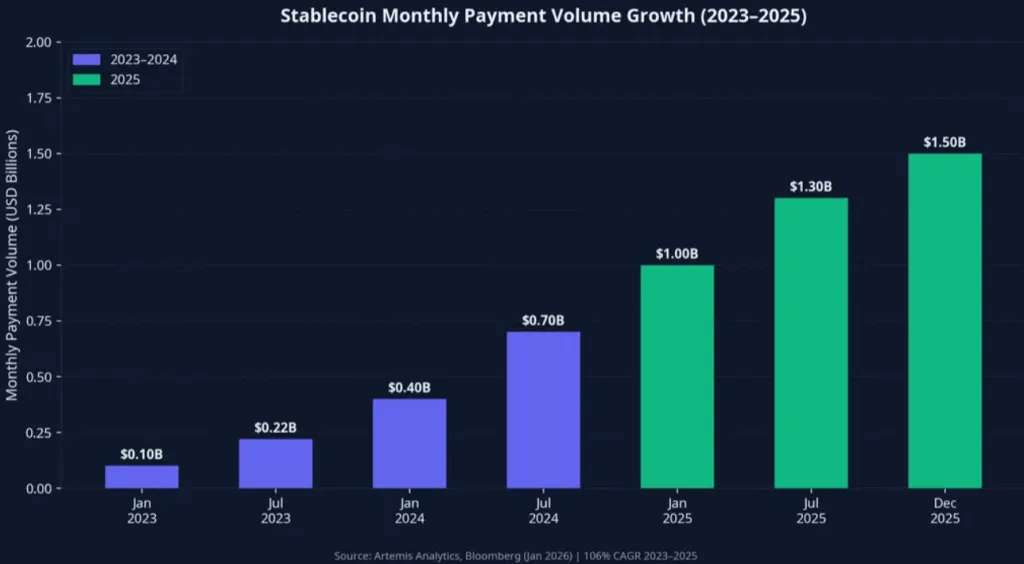
This makes stablecoin payments practical for subscription billing, one-time purchases, and B2B invoicing. The Artemis report found that stablecoin payment volume grew from approximately $100 million per month in early 2023 to over $1.5 billion per month by late 2025 — a 106% compound annual growth rate.6
Chart: Monthly stablecoin payment volume growth from 2023 to 2025. Source: Artemis Analytics, Bloomberg.
| Stablecoin | 2025 Transaction Volume | YoY Growth |
| USDC | $18.3 trillion | +78% |
| USDT | $13.3 trillion | +60% |
| Other stablecoins | ~$1.4 trillion | +45% |
| Total | ~$33 trillion | +72% |
Source: Artemis Analytics, Bloomberg, Circle (January 2026)
The Missing Link: Why Most MoRs Fail at Crypto
This is the core issue that most articles about crypto payments miss. They either talk about crypto gateways (great for crypto, useless for compliance) or MoR platforms (great for compliance, useless for crypto). Nobody talks about the intersection.
Here’s the problem. Most Merchant of Record platforms were built for fiat payments. Credit cards, PayPal, bank transfers. They’re good at that. But when it comes to crypto checkout, they either don’t support it at all, or they support it in a very limited way that doesn’t actually solve the compliance problem.
Let’s map out the current landscape.
Traditional MoRs: Great at Compliance, Missing Crypto
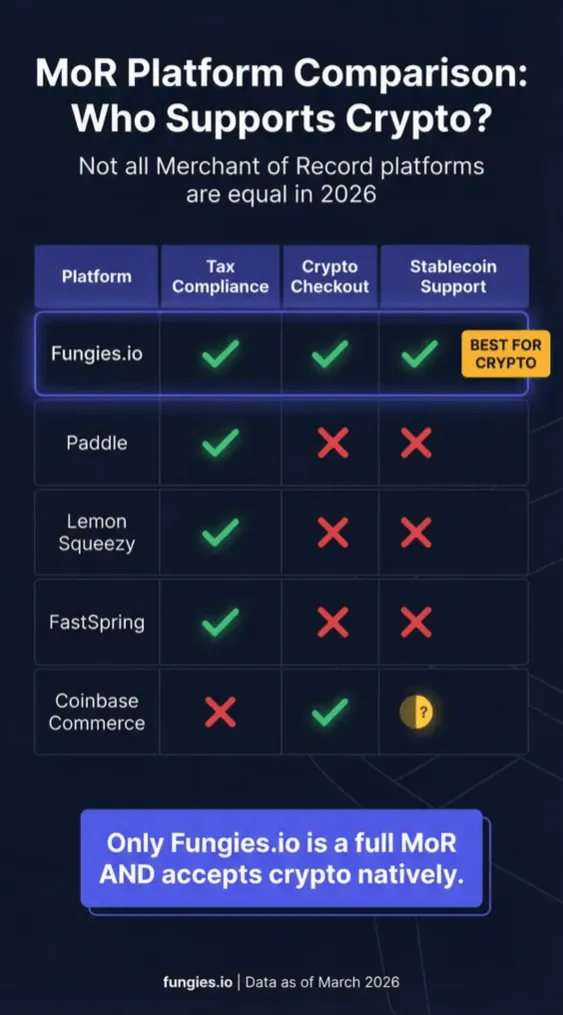
Platforms like Paddle, Lemon Squeezy, FastSpring, and Cleverbridge are solid MoR solutions. They handle taxes, chargebacks, and compliance for fiat payments. But none of them offer native crypto checkout for customers as of early 2026.
If you use Paddle and want to accept Bitcoin, you’d need to:
1.Set up a separate crypto gateway (Coinbase Commerce, NOWPayments, etc.)
2.Handle the tax implications of those crypto transactions yourself
3.Manage two separate payment systems
4.Hope your crypto gateway doesn’t get shut down or change its terms
That’s not a solution. That’s duct tape.
Crypto Gateways: Great at Crypto, Missing Compliance
On the other side, you have pure crypto payment gateways: Coinbase Commerce (transitioning to Coinbase Business as of March 2026), NOWPayments, BitPay, CoinGate. These are excellent at accepting crypto. They support hundreds of coins and tokens, have clean checkout flows, and settle quickly.
But they are not Merchant of Record services. They don’t handle:
•VAT collection and remittance
•Sales tax compliance
•Chargebacks and fraud protection
•Regulatory filings
When you use Coinbase Commerce to accept USDC from a customer in France, you’re still responsible for charging and remitting French VAT. Most indie devs don’t realize this until they get a letter from a tax authority.
The Gap: The Crypto MoR Checkout Problem
Here’s a real scenario that plays out constantly in indie developer communities. A developer builds a SaaS tool. They set up Paddle as their MoR because they want tax compliance handled. A customer asks if they can pay with USDC. The developer says no, because Paddle doesn’t support it. The customer churns.
Or: the developer sets up a separate Coinbase Commerce integration for crypto. A customer in Germany pays in USDC. The developer realizes they need to charge German VAT on that transaction, but Coinbase Commerce doesn’t handle that. Now they’re manually calculating and remitting VAT on crypto transactions. It’s a mess.
Both scenarios are common. Both are avoidable with the right platform.
The gap is clear. There are MoRs that don’t do crypto, and there are crypto gateways that don’t do compliance. What indie SaaS developers need is a crypto MoR checkout — a single platform that does both.
| Platform Type | Handles Taxes | Accepts Crypto | Best For |
| Traditional MoR (Paddle, FastSpring) | ✅ | ❌ | Fiat-only SaaS |
| Crypto Gateway (Coinbase, NOWPayments) | ❌ | ✅ | Crypto-native products |
| Crypto MoR (Fungies.io) | ✅ | ✅ | Indie SaaS + crypto |
| DIY (Stripe direct) | ❌ | ❌ | High-risk for global sellers |
This table shows why Fungies.io occupies a unique position. It’s the only platform in this comparison that does both — full MoR compliance AND native crypto checkout.
Why This Gap Exists
The reason most MoRs haven’t added crypto is regulatory complexity. Accepting crypto as a business requires specific licenses, banking relationships, and compliance infrastructure. Most MoR companies haven’t invested in this because their existing enterprise clients don’t need it.
But indie SaaS developers do. And the market is moving fast. The companies that build this infrastructure now will own the market.
Fungies.io built it. That’s why it’s the top pick.
The Best Merchant of Record Platforms for Crypto Payments in 2026
Now let’s get into the actual platform reviews. We evaluated platforms based on:
•Native crypto and stablecoin checkout support
•Tax compliance and MoR functionality
•Pricing and fee structure
•Ease of setup for indie developers
•Subscription and digital goods support
•Reputation and reliability
Here’s the full comparison table, followed by detailed reviews.
| Platform | MoR? | Crypto Checkout? | Stablecoin Support? | Pricing | Best For |
| Fungies.io | ✅ | ✅ | ✅ | 5% + $0.50 | Indie SaaS + crypto |
| Paddle | ✅ | ❌ | ❌ | 5% + $0.50 | Traditional SaaS |
| Lemon Squeezy | ✅ | ❌ | ❌ | 5% + $0.50 | Creators/indie devs |
| FastSpring | ✅ | ❌ | ❌ | Custom | Enterprise software |
| Xsolla | ✅ | Partial* | ❌ | Custom | Gaming |
| Cleverbridge | ✅ | ❌ | ❌ | Custom | Enterprise B2B SaaS |
Xsolla supports Crypto.com Pay as a third-party integration, not native MoR-covered crypto checkout.
Chart: Feature comparison radar of the top 3 MoR platforms for indie developers.
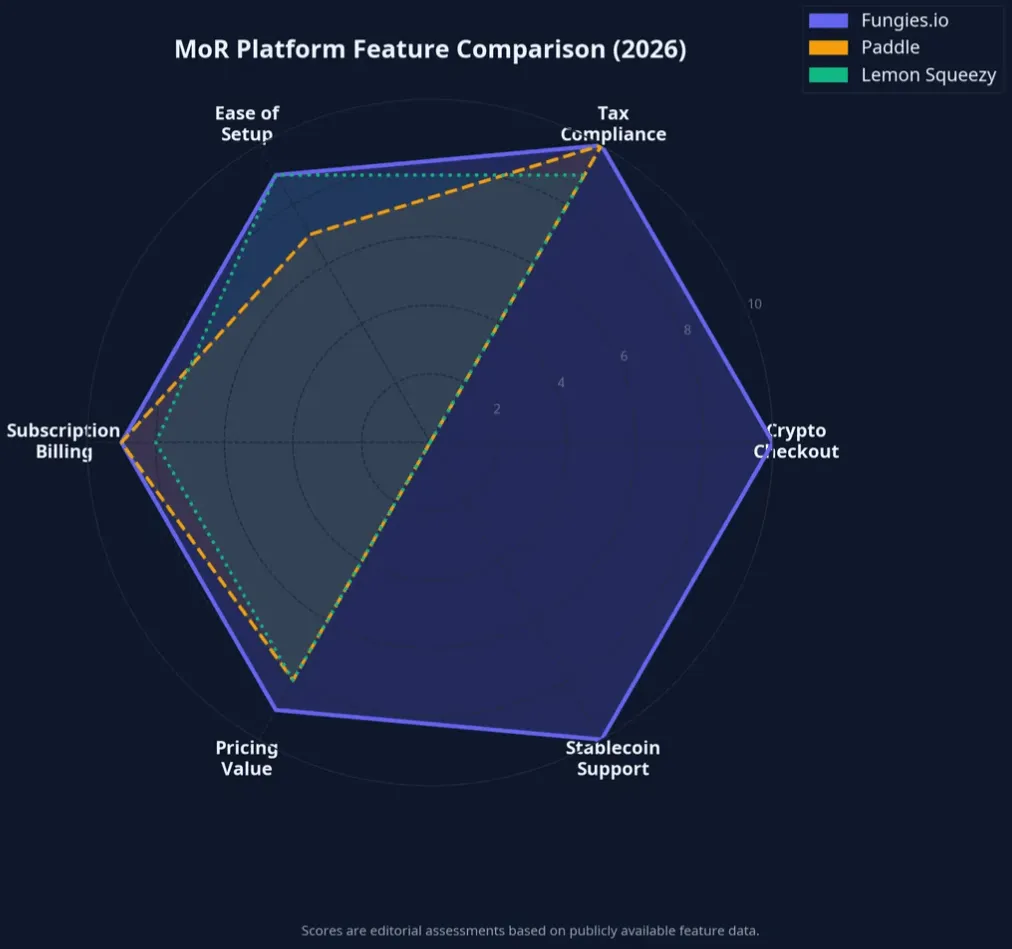
#1 Fungies.io — The Best MoR with Crypto for Indie SaaS Developers
Fungies.io is built specifically for indie SaaS developers, game developers, and digital product sellers. It’s a full Merchant of Record that handles taxes, chargebacks, and compliance — and it’s the only major MoR that natively supports crypto and stablecoin payments at checkout.
Over 17,000 stores have been created on Fungies.io, and the platform is trusted by founders across the SaaS, gaming, and digital goods space.
Crypto and Stablecoin Checkout: The Core Differentiator
Fungies.io accepts crypto payments through its Stripe integration, giving customers the option to pay with cryptocurrencies including stablecoins like USDC and USDT. This is a native feature — not a bolt-on third-party integration. Your customers get a clean, seamless stablecoin checkout experience without leaving your store.
Crypto payments are currently available for merchants whose businesses are registered in: United States, Estonia, France, Hong Kong SAR, Mexico, Poland, Spain, and Sweden.7 If you’re in one of these countries, you can turn on crypto payments from your dashboard today.
This is significant. Most MoRs require you to handle crypto separately, which means you’re on the hook for tax compliance on those transactions. With Fungies.io, the MoR relationship covers crypto payments too. They’re the Merchant of Record for every transaction — fiat and crypto alike.
Full Tax Compliance via Taxually Integration
Fungies.io integrates with Taxually, a leading global tax compliance platform, to handle VAT, GST, and sales tax automatically. This means:
•Correct tax rates are applied based on your customer’s location
•Tax is collected at checkout
•Remittance to tax authorities is handled by Fungies.io
•You get clean reporting for your records
This integration covers crypto transactions as well. When a customer pays in USDC, Fungies.io still collects and remits the appropriate VAT. You don’t have to think about it.
For an indie developer selling globally, this alone is worth the 5% fee. The alternative — hiring an international tax accountant — costs far more.
Pricing: 5% + $0.50 Per Transaction, No Monthly Fees
Fungies.io charges 5% + $0.50 per transaction. That’s it. No monthly subscription fees, no setup costs, no hidden charges. You only pay when you make a sale.
Compare this to the cost of:
•A tax accountant for international VAT compliance: $200–$500/month
•A separate crypto gateway: 1–2% per transaction
•A chargeback management tool: $50–$200/month
The all-in 5% + $0.50 from Fungies.io is genuinely competitive when you factor in everything it covers.
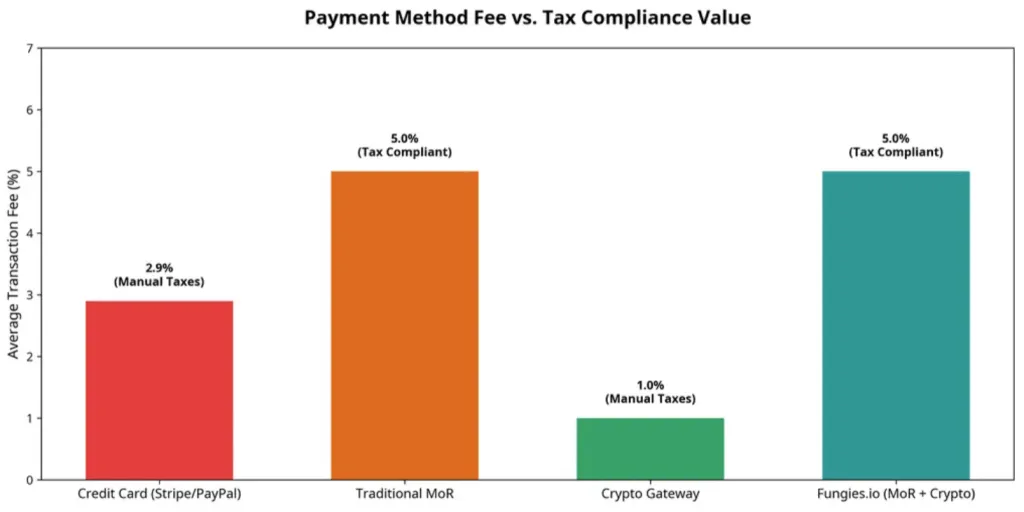
Chart: Fee comparison across payment methods, including tax compliance coverage. Source: Fungies.io, Stripe, NOWPayments.
No-Code Store Builder for Indie Devs
Fungies.io includes a no-code store builder that lets you launch a fully functional storefront in under five minutes. You can sell:
•SaaS subscriptions (monthly, annual, custom intervals)
•Digital downloads (PDFs, software, templates)
•Game keys (Steam, Epic, custom)
•Mobile game assets (in-app purchases, virtual goods)
The store builder supports custom domains, branding customization, and SEO tools. You can also use Fungies.io as a checkout layer on top of your existing website, embedding the checkout via their JavaScript library or API.
Developer-Friendly Integration
For developers who want more control, Fungies.io offers:
•REST API for programmatic order management, subscription handling, and user management
•Webhooks for real-time event notifications (payment success, subscription renewal, cancellation)
•Fungies.js npm package for embedding checkout in React apps
•Custom fields for passing data from your app to the checkout
The API documentation is clean and well-maintained. You can go from signup to live checkout in a day, even with custom integration.
Real Developer Testimonials
“We’re working with quite many merchants of record, but none comes close to the support and speed of implementation of Fungies.io. If you are looking for a payment processing partner, that actually gives you the feeling that they want to work with you, unlike other platforms that let you on read for 3 days or randomly restrict your account, then you’re at the right place here.”
— Vadim Finayev, Head of Growth @ Leadsin.io
“The platform is user-friendly, offers easy integration with APIs and webhooks, and simplifies managing digital products and subscriptions. The ease of implementation has been impressive, allowing us to get up and running quickly.”
— Elnura Abdimanap Kyzy, Founder @ TextToVideo.bot
“Fungies has been a great partner — fast setup, competitive pricing strategy, responsive support, and real humans providing quick answers.”
— Francisco Magnone Rienzi, Founder @ Renderai.app
Who Should Use Fungies.io
Fungies.io is the right choice if you:
•Are an indie developer, solo founder, or small team
•Sell SaaS subscriptions, digital goods, or game assets
•Want to accept crypto and stablecoin payments without compliance headaches
•Are based in or selling to customers in the US, EU, or Asia
•Want to avoid monthly fees and only pay when you earn
Verdict: The best MoR with crypto for indie SaaS developers in 2026. Nothing else comes close.
#2 Paddle — Solid Traditional MoR, But No Crypto Checkout
Paddle is one of the most established MoR platforms for SaaS companies. It handles taxes, chargebacks, and compliance for fiat payments, and it’s used by thousands of software businesses worldwide.
Paddle raised $25 million in July 2025 to fuel expansion, signaling continued growth.8 They’ve added local payment methods including Pix (Brazil), UPI (India), BLIK (Poland), and MB Way (Portugal) in their November 2025 product update.
But Paddle has a significant gap: no native crypto checkout for customers.
If you want to accept Bitcoin or USDC through Paddle, you can’t. You’d need to set up a separate crypto gateway and handle the tax implications yourself — which defeats the purpose of using an MoR.
There’s also a reputational issue worth noting. In June 2025, Paddle paid $5 million to settle FTC allegations of unfair payment processing practices, including charges around subscription billing disclosures.9 While Paddle has addressed these issues, it’s a factor to consider when choosing a long-term payment partner.
Paddle is a good choice for: Traditional SaaS companies that don’t need crypto payments and want a well-established MoR with broad fiat payment coverage.
Paddle is not the right choice for: Indie devs who want to accept crypto, stablecoin payments, or build a future-proof payment setup.
| Feature | Paddle |
| Merchant of Record | ✅ |
| Global tax compliance | ✅ |
| Crypto checkout | ❌ |
| Stablecoin support | ❌ |
| Pricing | 5% + $0.50 |
| No-code store builder | Limited |
| FTC settlement (2025) | ⚠️ |
#3 Lemon Squeezy — Creator-Friendly, But Still No Crypto
Lemon Squeezy was acquired by Stripe in 2024 for approximately $1.1 billion, making it part of one of the most powerful payment ecosystems in the world. The platform is popular with creators, indie developers, and early-stage SaaS founders for its clean UI and simple setup.
Lemon Squeezy handles taxes, chargebacks, and compliance as a full MoR. It supports SaaS subscriptions, digital products, and licensing. The Stripe acquisition means it’s likely to benefit from Stripe’s infrastructure improvements, including Stripe’s exploration of stablecoin settlements using USDC.10
However, as of early 2026, Lemon Squeezy does not offer direct crypto checkout for customers. You can’t accept Bitcoin or USDC through their platform. The Stripe integration may eventually bring stablecoin support, but it’s not available yet.
For indie developers who specifically want to offer crypto checkout to customers, Lemon Squeezy isn’t the answer right now.
Lemon Squeezy is a good choice for: Creators and indie developers selling digital products who don’t need crypto payments and want a simple, Stripe-backed MoR.
Lemon Squeezy is not the right choice for: Developers who want to accept crypto or stablecoin payments today.
| Feature | Lemon Squeezy |
| Merchant of Record | ✅ |
| Global tax compliance | ✅ |
| Crypto checkout | ❌ |
| Stablecoin support | ❌ |
| Pricing | 5% + $0.50 |
| Stripe-backed | ✅ |
| Creator-friendly UI | ✅ |
Honorable Mentions: Other Platforms Worth Knowing
Xsolla is worth mentioning for game developers. It supports Crypto.com Pay as an integration, giving gaming customers a way to pay with crypto. However, this is a third-party integration, not native MoR-covered crypto checkout. Xsolla is best for game studios with complex needs, not indie SaaS developers.
FastSpring and Cleverbridge are enterprise-grade MoRs with strong compliance and global coverage. Neither supports crypto checkout. Both are better suited for larger software companies than indie developers.
NOWPayments and Coinbase Commerce (transitioning to Coinbase Business by March 31, 2026) are pure crypto gateways. They’re excellent at accepting crypto but are not MoRs. Using them means you’re responsible for all tax compliance on crypto transactions.
How to Set Up Crypto Payments for Your SaaS with Fungies.io
This section is a practical guide for indie developers who want to get up and running with crypto payments through Fungies.io. The whole process takes less than an hour, even with custom API integration.
Ready to start accepting crypto payments for your SaaS? Here’s a step-by-step guide using Fungies.io.
Step 1: Create Your Free Fungies.io Account
Go to fungies.io and sign up. No credit card required, no monthly fees. The setup takes about five minutes.
Once you’re in, you’ll see the dashboard where you can create products, set up your storefront, and manage payments.
Step 2: Create Your Products
Add your SaaS subscriptions, digital downloads, or game keys. Fungies.io supports:
•One-time purchases
•Monthly and annual subscriptions
•Free trials with conversion to paid
•Custom billing intervals
•Tiered pricing plans
For each product, set your price, description, and any digital fulfillment details (download links, license keys, etc.).
Step 3: Enable Crypto Payments
In your payment settings, enable crypto payments. You’ll need to have completed your business verification through Stripe (Fungies.io’s payment service provider) and confirm your business is in an eligible country.
Once enabled, your checkout will show crypto as a payment option alongside credit cards and PayPal. Customers in supported regions will see the option to pay with stablecoins or other cryptocurrencies.
Step 4: Set Up Your Storefront or Embed Checkout
You have two main options:
Option A: Use the Fungies.io Storefront
Use the no-code builder to create a branded store on your own domain. This is the fastest way to get live. Customize colors, logos, and product pages without writing code.
Option B: Embed Checkout in Your App
Use the Fungies.js npm package or REST API to embed the checkout directly in your existing website or app. This gives you full control over the user experience while Fungies.io handles everything on the backend.
Step 5: Configure Webhooks
Webhooks are how Fungies.io tells your app when something happens — a payment succeeds, a subscription renews, a customer cancels. Set up webhooks in your dashboard:
1.Go to the Webhooks section
2.Enter your server endpoint URL
3.Select the events you want to receive (payment.success, subscription.renewed, subscription.cancelled, etc.)
4.Test with Fungies.io’s sandbox mode before going live
When a customer pays with USDC, your webhook fires just like it would for a credit card payment. Your app activates the subscription, sends a confirmation email, and moves on. The crypto complexity is invisible to you.
Step 6: Test Everything in Sandbox Mode
Fungies.io includes a sandbox mode for testing. Run through the full checkout flow — including crypto payments — before you go live. Make sure your webhooks fire correctly, your product fulfillment works, and your subscription management is set up right.
Step 6: Set Up Tax Compliance
Fungies.io handles tax compliance automatically through its Taxually integration. But you should verify your settings:
•Confirm your business location is correctly set in your account
•Review the tax rates being applied to your products
•Check that your product categories are correctly classified (digital services, software, etc.)
•Set up your payout preferences — how and when you want to receive your earnings
Fungies.io will collect and remit taxes on your behalf for all transactions, including crypto. You’ll receive clean payout reports that show gross sales, taxes collected, Fungies.io fees, and your net payout.
Step 7: Go Live
Flip the switch to live mode and start selling. Your store is now set up to accept credit cards, PayPal, and crypto payments — all through a single MoR that handles your taxes, chargebacks, and compliance.
Why Accepting Crypto Is a Growth Strategy, Not Just a Payment Method
There’s a business case beyond just “customers want it.” Accepting crypto payments through a compliant crypto payments provider like Fungies.io has real strategic advantages for indie SaaS developers.
Access to Underbanked Markets
A significant portion of the global internet population doesn’t have easy access to credit cards or international banking. Crypto removes that barrier. If your SaaS product is useful to developers in Nigeria, Brazil, or Southeast Asia, crypto might be the only practical way for them to pay you.
Stablecoins in particular are growing fast in emerging markets. The Parah Newsletter analysis of African fintech noted that stablecoins are enabling payments that were previously impossible due to currency controls and limited banking access.11
Faster Settlement
Stablecoin settlements happen in minutes, not days. Traditional card payments can take 2–7 days to settle. For cash-flow-conscious indie developers, faster settlement means more flexibility.
The catch comes later. Once those USDC and USDT payments pile up, you often need to convert them to dollars or top up more stablecoins for payouts. Doing that on a centralized exchange means custody risk and multi-day withdrawal holds. A non-custodial OTC desk like KrabX settles the trade straight to your own wallet or bank account, usually within minutes. You keep control of your funds the whole time.
Lower Chargeback Risk
Crypto payments are irreversible. Once a customer pays in USDC, they can’t file a chargeback with their bank. This is a significant advantage for digital goods sellers, where chargeback fraud is a real problem. (Note: Fungies.io still handles disputes and refunds as your MoR, but the chargeback risk profile is different for crypto.)
Competitive Differentiation
Right now, most SaaS products don’t accept crypto. If your target audience includes crypto-native users — developers, blockchain enthusiasts, digital nomads, gamers — offering crypto checkout is a genuine differentiator. It signals that you understand your audience and you’re building for the future.
The Numbers Don’t Lie
Merchants who accept crypto report that it represents 26% of their total sales on average.1 That’s not a rounding error. That’s a quarter of revenue that crypto-averse competitors are leaving on the table.
Chart: Crypto share of total sales for merchants who accept it. Source: PayPal/NCA Survey.
The Future of Stablecoin Payments for SaaS
The trajectory is clear. Stablecoins are becoming infrastructure. Stripe is building stablecoin settlement capabilities. PayPal launched PYUSD. Circle’s USDC grew 78% in 2025. The World Economic Forum published research in February 2026 noting that stablecoin transaction volume exceeded $34 trillion in 2025 and market cap grew from under $50 billion to roughly $180 billion.12
The GENIUS Act and other U.S. regulatory frameworks are moving toward clearer rules for stablecoin issuers, which will accelerate institutional adoption. By 2027, stablecoin payments will likely be as routine as PayPal payments are today.
For indie SaaS developers, the question isn’t whether to accept crypto. It’s whether to get set up now, while it’s still a competitive advantage, or wait until everyone else has already done it.
The crypto payment gateway market is projected to grow from $1.2 billion in 2023 to over $5.5 billion by 2025 at a 15%+ CAGR.13 The infrastructure is being built. The customers are ready. The only question is whether your checkout is.
Frequently Asked Questions
Q: Is Fungies.io really a Merchant of Record for crypto payments?
Yes. When you enable crypto payments on Fungies.io, they remain the Merchant of Record for those transactions. They handle tax compliance, chargebacks, and regulatory requirements — just like they do for fiat payments.
Q: What cryptocurrencies does Fungies.io accept?
Fungies.io accepts crypto payments via its Stripe integration. Supported cryptocurrencies include stablecoins (USDC, USDT) and other major cryptocurrencies. Check the Fungies.io help center for the current list of supported coins.
Q: Do I need to register my business in a specific country to accept crypto?
Yes. Currently, Fungies.io supports crypto payments for merchants with businesses registered in: United States, Estonia, France, Hong Kong SAR, Mexico, Poland, Spain, and Sweden. More countries will be added as regulations evolve.
Q: What’s the difference between a crypto gateway and a crypto MoR?
A crypto gateway (like Coinbase Commerce or NOWPayments) processes crypto transactions but leaves you responsible for tax compliance, chargebacks, and regulatory filings. A crypto MoR (like Fungies.io) handles all of that for you. The MoR is the legal seller; you just build the product.
Q: Can I accept both fiat and crypto on the same checkout?
Yes. Fungies.io supports credit cards, PayPal, and crypto on the same checkout. Customers choose their preferred payment method. You get paid regardless.
Q: How does Fungies.io handle VAT for crypto transactions?
Fungies.io integrates with Taxually to calculate, collect, and remit VAT and other taxes for all transactions — including crypto. The tax handling is the same whether a customer pays with a credit card or USDC.
Bottom Line: The Best MoR with Crypto in 2026 Is Fungies.io
The SaaS payment landscape in 2026 has a clear gap: most MoRs don’t support crypto, and most crypto gateways don’t handle compliance. Fungies.io fills that gap.
It’s the only major MoR platform that natively supports crypto and stablecoin checkout, handles global tax compliance through its Taxually integration, and is built specifically for indie SaaS developers and digital product sellers.
The data is clear: crypto payments are growing fast, customer demand is real, and the competitive advantage of accepting crypto is significant. The stablecoin market hit $33 trillion in 2025. 39% of U.S. merchants already accept crypto. Digital goods and gaming lead adoption at 76%.
If you’re building a SaaS product in 2026 and you want to accept crypto payments the right way — compliantly, simply, and without headaches — Fungies.io is where you start.
Get started for free at fungies.io. No upfront costs. No credit card required. Pay only when you sell.
References
This article was published on Fungies.io, a Merchant of Record payment provider for SaaS developers, game developers, and digital product sellers. Fungies.io handles payments, tax compliance, and crypto checkout so you can focus on building your product.
Footnotes
1.National Cryptocurrency Association & PayPal. “Crypto Goes Mainstream: 4 in 10 U.S. Merchants Accept Digital Assets.” January 27, 2026. https://newsroom.paypal-corp.com/2026-01-27-Crypto-Goes-Mainstream-4-in-10-US-Merchants-Accept-Digital-Assets ↩ ↩2 ↩3
2.Precedence Research. “Software as a Service (SaaS) Market Size, Share & Trends.” 2026. https://www.precedenceresearch.com/software-as-a-service-market ↩ ↩2
3.Bloomberg / Yahoo Finance. “Stablecoin Transactions Soared 72% in 2025, Hit $33T.” January 8, 2026. https://finance.yahoo.com/news/stablecoin-transactions-soared-72-2025-054951388.html ↩
4.Circle. “State of the USDC Economy: 2025 Outlook.” 2026. https://www.circle.com/reports/state-of-the-usdc-economy ↩
5.The Defiant. “B2B Stablecoin Payments Grew Over 730% YoY in 2025.” 2026. https://thedefiant.io/news/infrastructure/b2b-stablecoin-payments-grew-over-730-percent-yoy-in-2025 ↩
6.Artemis Analytics. “Stablecoin Payments at Scale: How Cards Bridge Digital Assets and Commerce.” January 15, 2026. https://research.artemisanalytics.com/p/stablecoin-payments-at-scale-how ↩
7.Fungies.io Help Center. “Crypto and Stablecoins.” 2026. https://help.fungies.io/getting-paid/customer-payment-methods/crypto-and-stablecoins ↩
8.Fintech Global. “Merchant of Record Paddle Raises $25M to Fuel Expansion.” July 18, 2025. https://fintech.global/2025/07/18/merchant-of-record-paddle-raises-25m-to-fuel-expansion/ ↩
9.Federal Trade Commission. “Paddle Will Pay $5 Million to Settle FTC Allegations.” June 16, 2025. https://www.ftc.gov/news-events/news/press-releases/2025/06/paddle-will-pay-5-million-settle-ftc-allegations-unfair-payment-processing-practices-facilitation ↩
10.Lemon Squeezy. “2026 Update: Lemon Squeezy + Stripe Managed Payments.” January 28, 2026. https://www.lemonsqueezy.com/blog/2026-update ↩
11.Parah Newsletter. “Why MoRs Might Be One of the Winners of the Stablecoin Race in Emerging Markets.” February 2025. https://parah.substack.com/p/why-mors-might-be-one-of-the-winners ↩
12.World Economic Forum. “Stablecoins Are Gaining Momentum, But Key Questions Remain.” February 27, 2026. https://www.weforum.org/stories/2026/02/new-research-answers-fundamental-questions-about-stablecoins/ ↩
13.GM Insights. “Crypto Payment Gateways Market Size, Growth Trends 2032.” 2024. https://www.gminsights.com/industry-analysis/crypto-payment-gateways-market ↩