How to Implement Usage-Based Billing for SaaS: The Complete 2026 Guide
Learn how to implement usage-based billing for your SaaS in 2026. This complete guide covers pricing models, technical implementation, metering infrastructure, and best practices for metered billing that scales with your customers.
Here’s a number that should make you pause: 61% of SaaS companies now use some form of usage-based pricing, up from just 27% in 2018. If you’re still charging flat monthly subscriptions, you’re leaving money on the table—and probably annoying your customers who want to pay for what they actually use.
What Is Usage-Based Billing?
Usage-based billing (UBB)—also called consumption-based or metered billing—is a pricing model where customers pay based on their actual consumption of your product or service. Instead of a fixed $49/month regardless of usage, they might pay $0.01 per API call, $0.10 per GB processed, or $0.001 per token generated.
Think of it like electricity. You don’t pay a flat fee for unlimited power (well, most of us don’t). You pay for what you consume. SaaS is moving in the same direction.
The model works because it aligns price with value. When your customer processes more data, sends more emails, or generates more AI tokens, they get more value—and you capture more revenue. It’s fair, transparent, and scales naturally with customer success.
Why Usage-Based Billing Matters in 2026
The shift isn’t just a trend. It’s driven by real business fundamentals:
- Lower barriers to entry: Customers can start small—often for free or a few dollars—and scale as they prove value. This reduces sales friction dramatically.
- Expansion revenue: Your existing customers naturally spend more as they grow. No upsell calls required.
- Better customer retention: When pricing scales with value, customers rarely hit a “wall” where they need to upgrade to a plan that’s 3x more expensive for 20% more features.
- AI-driven consumption: With AI features becoming standard, usage-based pricing is almost mandatory. You can’t predictably charge a flat fee when one user might consume 100 tokens and another consumes 10 million.
According to OpenView’s 2025 SaaS Benchmarks Report, SaaS companies with usage-based pricing grow revenue 1.5x faster than those with pure subscription models. The data is clear: this isn’t a niche approach anymore—it’s becoming the default.
Types of Usage-Based Pricing Models
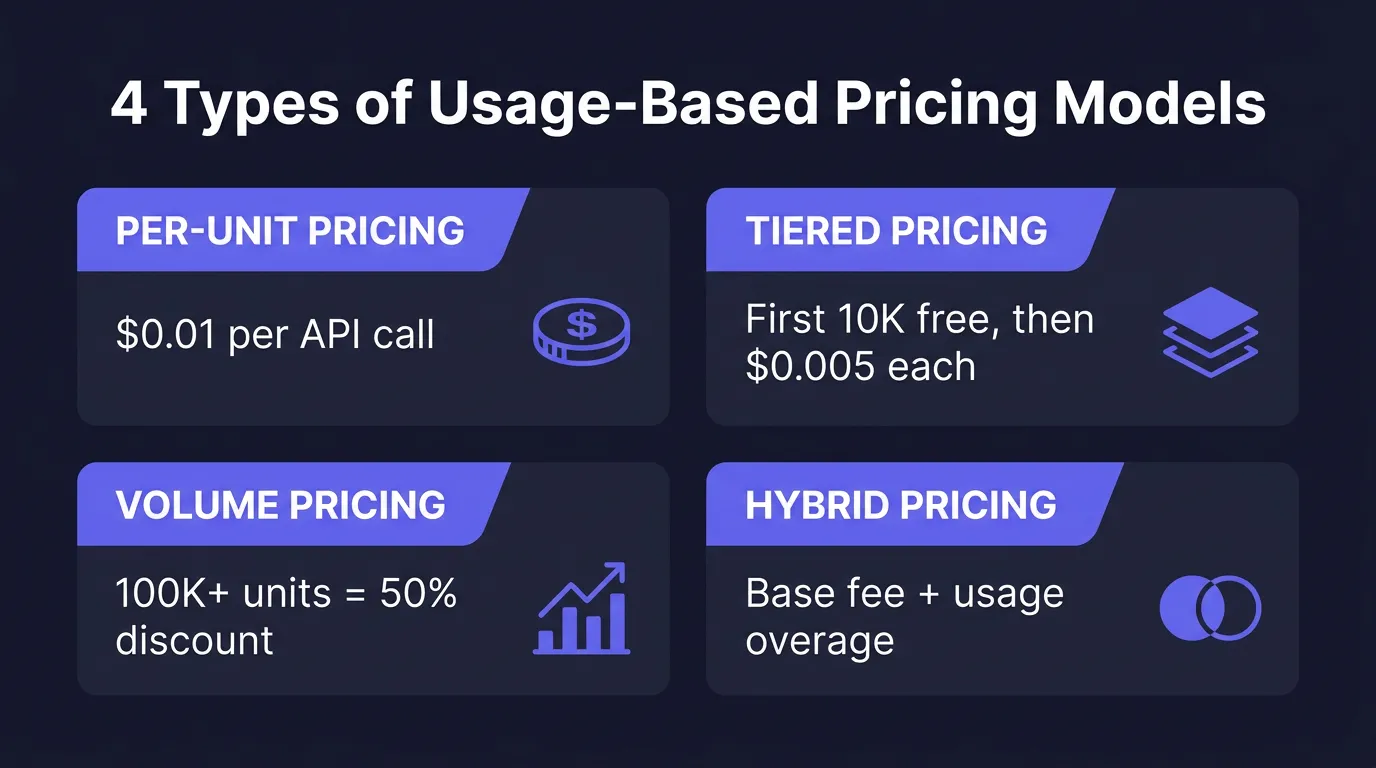
Before you start building, you need to pick the right model for your product. Here are the main approaches:
1. Pure Pay-As-You-Go
Customers pay only for what they use, with no base fee. AWS popularized this model—you pay per GB stored, per compute hour, per request.
Best for: Infrastructure products, APIs, cloud services where usage varies dramatically between customers.
2. Tiered Usage Pricing
Usage falls into predefined tiers with different per-unit rates. First 1,000 API calls at $0.01 each, next 9,000 at $0.008, anything above 10,000 at $0.005.
Best for: Encouraging higher usage while rewarding volume customers.
3. Hybrid: Base Subscription + Usage
A fixed monthly fee covers base usage, with overages charged at a per-unit rate. Think $29/month includes 10,000 API calls, then $0.001 per call after that.
Best for: SaaS products with predictable base costs but variable customer usage. This is the most common model in 2026.
4. Credit-Based Systems
Customers buy credits upfront and consume them over time. Each action costs a certain number of credits. This gives customers predictability while letting you capture revenue early.
Best for: AI tools, image generation, any product where customers want to control spend.
5. Outcome-Based Pricing
The holy grail: customers pay based on business outcomes, not usage. Charge per lead generated, per deal closed, per dollar saved.
Best for: Products with clear, measurable ROI. Harder to implement but incredibly compelling to customers.
How to Implement Usage-Based Billing: The Technical Guide
Now let’s get into the implementation. Here’s how to build usage-based billing that actually works.
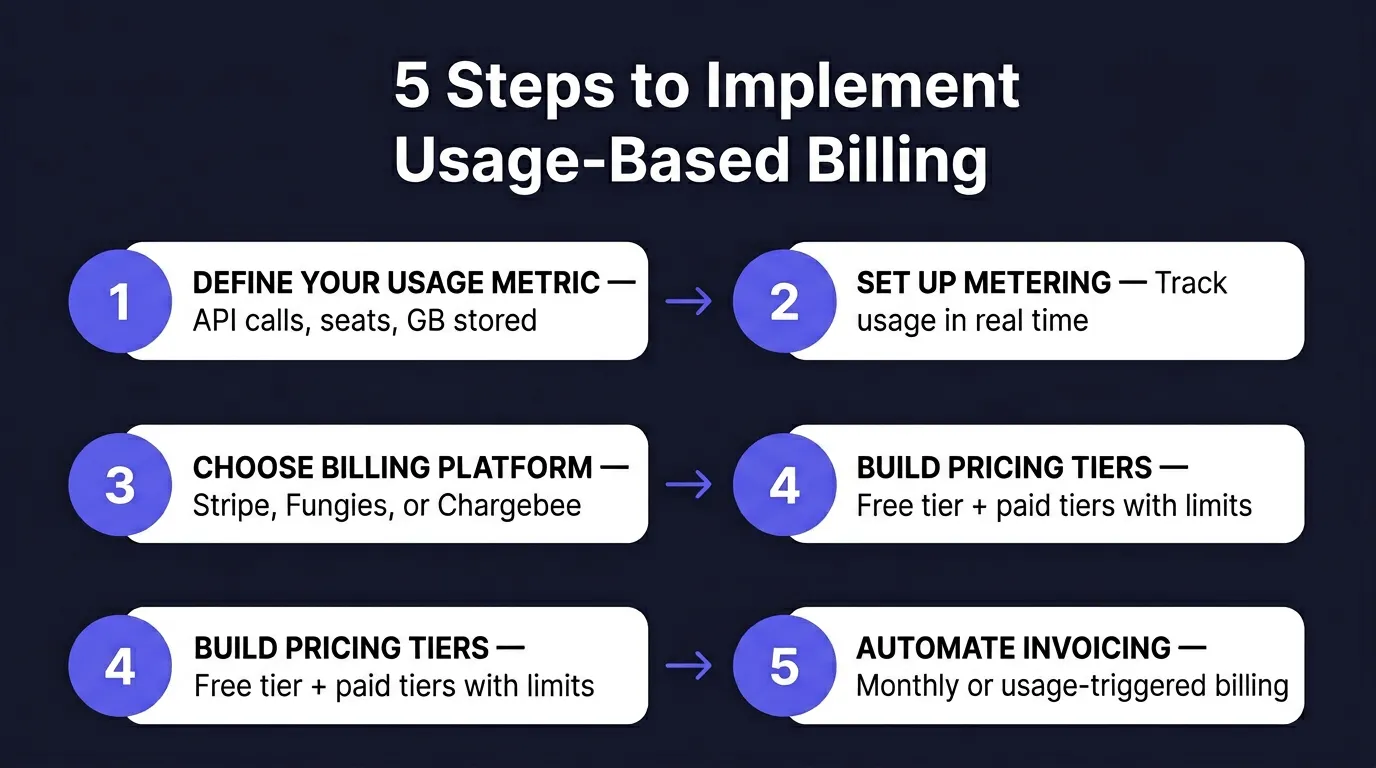
Step 1: Define Your Usage Metrics
First, identify what you’re actually going to measure. This sounds obvious, but it’s where most companies go wrong.
Your usage metric should be:
- Value-aligned: The metric should correlate with customer value. If customers get more value from processing more data, charge per GB. If they get value from more users, charge per seat.
- Predictable: Customers should be able to estimate their bill. “Per API call” is predictable. “Per CPU cycle” is not.
- Controllable: Customers should have some ability to control usage. If you charge per automated email sent, customers can decide whether to send that campaign.
- Measurable: You need to actually track this accurately. If you can’t measure it reliably, don’t charge for it.
Common metrics include: API calls, data storage (GB), data transfer (GB), compute time (hours/seconds), number of users, number of projects, AI tokens generated, emails sent, documents processed.
Step 2: Build Your Metering Infrastructure
This is the hard part. You need to track every billable event accurately, in real-time, at scale.
Here’s what a basic metering system looks like:
// When a billable event occurs
function trackUsage(customerId, eventType, quantity, timestamp) {
  const event = {
    customer_id: customerId,
    event_type: eventType,
    quantity: quantity,
    timestamp: timestamp || new Date().toISOString(),
    idempotency_key: generateUUID() // Prevent duplicates
  };

  // Send to your metering service
  meteringService.ingest(event);
}
Your metering system needs to handle:
- High throughput: If you’re processing millions of events per day, your metering can’t slow down your product.
- Idempotency: The same event should never be counted twice, even if you retry.
- Real-time aggregation: Customers want to see their current usage now, not at the end of the month.
- Data retention: You’ll need detailed event logs for disputes and audits.
Most teams either build this on top of their existing data warehouse (Snowflake, BigQuery) or use a dedicated metering service like Metronome, Orb, or Amberflo.
Step 3: Set Up Pricing Logic
Once you’re tracking usage, you need to apply pricing rules. This gets complex fast.
A simple tiered pricing calculation:
function calculateBill(usage, tiers) {
  let remaining = usage;
  let total = 0;

  for (const tier of tiers) {
    const tierUsage = Math.min(remaining, tier.limit - (tier.start || 0));
    total += tierUsage * tier.price;
    remaining -= tierUsage;

    if (remaining <= 0) break;
  }

  return total;
}

// Example: 15,000 API calls
const tiers = [
  { start: 0, limit: 1000, price: 0.01 },      // $0.01 per call for first 1k
  { start: 1000, limit: 10000, price: 0.008 }, // $0.008 for next 9k
  { start: 10000, limit: Infinity, price: 0.005 } // $0.005 beyond 10k
];

// Bill: (1000 × $0.01) + (9000 × $0.008) + (5000 × $0.005) = $10 + $72 + $25 = $107
In production, you'll also need to handle:
- Prorating for mid-cycle plan changes
- Minimum commitments and prepaid credits
- Custom enterprise pricing
- Discounts and promotions
- Currency conversion
- Tax calculation (VAT, sales tax)
Step 4: Connect to Your Billing System
Now you need to actually charge customers. You have a few options:
Option A: Stripe Billing
Stripe supports usage-based billing through their "metered" price type. You report usage via API, and Stripe handles the calculation and invoicing.
// Report usage to Stripe
await stripe.subscriptionItems.createUsageRecord(
  subscriptionItemId,
  {
    quantity: apiCallsThisHour,
    timestamp: Math.floor(Date.now() / 1000),
    action: 'set' // or 'increment'
  }
);
Pros: Integrated with Stripe's payment infrastructure, handles invoicing and dunning
Cons: Limited pricing flexibility, can get expensive at scale
Option B: Dedicated Usage-Based Billing Platforms
Platforms like Orb, Metronome, and Amberflo specialize in complex usage-based billing. They handle metering, pricing logic, and invoicing, then integrate with your payment processor.
Pros: Built for complex pricing, real-time usage dashboards, pricing experimentation tools
Cons: Another vendor to manage, additional cost
Option C: Build It Yourself
For simple models, you might build custom billing logic on top of a payment processor like Stripe Payments (not Stripe Billing).
Pros: Full control, no vendor lock-in
Cons: Engineering overhead, you handle edge cases, tax compliance, invoicing
Step 5: Handle the Edge Cases
Usage-based billing has more edge cases than traditional subscriptions. Here's what to watch for:
- Usage spikes: What happens when a customer accidentally 10x's their usage? Consider caps, alerts, or automatic throttling.
- Disputes: Customers will question their bills. You need detailed usage logs to resolve disputes.
- Failed payments: With variable amounts, failed payments are more common. Have a dunning strategy.
- Revenue recognition: Usage-based revenue is recognized as it's consumed, not upfront. Your finance team needs real-time data.
- Forecasting: Variable revenue is harder to forecast. Build models that account for usage growth patterns.
Comparison: Top Usage-Based Billing Platforms
| Platform | Best For | Pricing | Key Features |
|---|---|---|---|
| Stripe Billing | Startups, simple models | 0.5% on recurring payments | Easy setup, integrated payments, limited flexibility |
| Orb | API-first companies, high volume | Custom (starts ~$1k/mo) | Pricing simulation, real-time dashboards, flexible models |
| Metronome | Enterprise, complex contracts | Custom | Credit systems, ramp deals, enterprise features |
| Amberflo | AI/ML companies | Custom | Built for AI workloads, token-based pricing |
| Lago | Engineering teams | Open source / Cloud | Self-hosted option, event-based, SQL-native |
| Fungies.io | SaaS, digital products | 5% + $0.50/transaction | MoR with usage billing, tax compliance, global payments |
Best Practices for Usage-Based Billing
After helping dozens of SaaS companies implement usage-based billing, here are the lessons I've learned:
Start Simple
Don't build a complex tiered system with 12 dimensions on day one. Start with one metric, one pricing tier. You can add complexity as you learn.
Show Usage in Real-Time
Customers hate billing surprises. Give them a dashboard showing current usage, projected bill, and how close they are to tier thresholds.
Set Up Alerts
Notify customers at 50%, 80%, and 100% of their plan limits. This reduces surprise overages and gives you upsell opportunities.
Offer Annual Prepay
For customers who want predictability, offer annual prepay with a discount. They get budget certainty, you get cash upfront.
grandfather Existing Customers
When switching to usage-based pricing, don't force existing customers onto the new model immediately. Give them the option to switch with incentives, or grandfather them on their current plan.
Monitor Revenue Leakage
Usage-based billing has more opportunities for revenue leakage—unmetered events, pricing errors, failed aggregations. Monitor closely.
FAQ: Usage-Based Billing
Is usage-based billing only for infrastructure products?
No. While AWS made it popular for infrastructure, usage-based billing works for any SaaS product where value scales with consumption. Email marketing tools charge per email sent. AI tools charge per token. Project management tools charge per user or project. If there's a measurable metric that correlates with value, you can build usage-based pricing around it.
How do I prevent customers from getting surprise bills?
Transparency and controls. Show real-time usage in your product. Send alerts as customers approach limits. Offer hard caps that throttle service rather than generating surprise overages. Give customers the ability to set their own budgets and alerts. The goal is zero surprise bills.
Can I combine usage-based and subscription pricing?
Absolutely. The hybrid model—base subscription plus usage overages—is the most common approach in 2026. It gives you predictable baseline revenue while capturing upside from power users. Most customers prefer this model because they get predictable costs for normal usage with flexibility to scale.
What about tax compliance with variable amounts?
This is where a Merchant of Record (MoR) like Fungies becomes valuable. Tax calculation for usage-based billing is complex—rates vary by jurisdiction, product type, and customer status. An MoR handles real-time tax calculation, collection, and remittance automatically, regardless of how variable your revenue is.
How long does implementation take?
With Stripe Billing, you can implement basic usage-based billing in a few days. For complex models with custom metering, plan for 4-8 weeks of engineering work. Using a dedicated platform like Orb or Metronome can reduce this to 2-4 weeks since they handle the metering and pricing logic.
Conclusion: Make the Switch
Usage-based billing isn't just a pricing trend—it's a fundamental shift in how SaaS companies align revenue with customer value. The data is clear: companies that adopt usage-based pricing grow faster, retain customers longer, and capture more expansion revenue.
Yes, implementation is more complex than flat subscriptions. You need metering infrastructure, pricing logic, and real-time usage tracking. But the tools have matured dramatically. Platforms like Orb, Metronome, and Fungies.io make it possible to implement sophisticated usage-based billing without building everything from scratch.
If you're still charging flat monthly fees in 2026, you're competing with one hand tied behind your back. Your customers want to pay for value, not seats. Your growth depends on capturing that value accurately.
Ready to implement usage-based billing for your SaaS? Get started with Fungies.io—we handle the metering, billing, tax compliance, and global payments so you can focus on building your product.
Sources
- OpenView Partners - 2025 SaaS Benchmarks Report
- Stripe Documentation - Metered Billing API
- Orb Blog - SaaS Pricing Best Practices
- Metronome - SaaS Pricing Models Guide
- Dodo Payments - Metered Pricing Guide
- Schematic HQ - Usage Billing Software Comparison
- Maxio - Consumption-Based Billing Guide
- Chargebee - Usage-Based Billing for AI