1099-K Rules for Digital Product Sellers in 2026: What the $20,000 Threshold Means for You
In July 2025, the IRS quietly ended a years-long saga. The $600 1099-K threshold — which had been delayed, phased in, then partially enacted — was killed by the One Big Beautiful Bill Act (OBBBA). The threshold reverted to $20,000 in payments and 200+ transactions. If you sell digital products, courses, or SaaS subscriptions online,
In July 2025, the IRS quietly ended a years-long saga. The $600 1099-K threshold — which had been delayed, phased in, then partially enacted — was killed by the One Big Beautiful Bill Act (OBBBA). The threshold reverted to $20,000 in payments and 200+ transactions. If you sell digital products, courses, or SaaS subscriptions online, this directly affects how much tax paperwork lands in your mailbox.
But here’s the part most creators miss: even if you never receive a Form 1099-K, all your income is still taxable. And if you’re using a direct payment processor like Stripe or PayPal, you’re fully on the hook for sales tax, VAT, and self-reporting. If you use a Merchant of Record (MoR), the story changes completely.
This guide breaks down the 2026 1099-K rules for digital product sellers — the thresholds, what the OBBBA changed, how platform type affects your tax obligations, and the one setup that can eliminate 80% of this headache entirely.
What Is Form 1099-K and Who Gets One?
Form 1099-K is an IRS information return. Payment settlement entities (PSEs) — think PayPal, Stripe, Etsy, Gumroad — use it to report payments they processed on your behalf. The IRS cross-checks these against your tax return to ensure you’re reporting all income.
Two categories of entities issue 1099-Ks:
- Payment card networks (Visa, Mastercard) — issue for any amount, no minimum threshold
- Third-party settlement organizations (TPSOs) — PayPal, Venmo, Stripe, Cash App, online marketplaces — issue only when you exceed the federal threshold
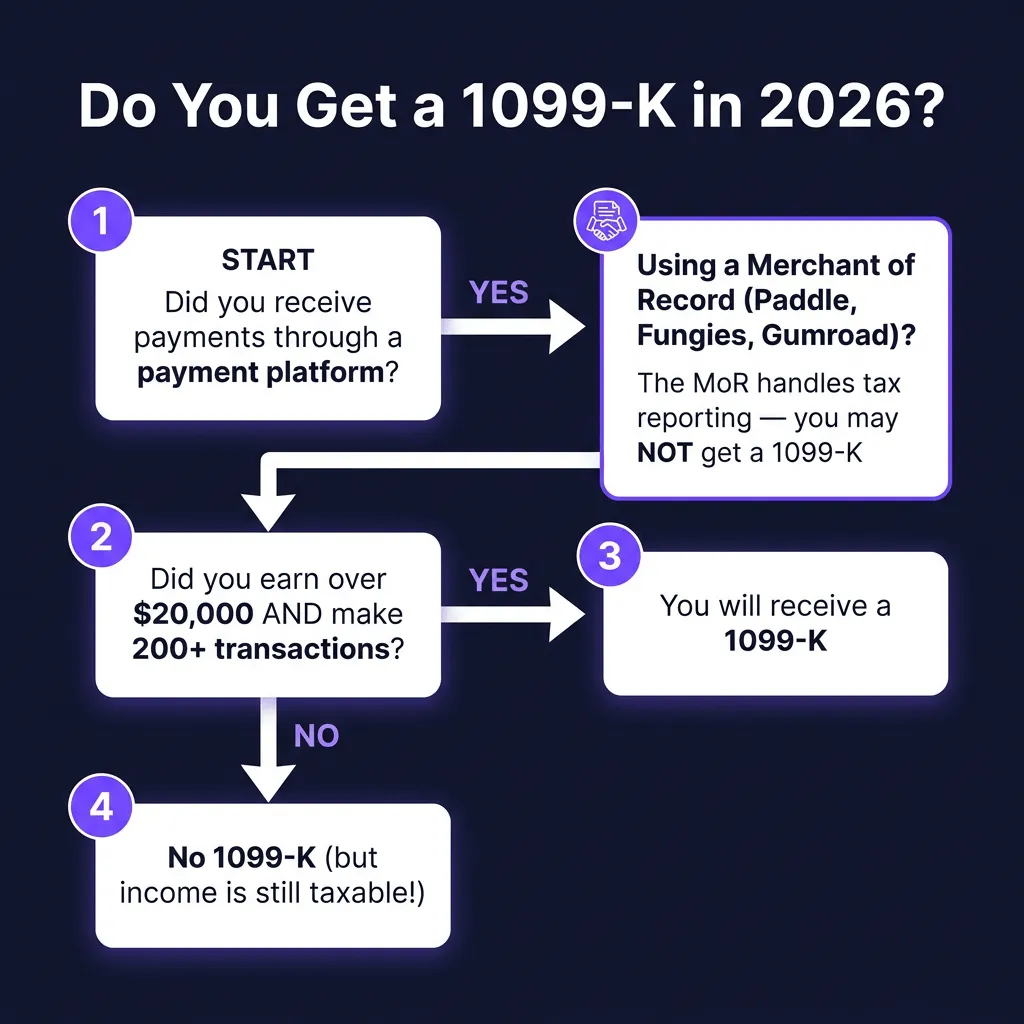
For digital product sellers in 2026, TPSOs are the relevant category. And thanks to the OBBBA, the federal threshold is back to where it was before 2022: more than $20,000 in gross payments AND more than 200 transactions in a calendar year.
Key word: gross. The 1099-K reports your total payments received before any fees, refunds, or chargebacks are deducted. If Gumroad processes $22,000 for you but charges $1,500 in fees, you’ll get a 1099-K for $22,000. You then deduct the fees yourself when filing.
The OBBBA: What Actually Changed in 2025/2026
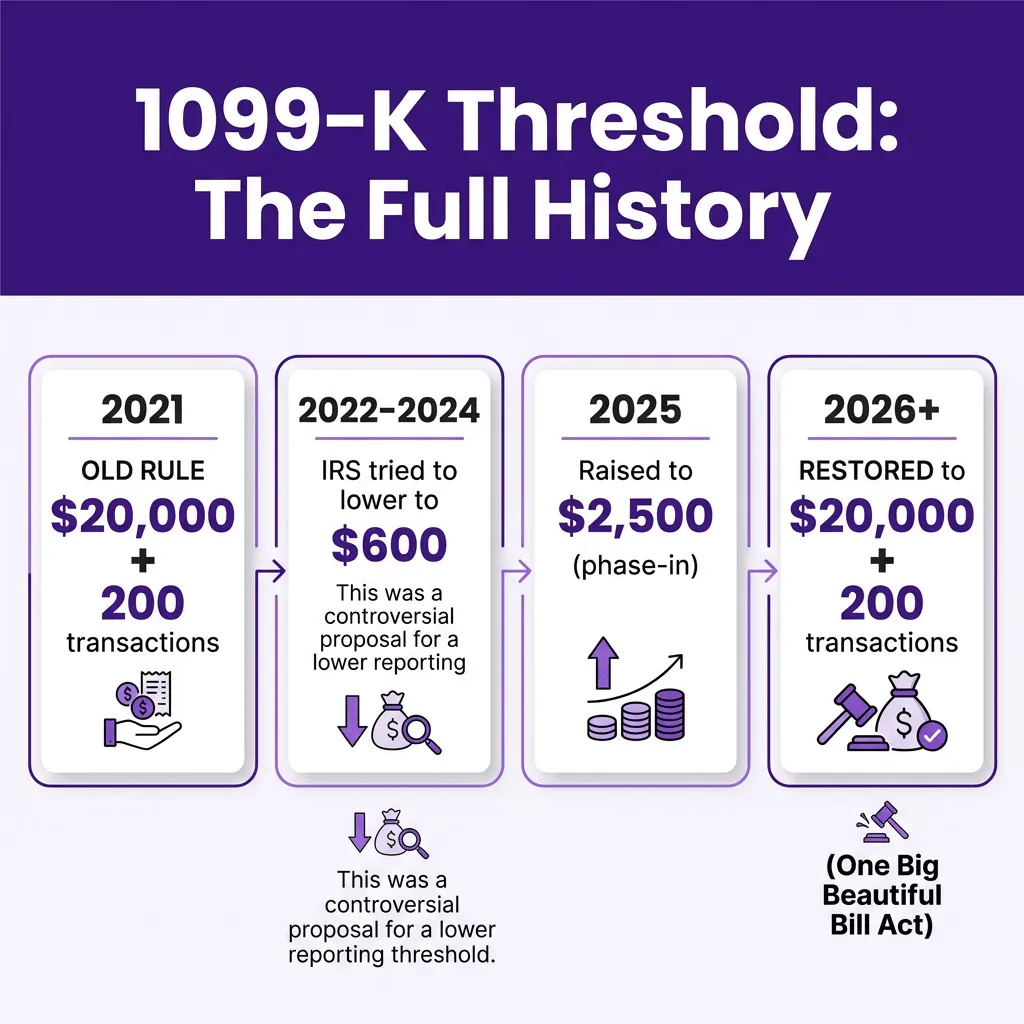
The history of 1099-K threshold changes reads like a tax thriller. Here’s the condensed version:
| Tax Year | Federal Threshold | What Happened |
|---|---|---|
| 2021 and before | $20,000 + 200 transactions | Original rule |
| 2022 | Was supposed to be $600 | IRS delayed at the last minute |
| 2023 | Was supposed to be $600 | Delayed again to 2024 |
| 2024 | $5,000 (phase-in) | IRS implemented partial phase-in |
| 2025 | $2,500 (phase-in) | Further step toward $600 |
| 2026 and beyond | $20,000 + 200 transactions | OBBBA reversed course entirely |
The One Big Beautiful Bill Act, signed into law in 2025, repealed the American Rescue Plan Act’s $600 provision and permanently restored the original threshold. The IRS issued updated FAQs confirming that for 2025 tax year filings (and all subsequent years), the threshold is back to $20,000 and 200 transactions.
What this means practically: most independent digital product sellers who earn under $20,000/year through platforms won’t receive a 1099-K at all. But — and this cannot be overstated — you still owe taxes on every dollar you earn. The 1099-K just helps the IRS verify you’re reporting correctly.
State-Level Thresholds: The Hidden Trap
Here’s where it gets complicated. The OBBBA changed the federal threshold. Several US states have their own, lower thresholds — and those weren’t changed by federal legislation.
| State | 1099-K Threshold | Notes |
|---|---|---|
| Maryland | $600, 0 transactions | Matches old federal $600 rule |
| Massachusetts | $600, 0 transactions | Long-standing state rule |
| Vermont | $600, 0 transactions | State-level enforcement |
| Illinois | $1,000, 4 transactions | Lower than federal |
| Virginia | $600, 200 transactions | Lower dollar threshold |
| All other states | Follows federal ($20K / 200) | OBBBA threshold applies |
If you’re in Maryland and earned $800 through PayPal this year, your payment platform may still issue you a state-level 1099-K — even though no federal form is required. You need to report that income on your state return.
Platforms that operate nationally have to track state-level requirements separately from federal ones. Larger platforms like Etsy and PayPal generally handle this correctly. Smaller platforms may not — which is yet another reason many creators are moving toward Merchant of Record solutions.
How Merchant of Record Platforms Change Your Tax Situation
This is the most important section if you’re building a digital product business in 2026.
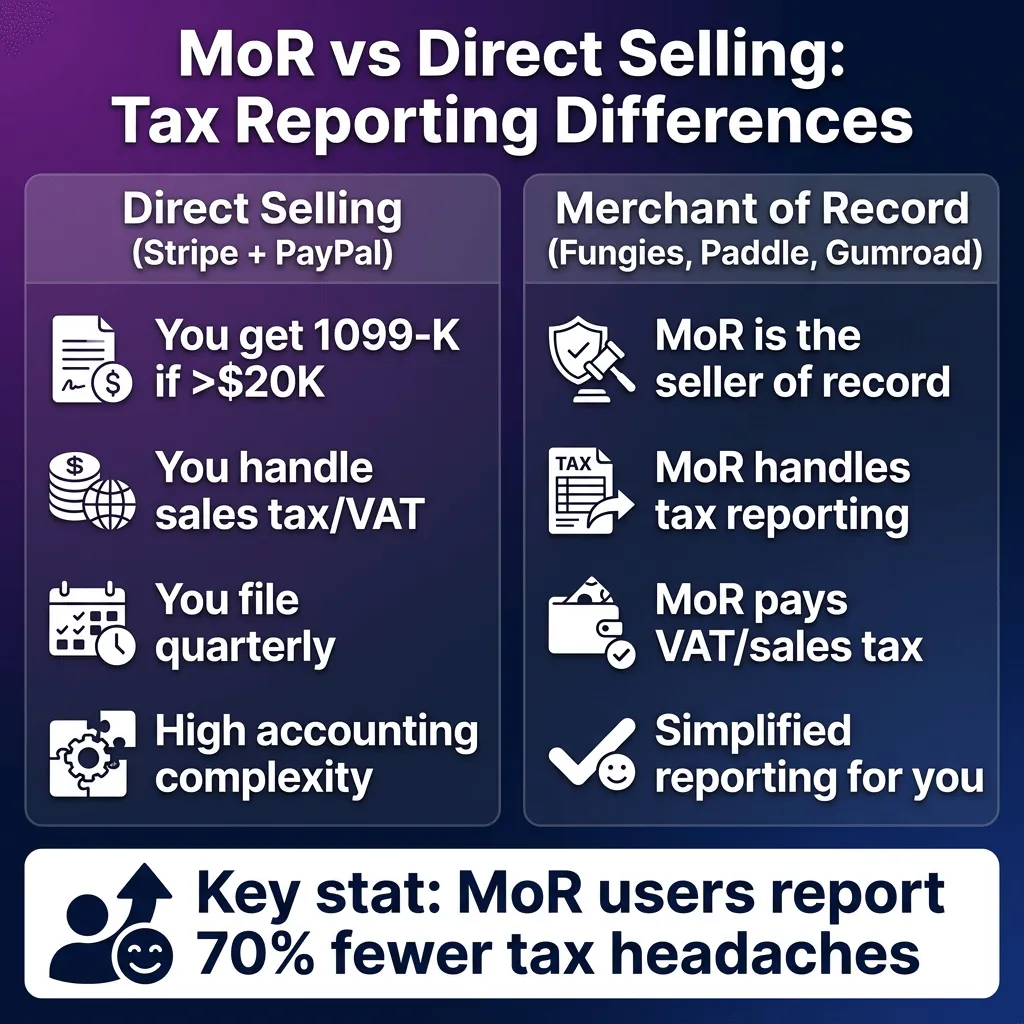
When you sell through a Merchant of Record (MoR) — Fungies, Paddle, Gumroad, Lemon Squeezy, FastSpring — the MoR becomes the seller of record on every transaction. They buy your product from you and resell it to the end customer. Legally, the customer is buying from Paddle (or Fungies, or whoever) — not from you directly.
The implications for 1099-K and tax reporting are significant:
- The MoR is responsible for collecting and remitting VAT/sales tax in every jurisdiction where it sells — not you
- The MoR may issue you a 1099-K if your payouts from them exceed $20,000 and 200 transactions — but you don’t have to manage the individual customer transactions
- No EU VAT registration required — the MoR handles EU VAT, UK VAT, Australian GST, etc.
- Chargebacks go to the MoR, not to your merchant account directly
Compare that to selling via Stripe directly:
| Tax/Compliance Task | Stripe (Direct) | Merchant of Record (Fungies, Paddle) |
|---|---|---|
| Collect US sales tax | You (via Stripe Tax or manual) | MoR handles automatically |
| Remit EU VAT | You (requires EU VAT registration) | MoR handles — no registration needed |
| File 1099-K reporting | Stripe files 1099-K for your customers | MoR is seller of record |
| Handle chargebacks | You fight them directly | MoR absorbs the risk |
| Track revenue for Schedule C | Manual reconciliation needed | MoR provides payout reports |
| International tax nexus risk | You bear the risk | MoR bears the risk |
That said, using an MoR doesn’t mean you have zero reporting obligations. You still need to report your payouts from the MoR as business income. The MoR will send you a 1099-K (or equivalent) if your payouts hit the threshold. The difference is that your reporting obligation is to the MoR, not to every individual platform your customers used to pay.
Does Gumroad Handle 1099-K for Sellers?
Yes — and this is a frequent source of confusion.
Gumroad acts as a Merchant of Record for transactions. When a customer buys your product on Gumroad, they’re technically buying from Gumroad. Gumroad collects the money, deducts its fee, and pays you the remainder. Because Gumroad is the seller of record, Gumroad handles tax reporting on those transactions.
However, Gumroad will still issue you a 1099-K if your payouts from Gumroad exceed $20,000 and 200 transactions in the calendar year — because you’re a payee and Gumroad is reporting payments made to you.
The same logic applies to Paddle, FastSpring, and Fungies. Each of these MoR platforms issues 1099-Ks to their sellers (payees) based on total payouts — not based on individual customer transactions.
Bottom line: Using an MoR simplifies your tax situation significantly, but doesn’t eliminate it. You receive fewer forms, have no international tax registration burden, and your income is cleanly summarized in one payout report — but you still owe income tax on your earnings.
What to Do If You Receive a 1099-K
Getting a 1099-K doesn’t mean you owe more taxes — it just means the IRS now has a record of your gross payments. Here’s what to do:
- Don’t panic. The 1099-K shows gross payments, not profit. You deduct platform fees, refunds, cost of goods, and business expenses.
- Cross-check against your own records. If the amount on the 1099-K doesn’t match your bookkeeping, investigate. Common causes: refunds counted in gross, multi-currency transactions, or timing differences.
- Report on Schedule C (sole proprietors) or your business return. List the gross income, then deduct allowable expenses. Your taxable profit is what you pay income tax on.
- Keep documentation. Save all fee reports, payout summaries, and refund records. If the IRS questions the difference between your 1099-K amount and reported income, you’ll need receipts.
- Consider quarterly estimated tax payments. If you’re making meaningful money from digital products, set aside 25-30% for taxes and pay quarterly to avoid underpayment penalties.
Common 1099-K Mistakes Digital Creators Make
A few patterns show up repeatedly when creators get into trouble with 1099-K reporting:
Thinking a 1099-K means they owe that exact amount in taxes. It doesn’t. It shows gross receipts. Your actual tax bill is on your net profit after expenses.
Assuming they don’t owe taxes because they didn’t receive a 1099-K. The IRS doesn’t require you to receive a form to owe taxes. Earn $5,000 selling digital products through any platform? That’s taxable income, period.
Not tracking which platform payments came from. If you sell through Gumroad, Etsy, and your own Stripe setup simultaneously, you may receive multiple 1099-Ks. Each one needs to be reconciled and reported.
Ignoring state-level requirements. Especially if you’re in Maryland, Massachusetts, Vermont, Illinois, or Virginia — state thresholds are lower and independent of the OBBBA change.
Forgetting to deduct MoR fees. If Paddle paid you $25,000 but charged $2,500 in fees, your gross income was $25,000 but you only received $22,500. You can deduct the $2,500 as a business expense. Don’t just report the gross and call it done.
Key Takeaways
- The 2026 1099-K threshold is $20,000 + 200 transactions — the OBBBA reversed the planned $600 rule permanently
- State-level thresholds (MD, MA, VT, IL, VA) remain lower — if you’re in those states, you may still get a state 1099-K even when no federal form is required
- 1099-K reports gross payments, not your profit — always deduct fees and refunds before calculating taxes owed
- Using a Merchant of Record eliminates most international tax complexity — but you’ll still receive a 1099-K from the MoR if payouts exceed the threshold
- Even without a 1099-K, all income is taxable — the form is a reporting tool, not a tax trigger
Frequently Asked Questions
Do I need to pay taxes if I didn’t get a 1099-K?
Yes. The 1099-K is an informational form — not a tax trigger. All income you earn from selling digital products is taxable regardless of whether any platform sends you a form. The IRS expects you to self-report all business income on your Schedule C or business return.
Does Paddle, Gumroad, or Fungies send me a 1099-K?
They can — if your total payouts from that platform exceed $20,000 and 200 transactions in a year. These are Merchant of Record platforms that pay you as a payee, so they’re required to issue 1099-Ks for qualifying payout volumes. For most indie creators earning under $20,000 annually on any single platform, you won’t receive one from them.
What’s the difference between a 1099-K and a 1099-NEC?
A 1099-K is issued by payment platforms and processors to report payments they processed for you. A 1099-NEC (Non-Employee Compensation) is issued by clients who paid you more than $600 directly for services (freelance work, consulting). If someone hires you directly and pays via bank transfer, that’s typically a 1099-NEC scenario. If you sell through a marketplace, it’s 1099-K territory.
Will the 1099-K threshold change again?
The OBBBA permanently restored the $20,000 / 200-transaction threshold in federal law — so it would require new legislation to change again. That said, tax law does change, and state-level thresholds can still differ. The safest approach is to track all your income accurately regardless of what threshold may apply.
Conclusion: Tax Clarity Is a Competitive Advantage
Most digital product creators spend more time worrying about 1099-K forms than they need to. The threshold is $20,000 and 200 transactions. If you’re earning less than that on any given platform, you won’t receive a form — but you still owe taxes. If you’re earning more, the form just confirms what you should already have recorded.
The bigger opportunity is structural: using a Merchant of Record platform means you don’t have to navigate sales tax, VAT, GST, or international compliance on your own. Platforms like Fungies act as the seller of record on every transaction, handling tax collection and remittance across 100+ countries so you can focus on building.
Ready to simplify your payment and tax setup? Start selling with Fungies — it takes under 10 minutes to set up.