How to Set Up an Affiliate Program for Your Digital Product or SaaS in 2026
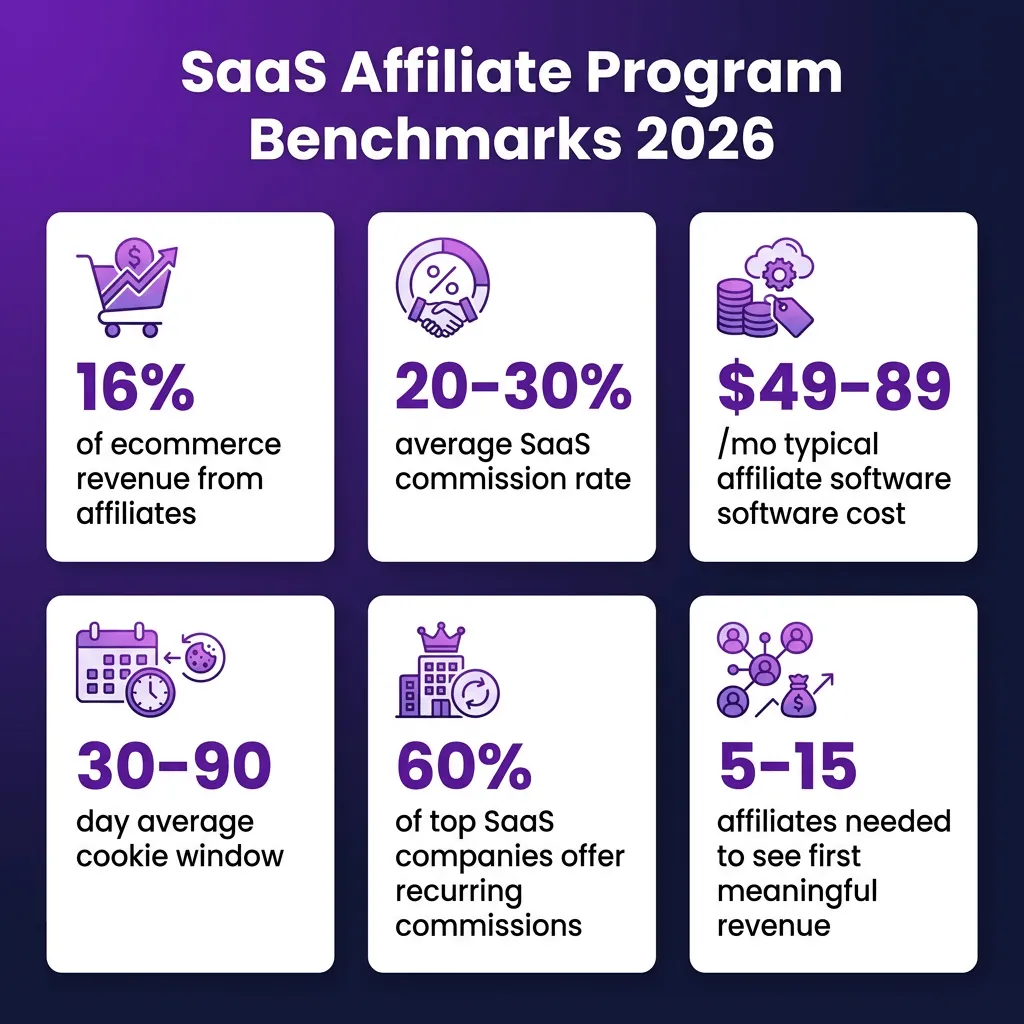
Affiliate marketing drives 16% of all ecommerce revenue globally — and for digital product sellers and SaaS founders, it’s one of the few growth channels that compounds over time without burning cash on ads. But most guides on setting up an affiliate program skip the part that actually matters for SaaS: how do commissions interact
Affiliate marketing drives 16% of all ecommerce revenue globally — and for digital product sellers and SaaS founders, it’s one of the few growth channels that compounds over time without burning cash on ads. But most guides on setting up an affiliate program skip the part that actually matters for SaaS: how do commissions interact with your payment infrastructure, tax obligations, and refund policy?
If you’re using a Merchant of Record (MoR) like Fungies to handle payments, VAT, and compliance, your affiliate setup looks fundamentally different from a founder using raw Stripe. This guide covers both paths — and shows you exactly how to build a program that pays affiliates correctly, handles tax edge cases, and scales without administrative chaos.
Why Affiliate Programs Hit Different for Digital Products and SaaS
Your gross margins are your superpower here. Digital products run at 70–95% gross margin. SaaS typically sits at 60–80%. That means you can pay a 20–40% affiliate commission and still have a customer acquisition cost (CAC) that beats paid search in most niches.
Three dynamics make affiliate marketing unusually effective for digital-first businesses:
- No inventory risk. Affiliates drive a sale, you deliver a download or provision a SaaS seat. Your costs don’t change materially per conversion.
- Recurring revenue = recurring affiliate income. A 25% recurring commission on a $49/month SaaS means an affiliate who refers 10 customers earns $122.50/month indefinitely. That’s a meaningful incentive that keeps them promoting you.
- Trust arbitrage. Creators, bloggers, and tool reviewers already have the attention of your exact target market. A genuine recommendation from a trusted voice converts far better than a display ad.
The 2026 affiliate marketing industry is projected to exceed $20 billion globally (Influencer Marketing Hub, 2025). That number isn’t driven by enterprise brands — it’s indie SaaS, digital products, and creator tools leading growth.
Choosing the Right Affiliate Software: Your Options in 2026
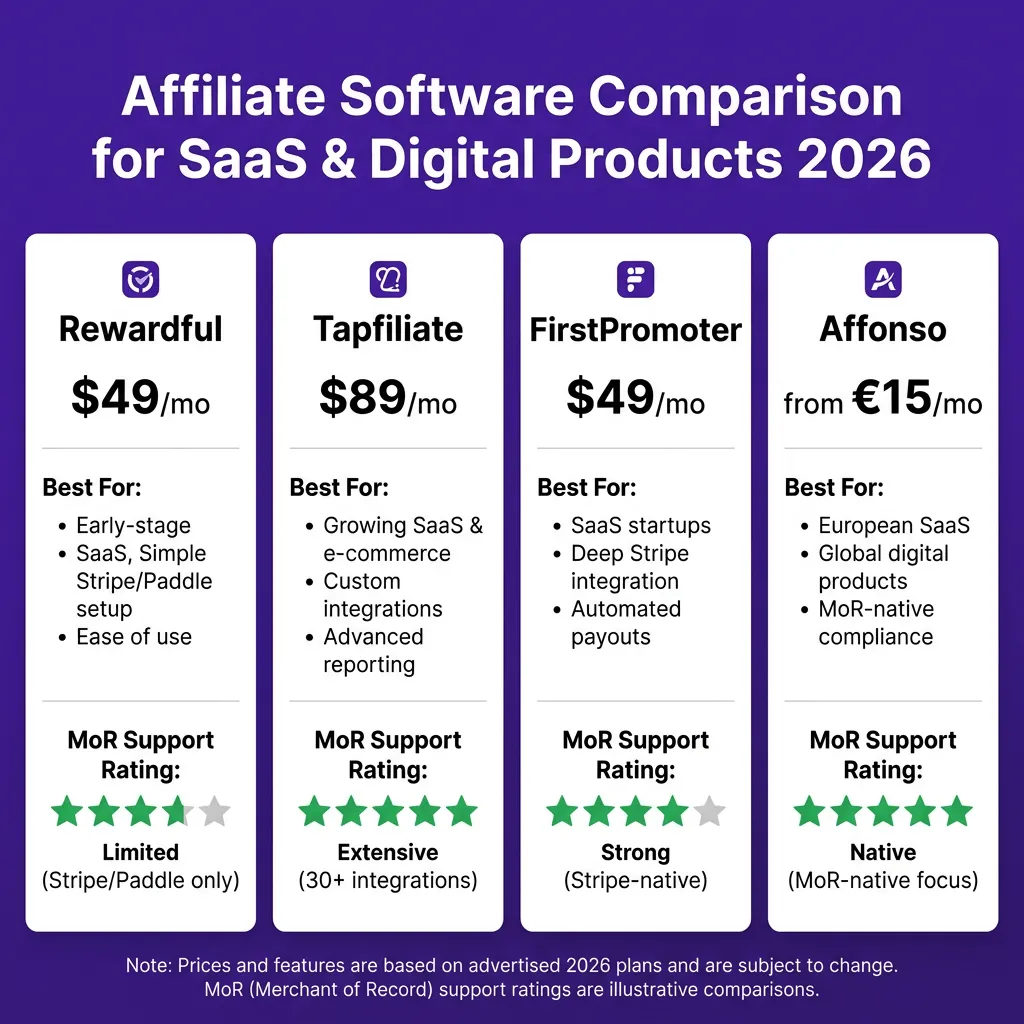
The affiliate software market has matured. You’re no longer stuck choosing between clunky enterprise tools and basic WordPress plugins. Here’s the actual landscape:
| Platform | Starting Price | Best For | MoR Support | Recurring Commissions |
|---|---|---|---|---|
| Rewardful | $49/mo | Stripe/Paddle SaaS | Paddle only | ✅ Yes |
| FirstPromoter | $49/mo | Stripe-native SaaS | Limited | ✅ Yes |
| Tapfiliate | $89/mo | E-commerce + SaaS | Via API | ✅ Yes |
| Affonso | €15/mo | MoR-native SaaS | Native (Fungies, Paddle, Creem, Dodo) | ✅ Yes |
| PartnerStack | Custom | Enterprise SaaS | Via API | ✅ Yes |
A few things to watch for when evaluating:
- Does it handle recurring commissions automatically? Manual tracking kills programs quickly.
- Does it integrate directly with your payment processor? Disconnected systems create commission attribution errors.
- What does payout compliance look like? If you’re paying affiliates in multiple countries, you need W-8/W-9 collection, currency conversion, and potentially withholding tax logic.
The MoR Difference: Why Your Payment Infrastructure Shapes Your Affiliate Stack
Here’s what most affiliate guides don’t explain: when you use a Merchant of Record, the MoR is the legal seller of record on every transaction. That changes how affiliate commissions are calculated and attributed.
With raw Stripe, your affiliate software hooks into Stripe webhooks and calculates commissions based on raw payment events. With a MoR, the MoR processes the payment, handles VAT/GST, and may issue refunds on your behalf. Your affiliate software needs to understand this chain — otherwise you’ll end up paying commissions on transactions that were later refunded, or missing revenue attribution for customers who upgraded after the initial sale.
Affonso was built specifically for MoR-native use cases. It integrates directly with Fungies, Paddle, Creem, and Dodo Payments, so commission events sync from the MoR layer rather than from raw Stripe events. That means refunds automatically reverse commissions, upgrades trigger additional attribution, and multi-currency conversions are handled correctly.
Setting Up Your Commission Structure: The Data-Backed Way
Commission structure is where most founders overthink it. Here’s what actually works in 2026, based on data from the top-performing indie SaaS affiliate programs:
One-Time Product Commissions
For digital downloads, templates, courses, and one-time-purchase tools:
- 20–30% is the sweet spot for most niches
- 40–50% is defensible if you’re building an affiliate channel as your primary acquisition method
- Anything below 15% typically doesn’t motivate serious affiliate partners
SaaS Recurring Commissions
For subscription SaaS, there are two dominant models:
| Model | Typical Rate | Payout Duration | Best For |
|---|---|---|---|
| Lifetime recurring | 20–30% MRR | As long as customer pays | High LTV products, loyal affiliate base |
| Time-limited recurring | 25–35% MRR | 12–24 months | Lower LTV, high churn risk niches |
| One-time upfront bounty | 50–100% first month | One payment | High volume, deal-site affiliates |
The most powerful programs for indie SaaS use lifetime recurring commissions. Why? Because it attracts content creators who build evergreen articles and tutorials — they want to write once and earn indefinitely. That’s exactly the kind of passive, compounding affiliate traffic you want.
Step-by-Step: Launching Your Affiliate Program
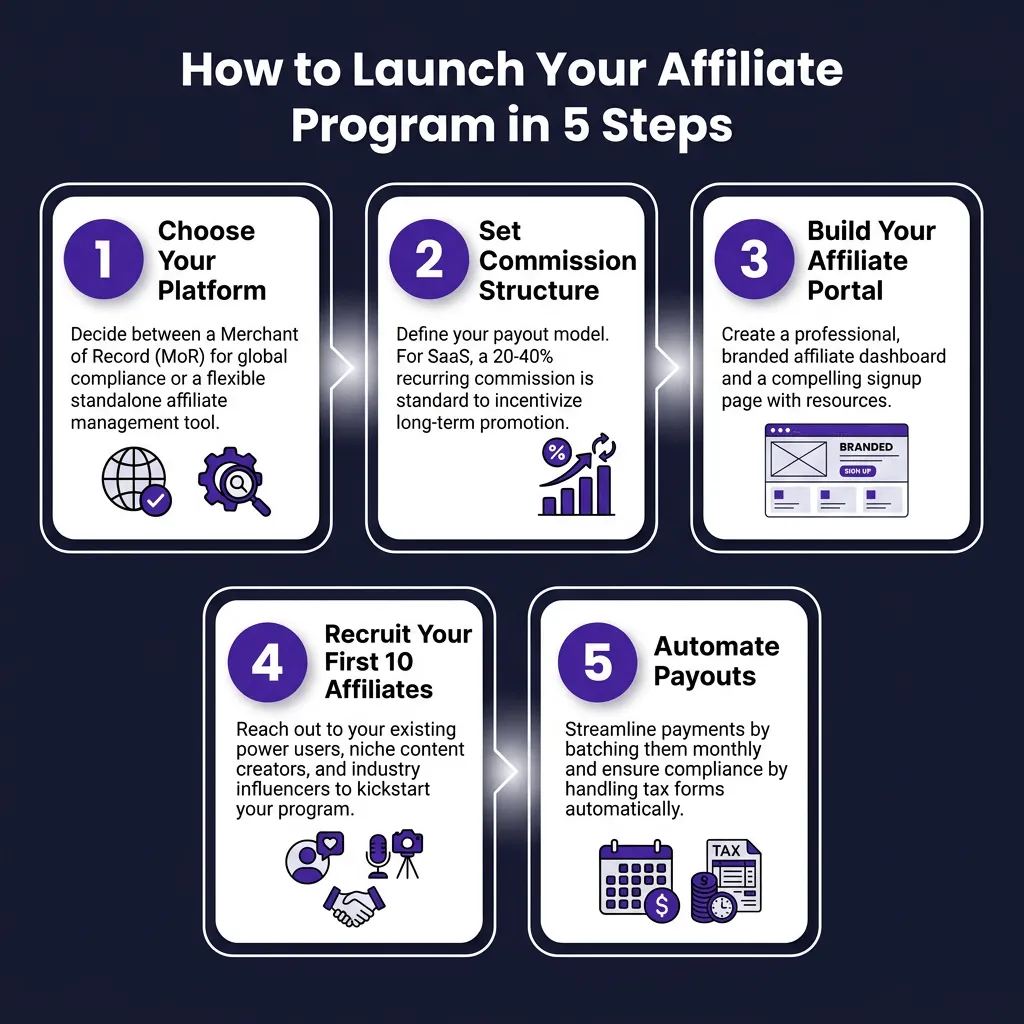
Step 1: Pick Your Platform and Sign Up
If you’re on Fungies or another MoR, start with Affonso (€15/mo entry) or Rewardful if you also use Paddle. If you’re Stripe-native, FirstPromoter at $49/mo is the cleanest integration.
Don’t overthink this decision. You can switch affiliate platforms later — affiliate links can be redirected. What matters is getting started with something that works.
Step 2: Define Your Commission Structure
For a typical indie SaaS launching an affiliate program in 2026, here’s a sensible starting template:
- Commission rate: 30% recurring
- Cookie window: 60 days (90 days if you have a long sales cycle)
- Minimum payout: $50 (batch monthly to reduce transaction costs)
- Commission hold: 30 days post-purchase (covers refund window)
Step 3: Build Your Affiliate Portal
Your affiliate portal needs three things to attract quality partners:
- A clear pitch. Tell affiliates exactly what they’ll earn, show example earnings (e.g., “Refer 20 customers at $49/mo = $294/month ongoing”), and explain who your product is for.
- Ready-to-use assets. Banners, logos, product screenshots, demo videos, and pre-written copy snippets. The easier you make it to promote you, the more affiliates will actually promote.
- A dedicated signup URL. Something like yourapp.com/affiliates or via your affiliate software’s hosted page.
Step 4: Recruit Your First 10 Affiliates
The biggest mistake founders make: building the infrastructure and then waiting for affiliates to show up. They won’t.
Your first 10 affiliates almost always come from these three places:
- Your existing customers. Email your active users with a personal invite. These people already love your product — they’re your best advocates. Offer an extra incentive for early affiliates (e.g., 40% for the first 3 months).
- Niche content creators. Find people who write about your category on Medium, Substack, YouTube, or via their blog. Reach out personally with a genuine note about why your product fits their audience.
- Product directories. List your affiliate program on directories like Affonso Marketplace, IndieHackers, or subreddits like r/affiliatemarketing where creators actively look for programs to join.
Step 5: Automate Payouts and Stay Compliant
Payout compliance is the part nobody talks about until they get into trouble. A few things to sort out before you scale:
- Tax form collection: For US affiliates earning over $600/year, you need a W-9 before paying them. Non-US affiliates need a W-8BEN. Platforms like Affonso and FirstPromoter handle this automatically.
- Currency. If you have international affiliates, batch payouts in USD via PayPal or Wise, or use a platform with built-in multi-currency payout support.
- Refund reversals. Your commission policy should state that commissions are reversed if a sale is refunded within your refund window. Make this clear in your affiliate agreement.
How Fungies Makes Affiliate Programs Easier for MoR Users
If you’re selling through Fungies as your Merchant of Record, you get a structural advantage: Fungies handles VAT/GST, fraud, chargebacks, and compliance at the payment layer. That means your affiliate software only needs to track clean revenue signals — not raw payment events that include tax, failed charges, and processing fees.
When an affiliate refers a customer who buys through your Fungies-powered checkout:
- Fungies processes the payment and handles tax collection
- Fungies passes a clean “successful sale” webhook to your affiliate software (via Affonso integration)
- The commission is calculated on net revenue (after MoR fees), not gross
- If the customer refunds within 30 days, Fungies fires a refund webhook and the commission is reversed
This is cleaner than the raw Stripe path, where you’d need to manually account for Stripe fees, tax, refunds, and disputed charges when calculating commissions.
| Scenario | Raw Stripe + Affiliate Tool | Fungies MoR + Affonso |
|---|---|---|
| Commission calculation | On gross charge (includes Stripe fees + tax) | On net revenue (after MoR fees) |
| Refund handling | Manual reversal needed | Automatic via webhook |
| Multi-currency payouts | DIY via PayPal/Wise | Managed via Affonso in 190+ currencies |
| Tax form collection (W-9/W-8) | Separate workflow | Built into affiliate portal |
| VAT on commission payouts | Manual | Auto-handled for EU affiliates |
Common Mistakes That Kill Affiliate Programs
Most affiliate programs that fail do so for one of these reasons:
- Setting commission too low. 10% for a $29/month SaaS means an affiliate earns $2.90/month per referral. Nobody builds content for that.
- Not providing assets. Affiliates who have to create their own screenshots and copy will just promote something easier to promote.
- Paying late or inconsistently. Nothing kills affiliate trust faster than delayed payouts. Automate monthly batch payments and stick to the schedule.
- No communication with affiliates. Send a monthly newsletter to your affiliates: new features, seasonal promotions, new assets, top performer shoutouts. Treat them like partners.
- Ignoring your best performers. Your top 3–5 affiliates will drive 60–80% of your affiliate revenue. Identify them early and offer custom deals, higher commissions, or exclusive access.
Key Takeaways
- Digital products and SaaS are uniquely well-suited for affiliate programs because of high margins and recurring revenue
- For MoR users (Fungies, Paddle, Dodo Payments), choose affiliate software that integrates at the MoR layer — not just Stripe webhooks
- Start with 20–30% recurring commissions; adjust after you see what attracts quality affiliates in your niche
- Your first 10 affiliates should come from your own customer base — recruit them with a personal email, not a form
- Automate tax form collection and refund reversals from day one — these are the two biggest admin headaches at scale
Frequently Asked Questions
How much should I pay affiliates for a digital product?
For digital downloads and courses, 20–40% is the standard range. For SaaS with recurring revenue, 20–30% recurring commissions are typical. Products with higher AOVs can sustain lower rates; lower-priced products need higher rates to attract serious affiliates.
Can I run an affiliate program if I’m using a Merchant of Record?
Yes — and it’s often simpler than running one on raw Stripe. MoRs like Fungies handle tax and compliance at the payment layer, so your affiliate software only needs to track clean revenue signals. Platforms like Affonso integrate natively with MoR providers for this reason.
What affiliate software works with Fungies?
Affonso integrates natively with Fungies and other MoR providers (Paddle, Creem, Dodo Payments). Tapfiliate can also work via API. Rewardful only supports Stripe and Paddle directly, so it won’t work with Fungies without custom webhooks.
How long should my affiliate cookie window be?
60–90 days is standard for SaaS. Shorter windows (30 days) hurt affiliates who write evergreen content — their readers might return weeks later to buy. The longer your cookie, the more attractive your program is to long-form content creators who drive the best quality traffic.
Start Your Affiliate Program Today
An affiliate program is one of the few growth channels where your cost scales directly with your revenue — there’s no upfront ad spend to risk. If you’re already selling through Fungies and want to add affiliates to your growth mix, the setup takes less than a day.
Start with Fungies to get your payments and compliance handled at the MoR layer, then layer on Affonso for affiliate tracking. You’ll have a functional program live before the week is out.
References
- Influencer Marketing Hub — Affiliate Marketing Benchmarks 2025: https://influencermarketinghub.com/affiliate-marketing-benchmark-report/
- Rewardful Pricing: https://www.rewardful.com/pricing
- Tapfiliate Pricing: https://tapfiliate.com/pricing/
- FirstPromoter Pricing: https://firstpromoter.com/pricing
- Affonso: https://affonso.io