Annual vs Monthly SaaS Pricing in 2026: Data-Backed Strategy for Founders
Here’s a number that should rewrite your pricing page this week: annual plan customers churn at 8% annually. Monthly plan customers churn at 32% annually. That’s not a rounding difference — it’s the difference between a business that compounds and one that bleeds. Yet 4 out of 5 SaaS businesses either don’t offer annual plans
Here’s a number that should rewrite your pricing page this week: annual plan customers churn at 8% annually. Monthly plan customers churn at 32% annually. That’s not a rounding difference — it’s the difference between a business that compounds and one that bleeds.
Yet 4 out of 5 SaaS businesses either don’t offer annual plans at all, or offer them so poorly that fewer than 10% of customers ever choose one. If that’s you, you’re leaving cash flow, retention, and LTV on the table every single month.
This guide covers the data behind annual vs monthly SaaS pricing, when to use each, how to structure your pricing page to push customers toward the right choice, and how a Merchant of Record platform like Fungies.io makes both billing cycles trivially easy to implement globally.
The Numbers That Actually Matter
Let’s start with hard data before we get into strategy.
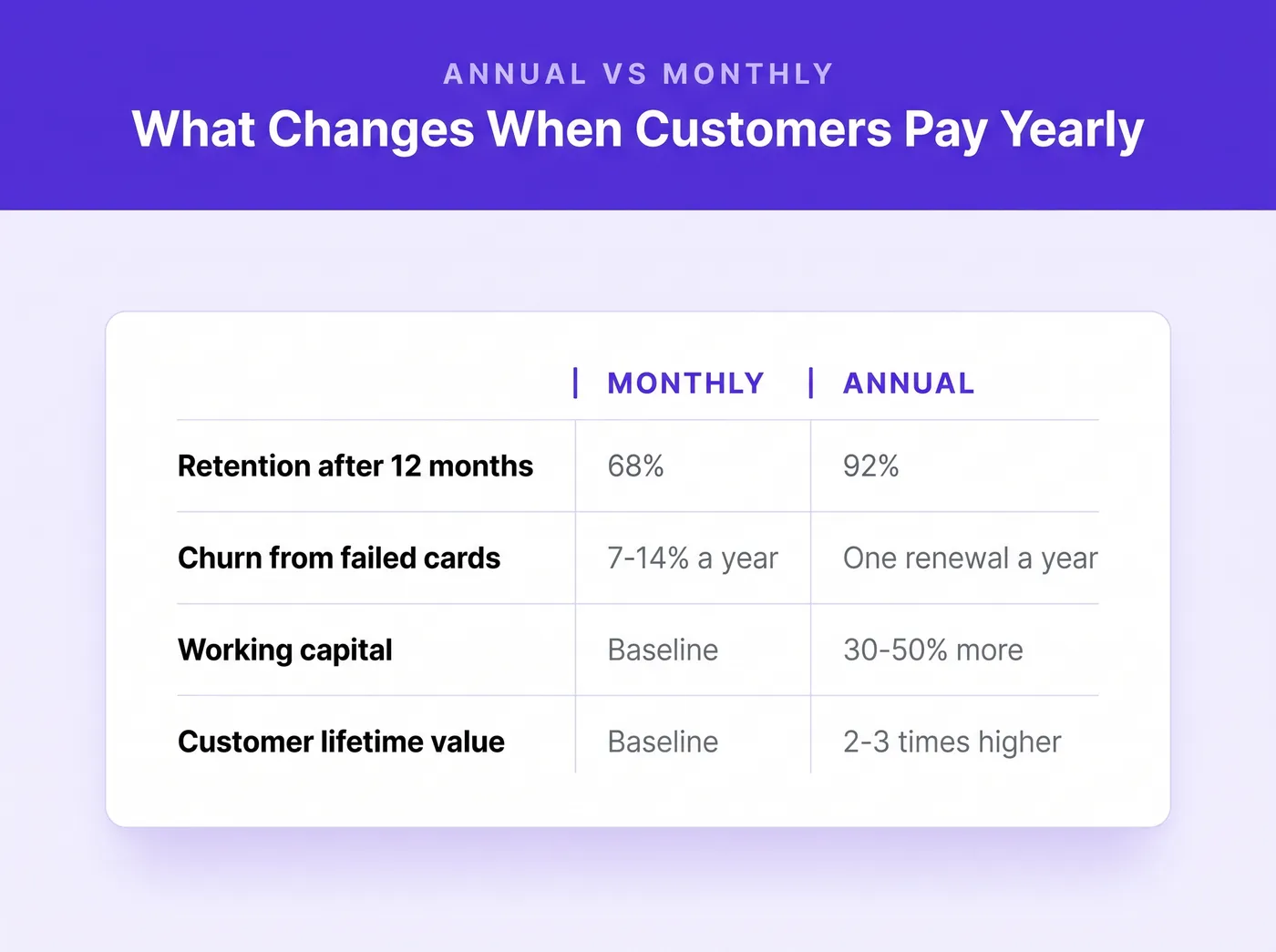
Churn: According to Baremetrics data, annual plans retain 92% of customers after 12 months. Monthly plans retain 68%. That 24-point gap compounds fast — if you start with 1,000 customers, after two years you have 847 left on annual vs 462 on monthly. Same acquisition cost, very different business.
Involuntary churn: This one’s sneaky. Failed card payments drive 7–14% annual churn on their own for monthly billing. Annual customers only face this risk once per year. That alone justifies nudging customers toward yearly plans.
Cash flow: SaaS businesses with predominantly annual contracts operate with 30–50% more working capital compared to those on monthly billing, according to ProfitWell/Paddle data. Collect $960 upfront instead of $80/month and you can reinvest in acquisition within the same quarter.
LTV: Annual customers typically have 2–3x higher LTV. They’ve made a commitment. They stay long enough to actually learn the product, get value from it, and renew.
When Monthly Pricing Is the Right Call
Annual billing isn’t universally correct. Monthly is better in specific scenarios:
- Early stage, pre-product-market fit. Monthly keeps the feedback loop tight. Customers who stay month-to-month are voting with their wallets in real time. That signal is valuable when you’re still figuring out what to build.
- Low ARPU (<$20/month). An annual commitment on a $10/month tool is a $120 upfront ask. For many users — especially consumers or indie developers — that’s a friction point that kills conversion. ProfitWell data shows low-ARPU products do better keeping monthly as the primary option.
- High churn-risk early users. If your activation rate is below 40%, annual billing will generate refund requests, disputes, and angry customers. Fix activation first.
- Contractual or usage-based products. If customers’ usage varies month-to-month (API calls, seats, consumption), monthly billing matches what they’re actually getting.
When Annual Pricing Should Dominate
Annual billing shines when these conditions are true:
- You’ve hit product-market fit. Customers renewing consistently at month 3+ are a strong signal you can ask for annual commitment.
- B2B with budget cycles. Enterprise and mid-market buyers often prefer annual contracts because they align with procurement processes. 75% of enterprise SaaS providers push annual billing by default (OpenView Partners).
- ARPU above $50/month. At $100+/month, a 20% annual discount is meaningful enough to motivate the switch. The math makes sense for the customer.
- Retention-focused growth strategy. If your NRR matters more than raw new MRR — which it should past $1M ARR — annual billing is the single highest-leverage lever you have.
How to Structure Annual vs Monthly on Your Pricing Page
This is where most founders get it wrong. The toggle exists — they just default it to monthly.
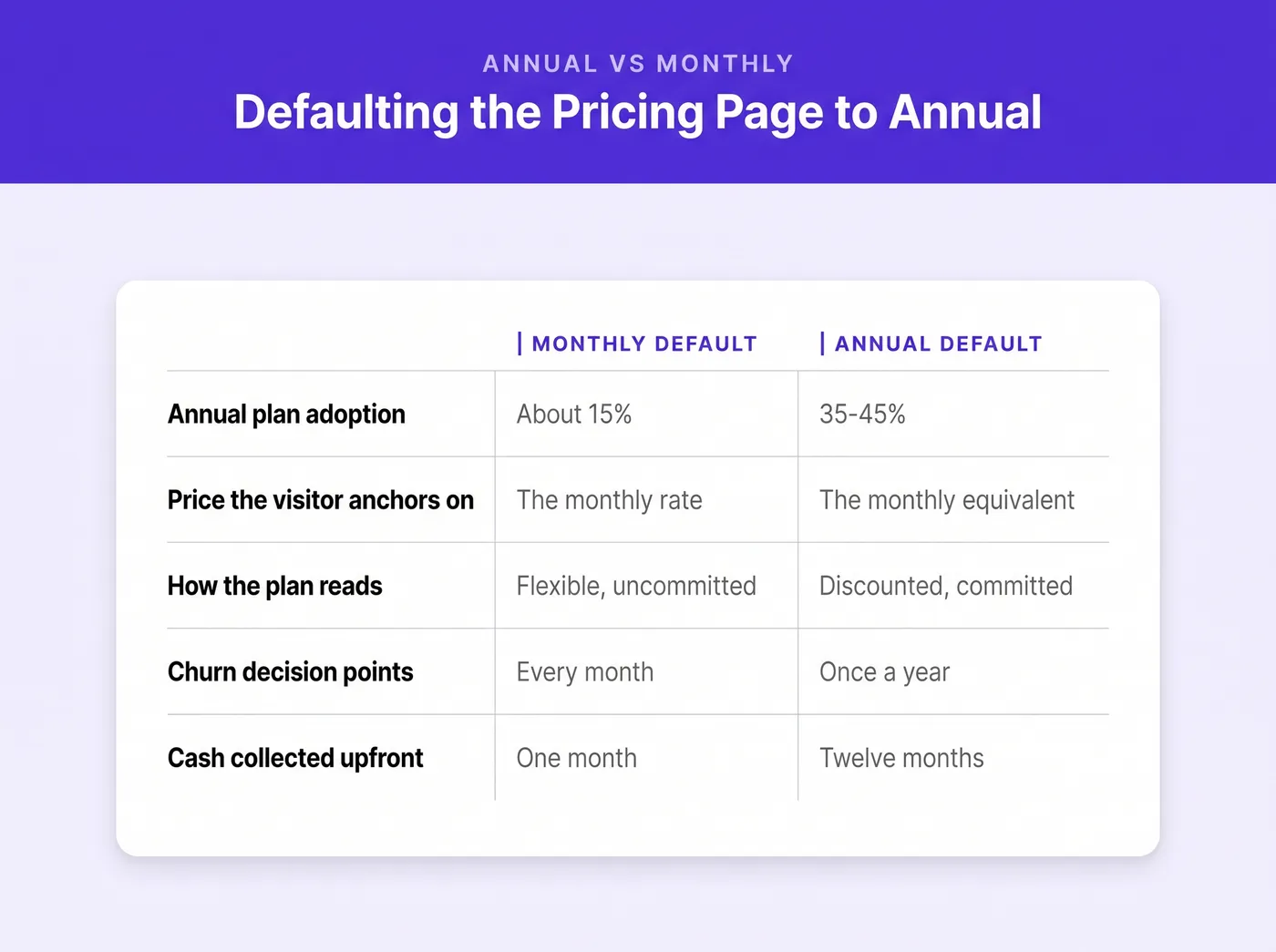
Default to annual. Products that default to annual on their pricing page convert 20–30% more annual plans than those defaulting to monthly (Monolit.sh data). Visitors anchor to whatever price they see first. Show them $80/month (billed annually) instead of $99/month, and you’ve already won the comparison.
Frame it as months free, not percentage off. “2 months free” performs better than “20% off” in virtually every A/B test. It’s concrete, not abstract. Humans understand “free months” intuitively.
The industry standard discount is 20%. Below 15% rarely motivates the switch. Above 30% signals that you’re either desperate or that your monthly price is inflated. 15–20% is the sweet spot that feels like a real deal without undermining your pricing integrity.
Add a money-back guarantee on annual plans. ConversionXL research shows this can increase annual plan conversion by up to 34%. It eliminates the perceived risk of “what if I hate it in month 3?” Most customers who claim it would have churned anyway.
| Pricing Page Element | Monthly Default | Annual Default |
|---|---|---|
| Annual plan adoption rate | ~15% | ~35–45% |
| Visitor price anchor | Monthly rate (higher) | Annual/12 rate (lower) |
| Perceived value | Flexible, low commitment | Savings-focused, committed |
| Churn risk | Monthly decision point | Annual decision point only |
| Cash flow impact | Steady drip | 12× upfront |
Converting Existing Monthly Customers to Annual
You don’t have to wait for new signups. Your existing monthly base is a conversion opportunity right now.
The 3-month mark is your window. Customers who’ve survived 3 months have passed the activation threshold and are getting value. That’s when a “switch to annual and save 2 months” email campaign hits hardest. Open rates and conversion on these are consistently 2–3× higher than generic discount emails.
The 6-month follow-up. Some users need more time. A second nudge at month 6 — especially if you can reference their usage data (“you’ve processed 847 transactions with us — here’s what annual would save you”) — converts another meaningful cohort.
In-app nudges beat email. A banner or modal in the product, triggered after a power-use moment (e.g., first payout, first integration, hitting a usage milestone), converts at 2–4× the rate of cold email. Context matters.
A/B test your upgrade offer, not your core price. Don’t test 15% vs 20% vs 25% with your full user base. Segment a cohort of new signups over 90 days, hold all other variables constant, and measure LTV impact over 12 months. Churn and expansion revenue will tell you more than conversion rate alone.
The Accounting and Metrics Reality
This part founders often skip until their CFO brings it up. Annual billing creates deferred revenue — you collect $960 upfront but can only recognize $80/month on your P&L. This matters for:
- SaaS metrics reporting: MRR from annual customers should be divided by 12. Don’t inflate your reported MRR by counting annual payments as single-month events.
- Churn calculations: Annual customers don’t show churn events until renewal. Your churn rate will look artificially low in the first 10 months after a push to annual billing. Model this.
- Failed payment risk: Credit cards expire. Annual customers have a 12-month gap between billing events, which means higher card expiry rates. Implement dunning and card updater services before scaling annual billing.
- Refund policy: Define it clearly. Prorated? No refunds after 30 days? Monthly-equivalent partial refund? Customers will ask, and ambiguity creates disputes.
| Metric | Monthly Plans | Annual Plans | Impact |
|---|---|---|---|
| Monthly churn rate | 5–8% | 0.5–1% | Annual: 6–16× lower |
| Annual churn (effective) | 46–63% | 6–12% | Massive retention gap |
| Involuntary churn | 7–14% of annual churn | 1–2% of annual churn | Annual: ~7× lower |
| Working capital vs monthly | Baseline | +30–50% | Reinvest same quarter |
| Customer LTV | Baseline | 2–3× higher | Better CAC payback |
| Card expiry risk | Low (monthly billing) | Higher (annual billing) | Needs dunning setup |
How Fungies.io Handles Annual and Monthly Billing
If you’re selling digital products or SaaS globally, the billing architecture question quickly hits a compliance wall: different countries, different tax rules, different payment methods. This is where a Merchant of Record like Fungies.io removes the friction.
With Fungies.io, you can set up both monthly and annual subscription plans in minutes — the platform handles VAT, GST, and sales tax automatically across 100+ countries regardless of billing cycle. You’re not managing deferred revenue accounting for tax purposes; Fungies does that as your MoR.
Annual billing with global compliance used to mean hiring a tax team or paying Paddle 5%+ per transaction. Fungies.io gives you the same MoR coverage at a fraction of the cost — which means the cash flow advantage of annual billing doesn’t get eaten by platform fees.
Key Takeaways
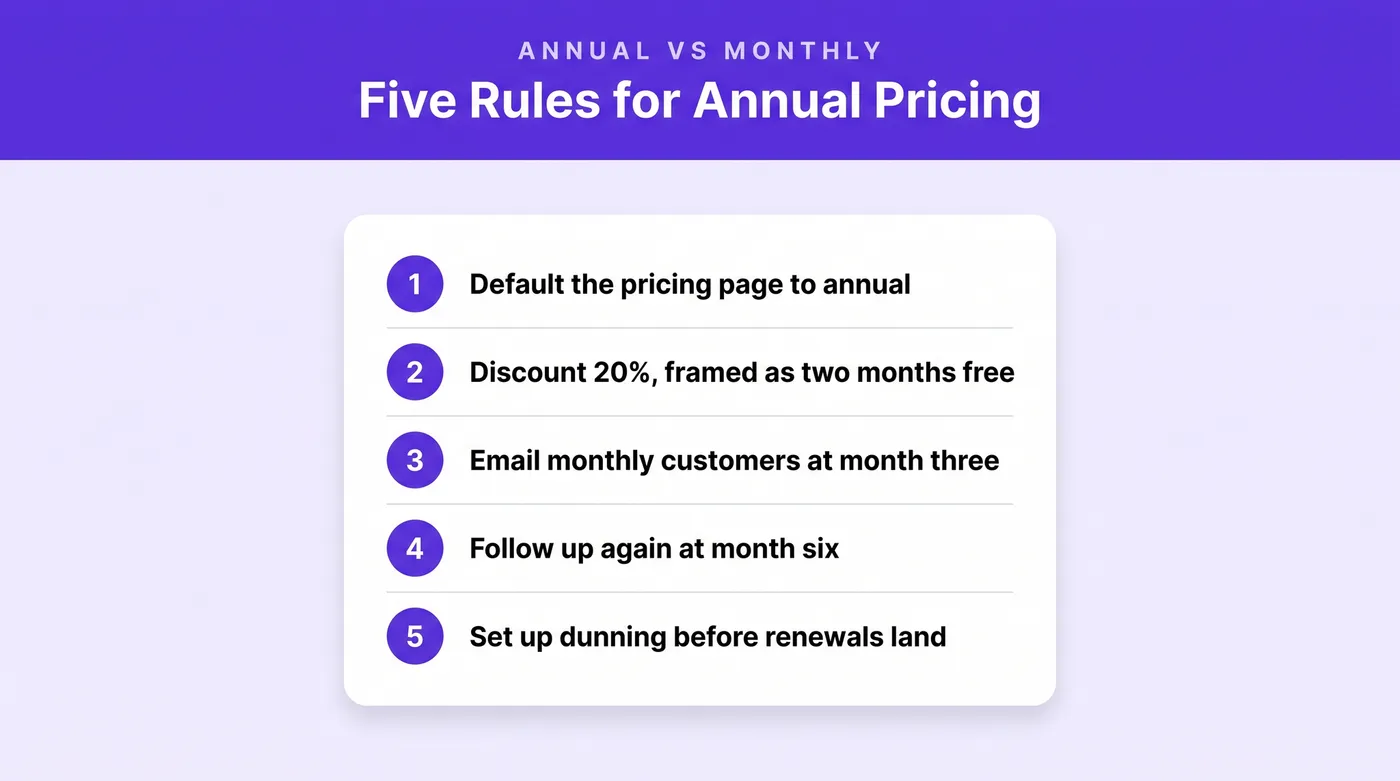
- Default your pricing page to annual. It’s the single highest-leverage change you can make today. Products that do this convert 20–30% more annual plans.
- 20% discount is the sweet spot. Frame it as “2 months free.” Below 15% doesn’t motivate; above 30% undermines your pricing.
- Annual plans cut churn by 4–8×. Retention at 92% vs 68% after 12 months compounds into dramatically different businesses over time.
- Email monthly customers at month 3 and month 6. These are your highest-intent cohorts. Personalize with their usage data.
- Fix your metrics first. Deferred revenue, churn calculation, and dunning need to be right before you push annual billing at scale.
Frequently Asked Questions
What discount should I offer for annual SaaS pricing?
The industry standard is 15–20%, typically framed as “2 months free” (which equals ~17% off). Below 15% rarely motivates monthly customers to switch. Above 30% can signal that your monthly pricing is inflated. For most B2B SaaS products, 20% (2 months free) is the optimal starting point — test from there.
Should I default my pricing page to monthly or annual?
Default to annual if you have product-market fit and want to maximize retention and cash flow. Data shows products defaulting to annual convert 20–30% more annual plan purchases. The exception: if you’re still in early validation, monthly default keeps the signal cleaner and reduces friction for new users who don’t know your product yet.
How do annual plans affect SaaS churn metrics?
Annual plans dramatically reduce churn — from 5–8% monthly to 0.5–1% monthly for equivalent customer segments. However, they create a false churn floor in the first 10 months after you push annual billing, since customers don’t have a cancellation opportunity until renewal. Model your churn cohorts separately for annual and monthly customers to get accurate numbers.
Can I offer both monthly and annual pricing simultaneously?
Yes, and you should. Most successful SaaS companies offer both, with annual as the default on the pricing page and monthly available via toggle. Zuora research shows companies offering both with appropriate discounts increase overall revenue 20–30% vs single-option businesses. The key is nudging customers toward annual through pricing page design, not forcing it.
Conclusion
Annual vs monthly SaaS pricing isn’t really a philosophical debate — it’s a retention and cash flow optimization problem with clear data behind it. For any SaaS product with product-market fit and an ARPU above $30–50/month, defaulting to annual billing and actively converting monthly customers is one of the highest-ROI moves you can make.
The mechanics aren’t complicated. Default the toggle. Offer 20% off framed as 2 months free. Email at month 3. Measure LTV by cohort. The business impact shows up within 90 days.
If you’re building a SaaS product and want to implement both billing cycles with global tax compliance handled automatically — no VAT filings, no MoR headaches — start with Fungies.io. Set up monthly and annual plans in minutes, sell in 100+ countries from day one.
References
- Baremetrics: Is Monthly or Annual Pricing Better for Retention?
- Paddle/ProfitWell: Annual plans: Why every SaaS company needs to sell them
- Monetizely: Monthly vs Annual Billing: How Subscription Length Impacts SaaS Churn and Cash Flow
- Monolit.sh: Annual vs Monthly Pricing: Which Is Better for SaaS in 2026?
- Dodo Payments: Annual vs Monthly Billing: Which Generates More SaaS Revenue?
- Torii: Are Monthly or Yearly SaaS Contracts More Common in 2026?